




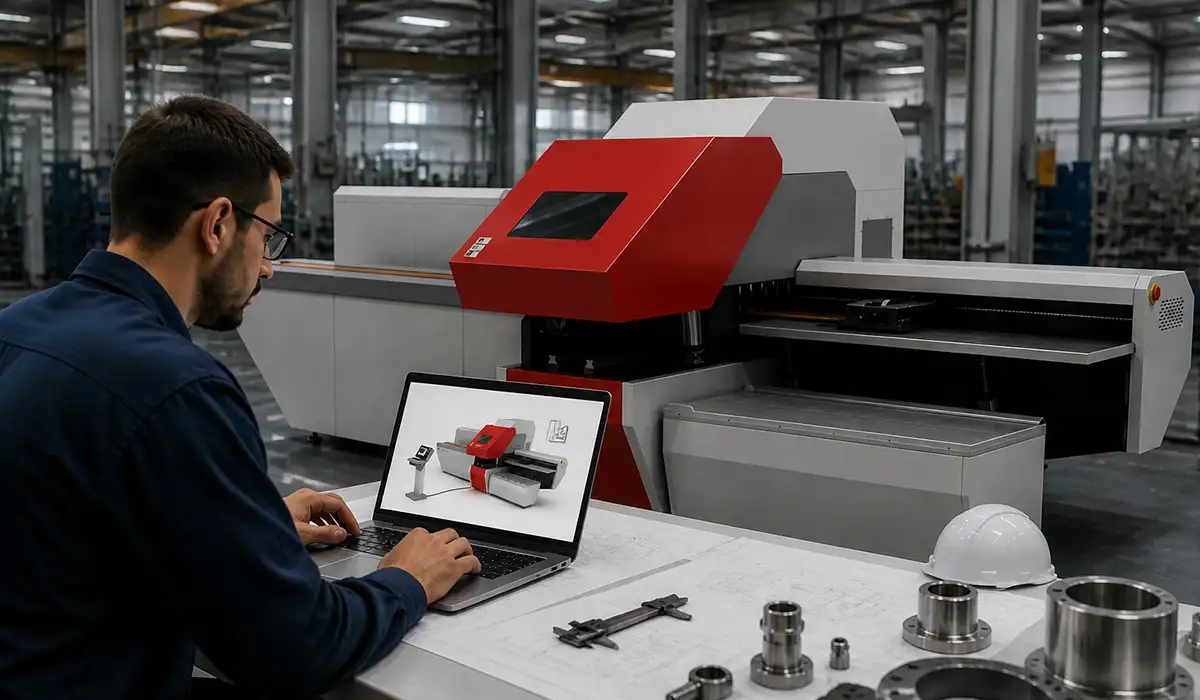

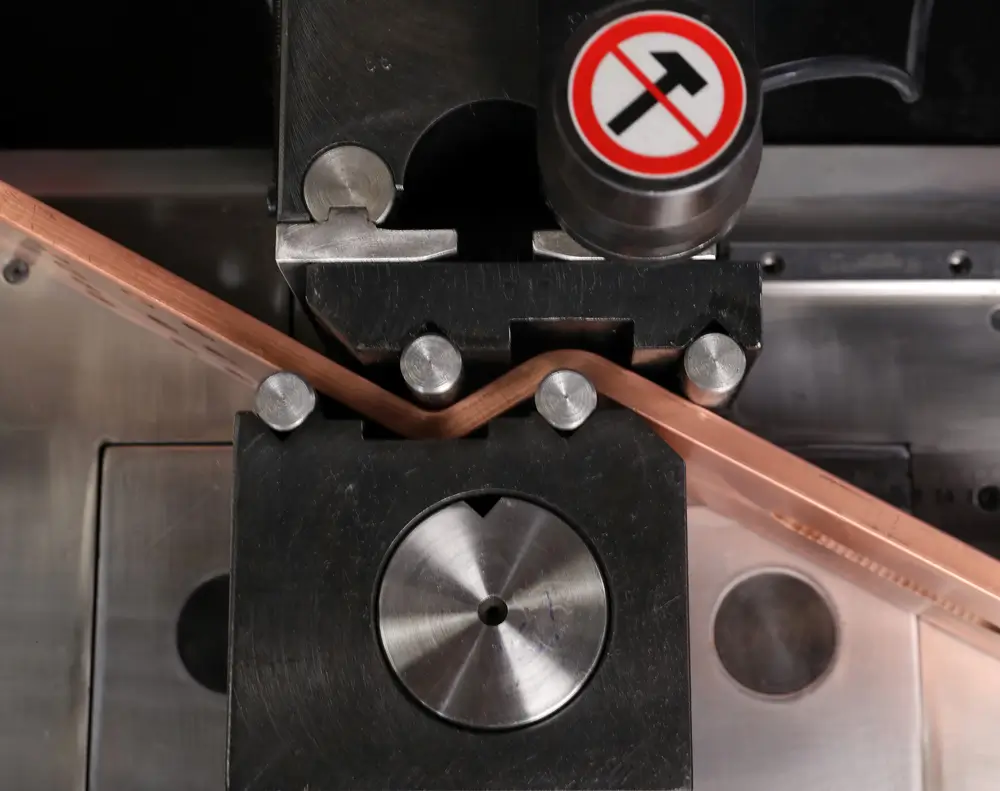
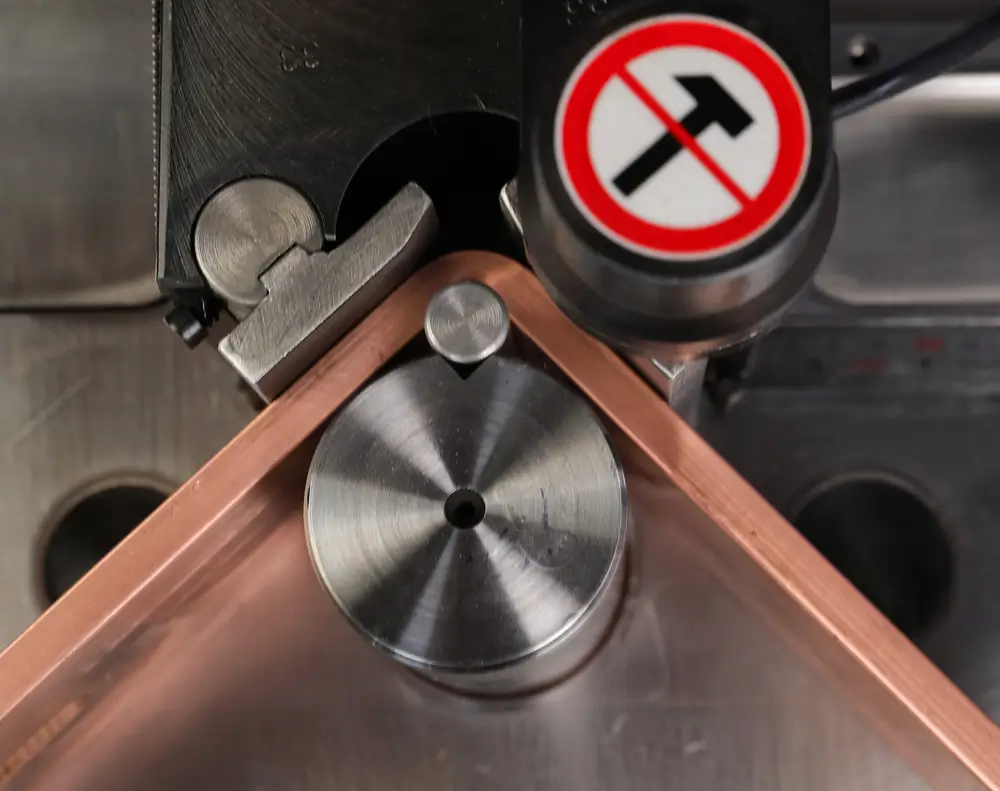
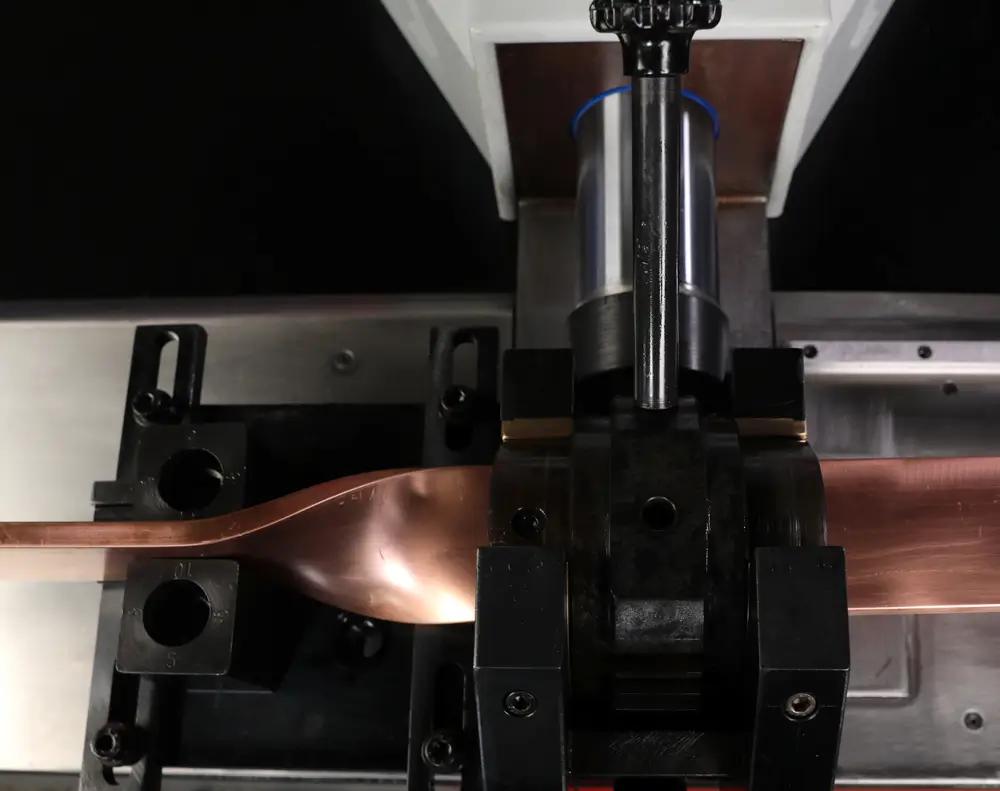
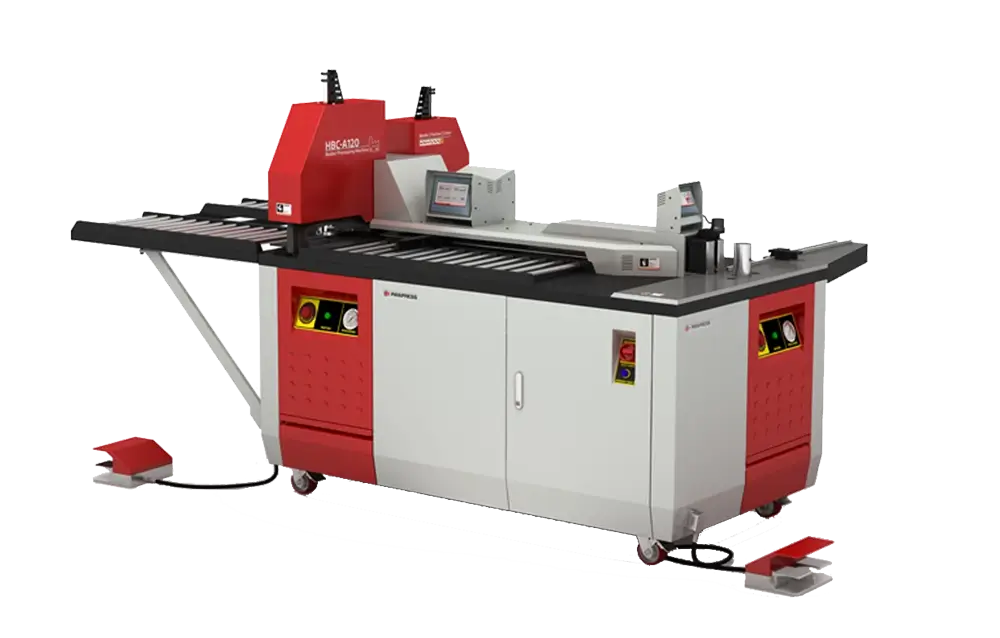
That commercial scale explains why design quality is no longer a narrow engineering concern. It affects throughput, energy use, maintenance intervals, worker safety, spare-parts strategy, and total cost of ownership. In practice, machinery design covers concept development, requirements capture, CAD modeling, simulation, prototyping, controls integration, compliance, and production readiness. Modern teams are therefore balancing manufacturing machinery innovation with reliability, maintainability, and faster launch cycles.
The pressure on design teams has also changed. As of 2025 and 2026, manufacturers have been pushed simultaneously by labor shortages, higher energy expectations, stronger cybersecurity concerns, and rising demand for connected equipment. That combination is reshaping what buyers expect from production assets, from advanced manufacturing technology and digital twins to more efficient drives, modular layouts, and data-ready controls.
This guide explains the subject from the ground up. It covers definitions, machine subsystems, materials and structural logic, sector-specific requirements, 2025–2026 trends, safety frameworks, digital tools, current design constraints, and the technologies likely to shape the next generation of industrial equipment. The goal is practical clarity for engineers, plant managers, procurement teams, and manufacturing business owners.
Prefer listening? You can play the audio version of the rest of this article below.
What Is Industrial Machinery Design? Core Definitions and Scope
At its broadest, Industrial Machinery Design and Trends describe the engineering of machines used for manufacturing, processing, assembly, material handling, and heavy-duty industrial operations. It is broader than drafting and narrower than general mechanical engineering. General mechanical engineering may address any mechanical system, but industrial machinery engineering focuses on machines that must perform predictably in production environments, with defined duty cycles, maintainability targets, safety functions, and compliance obligations. That is why industrial machine design principles must combine mechanics, controls, materials, and risk reduction from the start rather than as separate downstream tasks.
In practical terms, the scope begins with requirements: load case, product mix, takt time, accuracy, environment, operator interaction, utilities, and standards. It then moves through concept architecture, machine frame structural design, drive sizing, motion and control logic, component selection, thermal behavior, prototype validation, and production release. Designers are no longer only developing hardware. They are also shaping data flow, serviceability, and lifecycle traceability, which makes industrial equipment development a systems problem rather than a purely mechanical one.
For global manufacturers, standards shape the scope as much as physics does. ISO 12100 provides the core machinery risk-assessment methodology, ISO 13849 addresses safety-related parts of control systems, and CE-marked machinery in Europe still references the established machinery framework while the EU transitions to Regulation (EU) 2023/1230 from 20 January 2027. In parallel, ASME standards remain central across many mechanical design domains.
Key Disciplines Within Industrial Machinery Design
Industrial machinery design is multidisciplinary by necessity. Structural design defines stiffness, load paths, fatigue resistance, and vibration control in machines. Hydraulic system machinery is chosen where high force density and robust linear actuation matter, while hydraulic vs electric actuation becomes a defining tradeoff when cleanliness, controllability, efficiency, or maintenance priorities change. Pneumatic equipment design still plays a strong role in repetitive, fast, lower-force motion where simplicity and cycle speed matter.
Electrical and control engineering governs motors, sensors, PLC logic, safety circuits, and communication layers. Thermal management in machinery covers heat generated by motors, drives, hydraulics, spindles, and power electronics. Ergonomics and safety design determine guarding, access, operator reach, visibility, lockout logic, and service positions. The best machinery teams do not treat these as separate silos; they resolve them as interacting design constraints inside one machine architecture.
The Industrial Machinery Design Process — From Concept to Production
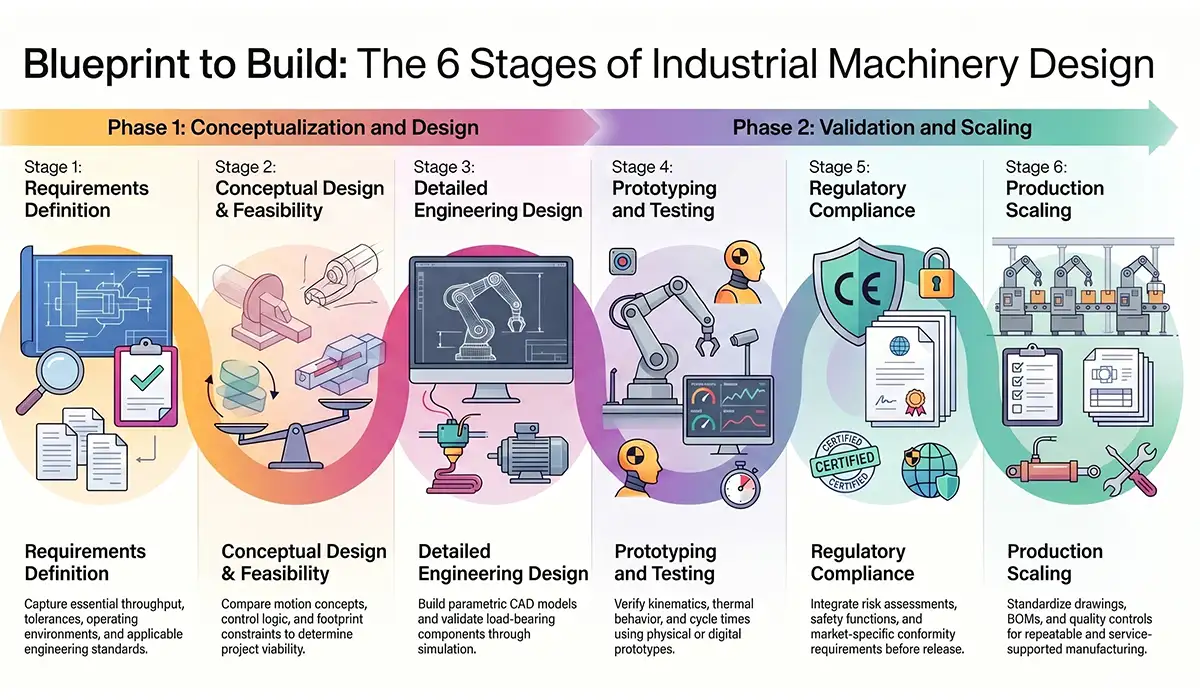
A common search phrase is industrial machinery design process step by step. In reality, the process is iterative, but most successful programs still move through six disciplined stages:
- Requirements definition
Capture product range, throughput, tolerances, utilities, operating environment, maintenance philosophy, and applicable standards. - Conceptual design and feasibility
Compare motion concepts, architecture options, manual vs CNC control logic, hydraulic vs servo strategies, and footprint constraints. - Detailed engineering design
Build parametric CAD models, define machine component design, size industrial drive systems, and validate load-bearing industrial components through simulation. - Prototyping and testing
Use physical prototypes, digital prototypes, or both to verify kinematics, thermal behavior, vibration, cycle time, and subsystem interactions. - Regulatory compliance and certification
Integrate risk assessment, safety functions, guarding, documentation, and market-specific conformity requirements before release. - Production scaling
Standardize drawings, BOMs, tolerances, quality controls, supplier approvals, and service documentation for repeatable manufacture.
Core Components of Industrial Machinery — A Technical Breakdown
When engineers ask what are the key components of industrial machine design, the answer starts with subsystem logic rather than brand names. Every industrial machine depends on a structural frame, power transmission elements, motion components, control hardware, bearings, sealing methods, and some form of thermal or environmental management. Procurement teams often focus first on visible modules, but long-term performance is usually decided by how these systems interact under load, heat, contamination, and duty-cycle stress.
The table below summarizes the technical building blocks that recur across precision engineering equipment, conveyors, robotic workcells, presses, forming systems, and custom automation.
| Component Category | Function | Common Materials | Key Design Consideration |
|---|---|---|---|
| Structural Frame | Load bearing, alignment, vibration damping | Welded steel, cast iron, aluminum alloy | Rigidity, resonance, fatigue life |
| Drive Systems | Power transmission and motion | Gears, belts, chains, shafts, couplings | Torque capacity, backlash, efficiency loss |
| Hydraulic Systems | Force amplification and actuation | Alloy steel cylinders, hoses, seals | Pressure rating, leakage control, serviceability |
| Control & Electrical Systems | Automation, sensing, safety, precision | PLCs, PCBs, sensors, drives, cables | EMI resistance, redundancy, compliance |
| Bearings & Seals | Reduce friction and protect interfaces | Bearing steels, polymers, ceramics | Load rating, contamination resistance |
| Cooling & Thermal Management | Remove heat and stabilize accuracy | Heat sinks, coolant channels, fans | Thermal dissipation and dimensional stability |
Machines that look similar from a distance can behave very differently because their internal choices differ. A welded frame may cost less than a cast base but react differently to vibration. A belt drive may be quieter and cheaper than a gear train but less suitable for high-torque precision. A compact enclosed design may protect against contamination yet increase thermal density. Good machinery design best practices come from resolving these tradeoffs early.
Materials Selection in Industrial Machinery Design
Material selection directly affects stiffness, wear life, manufacturability, corrosion resistance, and cost. Carbon and alloy steels remain dominant because they offer strong strength-to-cost performance and proven fabrication routes. Aluminum alloys reduce weight and can improve motion efficiency, especially in moving axes, while composites and engineered polymers are used where corrosion resistance, electrical isolation, or low mass matter more than bulk rigidity. Advanced ceramics still occupy narrower roles in high-wear or high-temperature interfaces.
The correct choice depends on the application. Steel vs aluminum is not a style preference; it is a design decision tied to stiffness targets, section geometry, damping, thermal expansion, and total system mass. For harsh process lines, corrosion behavior can outweigh raw mechanical strength. For motion-intensive systems, reducing moving mass can improve responsiveness and lower motor size. This is why how to design industrial machinery for high performance always begins with function, environment, and lifecycle assumptions, not with material habit.
Structural Design Principles — Load, Stress, and Fatigue Analysis
Structural design must account for static load, dynamic load, and repeated cycling. Static calculations are only the starting point. Most production assets experience vibration, shock, acceleration, deceleration, thermal gradients, and local stress concentrations. Those conditions make fatigue design critical, especially for welded frames, shafting, brackets, supports, and reciprocating mechanisms.
Finite Element Analysis has become the default validation tool for modern machine frames and heavily loaded assemblies because it helps engineers visualize stress distribution, deflection, and local weak points before physical fabrication. FEA is not a substitute for judgment, however. Boundary conditions, contact assumptions, fastener behavior, and realistic load cases still decide whether a simulation is trustworthy. In short, load-bearing industrial components fail when design teams oversimplify how real forces enter the structure.
Fatigue matters most when loads fluctuate over time. A structure that survives one peak load may still fail early if it sees millions of cycles around a stress concentration. That is why machine frame structural design also considers safety factors, joint details, weld quality, and vibration control in machines. The goal is not only to avoid collapse, but to hold alignment, preserve accuracy, and prevent crack initiation across the intended lifecycle.
Industrial Machinery Design for Specific Industries
Machinery architecture changes sharply from one sector to another. A food line prioritizes cleanability, hygienic surfaces, and washdown resilience. A mining machine is driven by abrasion, shock, dust, and uptime in remote conditions. Pharmaceutical equipment must support contamination control, validation, and cleanroom compatibility. These are not small variations. They change materials, sealing, access design, controls, documentation, and even how maintenance is planned.
This is why broad claims about “the best machine design” rarely hold across sectors. The real question is application fit. A design optimized for high sanitation may be overbuilt for dry packaging. A machine built for aggressive dust and vibration may be unnecessarily heavy for a clean electronics plant. Sector context is what converts abstract engineering into usable specification logic.
Machinery Design for Food and Beverage Processing
Food and beverage machinery prioritizes hygienic design. Surfaces must be cleanable, dead zones minimized, drains properly sloped, and materials selected to resist corrosion and repeated sanitation. Stainless steel dominates because it supports clean-in-place practices, tolerates many washdown environments, and reduces contamination risk when correctly finished and fabricated.
Here, indoor vs outdoor is less important than product-contact vs non-contact logic and cleanable vs contamination-prone geometry. Designers must think about gasket selection, weld finish, crevice control, access for inspection, and how sensors, guards, and cable routing behave during sanitation. In this sector, performance means more than cycle time; it means consistent cleanability without compromising throughput.
Machinery Design for Mining and Heavy Extraction
Mining and extraction demand machinery built for impact, dust, moisture, vibration, abrasive material flow, and difficult service access. Drives, motors, structures, and guarding must tolerate conditions that would quickly damage lighter factory equipment. ABB notes that mining applications routinely expose large machines to dusty, dirty environments, severe vibration, and temperatures ranging from -50°C to +50°C.
That reality makes industrial machinery design for harsh environments a distinct engineering discipline. Designers favor reinforced structures, more conservative sealing, abrasion-resistant surfaces, higher ingress protection, and easier field service. In many cases, the important contrast is not compact vs large but lightweight vs repairable, or high efficiency vs extreme durability. The best heavy equipment design trends now combine ruggedization with electrification, digital monitoring, and lower-emission operation.
Machinery Design for Pharmaceutical Manufacturing
Pharmaceutical machinery must support contamination control, repeatability, traceability, and validated operation. Equipment should be designed with suitable materials, accessible cleaning surfaces, and process control that supports GMP expectations. FDA GMP guidance also links equipment design to qualification and process validation, including IQ, OQ, and PQ activities.
In practice, this means cleanroom compatibility, minimized particle generation, documented change control, and carefully managed product-contact surfaces. Validation pressure also changes how design changes are handled: even a seemingly minor adjustment in materials, controls, or cleaning method can create a regulatory impact. This is one reason pharmaceutical machine projects often move more deliberately than general industrial automation builds.
Current Trends in Industrial Machinery Design (2025–2026)
In 2025 and 2026, Industrial Machinery Design and Trends has been defined by one reality: machine builders are being asked to deliver more output, more flexibility, more data visibility, and better energy performance at the same time. The result is a shift away from isolated assets toward connected, software-aware, and service-oriented equipment. These modern industrial equipment trends are being accelerated by automation demand, energy-efficiency policy, and the need to cope with labor scarcity without sacrificing uptime.
The trend set is consistent across sectors. Designers are embedding sensing earlier, moving more validation into virtual environments, favoring modularity over single-purpose rigidity, and pushing efficiency deeper into motors, drives, and motion logic. The rising value of industrial automation machinery now depends as much on software and data architecture as on raw mechanical capability.
Industry 4.0 and the Rise of Smart Machinery
A frequent buyer question is how does Industry 4.0 affect industrial machinery design. The practical answer is that machines are no longer expected only to perform motion and force. They are expected to sense, report, diagnose, and sometimes optimize themselves. That requires embedded sensors, network-ready controllers, edge processing, and communication layers that connect equipment to MES, SCADA, CMMS, and plant analytics environments.
For designers, this changes early decisions. Sensor placement affects wiring, accessibility, enclosure design, and contamination exposure. Data architecture affects controller choice and cybersecurity posture. Service models shift from reactive repair toward event-driven support. In short, how smart sensors improve industrial machinery design is not just by adding dashboards; it is by making the machine easier to optimize across its full operating life.
Digital Twin Technology in Machinery Design and Testing
Digital twins are now central to prototype reduction and faster commissioning. Siemens describes digital twins in manufacturing as virtual replicas of products, equipment, and production systems that can be used for monitoring, optimization, and validation before implementation. That makes them especially valuable for complex machinery where physical prototype changes are expensive or slow.
In practical terms, how digital twins are used in industrial machinery design includes validating motion sequences, checking collisions, testing control logic, studying thermal behavior, and simulating lifecycle scenarios before steel is cut. This does not eliminate physical testing, but it does reduce avoidable design iteration and shortens the path to virtual commissioning. For OEMs facing tighter lead times, that is one of the most important cost and schedule advantages now available.
Modular and Reconfigurable Machine Design
The shift from dedicated lines to flexible platforms is no longer limited to high-mix factories. A modular design approach for industrial equipment is increasingly used to reduce changeover time, simplify expansion, and lower lifecycle disruption when product families evolve. ASME reconfigurable manufacturing literature frames reconfiguration not as an afterthought, but as an intentional design objective.
This is one of the clearest contrasts in current machine architecture: fixed-purpose vs modular. Fixed-purpose systems can still win on speed and simplicity when the product set is stable. Modular machinery systems win when demand shifts, customization rises, or phased capital investment matters. For manufacturers under margin pressure, that can make modularity one of the most important cost-effective industrial machinery design strategies available.
Energy Efficiency and Sustainable Machinery Design
Energy is now a design input, not just an operating expense. The IEA highlights motor-system upgrades and the increased use of variable-speed drives as key measures for industrial energy savings. That directly affects machine builders because motors, fans, pumps, compressors, and motion axes are designed choices, not fixed givens.
The best answer to best practices for energy-efficient industrial machine design is therefore systemic: use efficient motors and drives, reduce moving mass where possible, minimize idle losses, recover energy where appropriate, and tune control logic so machine subsystems do not run harder than the process requires. ISO 50001 is relevant here because it formalizes energy management as a continuous improvement discipline rather than a one-time retrofit exercise.
Advanced Robotics and Collaborative Robot (Cobot) Integration
Collaborative robot integration continues to expand where flexibility, compact footprint, and human-machine interaction matter. IFR reported that cobots reached a 10.5% share of industrial robot installations worldwide in 2023, and its 2026 industrial robotics data showed 542,000 robot installations in 2024, confirming sustained global automation demand.
For machine designers, cobot integration is not simply about adding a robot arm. It changes guarding strategy, vision-system design, fixturing, force limits, controller architecture, and operator workflow. The real question is not robot vs human. It is how to combine industrial robotics design with human oversight in a way that improves safety, repeatability, and economic flexibility.
Safety Standards and Regulatory Compliance in Industrial Machinery Design
Compliance is not a paperwork stage at the end of a project. It shapes architecture from the first concept review onward. Guarding layouts, safety-related controls, access points, emergency stops, documentation, validation logic, and labeling are all influenced by the regulatory framework that governs the target market.
There is also an important timing issue. In Europe, Directive 2006/42/EC remains the active machinery framework during the transition period, but Regulation (EU) 2023/1230 will replace it from 20 January 2027. For exporters and OEMs with long design cycles, that makes forward-looking compliance planning essential. In the United States, OSHA and related standards remain central to machine safety expectations in use.
Key ISO and ASME Standards Every Designer Must Know
The standards below are not a complete library, but they are among the most useful starting points for design teams.
| Standard | Issuing Body | Scope |
|---|---|---|
| ISO 12100 | ISO | Risk assessment and risk reduction for machinery |
| ISO 13849-1 | ISO | Safety-related parts of control systems |
| ASME B30 | ASME | Safety requirements for cranes, hoists, and lifting systems |
| EN ISO 10218 | ISO/CEN | Safety requirements for industrial robots |
| ISO 50001 | ISO | Energy management systems |
ISO 12100 provides the foundational method for identifying hazards and reducing risk by design. ISO 13849-1 extends that work into safety-related control systems and performance levels. ASME standards become especially relevant in lifting, pressure, and mechanical-system domains where jurisdiction or application type demands them.
Machine Guarding and Operator Safety Design Principles
OSHA states that one or more methods of machine guarding must be provided to protect operators and other employees from hazards such as point-of-operation exposure, ingoing nip points, rotating parts, flying chips, and sparks. That simple requirement has major design consequences. Guarding is not a fence added later; it affects access, changeover, visibility, sensor integration, and operator productivity from the earliest layout stage.
Good guarding design uses the least dangerous architecture first, then fixed guards, interlocked guards, presence-sensing devices, safe distance, and procedural controls as appropriate. The poor alternative is retrofitting safety after the machine geometry is already frozen. That approach usually increases cost, creates awkward maintenance access, and still leaves risk reduction weaker than it should be.
The Role of Software and Digital Tools in Modern Industrial Machinery Design
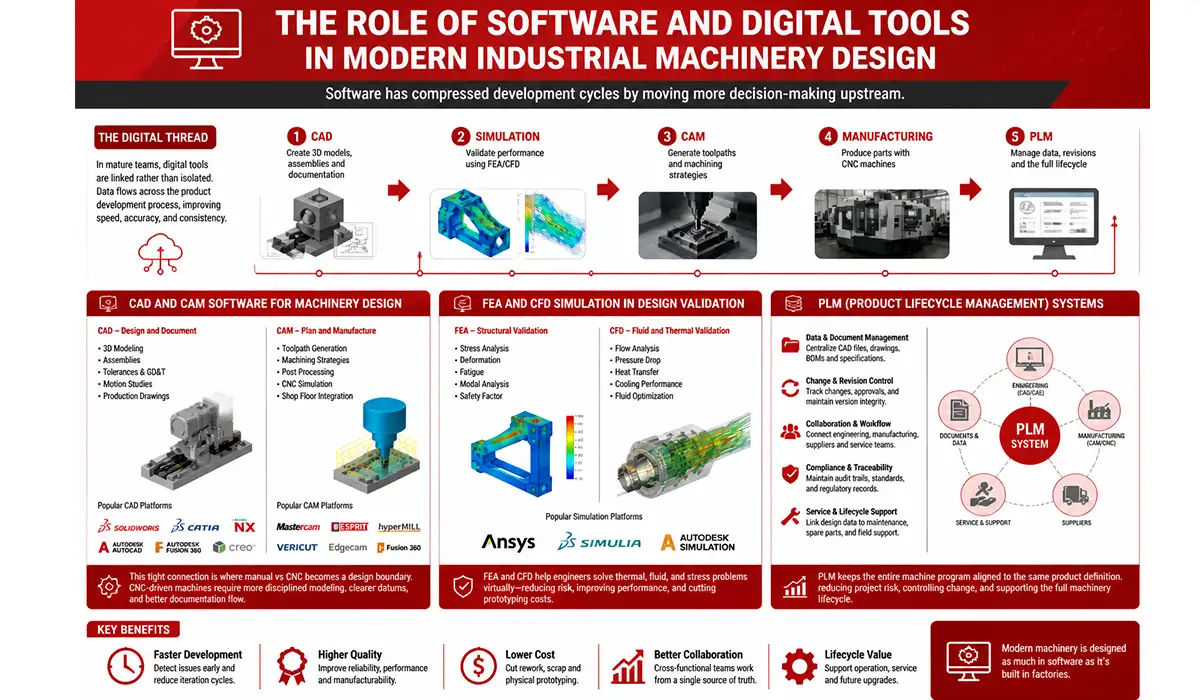
Software has compressed development cycles by moving more decision-making upstream. Instead of waiting for a physical build to reveal alignment issues, interference, thermal problems, or manufacturability conflicts, design teams can now detect many of those problems virtually. That changes both engineering speed and engineering quality. It also explains why software decisions now shape real machine performance, not just documentation efficiency.
In mature teams, digital tools are linked rather than isolated. CAD feeds simulation, simulation informs component sizing, CAM translates geometry into toolpaths, and PLM maintains configuration control across revisions. This digital thread is now a defining feature of serious CNC machine design, custom automation, and scalable machine programs.
CAD and CAM Software for Machinery Design
CAD is still the foundation of machine design because it defines geometry, assemblies, tolerances, and production-ready documentation. Modern 3D platforms also support motion studies, design rules, configuration management, and closer collaboration between engineering and manufacturing. On the CAM side, toolpath generation and machining strategy are now tightly linked to the source model, reducing translation errors between design and fabrication.
This tight connection is where manual vs CNC becomes a design boundary rather than just an operating choice. Machines intended for CNC-driven production require more disciplined digital modeling, clearer datum strategy, and better documentation flow. Widely used platforms include SolidWorks, CATIA, Siemens NX, AutoCAD Mechanical, Autodesk Fusion, and PTC Creo, each with strengths in parametric design, surfacing, configuration, or manufacturing integration.
FEA and CFD Simulation in Design Validation
FEA is used to validate structural integrity, stiffness, and fatigue-sensitive regions before fabrication. CFD extends that virtual validation into airflow, cooling, hydraulic passages, and thermal distribution. Together, they allow engineers to test design intent safely, quickly, and at lower cost than relying on hardware-only iteration.
These tools are especially important where thermal drift, fluid losses, or stress concentration would be difficult to solve after commissioning. ANSYS, Abaqus, and Autodesk simulation tools remain common in this space. In advanced projects, simulation is no longer a specialist side task. It is part of everyday design validation for energy-efficient industrial machines, fluid systems, and high-duty mechanical assemblies.
PLM (Product Lifecycle Management) Systems
PLM systems connect engineering data to the full product lifecycle. They manage drawings, revisions, change workflows, supplier collaboration, service information, and compliance records. In multi-disciplinary machine programs, PLM is what keeps the mechanical design, controls team, documentation group, and manufacturing organization aligned to the same product definition.
That matters because complex machine projects fail as often from uncontrolled change as from poor engineering. When bills of material drift, software versions mismatch hardware revisions, or compliance records fall behind design changes, project risk multiplies. PLM reduces that risk and makes machinery lifecycle management far more disciplined.
Challenges Facing Industrial Machinery Designers Today
Design teams are working in a tougher environment than even a few years ago. Supply-chain volatility still affects motors, castings, electronics, and specialty materials. Skilled labor shortages continue to increase the appeal of automation, but automation itself raises complexity in controls, software, integration, and cybersecurity. At the same time, energy and emissions expectations are tightening, which means new projects are judged on more than output and capex.
This is why challenges in modern industrial machinery engineering are increasingly cross-functional. Mechanical engineers must understand controls. Controls engineers must understand serviceability. Procurement teams must evaluate technical risk, not only price. Cybersecurity has become part of the machine conversation because connected equipment expands the attack surface of production assets and facility networks. SME has explicitly warned that manufacturing has been late to adopt stronger cybersecurity safeguards for connected machinery.
Another persistent challenge is time-to-market. Faster launches are expected, yet safety validation, documentation, supplier coordination, and multi-disciplinary reviews all take time. That tension explains why companies are investing in digital validation, modular platforms, better change control, and reusable subsystem libraries. The objective is not only speed, but speed without losing compliance or reliability.
There are also people challenges. As machines become more connected and more intelligent, the demand shifts from purely mechanical skills toward hybrid capability: machine design plus controls, design plus data, design plus service strategy. In that sense, the constraint on the future of machine building is not only technology maturity. It is the availability of teams that can combine those disciplines effectively.
Future Outlook — Where Industrial Machinery Design Is Heading
Looking ahead, Industrial Machinery Design and Trends is moving toward machines that are lighter, more connected, easier to reconfigure, and more capable of learning from their own data. The center of gravity is shifting from static hardware toward adaptive systems that combine mechanical performance with software intelligence. That direction points directly toward next-generation industrial machines rather than just better versions of legacy equipment.
One major force is AI-assisted design. Autodesk generative design already positions algorithmic optimization as a way to produce performance-focused parts with lower material use and shorter development cycles. Siemens has also expanded AI-enabled design assistance in NX, bringing engineering-focused AI deeper into day-to-day design work. This is not magic automation; it is a practical way to reduce iteration and discover geometries that traditional workflows may overlook.
Additive manufacturing will also keep reshaping machine architecture, especially for complex brackets, latticed structures, lightweight tooling, thermal components, and low-volume specialized parts. In many cases, the combination of generative design and additive methods will allow better performance from less material, which strengthens both efficiency and customization.
Heavy industry will continue exploring alternative powertrains. Hydrogen is already being positioned for heavy-duty applications where batteries struggle with range or weight, and suppliers such as Volvo Group and Cummins are openly advancing hydrogen-based solutions for trucks and off-highway equipment. That makes green hydrogen a serious area to watch, especially in mining, transport, and construction-adjacent sectors.
Autonomy is another clear frontier. Off-highway equipment markets are being reshaped by software, sensing, and customer demand for productivity, while long-running mining digitization efforts continue to show the case for automation in hazardous or remote conditions. The path will differ by sector, but autonomous and semi-autonomous equipment will keep moving from pilot deployments toward mainstream heavy-equipment strategy.
The final piece is the operator experience. Human-machine interface design is moving beyond buttons and HMIs toward richer diagnostics, contextual assistance, and augmented reality support. The World Economic Forum has highlighted how AR can accelerate training and task execution in manufacturing contexts. That points to a future where the future of industrial machinery design and automation includes not only smarter machines, but also smarter support for the people who use and maintain them.

Rate this article
Choose a rating from 1 to 5 stars.
No ratings yet