



Prefer listening? You can play the audio version of the rest of this article below.
What Is a DIN Rail? Meaning, Purpose, and Industrial Applications
A DIN Rail is a standardized metal mounting strip that engineers install inside electrical enclosures and control cabinets. The name comes from DIN — Deutsches Institut für Normung — Germany’s national standards organization, which originally developed these profiles to create a universal platform for mounting electrical equipment. Today, the international standard EN/IEC 60715 governs all compliant profiles, and manufacturers worldwide design components to snap directly onto them. Understanding what a DIN Rail is and how it works is the essential foundation before selecting any cutting tool or hardware.
The physical structure is simple but precise. A DIN Rail features a characteristic top hat cross-section — which explains why engineers also call it a top hat rail or omega rail. This profile creates two flanges that spring-loaded clamps on terminal blocks, circuit breakers, and relay modules grip firmly. The rail mounts inside an enclosure at standard intervals, and components align along its length without requiring individual screws or fasteners for each device. This snap-in mounting system dramatically speeds up panel assembly and simplifies future maintenance. A DIN Rail cutter is therefore one of the first tools a panel builder reaches for when preparing an enclosure, since every rail must be trimmed to the correct enclosure width before components can mount.
DIN Rails appear in virtually every industry that uses electrical control equipment. You find them in factory automation lines, commercial building management systems, railway signaling cabinets, renewable energy inverter panels, and HVAC control enclosures. Wherever multiple electrical devices need organized, accessible, and maintainable mounting, the standardized mounting rail delivers the solution.
For a comprehensive understanding of DIN Rail cutter, we highly recommend reviewing this article.
DIN Rail Types and Sizes: TS35, TS15, and Other Standard Profiles
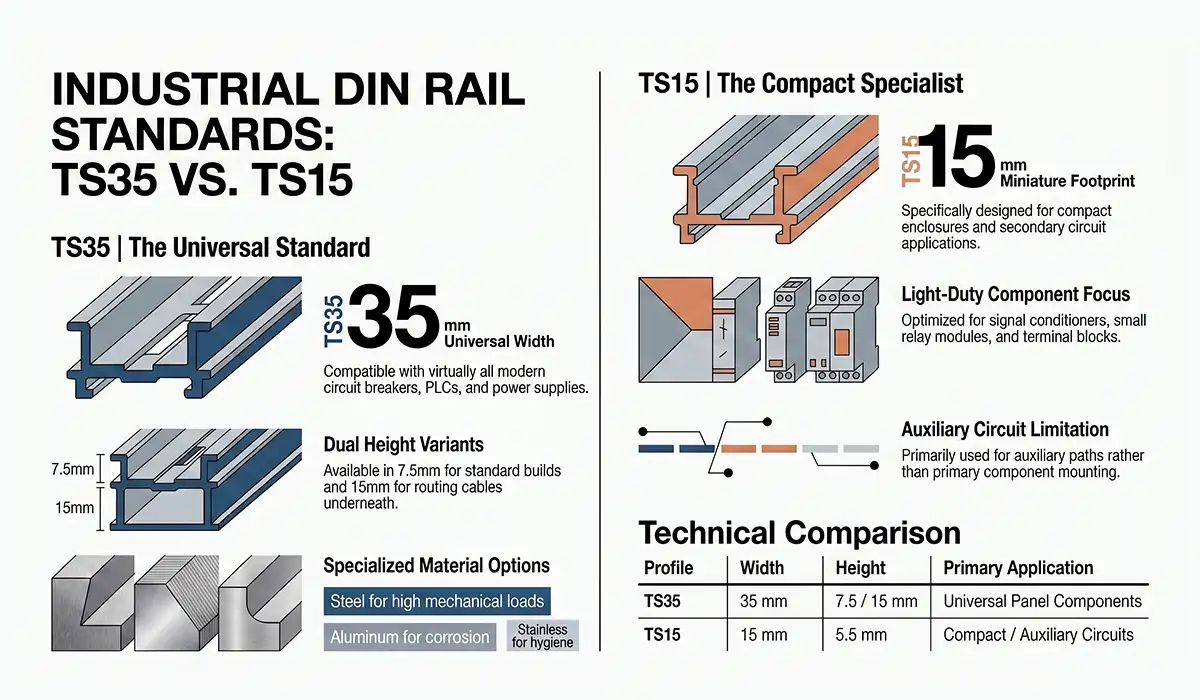
Understanding TS35, TS15, and other standard profiles helps panel builders choose the right rail before any cutting begins. Each profile suits specific component types, load requirements, and enclosure sizes. The market offers four main profiles, though TS35 dominates most industrial applications by a wide margin. Below is a full comparison across the standard rail types to guide initial selection.
| Rail Type | Width | Height | Common Use | Component Compatibility |
|---|---|---|---|---|
| TS35 (Top Hat) | 35 mm | 7.5 mm / 15 mm | Universal | Circuit breakers, terminal blocks, PLCs |
| TS15 | 15 mm | 5.5 mm | Compact panels | Light-duty components |
| G-Type | 32 mm | 15 mm | Heavy / legacy components | Older systems |
| C-Section | 25 mm | Variable | Specialty use | Limited |
TS35 DIN Rail — The Industry Standard Profile
TS35 is the most widely used rail profile in the world — and for good reason. Engineers commonly call it the Top Hat 35 or omega rail because of its characteristic cross-section. Its 35 mm width accommodates the snap-in mechanisms on virtually all modern circuit breakers, terminal blocks, PLCs, motor starters, and power supplies. This near-universal component compatibility explains why TS35 is the most common profile in both new panel builds and system upgrades.
TS35 comes in two height variants: 7.5 mm and 15 mm (deep rail). The 7.5 mm version suits standard panel assemblies where mounting depth carries no constraint. The 15 mm deep rail provides extra clearance beneath the rail body — useful when routing cables under the rail or when components have larger rear housings. Both variants follow the same EN/IEC 60715 footprint, so component compatibility stays identical regardless of height choice.
For a comprehensive understanding of DIN Rail Standard, we highly recommend reviewing this article.
Manufacturers produce TS35 in several materials. Steel rail — plain, zinc-plated, or galvanized — handles the highest mechanical loads and suits most industrial environments. Aluminum DIN Rail is lighter and resists corrosion more naturally, which makes it a strong choice for outdoor, marine, or thermally stressed enclosures. Stainless steel variants serve food processing, pharmaceutical, and chemical environments where hygiene requirements or aggressive cleaning agents rule out standard steel.
Additionally, panel builders can choose between perforated DIN Rail and solid DIN Rail. Perforated rail carries pre-punched holes along its length, allowing cable ties and grounding conductors to attach directly to the rail body. Solid rail offers a slightly cleaner appearance and marginally higher rigidity. Both types follow the same TS35 dimensional specification and accept the same components.
TS15 DIN Rail — Compact Profile for Tight Spaces
TS15 carries a 15 mm width and a 5.5 mm height — significantly smaller than the TS35 profile. As a result, it suits compact enclosures and secondary circuit applications where only light-duty components are involved. Signal conditioners, small relay modules, and certain terminal block series are specifically designed for TS15 mounting. In these cases, TS15 delivers a neat, space-efficient solution that TS35 cannot match in the available footprint.
However, TS15 does not support the full range of industrial components. Most circuit breakers, power supplies, and PLCs require the wider TS35 mounting footprint. Therefore, panel builders typically reserve TS15 for auxiliary circuits within a larger panel rather than as the primary component rail. When space is genuinely limited and the component list is small, TS15 is the right choice — in all other cases, TS35 is the better default.
For a comprehensive understanding of Types of DIN Rail cutter, we highly recommend reviewing this article.
G-Type and C-Section Rails — Specialty Profiles
G-type rail — sometimes called G32 — measures 32 mm wide and 15 mm tall. It predates the TS35 profile and still appears in legacy industrial systems, particularly across older factories and infrastructure installations built before EN/IEC 60715 became the universal standard. New panel designs rarely specify G-type rail. However, maintenance engineers working on existing installations must recognize it to source compatible replacement components without delaying repairs.
C-section rail follows a different cross-section profile and serves very specific niche applications. Its nominal width measures 25 mm, and height varies by variant. Component compatibility is far narrower than TS35, and globally available C-section-compatible devices are limited in range. In practice, panel builders almost never choose C-section rail for new designs unless a specific legacy device requires it. Therefore, for virtually every modern control panel application, TS35 remains the right starting point.
This article serves as a valuable resource for those seeking detailed information on How to Cut DIN Rail Cleanly.
DIN Rail Standard Explained: EN/IEC 60715 and Common Dimensions
The EN/IEC 60715 standard defines the physical dimensions, tolerances, and material requirements that all compliant mounting rails must meet. The International Electrotechnical Commission (IEC) publishes and maintains this standard globally, while the EN prefix designates its adoption across European member states. For panel builders and procurement specialists, this means that any rail carrying an EN/IEC 60715 mark will accept components from any manufacturer that designs to the same specification. Compliance, in short, is what makes global sourcing of control panel components practical.
The standard specifies the exact cross-section geometry of each profile, including flange width, overall height, the bend radii at the flanges, and the spacing of mounting holes along the rail length. For both TS35 and TS15, hole spacing runs at 25 mm intervals. This consistent pitch allows engineers to mount the rail itself inside an enclosure at predictable, repeatable positions using standard M5 or M6 hardware. Equally important, the standard controls material thickness tolerances. Thin or out-of-tolerance rail can deflect under a dense component population; a compliant rail maintains its geometry under full load.
Global sourcing relies heavily on this standard. A procurement specialist in one country can confidently order TS35 rail from a supplier in another country — knowing that every component already on the bill of materials will fit without testing. Furthermore, the EN/IEC 60715 mark simplifies compliance documentation for control panels that must meet IEC or CE requirements. Without this standard, every project would require individual dimensional verification, representing significant wasted engineering hours.
The table below summarizes the key dimensional parameters for quick reference:
| Dimension Parameter | TS35 Value | TS15 Value |
|---|---|---|
| Rail Width | 35 mm | 15 mm |
| Rail Height (standard) | 7.5 mm | 5.5 mm |
| Rail Height (deep) | 15 mm | — |
| Hole Spacing | 25 mm | 25 mm |
| Governing Standard | EN/IEC 60715 | EN/IEC 60715 |
DIN Rail Applications in Control Panels and Industrial Automation
DIN Rails appear in nearly every sector that uses electrical control equipment. Understanding DIN Rail applications in industrial automation helps engineers and procurement specialists make better decisions about rail profile selection, material grade, and installation quantity. Below are the most common application environments where mounting rails play a central role:
- Motor Control Centers (MCCs)
- PLC enclosures and automation cabinets
- Building automation and HVAC control panels
- Railway and transportation signaling systems
- Renewable energy and solar inverter panels
In Motor Control Centers, the mounting rail carries circuit breakers, contactors, overload relays, and terminal blocks across multiple panel sections. The rail organizes high-density component layouts and allows maintenance technicians to isolate or replace individual devices without disturbing neighboring assemblies. This organized, accessible arrangement reduces downtime during both planned maintenance and fault response.
PLC enclosures depend on modular rail systems to mount the PLC rack, I/O modules, power supplies, and communication modules in a single logical row. Moreover, rail-based layouts allow engineers to expand or reconfigure the cabinet as automation requirements evolve. Adding a new I/O module or safety relay requires only an available section of rail — no enclosure redesign or panel rewiring needed. This flexibility significantly reduces the cost of system upgrades over the life of an installation.
How to Cut DIN Rail Cleanly: Methods, Tools, and Best Practices
Cutting quality directly affects the outcome of every panel build. A poorly cut rail leaves sharp burrs that injure technicians during installation, deform the spring-loaded snap-in clips on components, and create mechanically unreliable connections. Accurate cut length, meanwhile, determines whether the rail seats correctly against the enclosure’s mounting pattern. Therefore, every professional panel builder needs a clear, repeatable method for producing accurate, burr-free cuts — and the right tool for their production volume.
The best cutting method depends on three factors: cut volume per day, portability requirements, and the tooling budget available. Each method below carries specific trade-offs across these criteria.
| Cutting Method | Cut Quality | Speed | Best For | Burr Risk |
|---|---|---|---|---|
| Dedicated Shear Cutter | Excellent | Fast | Panel shops, high volume | Very Low |
| Hacksaw | Fair | Slow | Field work, low volume | High |
| Angle Grinder | Poor–Fair | Medium | Emergency / field repairs | Very High |
| Cold Saw | Excellent | Medium | Workshop, precision work | Low |
| Metal Bandsaw | Good | Medium | Workshop | Low–Medium |
Using a Dedicated DIN Rail Cutter
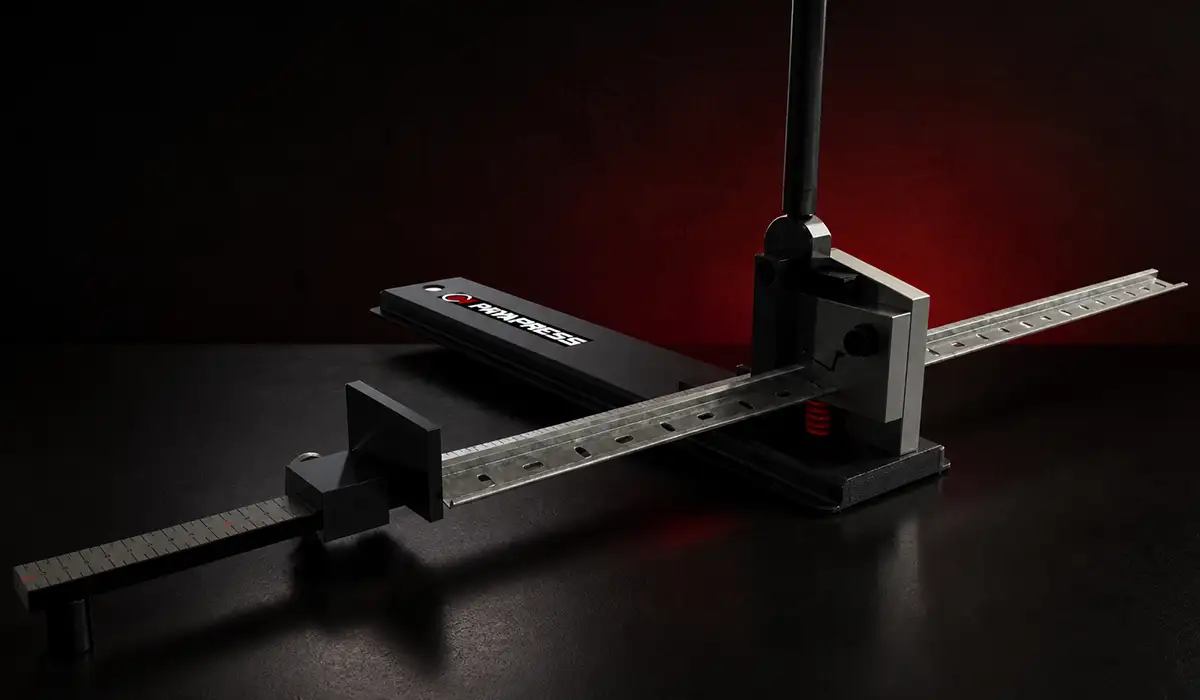
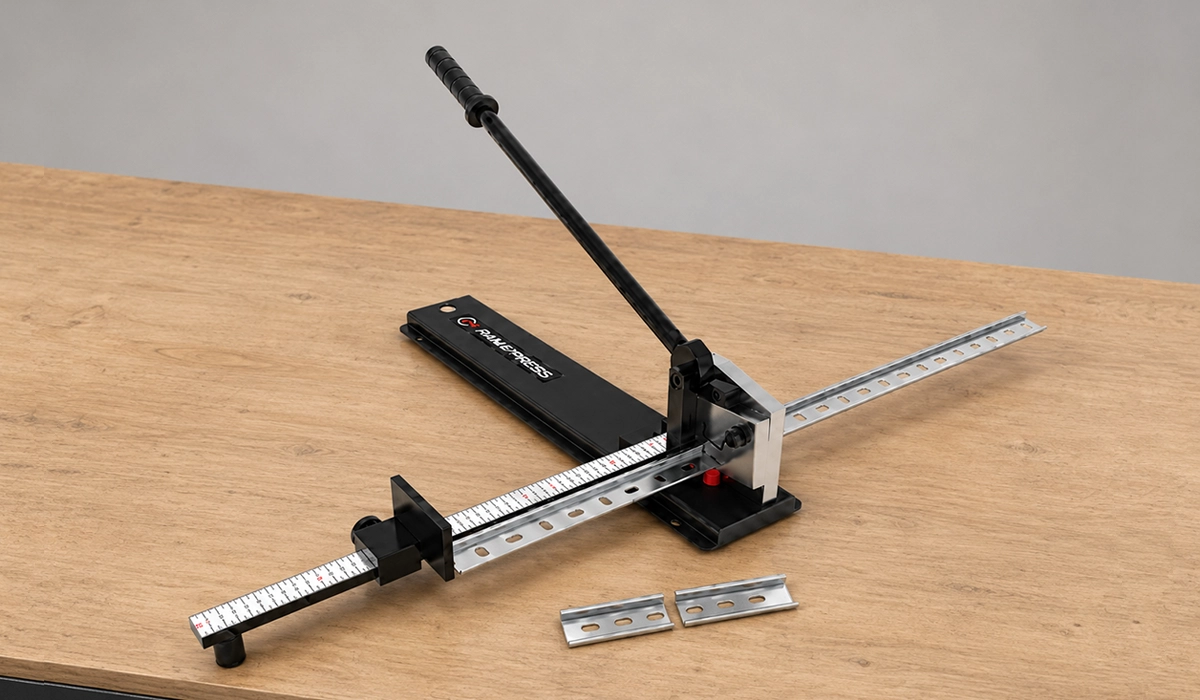
This shearing tool operates on a guillotine or shear mechanism. The operator positions the rail against a built-in length stop, then presses the handle to drive a hardened steel blade through the rail profile in a single clean motion. This shearing action severs the rail without lateral force that could distort the profile. The result is a flat, square, burr-free edge that accepts snap-in components immediately no deburring or finishing required.
For panel shops cutting dozens or hundreds of rails each week, this tool saves significant labor time. Additionally, the repeatability of a built-in stop gauge eliminates measurement error on every cut. Each piece lands at exactly the right length, which matters in high-density enclosures where even a few millimeters of variance affect component alignment and cable routing.
Furthermore, the shear mechanism keeps operators away from rotating blades, sparks, and swarf — making it the safest option for workshop environments. The best cutting tool for panel builders handles both TS35 and TS15 profiles, accepts both steel and aluminum rail, and includes a precision length stop gauge as a standard feature. Leading options from Phoenix Contact, Weidmuller, and Panduit meet all three of these criteria and deliver long service lives with minimal blade maintenance.
If the information related to Dedicated DIN Rail Cutter was interesting and informative to you, researching DIN Rail Cutter vs Saw Machine can be very engaging.
Cutting DIN Rail with a Hacksaw or Angle Grinder
A hacksaw offers a low-cost alternative for field work and occasional low-volume cutting. The process requires a fine-tooth metal-cutting blade — typically 24 to 32 teeth per inch for thin-walled steel profiles — and a stable vise or clamp to hold the rail securely during the cut. Even with good technique, a hacksaw leaves some burr on the cut edge, and the face rarely stays perfectly square unless the operator uses a guide or miter fixture.
Consequently, field technicians relying on a hacksaw must follow every cut with a deburring step. A flat file or handheld deburring tool removes the raised metal edge from both flanges and the web of the rail. This adds time to every job and introduces the possibility of inconsistent edge quality between different operators. For DIN Rail cutting methods compared on a purely occasional basis, the hacksaw is a practical workaround — but not a professional solution for any volume operation.
An angle grinder cuts faster than a hacksaw, but produces significant heat, sparks, and edge distortion. The abrasive disc leaves a rough, poorly squared face that requires more deburring effort than a hacksaw cut. Most experienced panel builders consider an angle grinder a last resort — acceptable only during field repairs where no better tool is available. The dedicated cutter vs hacksaw question always favors the shear mechanism in a professional context; the hacksaw remains useful only when portability and budget are the dominant constraints.
Cutting with a Cold Saw or Metal Bandsaw
A cold saw uses a toothed circular blade that rotates at low speed, often with a coolant or compressed air jet, cutting through metal without generating significant heat. Because the cutting zone stays cool, the blade preserves the metallurgical properties of the steel, and the resulting edge comes out clean with minimal burr. Cold saws deliver excellent cut quality and dimensional repeatability, making them a strong choice for high-volume workshop operations that cut a variety of metal profiles alongside DIN Rail.
Blade selection matters considerably with a cold saw. For thin-walled steel profiles like TS35, a blade with 40–80 teeth on a 200–250 mm disc produces the cleanest edge. Fewer teeth cause the blade to grab and vibrate, increasing burr formation and shortening blade life. Similarly, a metal bandsaw provides comparable quality at a somewhat lower capital cost. Vertical bandsaws allow the operator to guide the rail through the blade at a controlled pace, achieving results close to cold saw quality.
Both cold saws and bandsaws suit how to cut TS35 DIN Rail without burrs in volume workshop environments. However, neither tool matches the speed and single-action simplicity of a dedicated shear cutter for pure rail-cutting tasks. A cold saw or bandsaw makes the most sense for a workshop that cuts a wide variety of metal profiles and needs one piece of equipment to serve multiple purposes.
DIN Rail Cutter vs Saw: Which Cutting Method Is Better for Panel Builders?
Panel builders regularly debate whether a dedicated cutter versus a saw makes economic sense for their operation. This is a reasonable question, particularly for smaller shops handling moderate cut volumes. However, the answer becomes clear once you compare the full set of relevant criteria — not just purchase price.
| Criterion | Dedicated Cutter | Saw (Hacksaw / Cold Saw) |
|---|---|---|
| Cut Quality | Burr-free, precise | Requires deburring |
| Setup Time | None | Low–Medium |
| Cost | Medium–High | Low |
| Safety | High | Medium |
| Volume Suitability | High | Low–Medium |
| Portability | High | Medium |
| Skill Required | Low | Medium |
The dedicated cutter wins on cut quality, throughput, safety, and portability. Its upfront cost is higher than a hacksaw, but the time saved on deburring and rework pays back that investment quickly in any shop cutting more than 20 rails per week. Moreover, the safety advantage matters from a liability and compliance perspective — a shear mechanism eliminates rotating blades, sparks, and the hand-injury risks associated with saw operation in a busy workshop environment.
Saws retain value in specific scenarios. A cold saw or bandsaw suits a workshop that cuts a wide variety of metal profiles in addition to DIN Rail, since the capital investment covers multiple use cases beyond rail work. A hacksaw remains appropriate for occasional field repair where portability is the only priority and professional cut quality is not required. However, these are genuinely narrow exceptions.
For any panel builder working at professional volume, a dedicated cutting tool is the correct investment. It reduces cut time, removes the deburring step, improves operator safety, and delivers consistent, repeatable quality that reflects well on every finished panel leaving the workshop.
DIN Rail Cutter: Benefits, Features, and What to Look for Before Buying
Selecting what to look for in a quality mounting rail cutter starts with understanding your rail profiles, your daily cut volume, and your workspace. A cutter suited to a large panel shop may be overkill for a maintenance engineer cutting rail once a month. Equally, a low-capacity model will frustrate a busy production team and create bottlenecks on the workshop floor. The features below guide an informed purchase decision that matches the tool to the actual workload.
Key features to evaluate before buying:
- Cutting capacity: Confirm the tool handles the profiles you work with most — TS35 at 7.5 mm and 15 mm deep, TS15, and G-type if relevant. Not all shear cutters support every profile depth.
- Blade/shear material: A hardened steel shear blade delivers long service life and consistent cut quality. Low-grade blades blunt quickly and produce progressively worse edges.
- Cut length accuracy: A built-in ruler scale and an adjustable stop gauge allow repeatable cuts to a specific length without re-measuring on every piece — essential for high-volume production.
- Handle ergonomics: Operators making many cuts per day need a handle designed to reduce fatigue. Look for padded grips and a lever ratio that minimizes required hand force per cut.
- Portability: Benchtop models clamp to a workbench and offer the greatest cutting stability. Handheld models fit in a toolbox and suit field or mobile work. Match the format to your typical working environment.
- Material compatibility: Confirm the tool handles both steel and aluminum rail. The aluminum vs steel DIN Rail which to choose decision varies by application, but the cutter should accommodate both without blade changes or adjustment.
- Blade replacement: A tool that makes blade swaps easy reduces downtime in a busy shop. Check whether replacement blades are readily available from the manufacturer or from distribution partners.
- Brand reliability: Phoenix Contact, Weidmuller, and Panduit all produce well-regarded shear cutters with strong after-sales support and consistent performance data from the field.
When choosing the right cutting tool for your needs is the question, the most important starting point is your specific rail profile and your daily cut volume. A shop cutting TS35 steel rail fifty times per day needs a heavy-duty benchtop shear with a hardened blade and a precision stop gauge. A field technician visiting sites monthly needs something portable, compact, and robust enough to survive a toolbox. Define your scenario first — then match the specification to it. Buying the wrong format costs more time than the initial price difference.
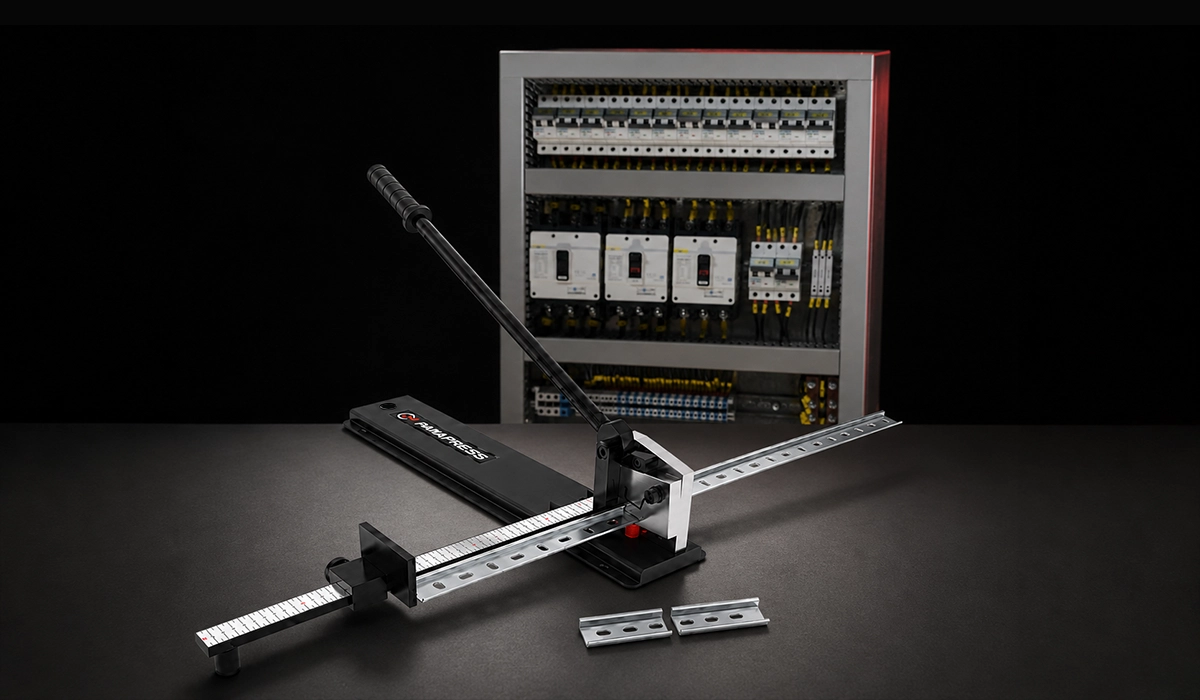
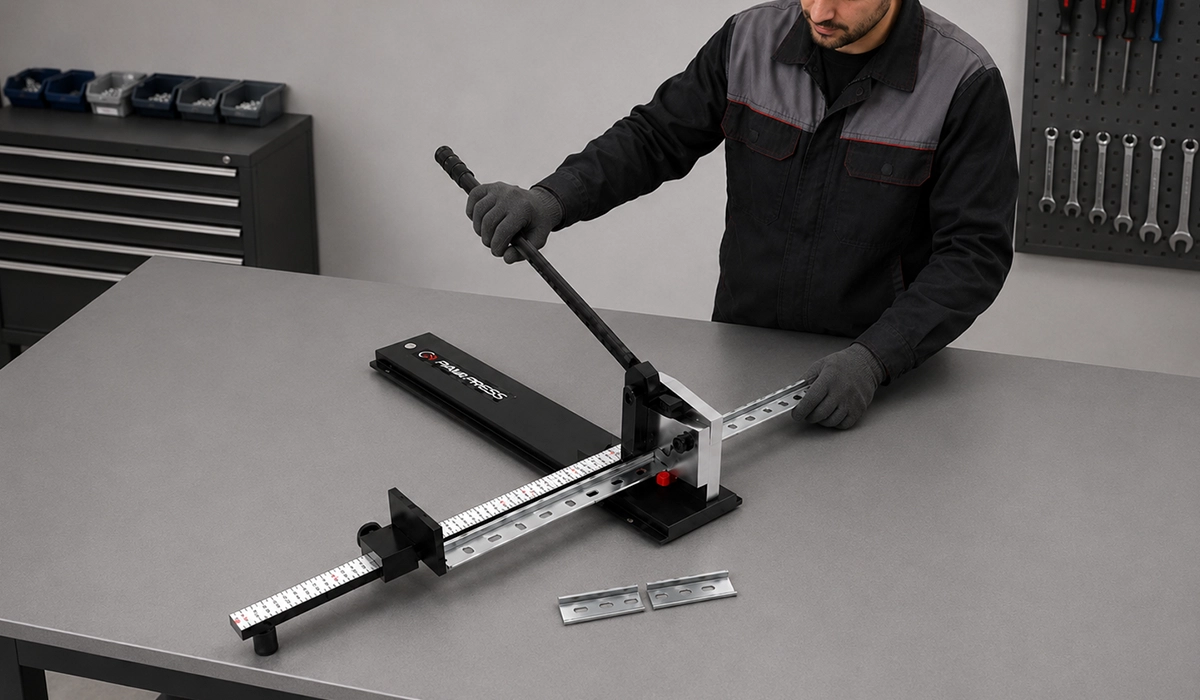
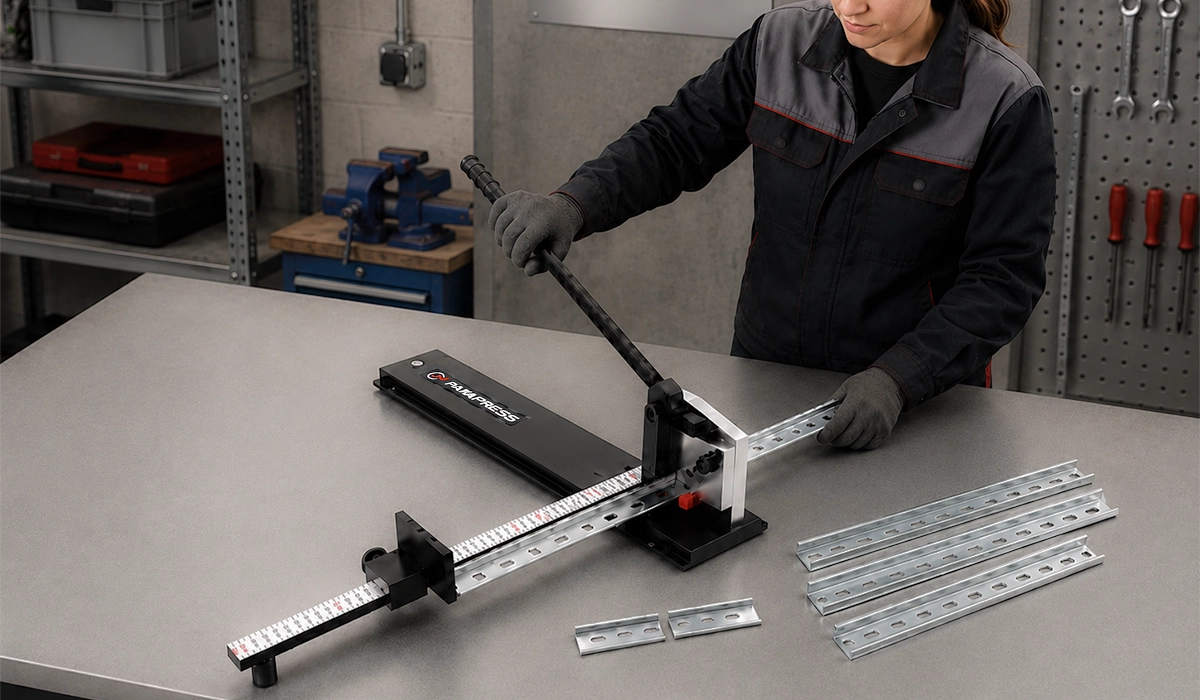
PAYAPRESS DIN Rail Cutting Tool
The Rail Cutter from PAYAPRESS offers a fast, efficient, and precise solution for cutting DIN rails used in electrical panel assemblies. Designed for ease of use, it provides clean, burr-free cuts with minimal effort. The integrated measuring guide ensures consistent length control, enhancing productivity and reducing the need for rework. Ideal for professionals seeking reliability and accuracy in their rail cutting processes, this tool is built to last with a durable high-strength steel blade. For more details and to get a personalized quote, please visit our Industrial Rail cutter and contact us today.
Conclusion about DIN Rail Cutter
A cutting tool for mounting rail is one of the most productive investments a panel builder can make. Precise, burr-free cuts reduce rework, protect operators, and speed up every panel assembly. The right mounting rail — whether TS35, TS15, or a specialty profile — starts with a clean cut made by the right tool for the job.
This guide has covered the complete picture: the meaning and purpose of DIN Rails, all standard profiles and their EN/IEC 60715-dimensional requirements, real-world applications from motor control centers to solar inverter panels, and a practical comparison of every available cutting method. It has also outlined the key buying criteria so you can select a cutting tool precisely matched to your workshop’s volume and profile requirements.
For panel builders working at any professional volume, the conclusion is clear. A quality shear cutter — from a trusted manufacturer, sized for your rail profiles, and equipped with a reliable stop gauge — will pay for itself in saved labor and improved cut quality within weeks. Choose your rail profile, match your tool to the specification, and cut with confidence.
FAQ about DIN Rail Cutter

Rate this article
Choose a rating from 1 to 5 stars.
No ratings yet