홈 ⪢ 부스바 절곡기
Busbar Bending Machine
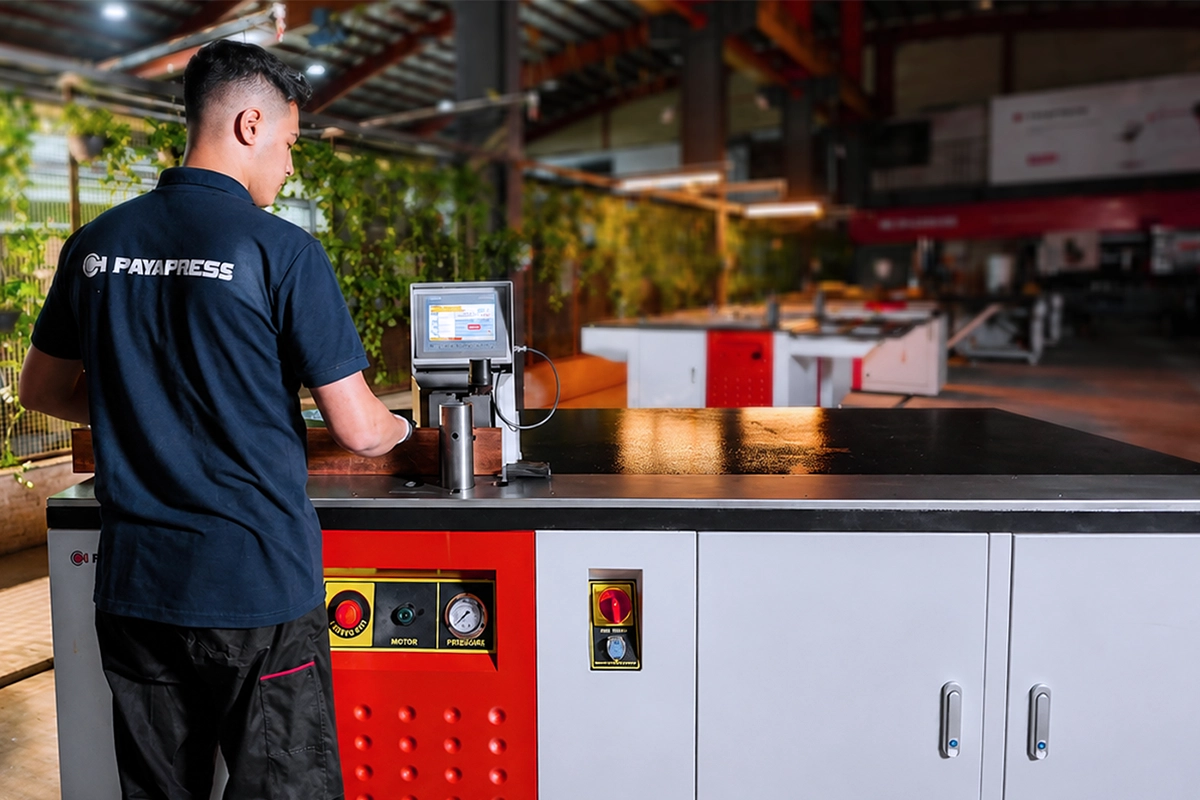
A busbar bender is a single-purpose machine: it bends copper and aluminium bars to a set angle, repeatably, without the compromises that come with a combined 3-in-1 unit. If your workshop already handles cutting and punching in-house, or subcontracts them, a dedicated bender is the more accurate and the more productive choice.PAYAPRESS has been a hydraulic busbar machine manufacturer since 1990. This category covers the full bending range — flat bends, edgewise bends, twists and offsets on both copper and aluminium busbars, with one operator at the controls. Each model is available in two control versions: a manual busbar bending machine for mixed, low-volume work, and an auto busbar bending machine with programmable angle sequences for repeat production. Select the frame size according to your largest bar cross-section, and the control version according to your batch sizes. The three models below are compared in detail on this page.
One machine, six dies — every bend your panel needs
Most busbar work is one plain bend after another, and the ordinary die handles all of it. The difficulty starts at the edges of the job: two bends sitting too close together, a bend right at the end of the bar, a bar that has to turn onto its side. Each of those has its own die. The six below cover the full range, and all of them run on the same machine.
Step / Offset Busbar Bend (Z-Bend)
A standard die needs more space between bends. This one handles two bends within 12 cm.
Twist Busbar Bend
Rotates the bar on its own axis, turning it from flat to upright.
Busbar Bar-End Bend (Type-V Bend)
For bends closer than 5.5 cm to the bar end, where an ordinary die cannot reach.
Wire Bending Mold
Normally used for bending wire shape busbars
Edgewise / Edge Bend
This die is used to bend the busbar edgewise (on its side / the hard way).
Normal Bend
The standard bend, made with the ordinary die. It covers most panel work
Compare the HBC-BE Hydraulic Busbar Bending Machines
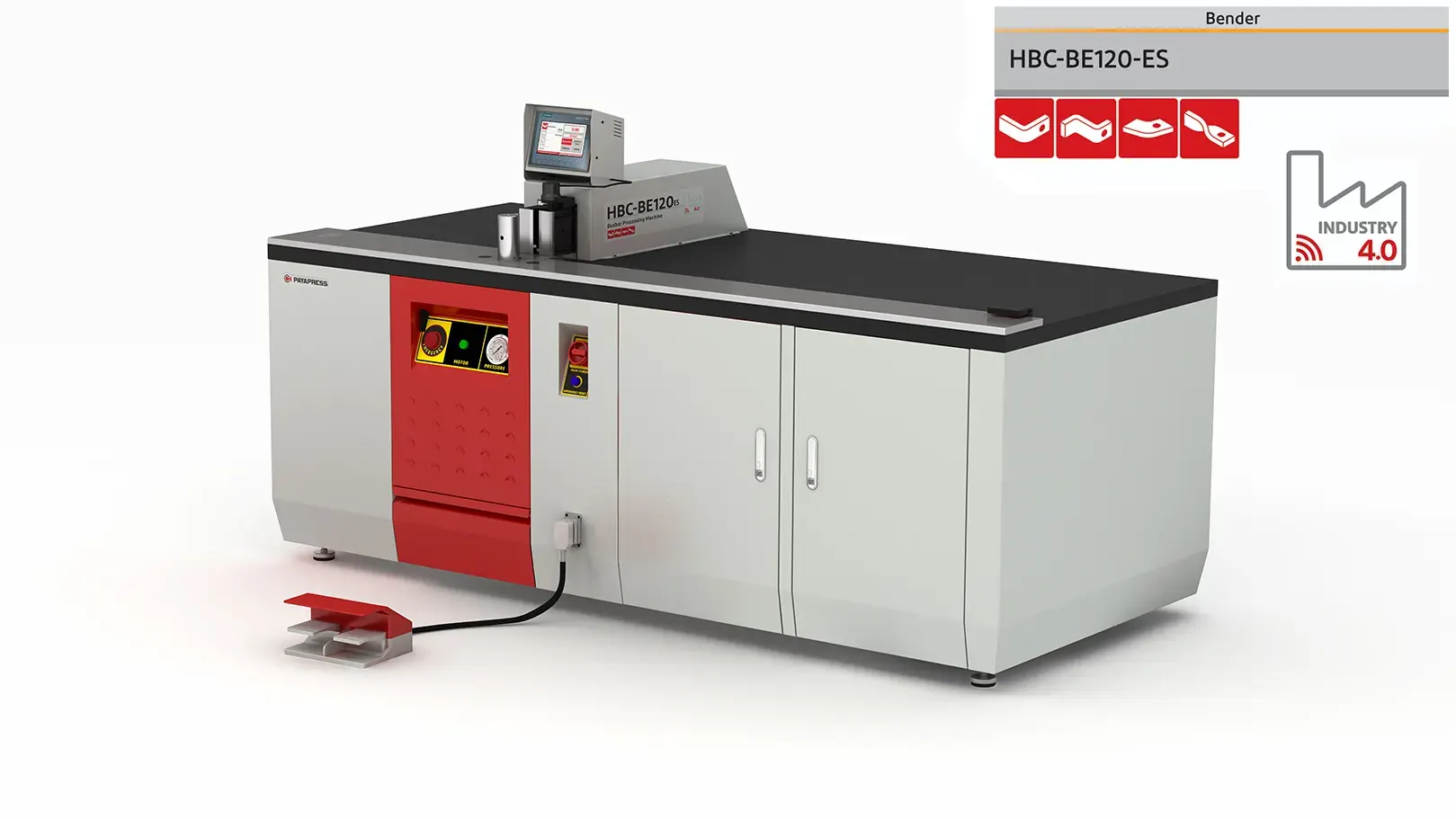
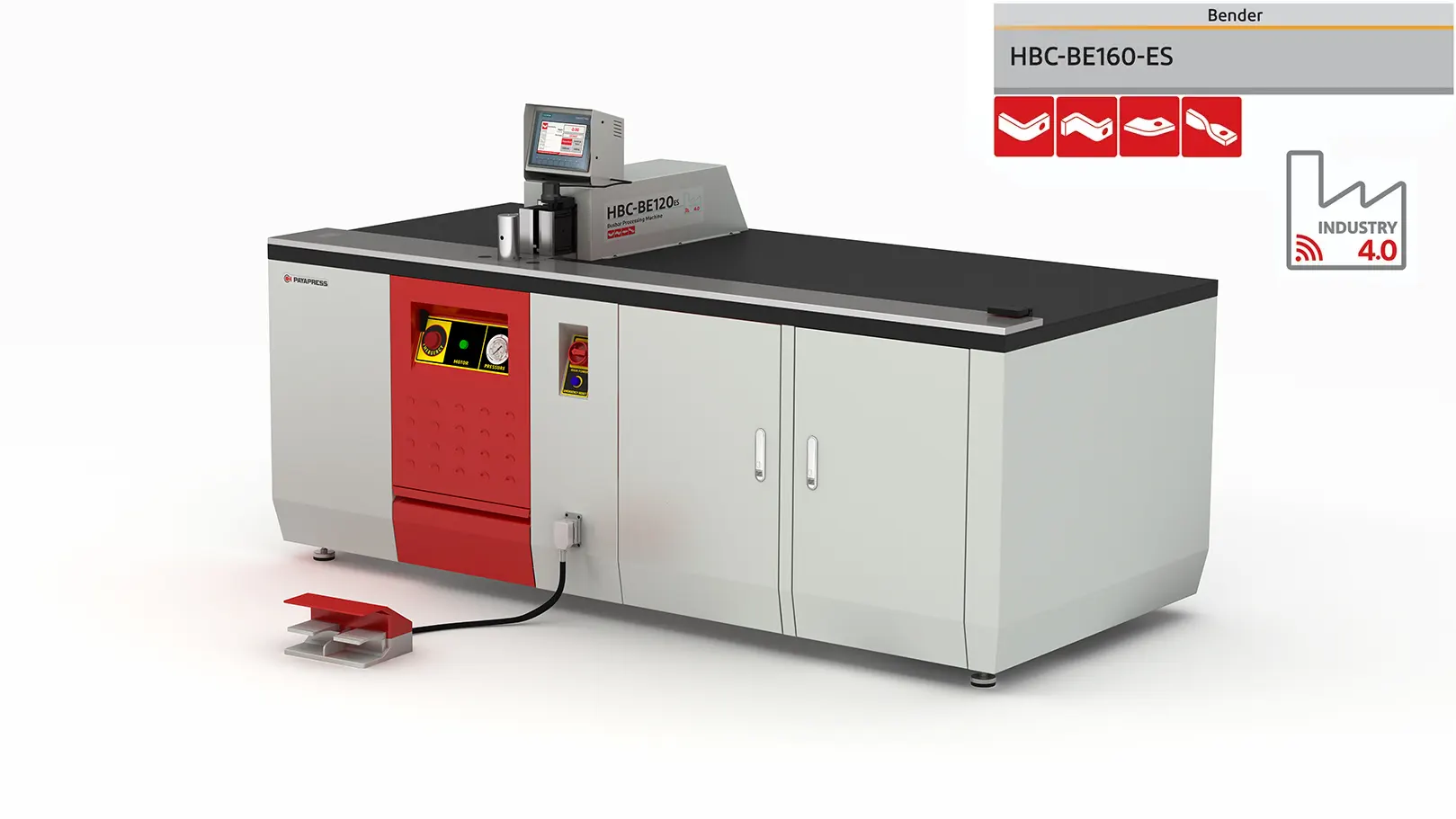
All three models are dedicated busbar bending machines — purpose-built busbar machine sharing the same five bend types, the same single-operator workflow, and the same choice between manual (EH) and automatic (ES) control. What changes is the bar you can put through them — 120 × 12 mm, 160 × 15 mm, or 200 × 20 mm — with the motor and hydraulics sized to match. Compare the full specifications below and choose the busbar machine frame that suits your largest copper or aluminium cross-section.
| Specification | HBC-BE120Up to 120 × 12 mm | HBC-BE160Up to 160 × 15 mm |
TOP OF RANGE HBC-BE200Up to 200 × 20 mm |
|---|---|---|---|
| Max busbar capacity | 120 × 12 mm | 160 × 15 mm | 200 × 20 mm |
| Bend typesWith the standard mold set | Normal, edge, V, Z (step) and twist bends | Normal, edge, V, Z (step) and twist bends | Normal, edge, V, Z (step) and twist bends |
| Max forming radiusStandard mobile mold | 12 mm | 14 mm | 14 mm |
| Total power | 1.7 kW | 2.5 kW | 4.2 kW |
| Operating pressure | 200 bar | 230 bar | 200 bar |
| Control versions | Manual (EH) / Automatic (ES) EH: handy length stopper · ES: programmable stopper | Manual (EH) / Automatic (ES) EH: handy length stopper · ES: programmable stopper | Manual (EH) / Automatic (ES) EH: handy length stopper · ES: programmable stopper |
| Industry 4.0 ready | Yes | Yes | Yes |
| Operators required | 1 | 1 | 1 |
| Machine weight | 610 kg | 610 kg | On request |
| DimensionsL × W × H | 246 × 110 × 135 cm | 130 × 110 × 100 cm | On request |
| Best suited for | Low-voltage panels and short production runs | The balance between capacity and power draw | High-current busbar systems |
| Full specifications | HBC-BE120 → | HBC-BE160 → | HBC-BE200 → |
HBC-BE Series
Busbar Bender Machine BE Series – PAYAPRESS
The HBC-BE series from PAYAPRESS gives up the shear and the punching station to put everything into a single function. What you get is a lighter machine, cheaper to maintain and far easier to master: one operator, one control, one movement.
A Copper Busbar Bending Machine for Bars up to 20 mm Thick
The hydraulic power pack works between 200 and 230 bar depending on the model — enough to form copper busbar up to 20 mm thick without marking the surface or over-stressing the material. The standard mobile mold gives a forming radius of 12 or 14 mm, which is what most low-voltage panels ask for, and the length stopper is set either by hand or automatically depending on the version you choose. Capacity runs from 120 × 12 mm on the HBC-BE120 up to 200 × 20 mm on the HBC-BE200, so there is a frame size for almost every bar a panel shop is likely to run.
Manual (EH) or Automatic (ES): Two Ways to Run the Same Machine
Every model in this range comes in two control versions, and the choice has more effect on your daily work than the frame size does. The manual busbar bending machine (EH) uses a handy length stopper — the simplest setup, the lowest cost, and the sensible choice when no two jobs look the same. The auto busbar bending machine (ES) adds a programmable stopper that stores and repeats angle positions, so the five-hundredth bar comes out exactly like the first one. Both versions are Industry 4.0 ready out of the box, which means you can connect the HBC-BE160 or any other model to your production system from day one if you work with traceability.
Built for Electrical Panel and Switchgear Builders
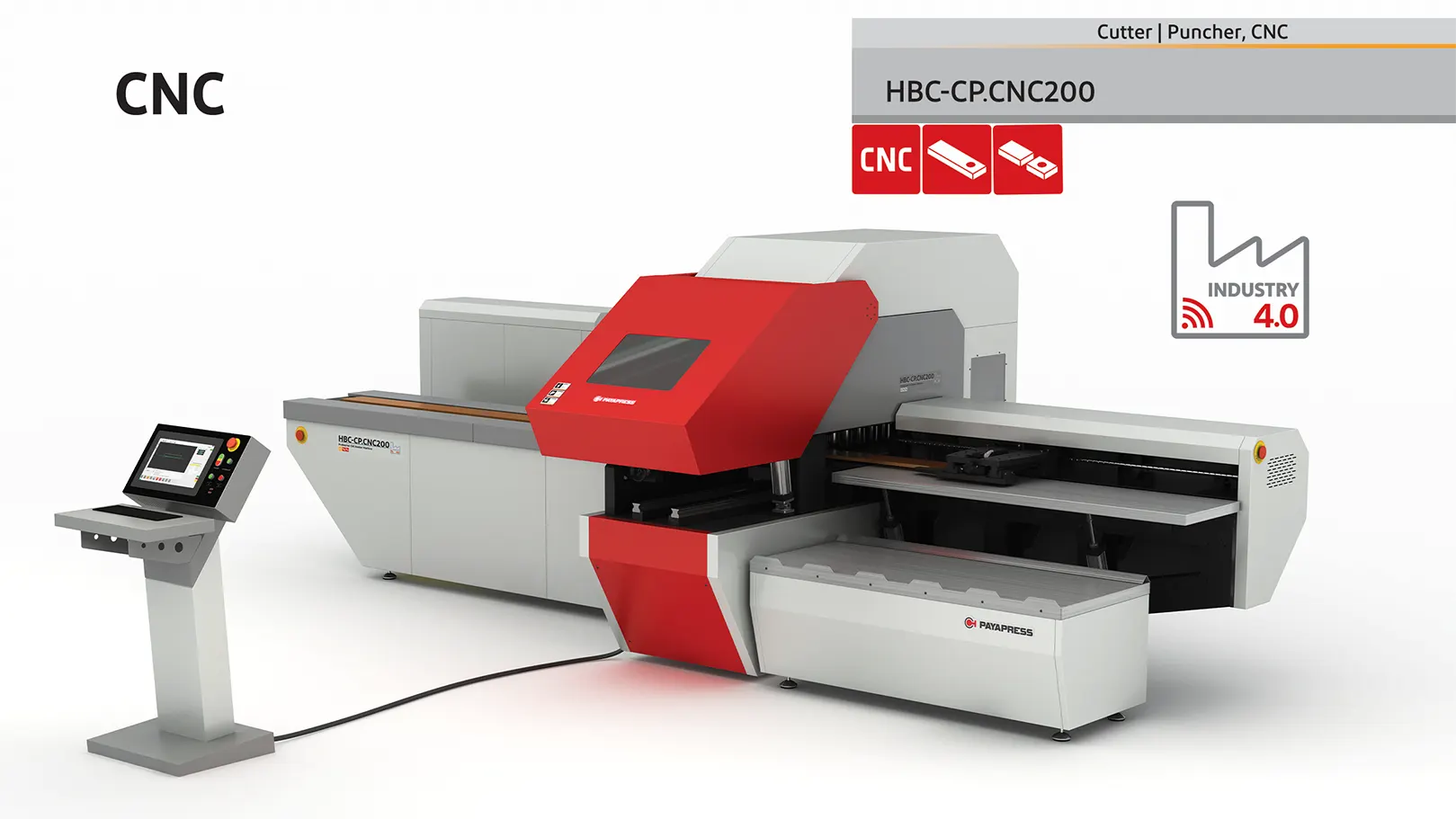
If you build electrical panels, LV switchgear, distribution boards or motor control centres, bending is the step where accuracy becomes visible. A bar that is two degrees off will still bolt down, but it puts stress on the joint and it shows in the final assembly. A dedicated busbar bender takes that risk out of the process: the same mold, the same stopper position and the same hydraulic pressure on every piece. For panel builders who already have cutting and punching covered — in-house or through a subcontractor — this is the machine that completes the line without the cost and the floor space of a 3-in-1 busbar processing machine.
Who Else Keeps a Busbar Bender Running Every Day
Panel building is the largest market for this range, but it is far from the only one. Anywhere copper or aluminium conductors carry serious current, someone has to bend them properly:
- Switchgear and MCC manufacturers — repeat production of identical bars, batch after batch.
- Transformer and substation builders — heavy sections, long bars, tight connection points.
- Busway and busduct producers — high volumes where a programmable stopper pays for itself quickly.
- Solar, storage and EV charging integrators — DC busbar work with short lead times.
- Data centre and industrial contractors — on-site modifications and replacement bars.
- Maintenance and repair workshops — one-off bars that have to match an existing installation exactly.
Every Bend Your Panel Needs, from One Forming Head
One forming head and five bend types cover the full range a panel builder actually needs, without changing machines for every shape. This is what makes the HBC-BE a true copper busbar angle bending machine rather than a single-angle press:
- Normal bend — the standard flat-face angle used on almost every panel connection.
- Edge bend — bending the bar on its narrow side, the hardest bend to get right by hand.
- V bend — sharp angular forming where the routing has to change direction quickly.
- Z bend (step bend) — two opposite bends that offset the bar onto a different plane.
- Twist bend — rotating the bar around its own axis to meet a connection at 90°.
Five optional molds are available for each machine, and special molds can be produced to a customer's drawing when a project needs a shape outside the standard set.
Busbar Bending Price: How to Get a Real Number
There is no single busbar bending price for this range, and any figure published without context would be misleading. The final cost depends on the frame size, on whether you choose the manual (EH) or the automatic (ES) control version, on the mold set your work actually requires, on your local voltage and frequency, and on shipping, installation and operator training. Two workshops buying the same model can end up with very different configurations.
So instead of a price list, we give you a real number for your own workshop. Use the Any Question? button below, tell us the bar sizes you run and how often you repeat the same job, and one of our engineers takes it from there — the right model, the right mold set, a firm price and the current lead time. It takes less than a minute to ask, and you are under no obligation to buy.
| Max busbar capacity | 120 × 12 mm |
|---|---|
| Total power | 1.7 kW |
| Operating pressure | 200 bar |
| Max forming radius | 12 mm |
| Max simultaneous operators | 1 |
| Control | Manual (EH) / Automatic (ES) |
| Functions | Bending |
| Max busbar capacity | 160 × 15 mm |
|---|---|
| Total power | 1.7 kW |
| Operating pressure | 200 bar |
| Max forming radius | 12 mm |
| Max simultaneous operators | 1 |
| Control | Manual (EH) / Automatic (ES) |
| Functions | Bending |
Wide range of busbar bending machines
In practice, the HBC-BE series fits well when you already have a cutting or punching machine in place and bending is the only step left to solve. It comes in three sizes:
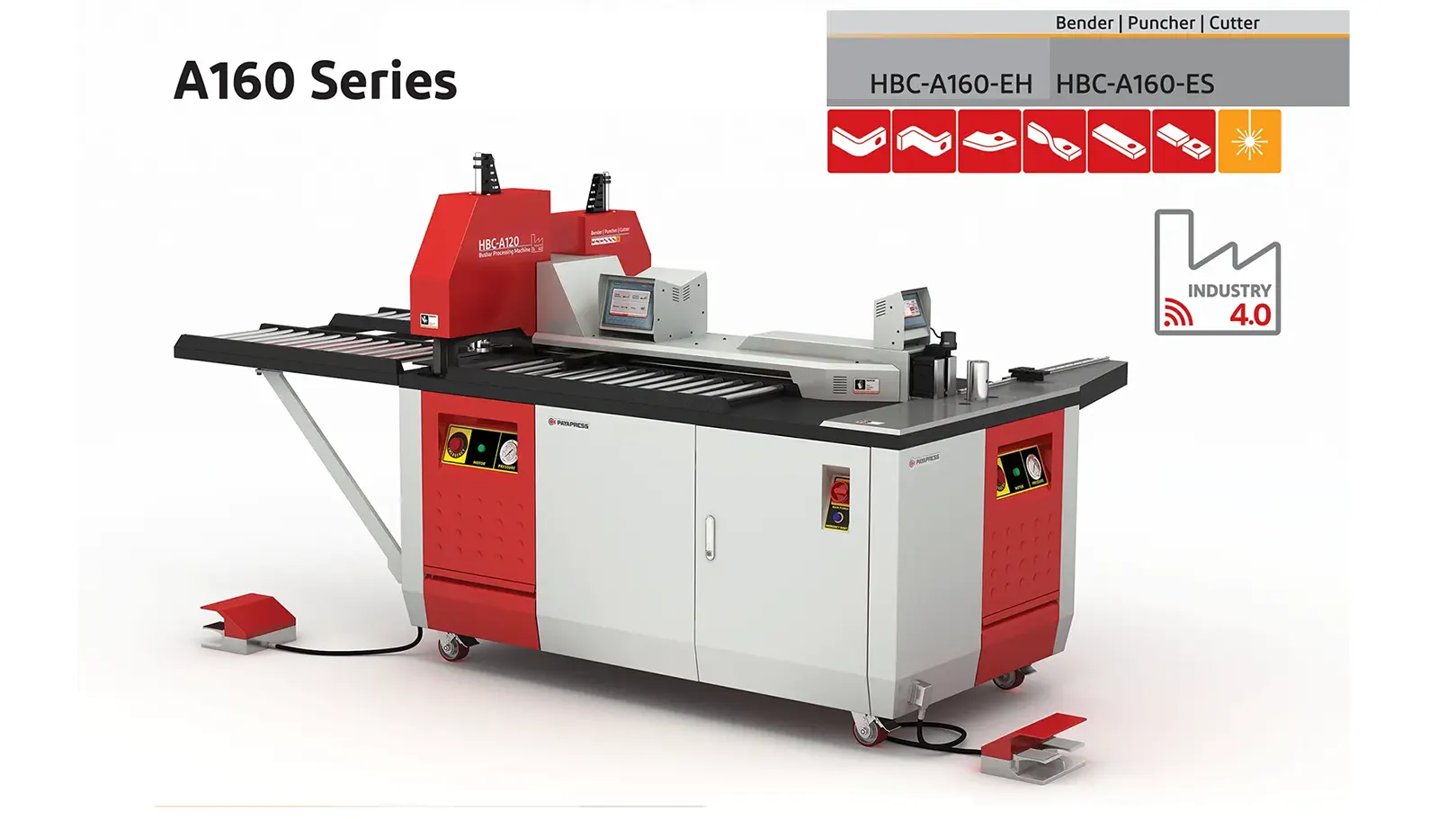
HBC-BE120
Bending of copper and aluminium busbars up to 120 × 12 mm
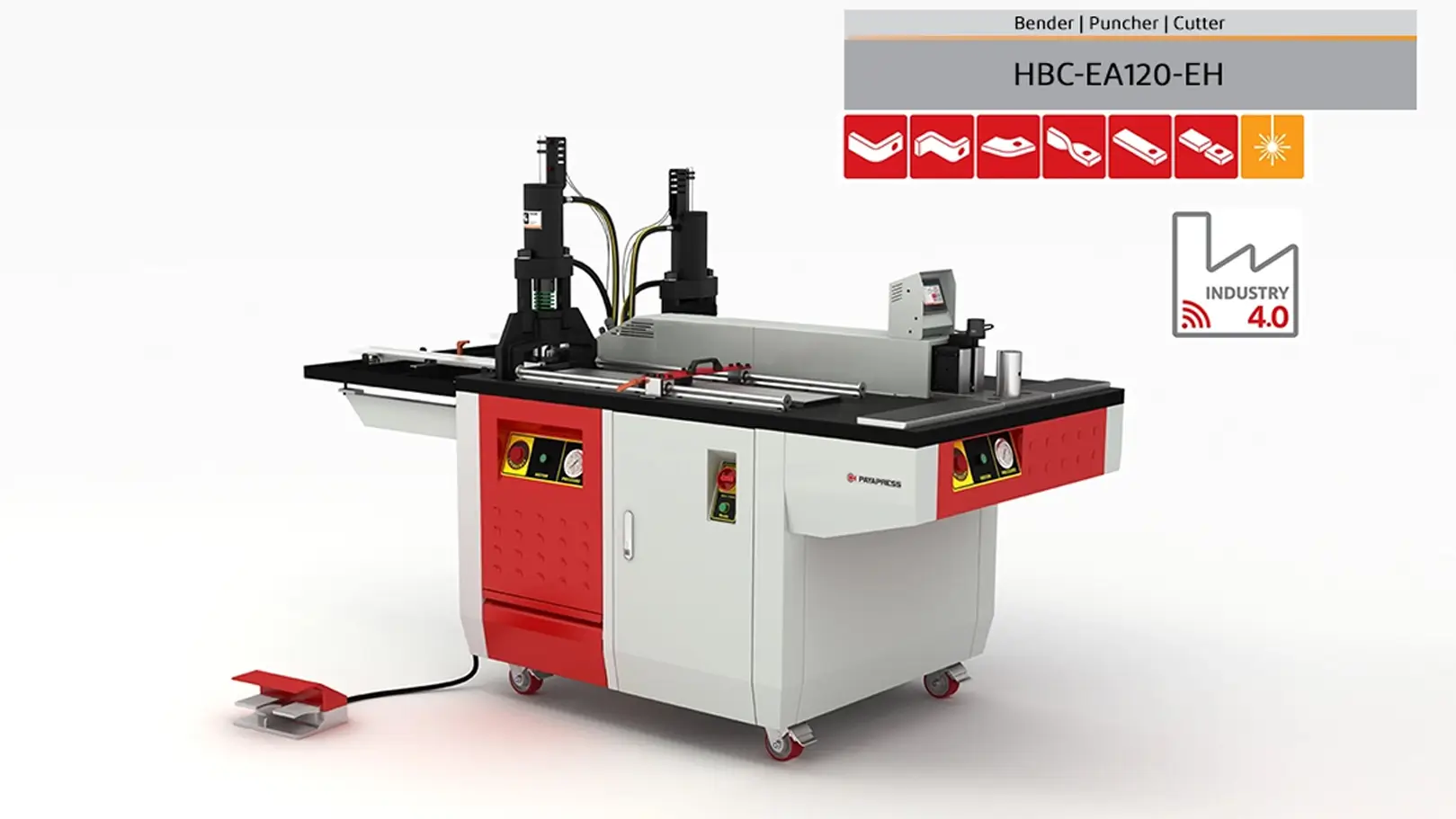
HBC-BE160
Bending of copper and aluminium busbars up to 160 × 15 mm
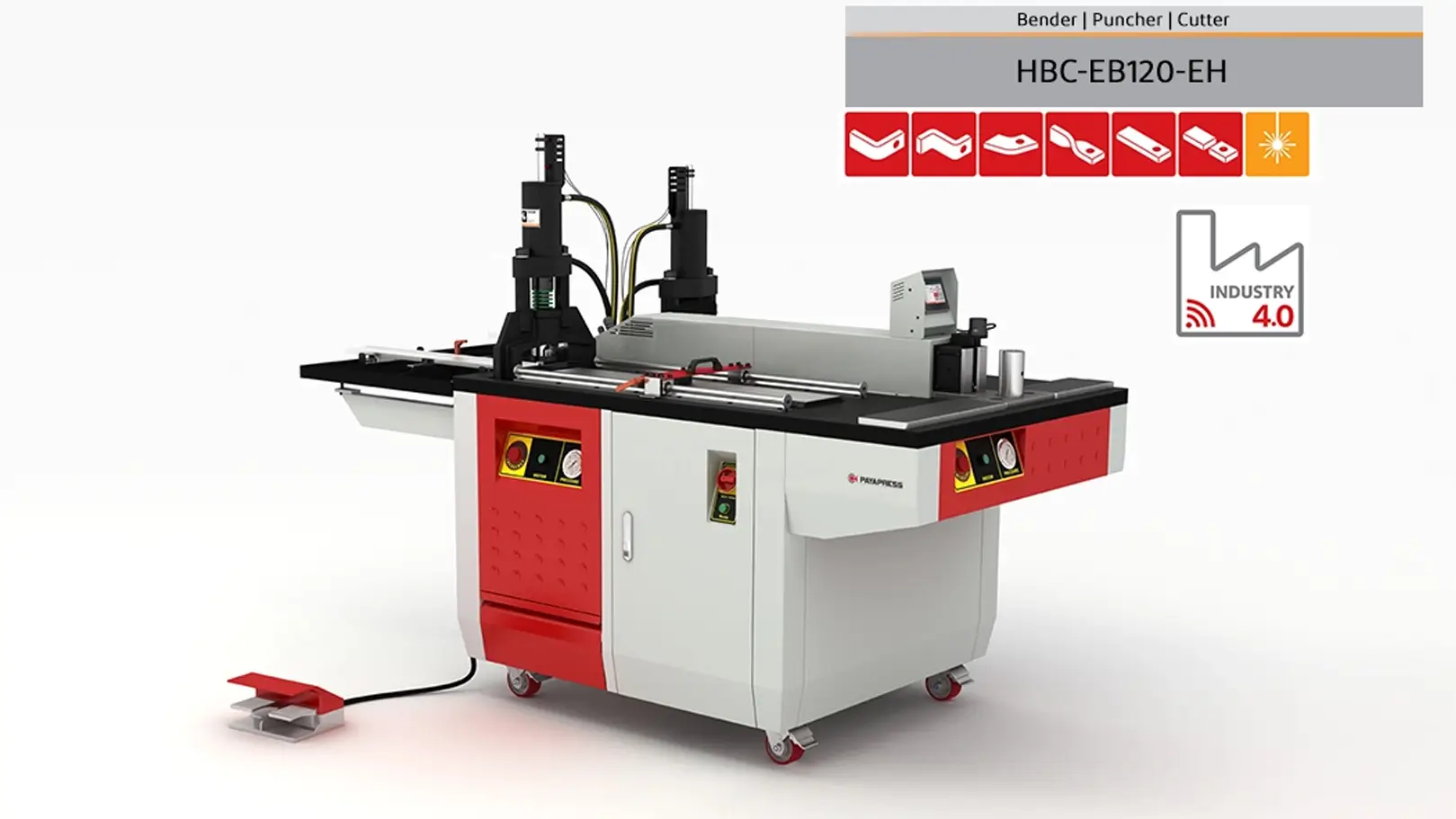
HBC-BE200
Bending of copper and aluminium busbars up to 200 × 20 mm
Global representative network
Where are our active representatives?
PAYAPRESS supports switchgear manufacturers across the GCC and beyond, with local representatives for sales, installation and service.
Europe
- Andorra
- Portugal
- Spain
- Turkey
- Ukraine
- Russia
Asia
- Japan
- Emirates
- China
- South Korea
South America
- Colombia
North America
- Canada
- United States
Oceania
- Australia
Need consultation?
Get a free technical quote
Get the right HBC busbar bending machine for your line — configured and priced. Just leave your email; we’ll handle the rest
- Free, no-obligation technical quote
- Model recommendation for your busbar sizes
- Your data is safe — no spam, ever
- Talk to an engineer, not a call centre
Free technical quote
Tell us about your line — email is all we need
"*" indicates required fields
FAQ
WHAT OUR CUSTOMERS ASK US MOST
What does a busbar bending machine do?
What is the difference between a busbar bender and a 3-in-1 busbar machine?
Which model do I need for my bar size?
Should I choose the manual (EH) or the automatic (ES) version?
Can these machines bend aluminium as well as copper?
What types of bends can the machine make?
Will the copper crack or mark during bending?
What power supply and how many operators does it need?
Related Products
Other Products