


For your convenience, if you prefer listening, you can listen to the rest of this article via the audio file below.
Why Safety Management Matters in Industrial Workshops
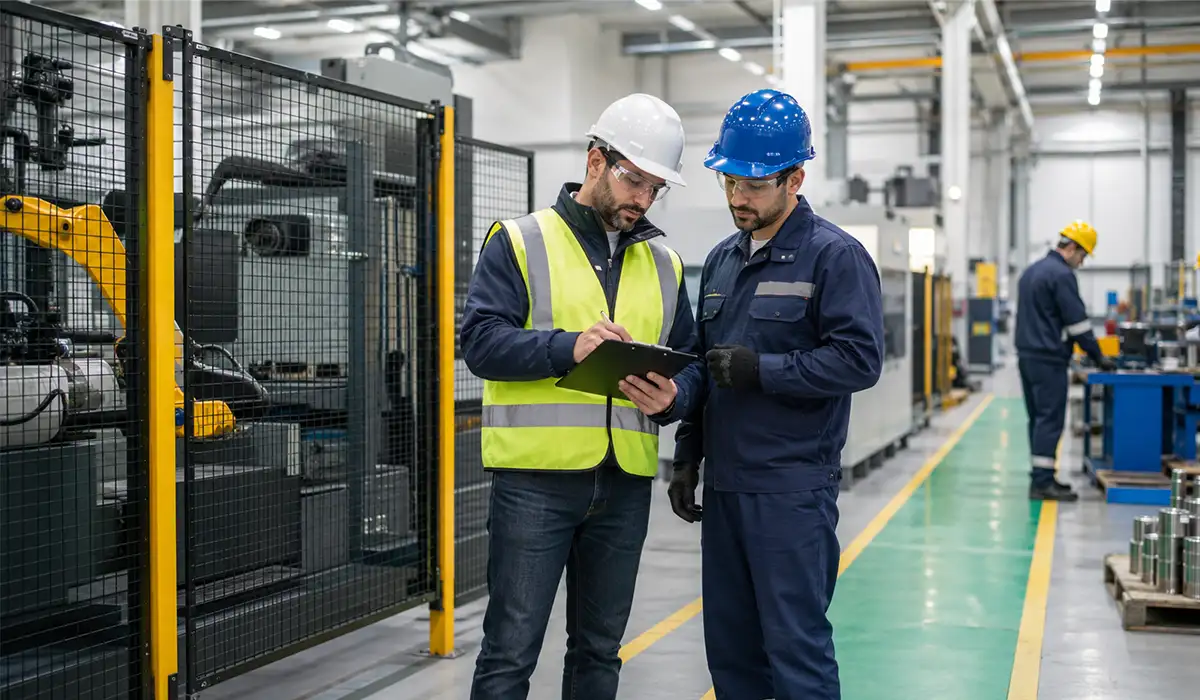
Why does Safety management in industrial workshops deserve management attention? Because one serious incident can injure workers, stop production, damage equipment, delay shipments, and weaken customer confidence.
The ILO reported in 2023 that nearly 3 million people die each year from work-related accidents and diseases, while 395 million workers sustain non-fatal work injuries. (International Labour Organization)
For industrial operators, safety is therefore legal, ethical, and operational. It influences insurance exposure, absenteeism, rework, maintenance cost, and the reliability of daily output.
Reactive correction starts after harm. Proactive manufacturing plant safety management identifies hazards before failure, which is the only sustainable way to control workshop risk.
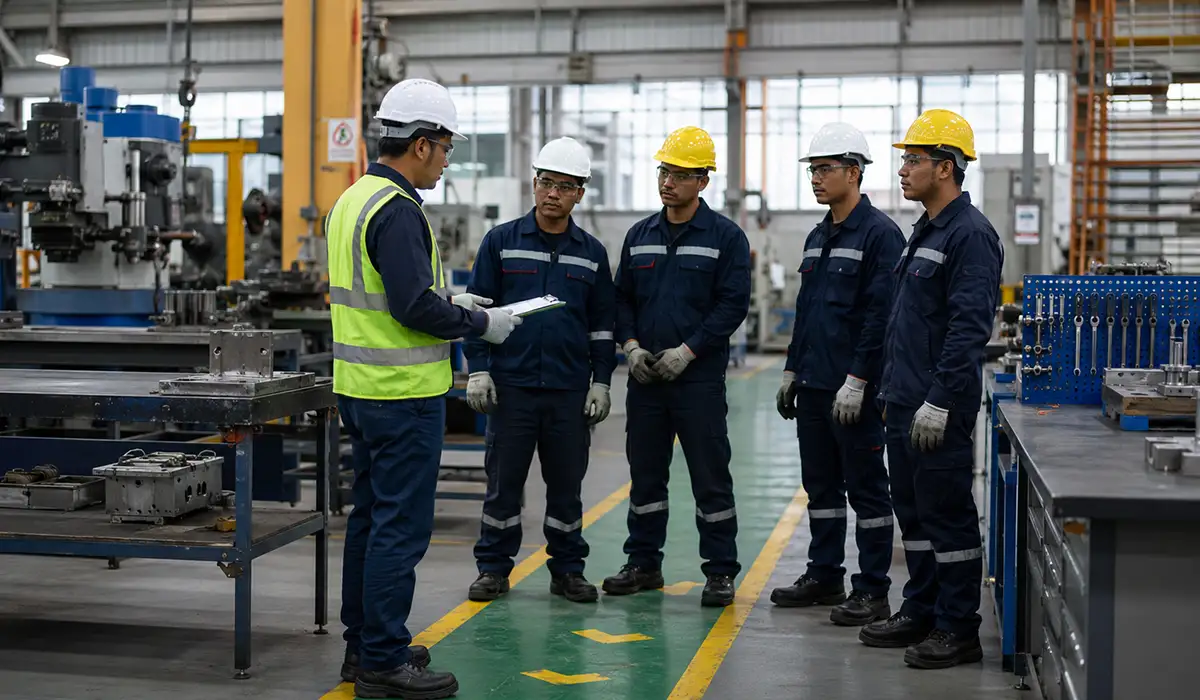
Key Elements of an Industrial Workshop Safety Management System
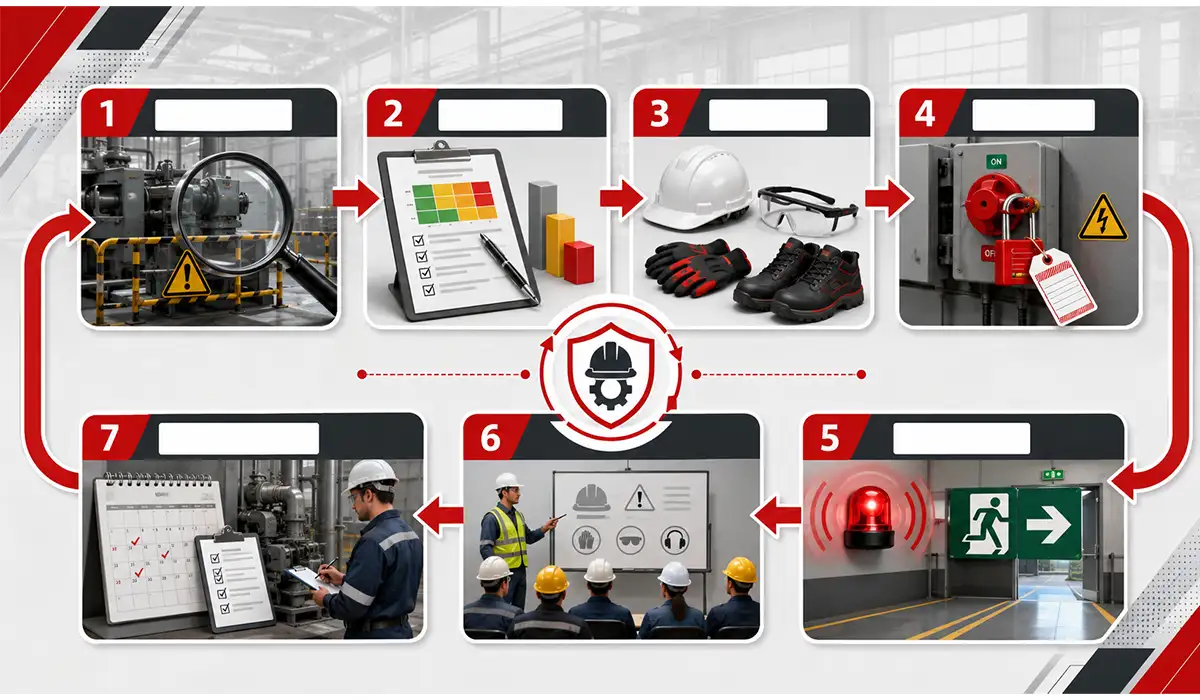
A workshop safety management system works only when it behaves like a management loop, not a shelf document. It sets responsibilities, risk criteria, reporting paths, and measurable objectives.
Policy and leadership commitment give the program authority. Hazard identification and risk assessment reveal exposure, while legal compliance converts regulations into workshop-specific controls.
Training and competency management ensure people can work safely. Incident reporting and investigation expose weak barriers, and corrective action closes gaps before repeat events occur.
The final element is continual improvement through Plan-Do-Check-Act. That cycle turns industrial safety procedures into living controls rather than forgotten documents.
The Role of ISO 45001 in Workshop Safety Governance
ISO 45001 occupational health and safety gives workshops a recognized framework for leadership, worker participation, risk control, legal compliance, and continual improvement. It replaced OHSAS 18001.
Certification is voluntary, but many international clients treat it as evidence of governance. ISO does not certify organizations; independent certification bodies audit the system and issue certificates.
Common Hazards Found in Industrial Workshops
If you ask what are the main hazards in industrial workshops, the answer is rarely one issue. Most shops combine mechanical, electrical, chemical, ergonomic, thermal, fire, noise, and vibration exposure.
Hazards also interact. Poor housekeeping can worsen slips, blocked access can slow evacuation, and weak machine guarding safety can turn a small jam into an amputation event.
Routine production and non-routine maintenance do not carry the same risk. Setup, cleaning, troubleshooting, and changeovers often create higher exposure than stable production runs.
The table below gives a scannable view of workplace hazard control in manufacturing by category, example, and likely consequence.
| Hazard Category | Examples | Potential Consequence |
|---|---|---|
| Mechanical | Unguarded machinery, rotating shafts, pinch points | Crush injuries, amputations, entanglement |
| Electrical | Exposed wiring, damaged cords, overloaded panels | Electric shock, arc event, fire |
| Chemical | Solvents, coolants, lubricants, welding fumes | Poisoning, dermatitis, respiratory disease |
| Ergonomic | Repetitive motion, awkward posture, manual lifting | Musculoskeletal disorders, fatigue |
| Thermal | Welding arcs, furnaces, hot surfaces, steam | Burns, heat stress |
| Fire & Explosion | Flammable liquids, sparks, dust clouds, gas leaks | Fatalities, blast damage, asset loss |
| Noise & Vibration | Power tools, presses, compressors, grinders | Hearing loss, HAVS, reduced concentration |
Risk Assessment Process for Industrial Workshops
To understand how to conduct a risk assessment in a manufacturing workshop, start with tasks, not assumptions. Review routine work, maintenance, cleaning, setup, lifting, contractor activity, and abnormal conditions.
Use the HSE model: identify hazards, decide who may be harmed, evaluate risks and precautions, record findings, and review controls. That structure keeps assessments practical and repeatable.
A risk matrix combines likelihood and severity. It does not replace judgment, but it helps supervisors rank action so fatal or irreversible outcomes are addressed first.
Assessments should change when layout, tooling, materials, staffing, or production rates change. A valid review is dynamic, not annual paperwork completed on autopilot.
Simple 3×3 Risk Matrix
| Severity / Likelihood | Low | Medium | High |
|---|---|---|---|
| Minor injury / limited loss | Low | Low | Medium |
| Recordable injury / short outage | Low | Medium | High |
| Major injury / fatality / major loss | Medium | High | Critical |
Hierarchy of Hazard Controls in Workshop Environments
Apply the control hierarchy from top to bottom. Elimination removes the hazard, substitution uses a safer option, and engineering controls isolate exposure through guards, interlocks, barriers, or ventilation. (CDC)
Workshop examples include removing manual deburring, replacing a high-VOC solvent, adding fixed guards, using permit-to-work rules, and requiring face shields. Engineering controls outperform PPE because they reduce exposure at the source.
Personal Protective Equipment (PPE) Requirements in Industrial Workshops
The importance of PPE in industrial workshop safety is real, but PPE sits at the bottom of the control hierarchy. It supports guarding, ventilation, and procedures; it cannot replace them.
Selection should follow task-based hazard assessment, correct sizing, compatibility, and training. Eye protection that fogs, gloves that reduce dexterity, or hearing protection with poor fit quickly fail in practice.
Common compliance failures include damaged PPE, informal substitutions, poor storage, skipped fit checks, and weak supervision during short or non-routine tasks.
For occupational health and safety in workshops, the right PPE program includes issue, inspection, replacement, refresher training, and enforcement that stays consistent across shifts.
| PPE Type | Application | Relevant Standard |
|---|---|---|
| Hard Hat | Overhead hazard zones, suspended loads | ANSI Z89.1 |
| Safety Glasses / Goggles | Machining, grinding, cutting, welding support tasks | ANSI Z87.1 |
| Hearing Protection | Areas above 85 dB, high-noise machine rooms | OSHA 29 CFR 1910.95 |
| Gloves | Sharp material handling, chemical contact, hot parts | EN 388 / EN 374 |
| Safety Footwear | Heavy equipment zones, material handling aisles | ASTM F2413 |
| Respiratory Protection | Dust, fumes, mists, chemical vapors | NIOSH 42 CFR Part 84 |
| High-Visibility Vest | Forklift lanes, loading zones, vehicle interaction | ANSI/ISEA 107 |
Lockout/Tagout (LOTO) Procedures in Workshop Safety
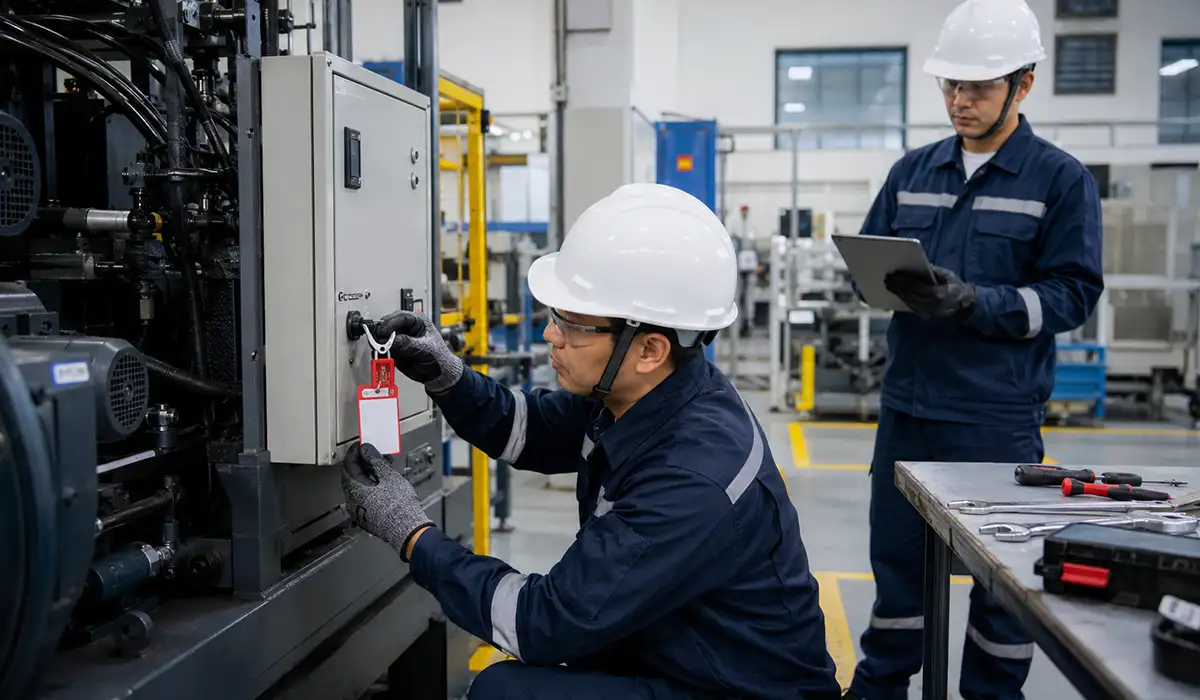
A lockout tagout procedure isolates hazardous energy before servicing, cleaning, troubleshooting, or maintenance. Without it, a worker can face unexpected startup, stored energy release, crushing, shock, or amputation.
A typical sequence is shutdown, isolation, lockout, tagout, release of stored energy, verification of zero-energy state, task completion, and controlled return to service by authorized personnel.
Effective LOTO must cover electrical, mechanical, hydraulic, pneumatic, thermal, and chemical energy. Group lockout, contractor coordination, and shift change control are especially important in larger workshops.
OSHA continues to list lockout/tagout among its most frequently cited standards, which shows how often facilities still rely on habit rather than verified isolation. (osha.gov)
Emergency Preparedness and Response Planning
The steps to create an emergency evacuation plan for workshops should start with realistic scenarios: fire, electrical fault, chemical spill, medical emergency, gas release, or catastrophic machine failure.
A sound emergency response plan workshop must define reporting methods, evacuation routes, assembly points, accountable supervisors, first aid stations, trained first aiders, and emergency shutdown procedures for machinery.
It also needs chemical spill response, isolation of utilities, communication systems, alarm testing schedules, and clear instructions for visitors, contractors, and workers on night or weekend shifts.
Plans fail when they are written once and never drilled. Fire safety in manufacturing plant environments depends on rehearsed movement, clear exits, functioning alarms, and supervisors who can make fast decisions under pressure.
Safety Training and Building a Safety Culture
Best practices for workshop safety management systems depend on behavior as much as documentation. Rules matter, but worker decisions on the shop floor decide whether controls are actually followed.
Every new employee needs induction on hazards, emergency rules, PPE, reporting lines, and task authorization. After that, toolbox talk industrial safety sessions should refresh attention around current tasks and recent incidents.
A strong near miss reporting system is blame-free and fast. It treats weak signals as free lessons, not as reasons to punish the person who reported them.
The Campbell Institute emphasizes leadership accountability and worker empowerment. In practice, that means visible supervisors, consistent coaching, recognition of safe behavior, and a real safety culture in industry. (thecampbellinstitute.org)
Safety Inspection and Audit Schedules for Industrial Workshops
Safety management in industrial workshops stays credible only when supervisors inspect what the written program claims to control. A rule with no field verification is an assumption, not a control.
Inspections and audits are related, but not identical. Daily checks find visible defects fast, while formal audits test whether the broader system is implemented, documented, and improving.
Good schedules balance frequency with consequence. High-exposure equipment needs closer attention than low-risk storage areas, and findings should trigger owners, deadlines, and verification of closure.
This cadence strengthens safety compliance in industrial facilities by making performance visible. Daily checks are immediate and operational; annual audits are broader, slower, and evidence-driven.
| Inspection Type | Frequency | Responsible Party |
|---|---|---|
| Daily walkthrough / visual check | Daily | Shift supervisor |
| Machine and equipment inspection | Weekly | Maintenance team |
| PPE condition check | Monthly | Safety officer |
| Fire extinguisher and alarm test | Monthly | HSE coordinator |
| Full internal safety audit | Quarterly | Safety manager |
| Third-party / compliance audit | Annually | Certified auditor |
Conclusion: Building Safer, More Reliable Industrial Workshops
Safety management in industrial workshops is not only about preventing accidents; it is about protecting people, equipment, production continuity, and long-term business reliability. A strong workshop safety management system connects hazard identification, risk assessment, PPE control, lockout/tagout, emergency planning, training, inspections, and continual improvement into one practical operating discipline.
The most effective safety programs are proactive, not reactive. They identify weak points before an incident occurs, assign clear responsibilities, and verify that safety procedures are actually followed on the shop floor. By combining leadership commitment, worker participation, ISO 45001 principles, and regular inspection routines, industrial workshops can reduce risk, improve compliance, and create a safer environment for every worker
FAQ about safety management


Rate this article
Choose a rating from 1 to 5 stars.
No ratings yet