



If you think reading this article takes too much of your time, you can listen to the podcast below instead.
Why Small Workshops Pay Twice When They Buy the Wrong Busbar Machine
Two opposite mistakes dominate small-workshop regret around the busbar machine price for small switchgear workshops. Small workshop busbar fabrication has a narrow economic window, and missing it in either direction hurts. The first is buying too cheap. Entry-level manual or basic semi-automatic machines with ±1.5–2° bend tolerance cannot reliably meet switchgear phase clearance requirements; inspection failure rate climbs, accuracy varies operator-to-operator and shift-to-shift, and tooling on under-engineered platforms wears faster than expected. Low purchase price is followed by high cost of ownership, and the affordable busbar machine bought on the basis of headline number alone is the single most common regret reported by small switchgear workshop buyers.
The opposite mistake is buying too expensive. A full three-function CNC platform priced at $80,000–$150,000 is designed for continuous high-volume production. A workshop running 50–150 busbar sets per month will never hit the throughput needed to recover that investment inside a sensible timeframe. Overcapacity ties up cash, blocks other equipment or staffing investments, and creates training overhead the team did not need.
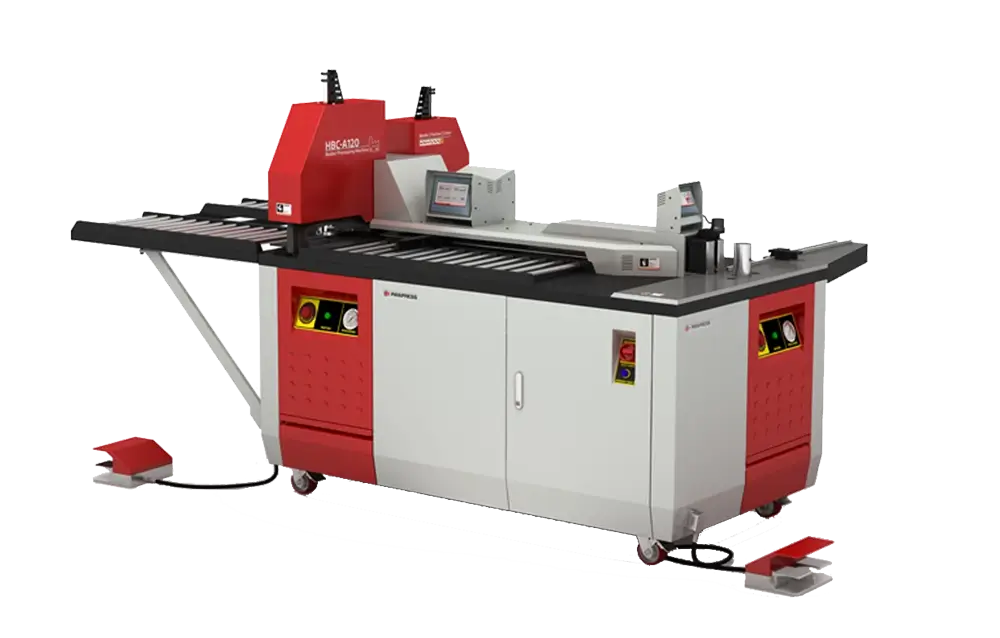
From the context of CNC busbar machines, you can visit one of the best machines that also comes at a competitive price.
| Mistake | Consequence | Financial Impact |
|---|---|---|
| Underbuy (too cheap) | Rework, inspection failure | Margin erosion per panel |
| Underbuy (too cheap) | Operator-dependent accuracy | Inconsistent quality |
| Overbuy (too expensive) | Idle machine capacity | Poor ROI, cash flow pressure |
| Overbuy (too expensive) | Complexity beyond team skill level | Training cost, underutilisation |
For the latest available details about Industry association guidance on equipment selection for switchgear and panel fabrication shops, check the official page directly.
What Specifications Matter Most at Small-Workshop Production Volumes
Calibrate every specification against a realistic small switchgear workshop scenario: 30–200 busbar sets per month, LV through low-end MV, copper in standard cross-sections.
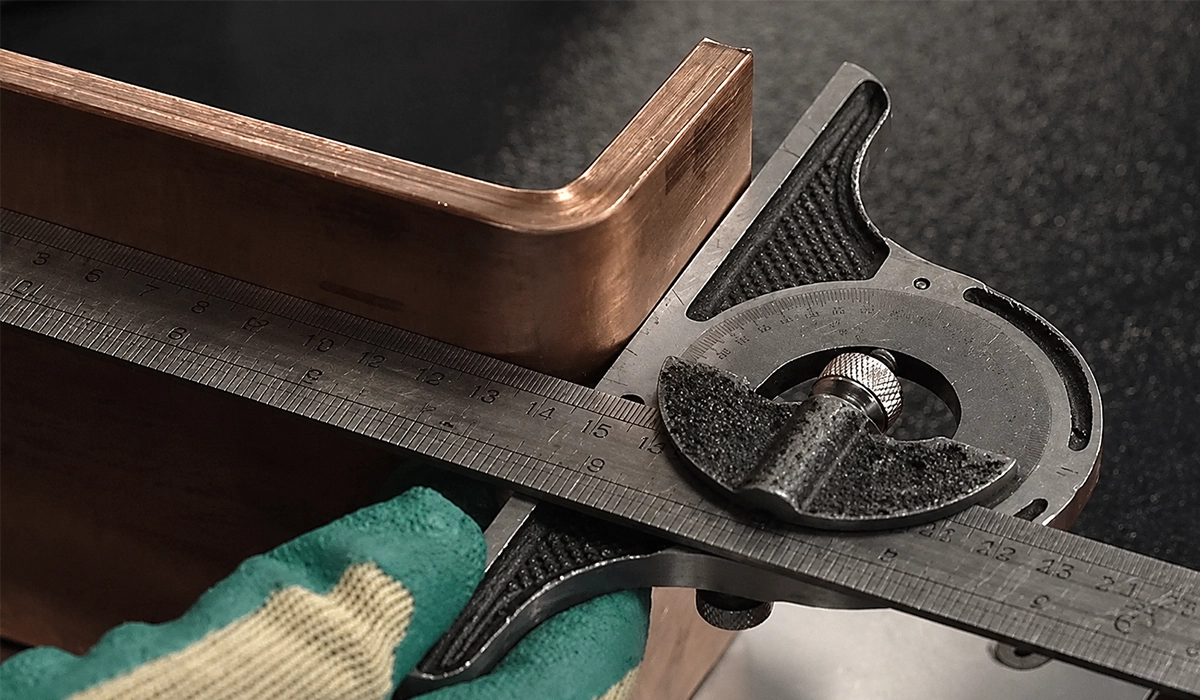
Bend angle accuracy. The non-negotiable minimum for switchgear-grade work is ±0.5° as a production-run average — not a single-sample demonstration. For LV panel shops working below 1 kV, ±1° may be acceptable depending on enclosure design and clearance margins. Small workshops often accept ±1–2° machines on the assumption the error is tolerable in service. It is not in certified switchgear assembly.
Punching force and cross-section capacity. A compact busbar machine switchgear shop rarely needs more than 600 kN. Most LV and low-MV busbars fall inside 80×10 mm copper or 100×10 mm aluminium. Buying 1,000 kN to run 60×6 mm copper is paying for force that will never be used. Confirm continuous duty rating at the workshop’s typical cross-section, not peak single-cycle force.
Cut quality. Burr-free cutting is non-negotiable wherever heat-shrink insulation is applied. Any burr creates a void under the sleeve and becomes a dielectric failure point. Burr height ≤0.1 mm is the practical standard for insulation-grade work; demand the figure in writing.
Three-function integration vs. standalone bender. For a shop running combined punch/cut/bend sequences on the same busbar, a three-function platform eliminates repositioning error between operations. This is exactly where small workshops get disproportionate quality benefit relative to cost. A standalone bender only makes sense if existing punching and cutting capacity is already reliable.
Footprint and power supply. Small workshops have real space and electrical limits. Confirm footprint (m²) and supply requirement (single-phase vs three-phase, kVA) before shortlisting. Some mid-range machines need three-phase 32A or higher.
Software complexity. Without a dedicated CNC programmer, look for intuitive on-screen programming, clear operator interface, and DXF import that any trained operator can use. Machines that require vendor training every time a new operator joins are a poor fit for low-headcount shops.
Common spec mistakes. Comparing peak punching force without continuous duty rating, accepting bend angle tolerance as a single-demo figure, ignoring footprint until delivery day, and assuming power supply will accommodate whatever arrives.
For readers who want more technical depth about Authoritative reference on copper busbar fabrication tolerances applicable to LV and low-MV switchgear production, this reference page is a useful starting point.
If you are looking for more information about Industrial Copper Processing, it is recommended not to miss reading this article.
Busbar Machine Price Tiers — What Small Workshops Actually Get at Each Budget
The current busbar machine price ranges below are market estimates — verify against quotations as pricing shifts with currency, tariffs, and supply chain conditions. Total busbar processing machine cost over 24–36 months matters more than headline purchase price.
The entry tier runs roughly $18,000–$30,000 USD: manual or basic semi-automatic operation, ±1.5–2° operator-dependent angle accuracy. As a busbar machine for panel builders running occasional work, it covers the basics — LV panel shops, maintenance workshops, and occasional busbar work below 400V. It does not suit certified switchgear assembly, MV busbars, or any production volume needing consistent repeatability. TCO risk is high — tooling wear, rework labour, and inspection failures eat the initial price saving inside 18–24 months in most shops.
The mid-range tier sits at $30,000–$65,000 USD: semi-automatic CNC through full CNC with angle feedback, ±0.5–0.8° production accuracy. It suits small switchgear workshops, LV and low-MV panel fabrication, and copper and aluminium across standard cross-sections. This is the correct tier for most small switchgear workshops — precision meets production volume without paying for capacity that sits idle. A CNC busbar machine small workshop owners actually grow into is the goal here. The mid-range entry-level busbar machine is also a logical first step for shops planning to grow into higher production over three to five years.
If you are looking to find the best price for busbar bending machines, I recommend not missing this article about busbar bending machine price.
The premium tier runs $65,000–$150,000+ USD: full CNC, closed-loop feedback, multi-function integration, ±0.3° in production. It belongs in medium-to-large switchgear manufacturers, busbar duct production, and high-volume type-tested assembly lines. For shops running under 200 sets per month, ROI extends beyond five years.
| Tier | Price Range (USD) | Bend Accuracy | Right For |
|---|---|---|---|
| Entry | $18,000–$30,000 | ±1.5–2° | LV maintenance, occasional work |
| Mid-range | $30,000–$65,000 | ±0.5–0.8° | Small switchgear workshops |
| Premium | $65,000–$150,000+ | ±0.3° | High-volume, MV, busbar duct |
For a clearer comparison about Industry association reference for calibrating capital equipment budget expectations, you can review the information provided on this website.
Busbar Machine Manufacturers for Small Switchgear Workshops — A Neutral Comparison
The summaries below are equal-depth profiles intended for shortlisting only, listed alphabetically to avoid implying any ranking. A serious busbar machine comparison price exercise requires direct quotations and demonstrations — these summaries are a starting framework.
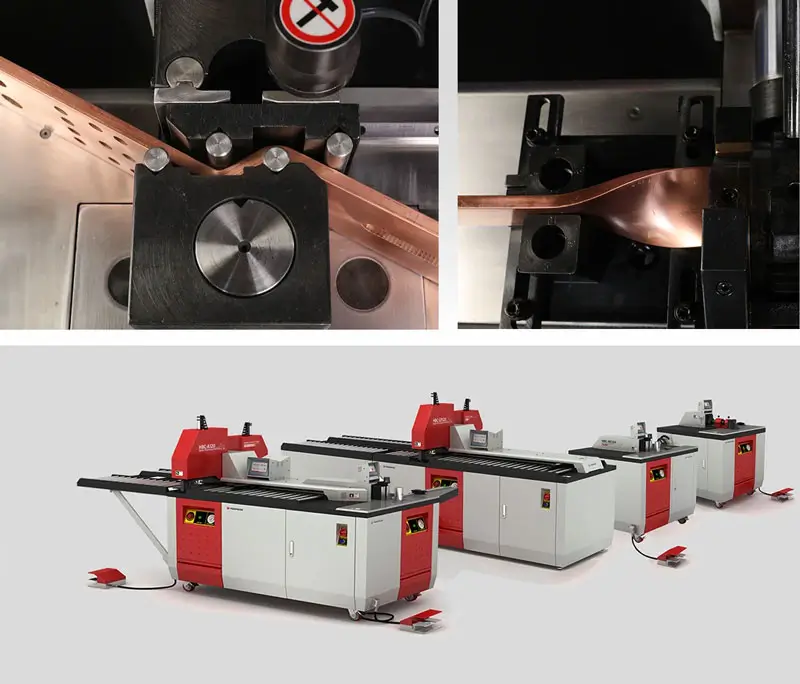
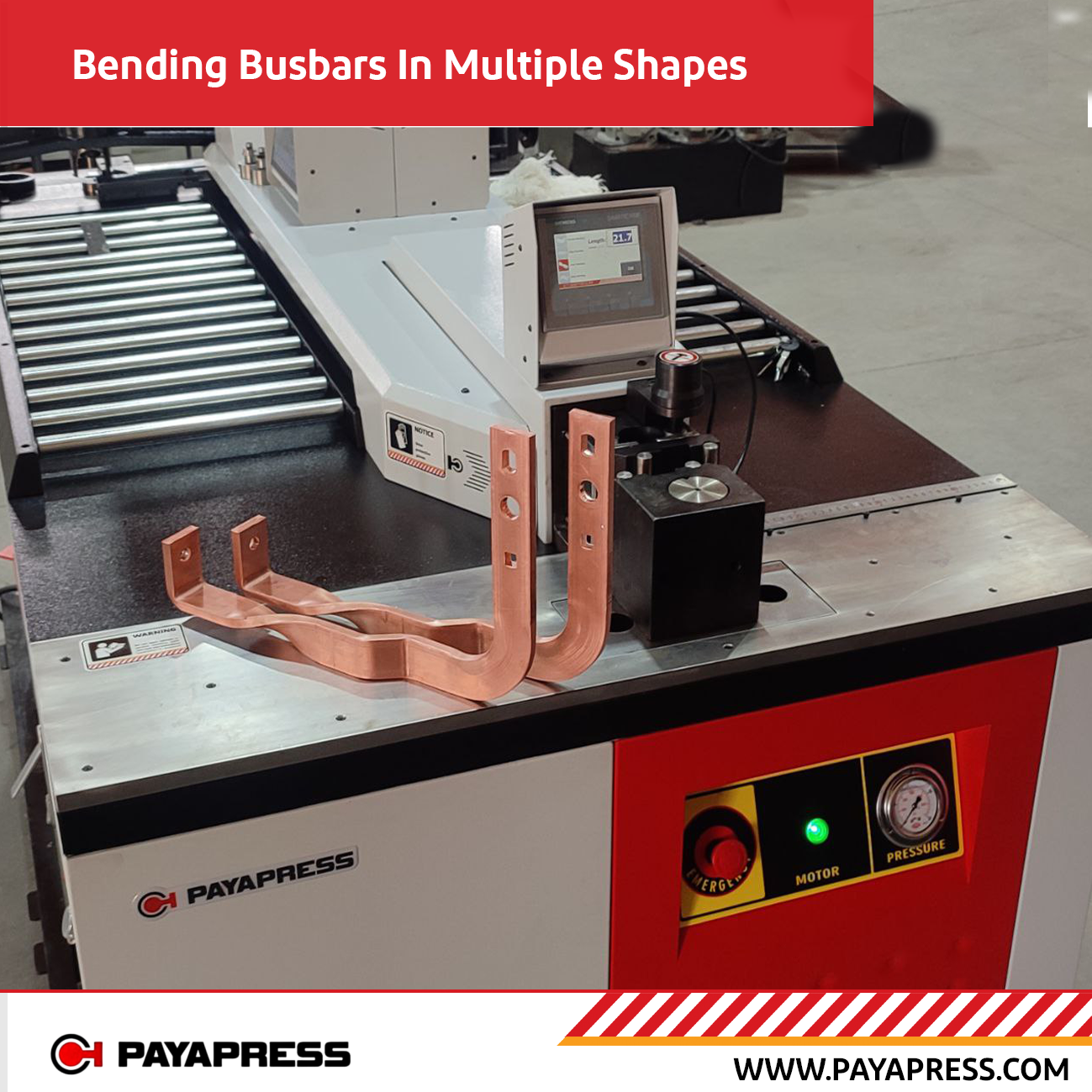
PAYAPRESS (International). PAYAPRESS manufactures CNC busbar fabrication machines including combined punch/cut/bend platforms for switchgear and panel fabrication, with models relevant to small workshop production volumes. Specification details — bend angle tolerance, cross-section capacity, and regional distribution — should be confirmed directly with PAYAPRESS before purchase.
Another useful point worth mentioning is that PAYAPRESS manufactures excellent economy-priced machines specifically designed for small workshops. For more information, you can visit this page on their economic busbar machine.
Geka (Spain). Geka manufactures busbar and ironworker fabrication equipment with semi-automatic and CNC busbar-specific options across entry to mid-range price tiers. Relevant for small workshops seeking a lower-cost entry with established brand history. Evaluate CNC angle feedback capability and regional service coverage directly before shortlisting.
MBI (Italy). MBI produces a range of busbar fabrication machines including entry and mid-range CNC models relevant to small workshop budgets, with three-function (punch/cut/bend) platforms covering standard LV and MV cross-sections. Widely distributed internationally. Confirm current regional distributor, spare parts lead times, and after-sales coverage before purchase.
SOCO (Taiwan). SOCO offers CNC busbar processing machines at competitive price points with broad international distribution. Combined punch/cut/bend platforms sit in the mid-range tier relevant to small workshop buyers. Price-to-specification ratio is a noted characteristic. Verify dimensional accuracy documentation and regional spare parts availability independently before purchase.
Real-World Cost Comparison — Busbar Machine Investment vs. Rework Cost for a Small Workshop
The figures below are a clearly labelled hypothetical illustration — replace with verified production data before publishing. Scenario: a small switchgear workshop running 80 busbar sets per month in Cu-ETP at 50×5 mm to 80×8 mm, on LV switchgear panels. Labour rate assumed at $40/hr.
| Metric (hypothetical) | Entry Machine | Mid-Range CNC |
|---|---|---|
| Machine purchase price (USD) | $22,000 | $90,000 |
| Avg. rework rate at inspection | 22% | 5% |
| Monthly rework labour cost (USD) | $2,640 | $600 |
| Annual rework cost (USD) | $31,680 | $7,200 |
| Rework cost over 24 months | $63,360 | $14,400 |
| Total 24-month cost of ownership | $75,360 | $46,400 |
Net saving with the mid-range CNC over 24 months runs around $28,960 in this hypothetical scenario. The pattern matters more than the precise figures — a typical busbar machine ROI panel shop calculation pivots on rework reduction, not headline price, and the break-even almost always favours the mid-range tier for shops above 40 sets per month.
This website provides a helpful external reference for readers who want to go beyond the summary about Peer-reviewed research library on capital equipment cost-of-ownership in industrial fabrication.
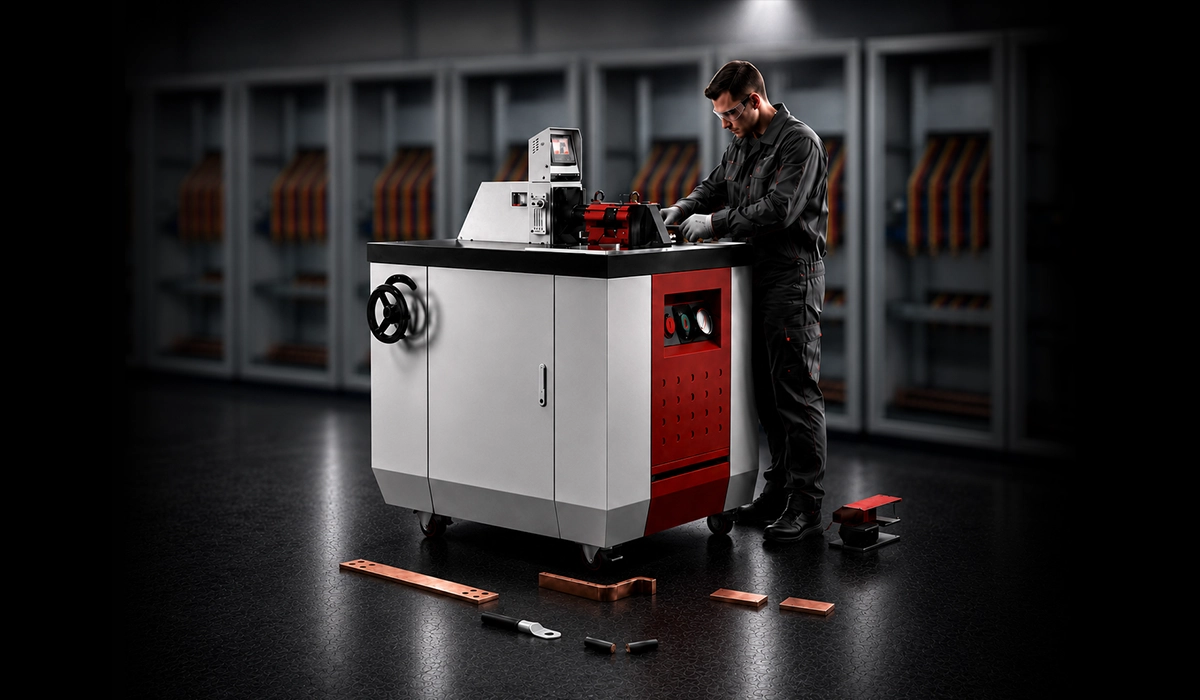
Buying Process — How a Small Switchgear Workshop Should Evaluate and Purchase a Busbar Machine
Sequenced correctly, the busbar machine price for small switchgear workshops becomes a calculable decision rather than a leap of faith. A clean procurement sequence sized for low-volume busbar fabrication equipment buyers — without a dedicated procurement team — runs as follows. First, define the production baseline before contacting any supplier: maximum cross-section (width × thickness in mm), material type (copper, aluminium, or both), estimated monthly busbar sets, and voltage range (LV or MV). Second, set the non-negotiable minimum bend angle accuracy at ±0.5° for switchgear work and use it as the first filter, before price. Third, confirm available floor space and electrical supply (single-phase or three-phase, maximum kVA) and eliminate any machine that does not fit before evaluating specs. Fourth, request written technical specification sheets from at least three suppliers — not website specs and not verbal sales claims. Fifth, ask each shortlisted supplier for a live demonstration on the buyer’s own material, bringing a sample busbar to the demo. Sixth, request a total cost of ownership breakdown: tooling set price, tooling replacement interval, service call rate, and spare parts lead time on the top five consumables. Seventh, confirm after-sales support in writing — service technician location and response time, spare parts availability, and commissioning included in the purchase. Eighth, compare shortlisted options on total 24-month cost using the ROI framework above, not purchase price alone.
Conclusion about Busbar Machine Price for Small Switchgear Workshops
The right busbar machine price for small switchgear workshops is not the lowest price. It is the price at which documented precision and realistic production capacity intersect. For most shops, that intersection sits in the mid-range CNC tier — $25,000–$85,000 — delivering precision that entry-level machines cannot match and avoiding the idle capacity cost that makes premium platforms uneconomic at low volumes. Evaluate on documented bend angle accuracy across a production run, not on purchase price or brand alone. Request specification sheets and live demonstrations from Geka, MBI, PAYAPRESS, and SOCO, and compare on total 24-month ownership cost before deciding.

Rate this article
Choose a rating from 1 to 5 stars.
No ratings yet