


Alternatively, an audio version of this article is available below for your convenience.
A UL 891 switchboard is where a building’s incoming power gets divided, protected, metered and sent to every feeder downstream. It is also where a vague specification causes the most expensive failures: a board that “meets UL 891” on a brochure but carries no listing mark, or a fault rating below what the utility can deliver. In this UL 891 switchboard guide, I explain what the standard actually covers in its current edition and where to read it legitimately. I also cover how dead-front construction and listing work, which NEC Article 408 rules inspectors check, and what North Carolina adds. The guide closes with the exact lines your RFQ needs so the gear that arrives is the gear you approved.
What Is a UL 891 Switchboard? The Industrial Power Hub, Defined
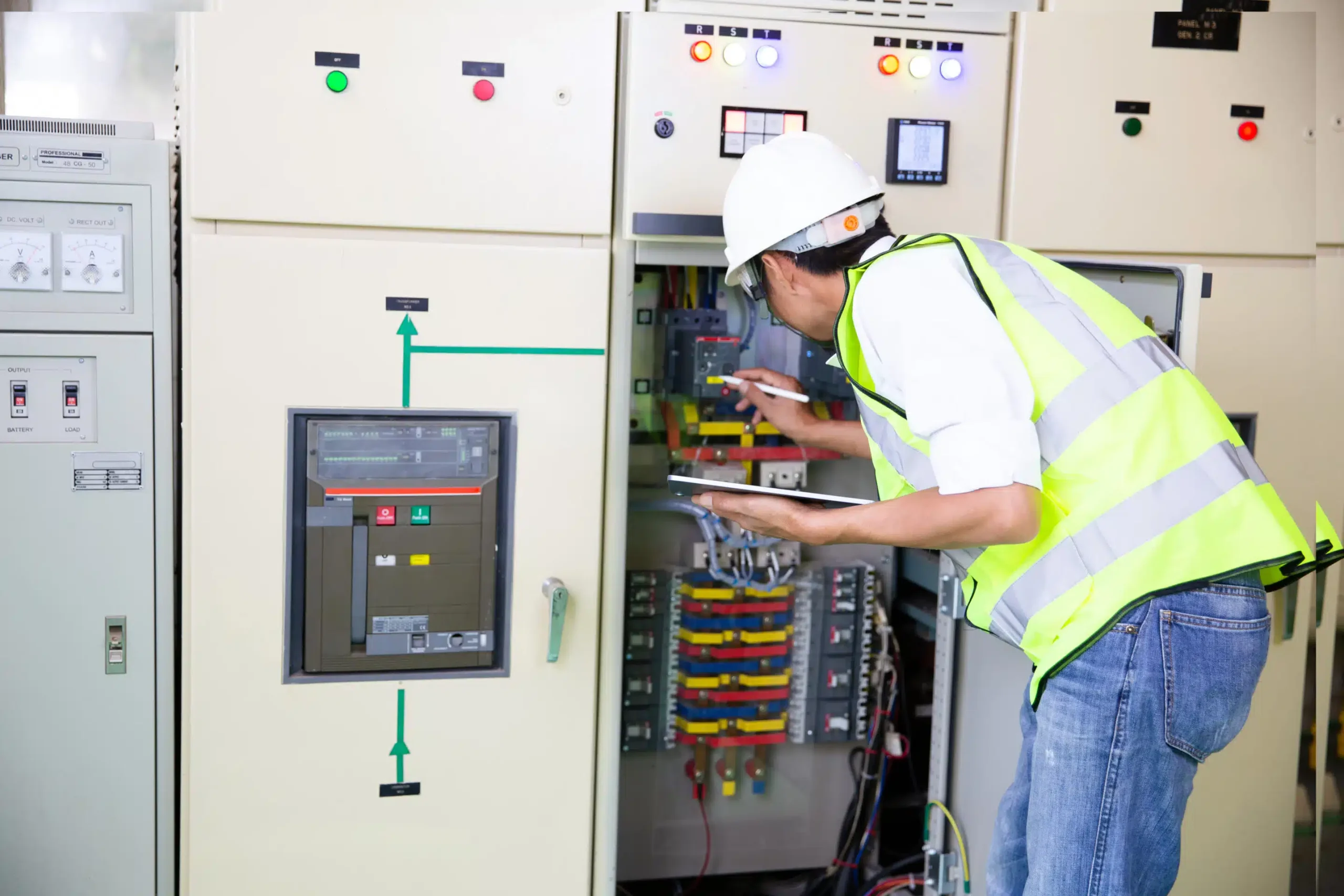
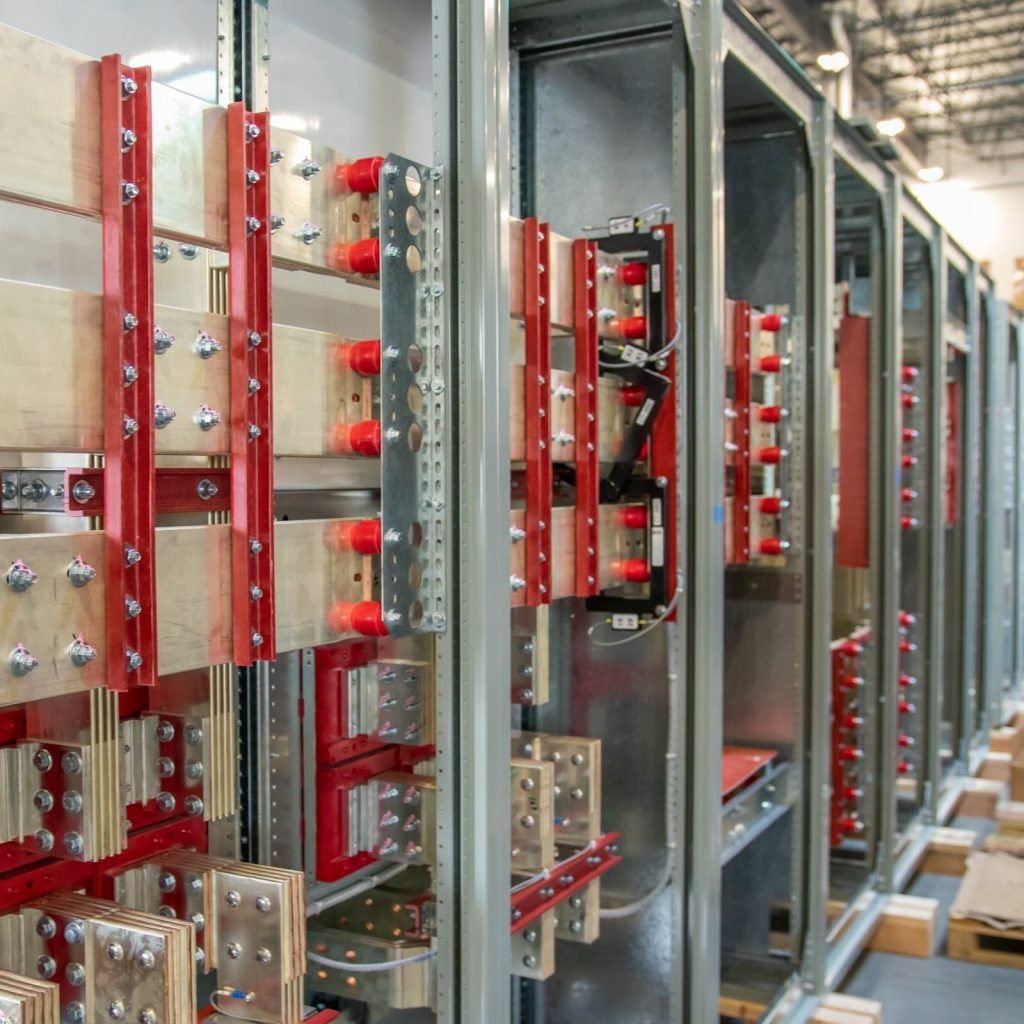
A UL 891 switchboard is a floor-standing, low-voltage distribution assembly. It takes one or more incoming feeds and distributes power to multiple feeder and branch circuits through busbars and overcurrent devices. A typical lineup includes:
- a steel structure with a main section (main breaker or main lugs)
- horizontal and vertical bus in copper or aluminum
- utility or customer metering, surge protection, and a feeder section built from molded-case, insulated-case or fusible devices
What makes it a UL 891 switchboard is not its appearance. The assembly has been evaluated to UL 891 and carries a listing mark from the testing laboratory that certified it.
Switchboards sit between panelboards and switchgear. They handle higher currents and larger devices than wall-mounted panelboards, with bolted bus connections and front or rear access for maintenance, but without the compartmentalized, draw-out construction of switchgear. That is why they are the default service and distribution equipment in commercial buildings, factories, data halls and utility rooms.
The selection drivers are system voltage, calculated load, bus rating, available fault current, access (front-only or rear), enclosure type and expansion space. Each of these is covered below.
UL 891 Standard: Scope, Current Edition and What It Covers
The UL 891 standard is the North American product safety standard for dead-front switchboards. The current text is a trinational document: the twelfth edition of UL 891, published jointly as CSA C22.2 No. 244 in Canada and NMX-J-118/2-ANCE in Mexico. The same requirements therefore support installations under the U.S. National Electrical Code (NFPA 70), the Canadian Electrical Code Part I, and Mexico’s NOM-001-SEDE. The harmonized text received revision pages dated March 21, 2025. When you reference “UL 891” in a specification, cite the current edition with its revisions rather than an old copy.
In scope terms, the standard applies to switchboards nominally rated 1,000 V or less, and for circuits with available short-circuit current of not more than 200,000 A. Older articles and datasheets still say “600 V.” That limit belongs to the 2005 edition. Within that scope, UL 891 sets requirements for:
- construction, spacings and insulating materials
- bus and wiring, and bonding and grounding
- temperature rise and short-circuit withstand testing
- markings
UL 891 is a product standard: it governs how the switchboard is built and tested. How and where it is installed is governed by the NEC, mainly Articles 110 and 408.
What UL 891 Switchboards Do Not Cover
The scope has deliberate exclusions, and they matter when you choose equipment. UL 891 switchboards do not include:
- live-front switchboards
- theater preset and dimmer-control boards
- railway control or electrification boards
- constructions intended only to receive motor control center units
The standard also does not cover switchboards with short-time current ratings. This is the clearest line between a switchboard and UL 1558 switchgear. If your coordination study depends on breakers holding closed through a downstream fault for a set time, specify switchgear, not a UL 891 switchboard.
UL 891 Online: Read the Standard Free, or Buy the Official PDF
New body (replaces the whole section, including the link to payapress-ul891.pdf):
You do not need a pirated copy to read UL 891 online. UL Standards & Engagement (ULSE), the standards body behind UL standards, offers Digital View: free, view-only access to nearly its entire catalog after you register at ShopULStandards.com. Search “891,” open the switchboard standard, and read it in the browser.
If you need a copy for a contract file, submittal review or offline use, buy the PDF or print edition from the same site. Canadian and Mexican teams can buy the identical harmonized text as CSA C22.2 No. 244 or NMX-J-118/2-ANCE.
Two cautions from procurement experience:
- Files circulating as “UL 891 PDF free download” are often outdated editions, or not the standard at all. Manufacturer manuals and datasheets frequently carry “UL891” in their filenames.
- Your RFQ should name the edition you are designing to, so the vendor’s submittal and your review use the same text.
Is There a UL 891 EPUB or eBook?
The official channels offer UL 891 as a browser Digital View, a PDF, or print; EPUB is not among the listed formats. A “UL 891 EPUB” or “UL 891 ebook” found on a file-sharing site is an unofficial conversion. You cannot confirm its edition or completeness, and it is not a document you should cite in a specification. For reading on a tablet, Digital View works in a mobile browser. For a portable file, the purchased PDF is the version to keep on record.
UL 891 Dead Front Switchboard: What “Dead-Front” Really Protects
In UL 891, the term “switchboard” always means a dead-front switchboard: no live parts are exposed on the front. Operators work breaker handles, meters and controls through the front covers while energized bus and terminations stay behind barriers. That protection holds during normal operation with covers in place. It does not make the board safe to work inside. Once a cover or trim comes off, you are in arc-flash and shock territory, and NFPA 70E rules apply.
Dead-front construction is also what makes spacing, insulation and barrier requirements testable. The standard checks that live parts stay out of reach with covers in place, and that barriers withstand the mechanical and fault stresses they will see. When you review a UL 891 dead front switchboard submittal, confirm three things:
- the access type (front-only or rear-access), because it drives your room layout
- which sections need rear or side access
- whether the vendor has offered optional barriers, such as insulated bus or barriered cable compartments, where your maintenance approach needs them
UL891 Switchboard Listing: Read the Label, Not the Brochure
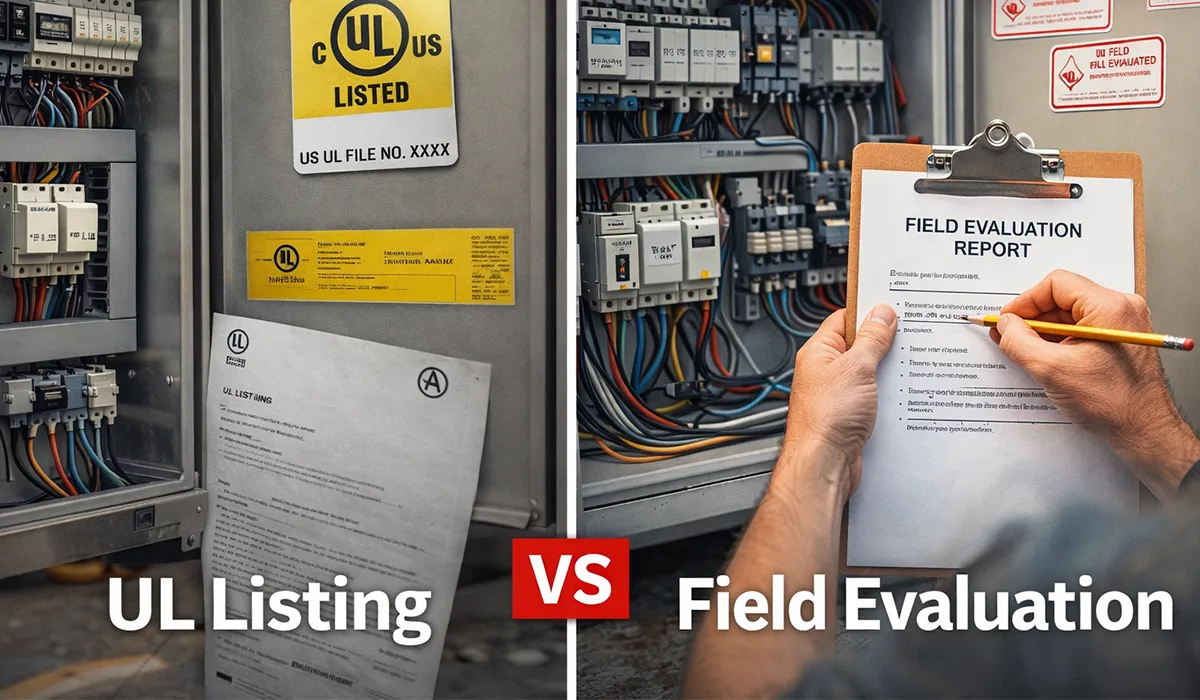
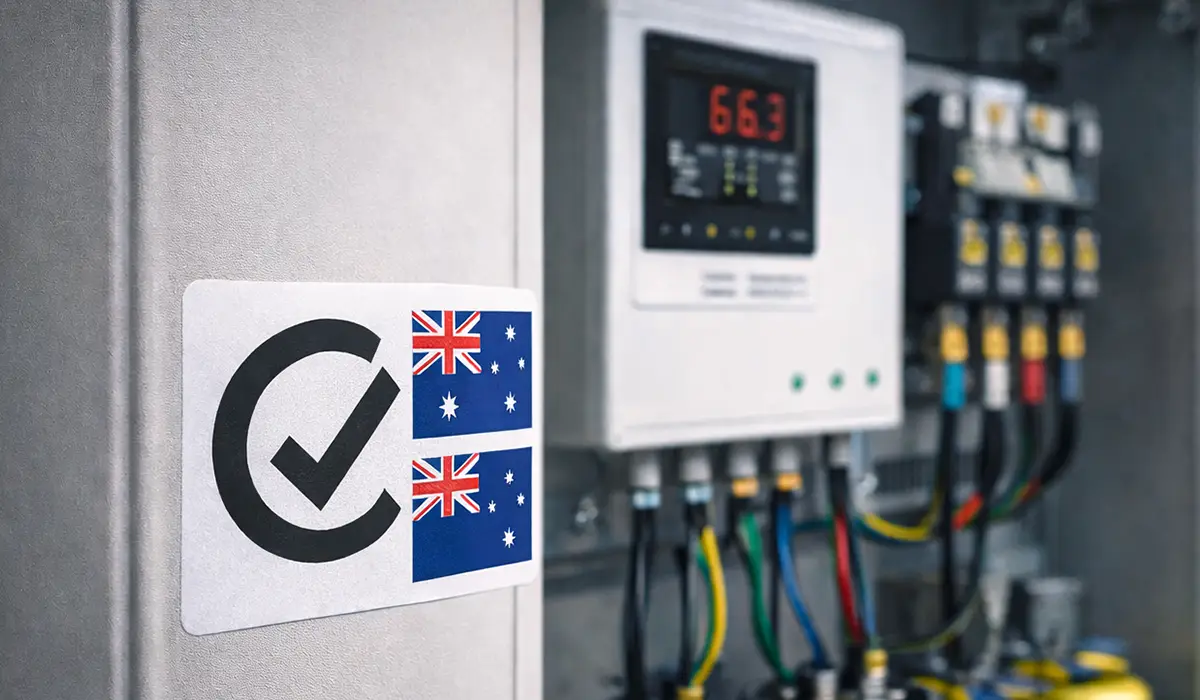
“Designed to UL891” and “built to UL 891 standards” are marketing phrases. They are not a listing. A UL891 switchboard is compliant for inspection purposes only when a testing laboratory has certified it and the equipment carries that lab’s listing mark. Any nationally recognized testing laboratory can list to the standard, so the mark may come from UL Solutions, Intertek (ETL) or another accredited lab.
Many builders use UL’s General Coverage Program. Designs that follow the standard’s Annex G construction rules can be certified with little or no additional short-circuit and temperature testing. Custom designs outside those rules need witnessed testing.
On delivery, check the main nameplate against the approved submittal:
- voltage and system (phase and wires)
- main bus ampacity and material
- short-circuit current rating
- enclosure type
- section numbers and the listing mark
Write “UL 891 listed and labeled” into the RFQ. Never write “UL 891 compliant.”
Sizing a UL 891 Switchboard: Bus, Sections and Fault Ratings
Sizing starts with the unexciting inputs that prevent expensive rework:
- system voltage and configuration (for example 480Y/277 V, 3-phase 4-wire)
- the calculated load under NEC Article 220
- main type (main breaker or main lugs)
- realistic expansion space, both spare breaker spaces and future sections
From the load, pick the main bus ampacity and material, copper or aluminum. Then lay out the lineup: incoming or service section, utility metering if required, surge protection, and feeder distribution sections.
Next, fix the two fault numbers that decide whether the gear survives a bad day:
- Assembly SCCR at the line terminals. It must be at least the available fault current from your short-circuit study. If the study shows 65 kA, a 42 kA board fails inspection regardless of how good it looks.
- Each device’s interrupting rating (AIC) at its installed point. It must be at least the available fault current there, either fully rated or as a tested series combination listed for that board.
Put the bus rating and material, SCCR, section layout, access type and enclosure type into the RFQ. The vendor can then engineer the full lineup rather than quoting a guess.
Busbar geometry drives temperature rise and fault withstand. See how busbar systems inside power switchboards are structured.
NEC Article 408 Rules Every UL 891 Switchboard Installation Must Pass
UL 891 governs the product; NEC Article 408 (switchboards, switchgear and panelboards) governs the installation, together with Article 110. The rules inspectors check most often are:
- 408.6, short-circuit current rating. The switchboard’s SCCR must be at least the available fault current. Except at one- and two-family dwellings, the available fault current and the date it was calculated must be field-marked on the enclosure at the point of supply. Keep the calculation on file, because the utility can change the transformer.
- 408.4, circuit directory. Every circuit must be legibly and specifically identified, not by transient descriptions such as “John’s office.”
- 408.3, arrangement and barriers. This covers phase arrangement and the barrier requirements for service switchboards.
- 408.18, clearances. This covers space above the switchboard and around it, with working space under 110.26. Rear-access boards need the rear clearance built into the room layout.
- 110.24, service equipment. Service switchboards also need the available-fault-current marking under this section.
Confirm the edition your authority having jurisdiction (AHJ) enforces, since section wording shifts between NEC cycles.
UL 891 Switchboards in North Carolina: Listing Law and the Code in Force
North Carolina is stricter than most states on how electrical equipment gets approved. Under N.C. Gen. Stat. § 66-25, all electrical materials, devices, appliances and equipment must be evaluated for safety and suitability. The evaluation must follow nationally recognized standards and be done by a qualified testing laboratory. The Office of State Fire Marshal (OSFM) approves those laboratories and publishes the list. The statute applies to electrical equipment statewide, independent of local code enforcement. For a UL 891 switchboard in North Carolina, that means:
- the board must carry the listing mark of an OSFM-approved laboratory
- “built to UL 891” without a mark will not pass
- equipment that complies with § 66-25 satisfies the equipment-approval requirement of NEC 110.3(A) as adopted in the State Electrical Code
On the installation side, the 2020 State Electrical Code (2020 NEC with North Carolina amendments) has been the code in force since November 1, 2021. The 2023 State Electrical Code was adopted, but its effective date has been delayed indefinitely by legislation. The 2020 NEC already contains the 408.6 fault-current marking rule, so it applies to North Carolina switchboard installations today.
Before you order:
- confirm the listing laboratory against OSFM’s current list
- check local utility requirements for service-entrance sections and metering compartments
- confirm the code edition with the local inspection department, since the delay may be lifted
(Legal note for the page: this summarizes public requirements and is not legal advice.)
Where a UL 891 Switchboard Fits Between Panelboards and Switchgear
A UL 891 switchboard sits between UL 67 panelboards, which handle branch distribution near the loads, and UL 1558 switchgear. Switchgear adds power circuit breakers, compartmentalization and 30-cycle short-time withstand for critical facilities. If you need short-time ratings, draw-out maintenance or arc-resistant construction, choose switchgear. For dense, economical service and main distribution, a switchboard is usually the answer. For the full side-by-side comparison, see our UL 891 vs UL 1558 vs UL 67 comparison.
SCCR vs AIC: The Two Ratings Every UL 891 Switchboard Must Get Right
SCCR (short-circuit current rating) belongs to the assembly. It is the maximum available fault current the switchboard can safely withstand at its line terminals, limited by the bus bracing and the weakest device or combination inside. UL 891 covers ratings up to 200 kA. Common marked values are 42, 65 and 100 kA, and 200 kA is available for high-fault services.
AIC (interrupting rating) belongs to each overcurrent device. It is the maximum fault current the device can safely interrupt at its rated voltage.
The rule is simple:
- the assembly SCCR must be at least the available fault current at the supply
- each device’s AIC must be at least the available fault current where that device is installed, unless it is part of a tested series rating marked on the board
A switchboard is only as strong as its lowest-rated component, so check both numbers on the submittal, not just the main breaker.
UL 891 Switchboard Enclosures: Type 1, Type 3R and Beyond
North American inspectors look for UL/NEMA enclosure Type ratings, not IP codes.
- Type 1 is the standard choice for indoor, dry electrical rooms.
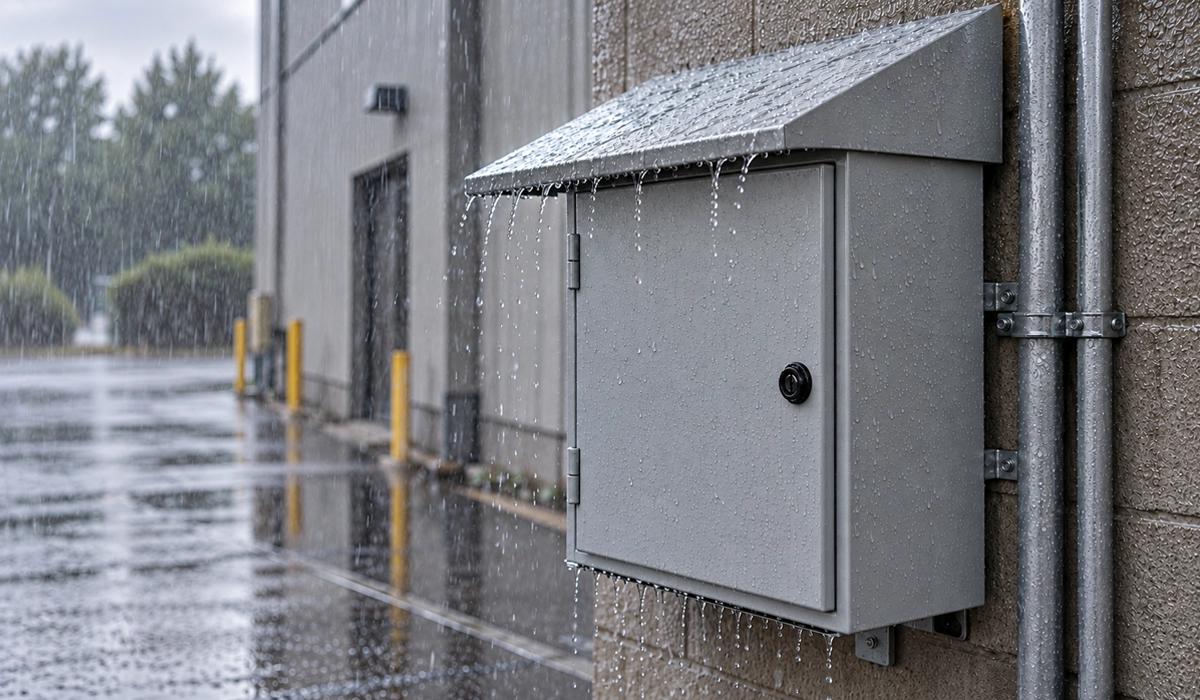
- Type 3R is typical for outdoor switchboards, protecting against rain and snow.
- Type 12 suits dusty industrial interiors, and Type 4 or 4X suits wash-down or corrosive areas, where the manufacturer offers them.
If an international spec calls for an IP rating, list it as a supplementary requirement next to the Type rating, never instead of it. Outdoor lineups also need attention at shipping splits, roof caps and any busway flange, because those joints are where water gets in.
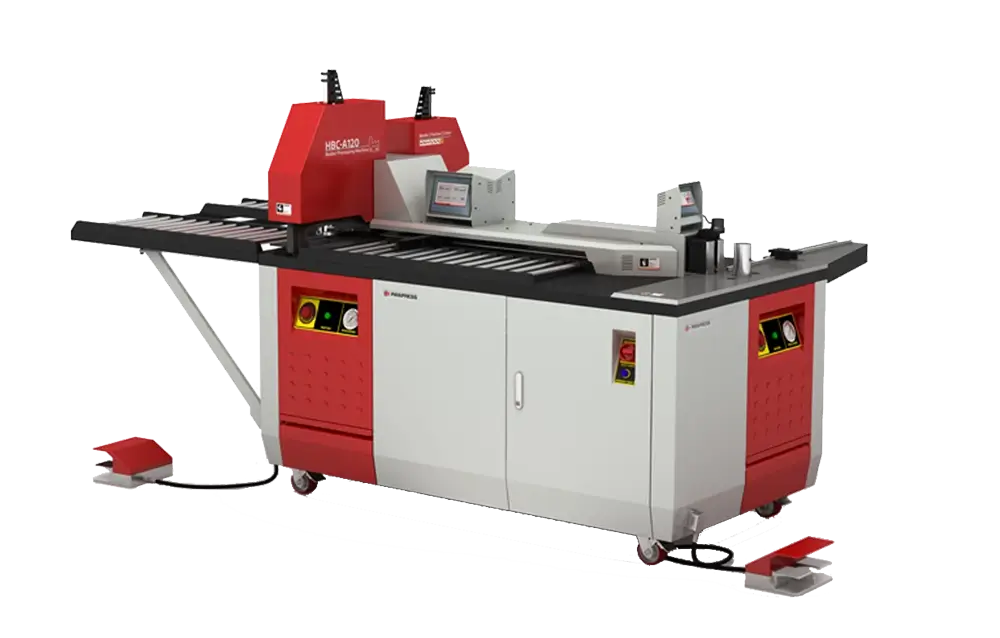
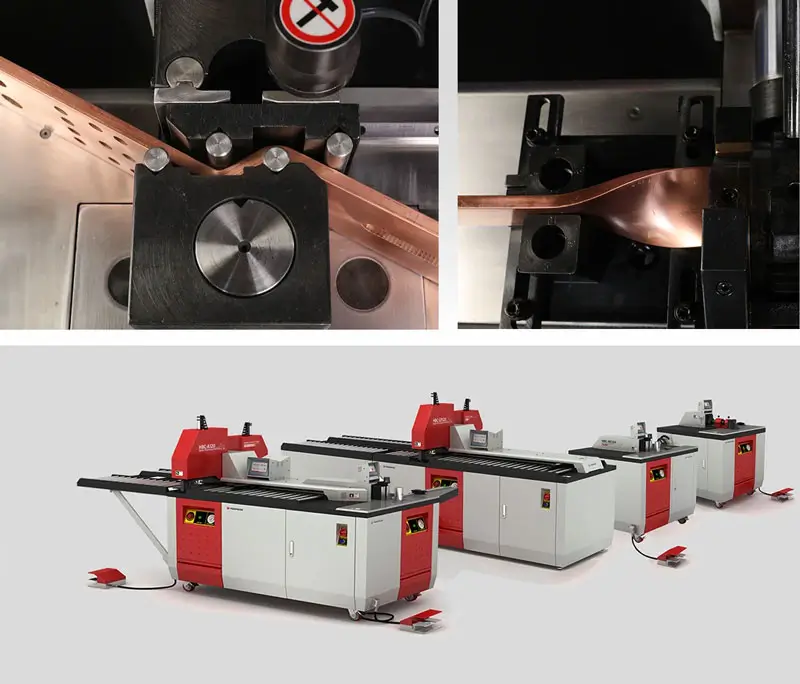
If your switchboard project includes sheet-metal enclosures, corner quality affects alignment, sealing, and long-term durability. See how a weld-free approach improves consistency with a corner forming machine.
For low-voltage power distribution, get the switchboard spec right by aligning the product with its standard and the site code: state “UL 891 listed & labeled” in your RFQ, match the enclosure rating to the environment (NEMA/IP), and confirm the assembly SCCR meets or exceeds available fault current while each breaker’s AIC is adequate. For an authoritative source, see UL’s overview of the UL 891 switchboard standard, which explains the scope and intent of the listing and testing requirements.
Arc-Flash Safety for UL 891 Switchboards
A dead-front board is safe to operate, not safe to open. Base PPE and approach boundaries on your site’s arc-flash risk assessment under NFPA 70E (CSA Z462 in Canada), and keep the NEC 110.16 arc-flash label current whenever settings or the utility source change.
Where a breaker’s highest continuous-current trip setting is 1,200 A or more, NEC 240.87 requires an arc energy reduction method. Options include an energy-reducing maintenance switch, zone-selective interlocking or differential relaying. Specify it on the main and large feeders at the RFQ stage, not after installation.
Other features worth specifying:
- infrared inspection windows, for thermography without removing covers
- remote racking or remote operation where available
- a documentation package with the single-line diagram, layout, nameplate data and torque values
UL 891 Switchboard RFQ Checklist
Copy these lines into your request for quotation:
| RFQ item | What to write |
|---|---|
| Standard | UL 891 (current edition), listed and labeled by an NRTL |
| System | Voltage, phase and wires, frequency, grounding system |
| Main | Main breaker or main lugs, frame and trip rating, arc energy reduction if ≥1,200 A |
| Bus | Ampacity, copper or aluminum, plating, full or reduced neutral, ground bus |
| Fault ratings | Assembly SCCR ≥ available fault current; device AIC or series rating |
| Access | Front-only or rear-access; top or bottom entry |
| Enclosure | Type 1 / 3R / 12 / 4X |
| Sections | Service/utility metering, surge protection, customer metering, feeders, spaces |
| Documents | Submittal drawings, nameplate data, test and inspection reports, O&M manual |
Conclusion: Specify the Listing, Not the Look
A UL 891 switchboard earns its place in a design only when four things line up:
- it is listed and labeled to the current edition of the standard
- its SCCR and device interrupting ratings meet the available fault current
- its enclosure fits the environment
- its installation passes NEC Article 408, plus state rules such as North Carolina’s § 66-25 listing requirement
Read the standard through the official Digital View, write the checklist above into your RFQ, and check the nameplate against the submittal on delivery. Those steps separate a switchboard that passes inspection and serves for decades from one that gets red-tagged.

Rate this article
Choose a rating from 1 to 5 stars.
No ratings yet