


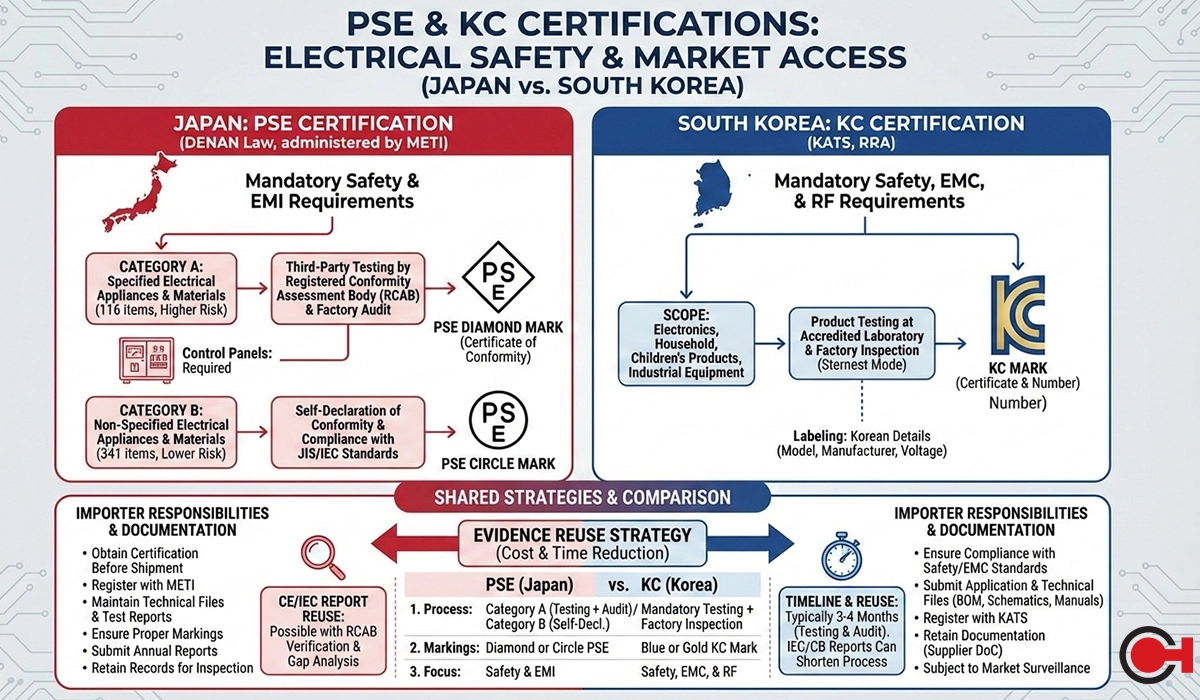
The law categorizes electrical and electronic products into two primary groups:
-
Category A (Specified Electrical Appliances and Materials): These products, deemed higher-risk, require third-party certification from accredited organizations to verify their compliance with the PSE Law. This category involves extensive procedures, including product testing, factory audits, and a detailed evaluation of safety risks.
-
Category B (Non-Specified Electrical Appliances and Materials): These products, considered lower-risk, must follow Japan Industrial Standards (JIS) or International Electrotechnical Commission (IEC) standards and do not require third-party certification.
Importers are legally responsible for ensuring that all products, whether Category A or B, meet these safety standards before entering the Japanese market. Products that comply with these standards must bear the PSE logo, signifying that they are safe for use in Japan.
Failure to comply with these regulations results in import restrictions and market withdrawal. This rigorous certification process helps prevent electrical accidents, enhance consumer protection, and ensures that Japan’s safety standards align with international best practices, providing a secure environment for the use of electrical products.
If you are interested in learning more about the standards within the electrical industry, particularly international standards in the field, don’t forget to check out the details on IEC 61439. This standard offers in-depth guidance on the design, assembly, and testing of low-voltage switchgear and controlgear assemblies, which are integral to ensuring safety and functionality in electrical systems worldwide.
If you’d rather listen than read, feel free to play the audio file below for the rest of this article
What DENAN Regulates: 457 Categories, Not All Electrical Products
The Electrical Appliances and Materials Safety Act, known as DENAN, is administered by METI. It regulates three things:
- parts of electrical facilities for general use connected to AC commercial supply at 100 V or 200 V
- portable power generators
- secondary batteries
Within that, the Act designates 457 product categories:
| Count | Conformity route | Mark | |
|---|---|---|---|
| Specified electrical appliances and materials | 116 | Third-party assessment by a Registered Conformity Assessment Body | Diamond PSE |
| Non-specified electrical appliances and materials | 341 | Self-inspection by the manufacturer or importer | Circle PSE |
Two boundaries matter more than any other detail on this page:
- Only designated items are regulated. A product must match a category defined in the Act’s annex before notification and marking obligations apply. There is no catch-all clause.
- The scope is oriented to general-use electrical facilities — the low-voltage supply serving homes and small premises — rather than to industrial installations. TÜV Rheinland’s summary of DENAN’s product list reads accordingly: wiring, fuses, switches, plugs and sockets, transformers, heating devices, pumps and power supplies for home use.
Some bounds on individual categories are tight. AC/DC power supplies in scope are defined at 100–300 V rated voltage and 50/60 Hz, and DC-operated appliances are not designated.
Before assuming anything about a product, check it against the annex list and confirm with an RCAB.
For the international standards that govern the assemblies themselves, see our guide to IEC 61439 design verification.
Do Industrial Control Panels Need PSE? Usually Not — but Their Components Might
A custom industrial control panel or switchboard, built to order for a factory or plant, is not one of the 457 designated categories. DENAN’s designated list covers defined appliance and component types connected to general-use electrical facilities; it does not contain a category for bespoke industrial assemblies.
So in most cases the assembly itself carries no PSE mark, because there is no category for it to be marked under.
Where the obligation actually lands:
- Designated components inside the panel. Wiring, switches, fuses, transformers, power supplies and similar items are designated categories in their own right. Where those components are in scope, they must carry the correct PSE mark, and your obligation as a builder is to source marked components and keep the evidence.
- Anything you sell as a standalone designated item. Selling a component separately into Japan is a different question from selling it installed inside a panel.
- The installation itself is governed by Japanese electrical installation rules and the Electricity Business Act, not by DENAN.
What to do before you quote:
- List every component that will be energised in the finished panel.
- Check each against the designated list to see whether it is specified, non-specified, or outside scope.
- Collect PSE evidence for the in-scope components from your suppliers, and keep it with the technical file.
- Ask an RCAB where a component’s classification is genuinely unclear — that is a short conversation, and far cheaper than a certification you did not need.
- Confirm the end installation type with your customer. Equipment destined for general-use facilities is treated differently from equipment for a plant’s own high-voltage receiving installation.
Be careful with blanket claims in either direction. A supplier telling you “everything needs PSE” is usually selling certification; a customer telling you “nothing needs PSE” may be overlooking the components. The answer is per item, against the list.
Diamond or Circle: Which PSE Mark Applies
The two marks correspond directly to the two categories.
Diamond PSE — specified items (116 categories). These are judged particularly likely to cause hazards: products left running unattended for long periods, used by vulnerable people, or in direct contact with the body. Conformity requires third-party assessment by a Registered Conformity Assessment Body, which tests the product, issues a Certificate of Conformity, and inspects the factory. The mark is accompanied by the assessment body’s registered name.
Circle PSE — non-specified items (341 categories). These follow self-inspection by the manufacturer or importer against the applicable technical standards, with no third-party involvement required. Voluntary certification, such as the S-Mark, is available and sometimes requested by Japanese buyers as added assurance, but it is not a legal requirement.
Both marks must be accompanied by the name of the notifying supplier, and both must be legible and durable on the product.
Records the Importer Has to Keep
Conformity inspection records must be preserved, and the importer is responsible for retaining them and for correct PSE marking. METI’s guidance sets the obligation without a single universal retention period, so confirm the applicable period for your product category rather than assuming a number.
Keep, at minimum: the conformity certificate for each specified item, inspection records for self-declared items, component evidence from suppliers, and your METI notification.
PSE vs PSC: Two Japanese Marks, Two Different Laws
These two get conflated constantly, and for a panel builder the distinction resolves quickly.
| PSE | PSC | |
|---|---|---|
| Law | Electrical Appliances and Materials Safety Act (Act No. 234 of 1961) | Consumer Product Safety Act (Act No. 31 of 1973) |
| Authority | METI | METI |
| Covers | Designated electrical appliances and materials — 457 categories | Designated consumer products, largely non-electrical, where failure is acutely dangerous |
| Examples | Wiring, switches, transformers, power supplies | Pressure cookers, motorcycle helmets, infant beds, mountaineering rope, portable laser devices, lighters |
| Structure | 116 specified (diamond) / 341 non-specified (circle) | Specified products, with four “special specified” products requiring third-party assessment |
For industrial equipment, PSC is not your regime. It applies to consumer products where failure puts a user in direct contact with heat, water or their own body. An industrial control panel is outside it.
The relevance is defensive: if a Japanese buyer or agent asks for “PSC certification” on a control panel, they have most likely confused the two marks, and the conversation should move to PSE and to which components are designated.
Japan EMC Requirements: Less Mandatory Than You Expect
Exporters used to the EU’s EMC Directive assume Japan has an equivalent. It does not, and this catches people out in both directions.
There is no horizontal mandatory EMC regime in Japan. Instead:
- VCCI is voluntary. The Voluntary Control Council for Interference runs an industry-led EMC scheme covering multimedia equipment — IT equipment, audio and video devices, broadcast receivers and entertainment lighting controllers. Testing follows VCCI-CISPR 32, aligned with the international CISPR 32; the transition away from CISPR 22 completed in March 2019. Using the mark requires VCCI Council membership, testing at a registered facility, and product registration. Equipment is classified Class A for commercial and industrial environments, carrying a warning statement, or Class B for residential use.
- An industrial control panel is outside VCCI’s multimedia scope, so the VCCI mark is generally not applicable to it.
- Radio equipment is regulated separately under the Radio Act, through technical conformity certification. If your panel contains a wireless module, that module needs its own Japanese radio approval — and this is a genuine obligation, unlike the EMC question.
- DENAN’s technical standards include interference-related requirements for certain designated categories. That is per-category rather than general, so check the technical standard for the specific item rather than assuming either that PSE covers EMC or that it ignores it.
The practical answer for a panel exporter: design to the IEC 61000 series as you would for any market, keep the test evidence, and treat Japanese EMC as a customer-specification question rather than a legal gate — unless there is radio in the panel, in which case the Radio Act applies.
Can Your CE or IEC Reports Be Reused for PSE?
Partly, and the honest answer is more conditional than most vendor pages suggest.
Foreign test reports to CE or IEC standards may be accepted where they demonstrate conformity with the applicable Japanese technical standard, but they do not transfer automatically. For specified items, an RCAB must be satisfied that the evidence meets Japanese requirements, and additional testing is frequently needed where the Japanese standard differs from the IEC text.
A workable sequence:
- Identify the Japanese technical standard that applies to the designated item — either the J-IEC-based standard or the traditional Japanese standard.
- Map your existing CE or IEC report clause by clause against it.
- List the gaps — typically construction details, markings in Japanese, or national deviations.
- Decide what to close by additional testing and what by design change.
- Take the package to an RCAB before committing to a test programme, so you pay for the delta rather than a repeat.
Test evidence reuse genuinely saves money. It works best when the gap analysis happens first and the RCAB is consulted early, rather than after a full retest has been booked.
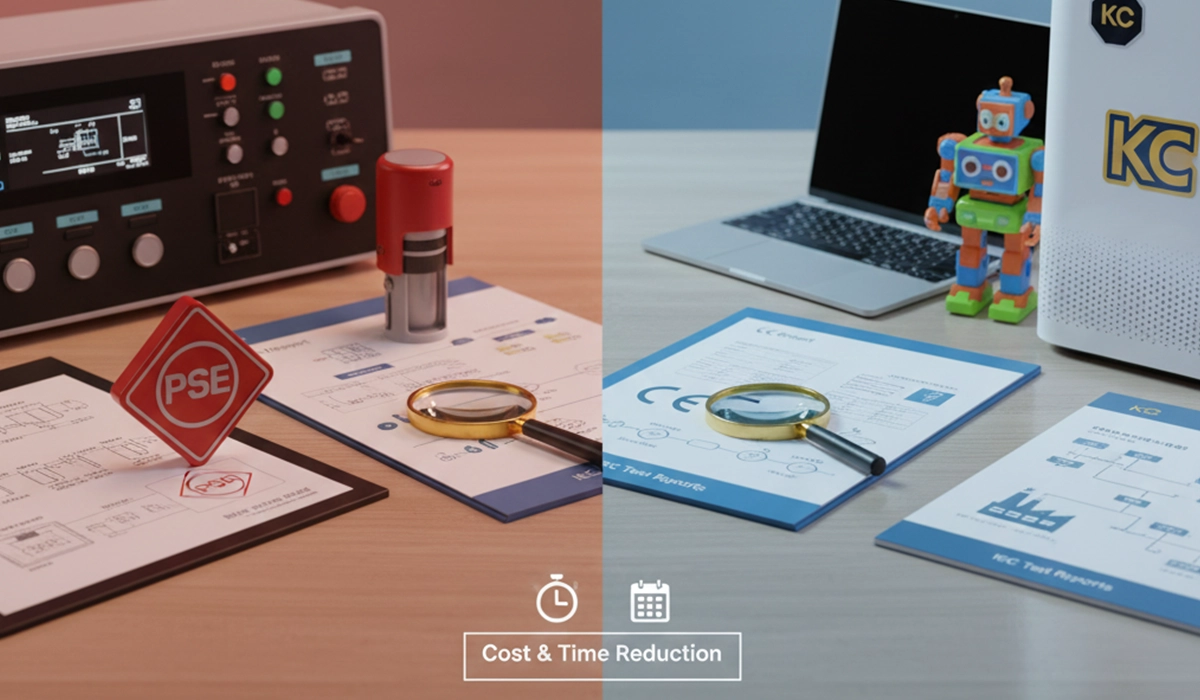
PSE and KC: How Japan and Korea Differ
Exporters often face both markets, and the two regimes are structured differently.
| Japan — PSE | Korea — KC | |
|---|---|---|
| Law | Electrical Appliances and Materials Safety Act (DENAN) | Electrical Appliances and Consumer Products Safety Control Act |
| Authority | METI | KATS |
| Scope model | Closed list of 457 designated categories | Product classes with differing assessment levels |
| Routes | Third-party assessment (specified) or self-inspection (non-specified) | Certification with testing and factory inspection, or Declaration of Conformity, by class |
| Local testing | Required for specified items via an RCAB | Generally required at an accredited Korean laboratory |
| Language | Japanese markings and documentation | Korean manual and markings mandatory |
The pattern for a panel exporter is similar in both: the bespoke assembly is usually outside the designated product lists, while the components inside it carry their own obligations.
For the full Korean process — KC classes, KN EMC standards, the documentation set, radio module registration with the RRA, and labelling rules — see our dedicated guide to KC certification. (Link to the new page once it exists.)
Correction to carry into that page: the current text says “KC 62368-1 is relevant for industrial equipment, focusing on safety for control systems and machinery.” That is wrong. IEC 62368-1 covers IT and AV equipment and replaced IEC 60950-1 and IEC 60065, both withdrawn on 20 December 2020. Industrial machinery electrical equipment is covered by IEC 60204-1 and low-voltage assemblies by IEC 61439, adopted in Korea as KS C IEC equivalents.
DoC vs certification
KC DoC is a declaration confirming product compliance with standards, while KC certification involves testing and factory inspection. The difference lies in the level of scrutiny, varying by product class.
Labeling size & content
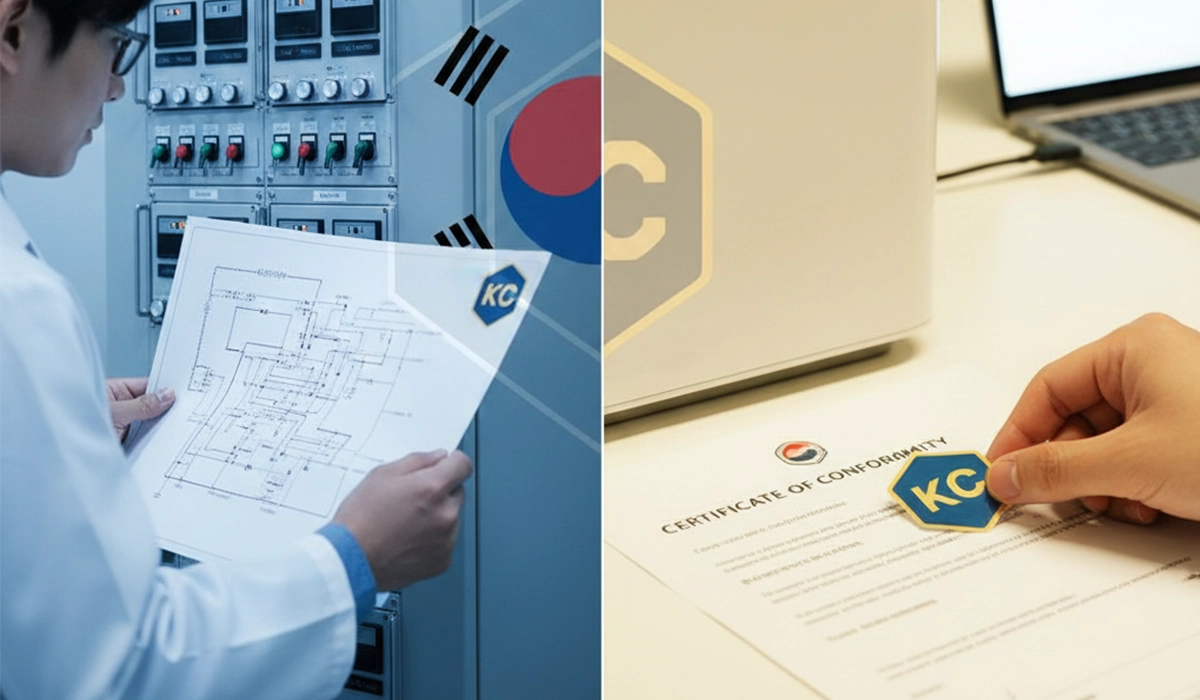
Once certified for the South Korean market, products must display the KC Mark in blue or gold, along with the certificate number. The label should include Korean product details, such as model, manufacturer, and voltage.
Validity & changes
KC certification typically takes 3-4 months, including 1-2 months for product testing and evaluation. CB certification can shorten the process by eliminating the need for retests. Factory audits add extra time for preparation.
Since buses play a crucial role in the production of electrical panels, obtaining more information about KC certification for panels can be very important and essential.
What the Importer Must File in Japan
Under DENAN, the importer carries the obligations, not the overseas manufacturer.
- Notify METI within 30 days of starting the business, using Form 1, submitted to the relevant Regional Bureau of Economy, Trade and Industry.
- Complete the correct conformity route — third-party assessment under Article 9 for specified items, self-inspection under Article 8(2) for non-specified items.
- Obtain and preserve the conformity certificate for specified items.
- Apply the correct PSE mark, with the notifying supplier’s name.
- Retain inspection records and make them available for inspection.
If you are the panel builder rather than the importer, your practical role is supplying the evidence your importer needs — component certificates, technical documentation and declarations — in a form they can file.
Conclusion: Check the List Before You Buy a Certificate
PSE is narrower than most exporters assume, and the cost of misunderstanding it runs in both directions — certifying what needs no certificate, or shipping a panel full of unmarked components.
Four things to hold onto:
- DENAN regulates a closed list of 457 designated categories. Outside the list, there is no PSE obligation.
- Your panel is probably not a designated item; some of its components probably are. Build the component list first.
- Diamond means third-party assessment; circle means self-inspection. The category decides, not the supplier.
- Japan’s EMC regime is largely voluntary, but radio modules are regulated under the Radio Act and that is not optional.
Where classification is genuinely unclear, one conversation with an RCAB settles it.

Rate this article
Choose a rating from 1 to 5 stars.
No ratings yet