


If you’d rather listen than read, feel free to play the audio file below for the rest of this article.
How to Get the RCM Mark
To obtain the Regulatory Compliance Mark (RCM) in Australia, the responsible party (importer, distributor, or manufacturer) must ensure their electrical, electronic, or radio products comply with applicable standards. This includes adhering to Radio and EMC specifications. The process involves product description, obtaining compliance certification, and possibly submitting accredited lab test reports. Since two compliance labels (RCM and R-NZ) were introduced in 2013, suppliers should follow detailed guides and consult compliance experts to ensure full adherence.
Supplier Registration: Two Schemes, One Database
The RCM is used by two independent regulatory schemes. Which one applies — or whether both do — depends on your product.
| ACMA pathway | EESS pathway | |
|---|---|---|
| Covers | EMC, radiocommunications, telecommunications, EME | Electrical safety |
| Administered by | Australian Communications and Media Authority | State and territory electrical regulators, via ERAC |
| Register as | Responsible Supplier in the EESS Registration Database | Responsible Supplier in the EESS Registration Database |
| Product registration | Not required — no product details entered | Required for Level 2 and Level 3 equipment, each model individually |
| Fee | None | Registration fees apply |
| Level 3 additional | — | Certificate of Conformity from an accredited certification body, and separate registration by each importer |
The database is shared; the schemes are not. Registering for ACMA purposes does not satisfy EESS obligations, and vice versa. An industrial control panel will typically fall under both — EMC under ACMA, electrical safety under EESS.
Complete the SDoC
The Supplier’s Declaration of Conformity is a form required by the Australian Communications and Media Authority (ACMA) for suppliers of electrical, electronic, and radio products. It confirms compliance with regulations like the Radiocommunications Act 1992 and Telecommunications Act 1997. The form collects company and product details, along with proof of compliance, such as test reports or certifications. Suppliers must ensure accuracy in their declarations, as false information can result in legal penalties.
Apply the RCM Label
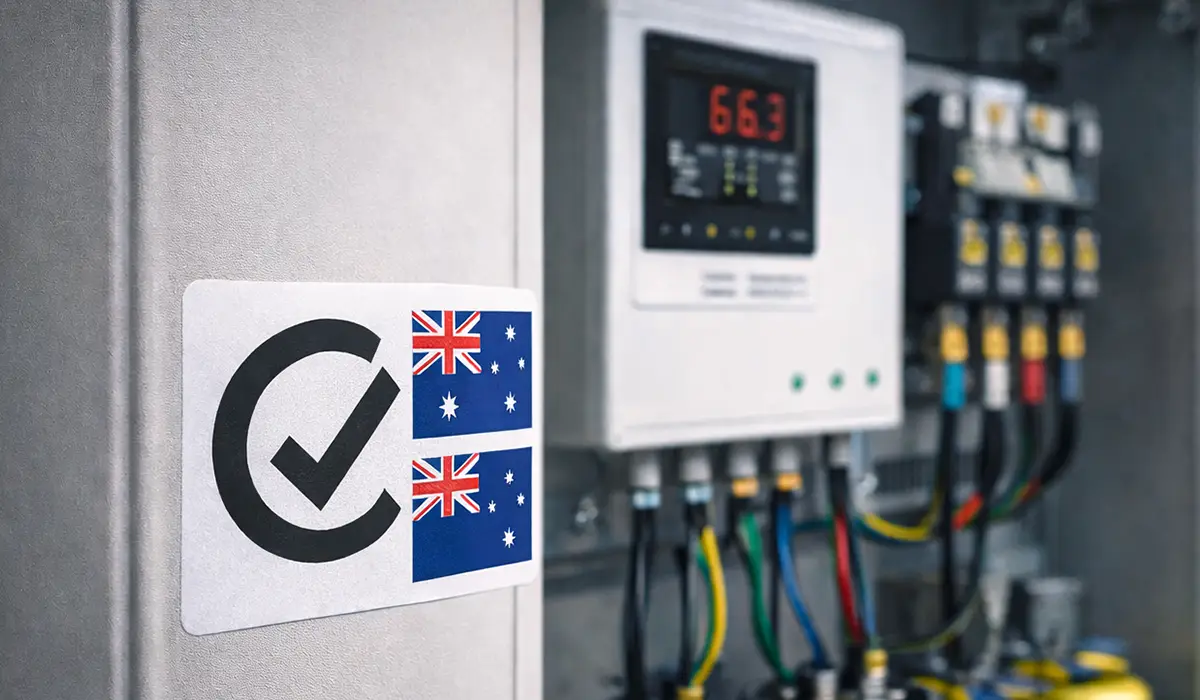
The RCM label certifies compliance with Australian and New Zealand regulations for electrical, electronic, and radio products.
Under AS/NZS 4417.1 the mark must be at least 3 mm in height, permanent, and resistant to fading or removal. It must be clearly visible on the product or its packaging, positioned as near as practicable to the model identification. Where the product is too small to carry the mark legibly, a QR code linking to a page displaying the RCM is an accepted alternative.

RCM Scope for Industrial Equipment
In Australia, industrial equipment must comply with ACMA EMC requirements for placing products in the market. This means meeting CISPR Class A emission limits and the immunity requirements of IEC 61000-6-2 for industrial environments. Products must adhere to CISPR 11, CISPR 32, and IEC 61000-6-2/-6-4 standards to ensure compliance.
Who Must Register (ANZ)
A Responsible Supplier must be a legally identifiable Australian or New Zealand entity holding an ABN. Overseas entities cannot register.
This is the constraint that shapes every other decision. A manufacturer outside ANZ cannot be the Responsible Supplier, regardless of who holds the test reports or designed the product. Supplying into the market requires a local importer, subsidiary or appointed agent who accepts that role — and with it, legal responsibility for the declaration, the evidence pack, and the record-keeping obligations.
In RCM compliance in Australia, determining who is the responsible supplier can be unclear. Typically, the importer or manufacturer is accountable, but distributors can also assume this role under certain conditions. When appointing an Australian agent for RCM, it’s essential to clarify whether a NZ entity is acceptable for local supply.
Importer vs Manufacturer
In RCM compliance, the importer is typically responsible for signing the Supplier Declaration of Conformity (SDoC) and maintaining records. The manufacturer may also sign if they are directly responsible for the product’s compliance.
Using an AU/NZ Agent
A foreign OEM has three practical routes:
- Local subsidiary — the OEM retains direct control of the compliance file, but the subsidiary carries the legal liability and must hold an ABN.
- Importer as Responsible Supplier — the most common arrangement. The importer signs the SDoC and holds the records. Note that for Level 3 equipment, each importer must register separately, even if another importer has already registered the same model.
- Appointed agent — a third-party compliance representative registers as the Responsible Supplier. Contractually workable, but the agent carries the regulatory exposure and will expect the evidence pack to be complete before signing.
SDoC & Evidence Pack
The Supplier Declaration of Conformity (SDoC) must include product details, compliance standards (e.g., CISPR 11/32, IEC 61000-6-2/-6-4), and evidence of compliance. CB/CE reports are acceptable if from an accredited lab. Retaining compliance records is mandatory, including test reports.
| Required document | Owner | Versioning |
|---|---|---|
| Supplier’s Declaration of Conformity (SDoC) | Responsible Supplier | Latest, signed and dated |
| Test reports (CB / CE / accredited lab) | Accredited laboratory | Versioned — must match the tested configuration |
| Applied standards list with editions | Responsible Supplier | Latest applicable edition |
| Product documentation and nameplate details | Responsible Supplier | Updated at each design change |
Accepted Test Standards
In Australia, CISPR 11 Class A limits specify emissions limits for industrial equipment, while IEC 61000-6-2 outlines immunity requirements for industrial environments. These standards ensure that equipment remains functional and compliant in environments with electrical disturbances.
The immunity and emissions standards referenced here are covered in more depth in EMC requirements under IEC 61000.
Using CE Reports in ANZ
Short answer: usually yes, as evidence — but they don’t replace the SDoC.
Because the EMC standards are substantially the same, a CE or CB test report from an accredited laboratory is generally acceptable as evidence supporting an RCM declaration. Three conditions have to hold:
- The report is from a laboratory with recognised accreditation
- The standard and edition tested against match what applies in ANZ — editions diverge, and an outdated report is the most common rejection
- The tested configuration matches what is being supplied
What a CE report does not do is remove the requirement for an AU/NZ Responsible Supplier to hold and sign the SDoC, register, and keep the records. CE marking is not recognised in place of the RCM.
RCM Mark: Size & Placement
AS/NZS 4417.1 sets the general rules for use of the mark — minimum 3 mm height, placement on the external surface as near as possible to the model identification, and durability requirements. AS/NZS 4417.2 defines which equipment is in scope and its risk level.
Responsible Suppliers are issued a copy of AS/NZS 4417.1 on registration, which includes the correct mark proportions. Reproducing the RCM from a web image rather than the standard is a common source of non-compliant labelling.
Radio Devices & RF Exposure
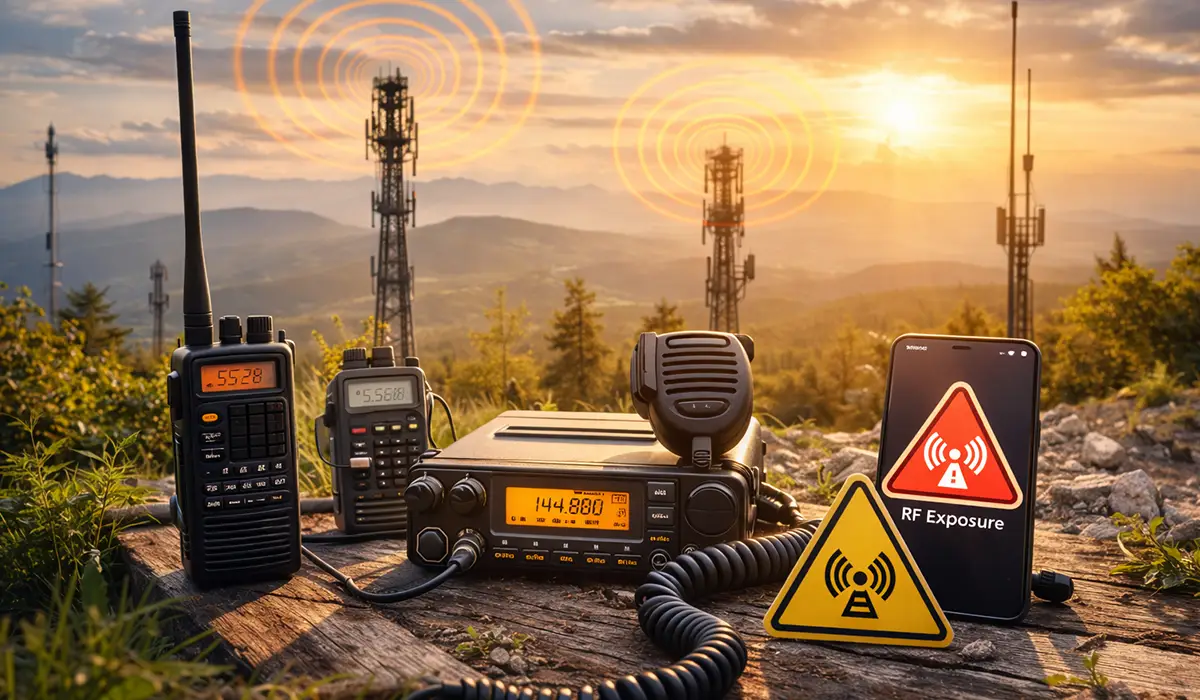
Radiocommunications compliance in Australia, as outlined in the Radiocommunications Compliance Labelling Notice, ensures that radio devices meet RF exposure limits to protect public health. Devices like radio modules must undergo specific testing and comply with ACMA’s guidelines. A distinct pathway is required for radio devices, unlike EMC-only devices. An ACMA radio device compliance checklist helps navigate these regulations, ensuring proper integration and documentation for compliance.
Module vs Host Approvals
When integrating certified radio modules, the host is responsible for ensuring overall radiocommunications compliance, including RF exposure limits. A common integration pitfall is neglecting to account for module interaction, which may lead to non-compliance with ACMA regulations and potential RF exposure issues.
Antennas & Output Power
When substituting antennas, it’s crucial to ensure they match the original specifications, as changes can impact output power and SAR/EME (Specific Absorption Rate/ Electromagnetic Exposure) thresholds. Non-compliance can lead to regulatory issues. Practical design implications involve testing the substituted antenna to verify it remains within safe SAR/EME limits.
EESS Pathway Essentials (ANZ)
In Australia, the EESS pathway ensures electrical equipment is electrically safe through compliance with standards like AS/NZS 3820. Suppliers must demonstrate safety through documentation, including design drawings, test reports, and applied standards. EESS registration in the ERAC database is required for in-scope products, and compliance with AS/NZS 4417 ensures products meet electrical safety criteria. A Suitably Qualified Person may be needed to assist with technical documentation and certification.
Assembly-level verification for switchboards is covered separately — see AS/NZS 61439 vs IEC 61439.
Risk Classes & Evidence
In the EESS, electrical equipment is classified into risk classes based on potential hazards. Level 1 and Level 2 require basic safety proof, while Level 3 products need more detailed proof of compliance through testing, documentation, and certification.
Evidence & Record-Keeping
For RCM compliance, it’s essential to maintain proper documentation retention for at least five years. This includes keeping a compliance folder with critical documents like the SDoC, test reports, design records, and evidence of compliance with the General Equipment Rules. Regular post-market audits by ACMA ensure ongoing compliance, so being audit-ready is crucial. Retaining these records helps avoid legal exposure and ensures you’re prepared if compliance is ever questioned.
Post-Market Surveillance & Penalties
Post-market surveillance ensures ongoing RCM compliance through inspections and audits by ACMA. If products fail to meet standards, enforcement actions, including penalties, can be imposed on suppliers. Under the Radiocommunications Act and EMC Labelling Notice, suppliers must fulfill obligations to maintain compliance, ensuring their products are safe and meet the required performance standards.
CE vs RCM Acceptance (ANZ)
CE vs RCM acceptance involves evaluating mutual recognition for compliance. While EU test reports may be used for RCM compliance, the standards’ equivalence must be verified. For instance, CISPR 11/32 and IEC 61000-6-2/-6-4 are relevant for both. ACMA may accept certain CE-marked products but requires proof of conformity with Australian standards.
| Requirement | RCM (Australia / NZ) | CE (EU) |
|---|---|---|
| Standards | CISPR 11, CISPR 32, IEC 61000-6-2, IEC 61000-6-4 | CISPR 11, CISPR 32, IEC 61000-6-2, IEC 61000-6-4 — largely equivalent |
| Declaration | SDoC held by an AU/NZ Responsible Supplier | EU Declaration of Conformity |
| Test reports | Accredited lab reports. CE/CB reports accepted where the standard and edition match | EU accredited lab |
| Mutual recognition | None automatic. CE evidence is usable material for the SDoC, not a substitute for it | — |
| Registration | Responsible Supplier registration required | Not applicable |
For the EU-side equivalent, see CE marking for industrial control panels.
Cost & Timeline (ANZ)
The RCM compliance cost and timeline in Australia vary based on the product and testing requirements. EMC testing typically takes several weeks, with accredited labs charging fees for both initial testing and possible retests. The ACMA oversees registration, which may take additional time for SDoC submission. Planning for these costs and timelines is crucial for meeting market entry goals in ANZ.
Industrial Examples & Pitfalls (ANZ)
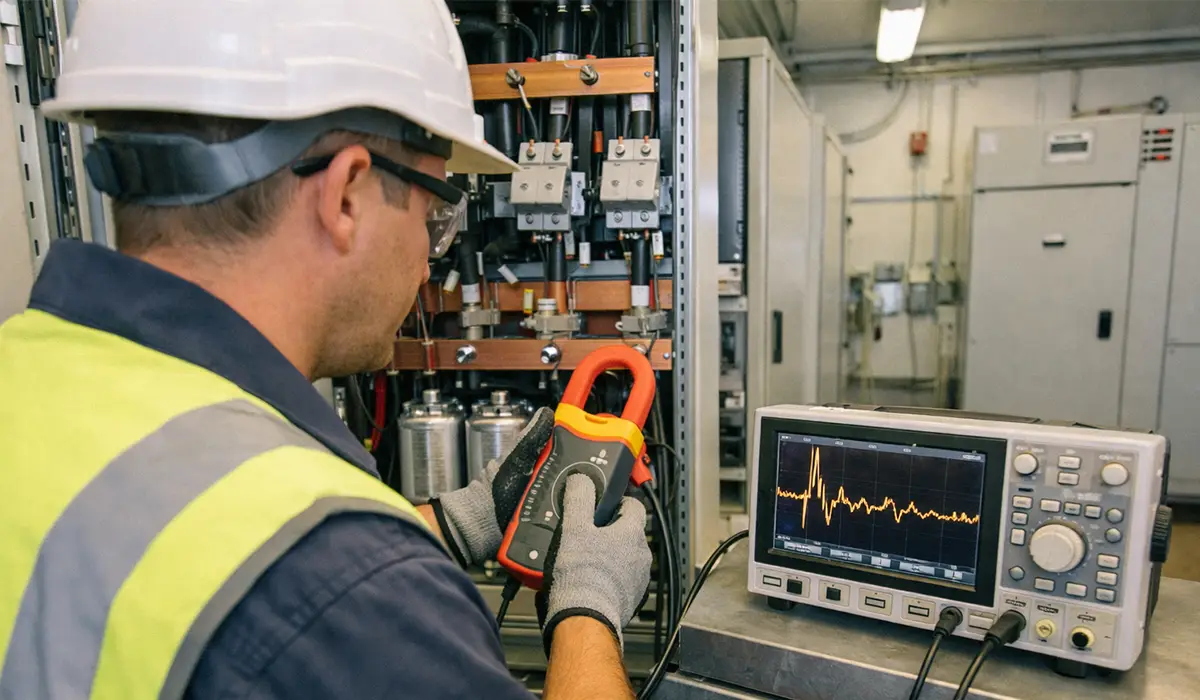
For RCM marking on control panels and switchboards in ANZ, it’s essential to ensure proper product identification and traceability, including nameplate details in the compliance folder. Common pitfalls include missing or incorrect AS/NZS 4417 compliance and improper documentation for CISPR 11 emissions limits. Suppliers often overlook these details, leading to compliance issues. Ensuring accurate traceability and maintaining a comprehensive folder will prevent errors, reducing the risk of enforcement actions and facilitating smooth market entry.



Rate this article
Choose a rating from 1 to 5 stars.
No ratings yet