

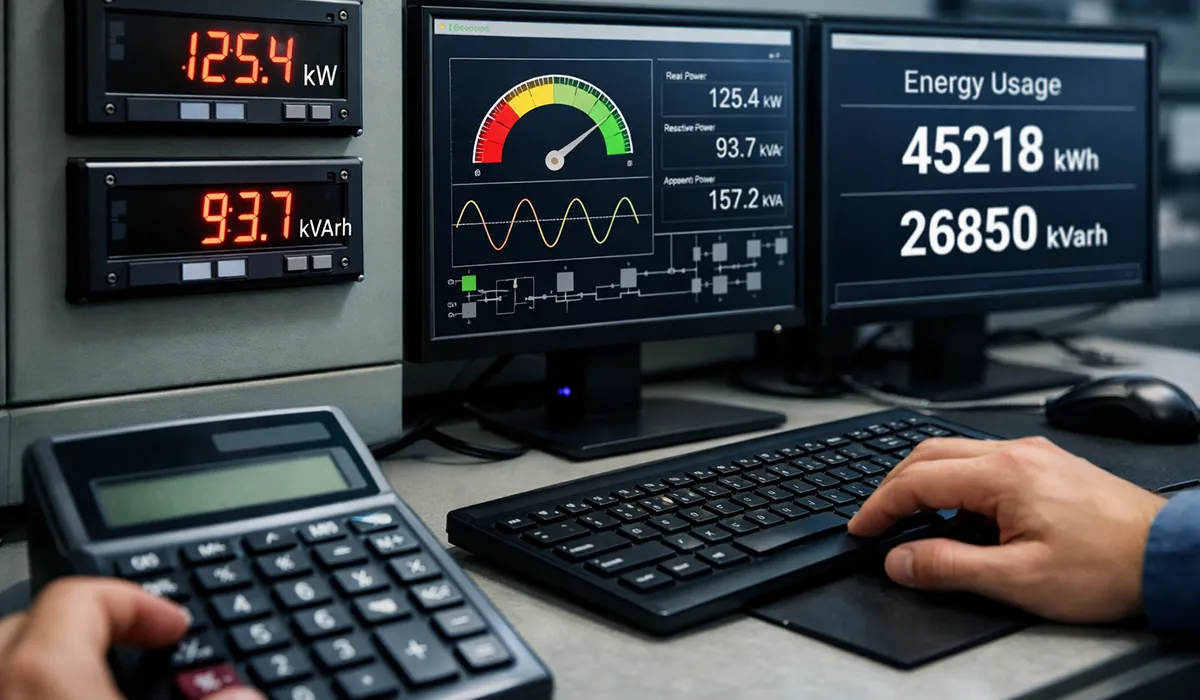

This article provides a practical, step-by-step guide to calculating the required capacitor bank capacity using data readily available on your electricity bill. Whether you manage a manufacturing plant, a commercial building, or any energy-intensive operation, understanding and correcting your power factor is one of the most cost-effective improvements you can make.
Prefer listening? You can play the audio version of the rest of this article below.
What is Power Factor and Why Is It Important?
Power factor (Cos φ) is a ratio that shows how much of the electrical energy drawn from the grid is actually converted into useful work — such as lighting, heating, or mechanical motion. A power factor of 1.0 (unity) means all consumed energy is doing productive work. Anything below that means a portion circulates reactively without contributing to output.
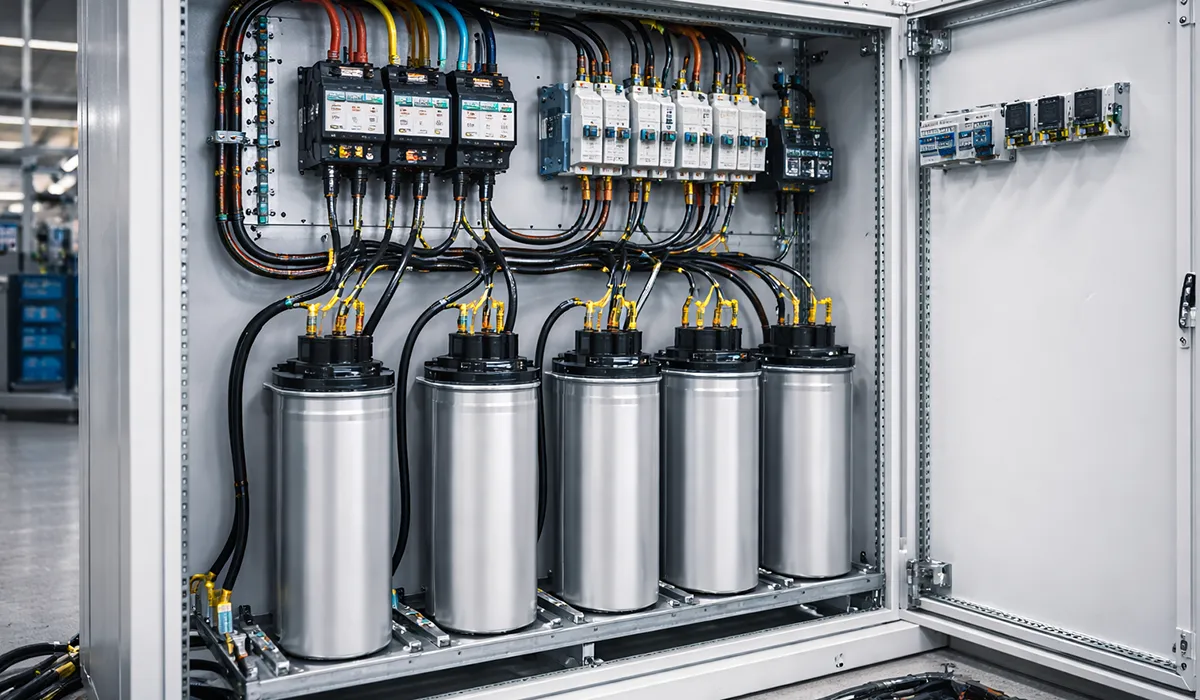
Capacitor banks are usually installed inside switchgear or a dedicated PFC panel — see standards for switchgear and busbar systems for the assembly requirements that apply.
-
Active Power (P): Real energy that performs useful work, measured in kilowatts (kW).
-
Reactive Power (Q): Energy that oscillates between the source and inductive loads such as motors and transformers, measured in kVAR. It does no useful work but stresses the network.
-
Apparent Power (S): The vector combination of active and reactive power, measured in kVA.
| Description | Symbol |
|---|---|
| Active Power — Real energy that performs useful work. | P (kW) |
| Reactive Power — Oscillates between source and inductive loads. Does no useful work. | Q (kVAR) |
| Apparent Power — Vector combination of active and reactive power. | S (kVA) |
Power Factor Definition
A low power factor forces utilities to deliver more current for the same useful output. This is why most providers impose penalties on industrial consumers whose power factor falls below a defined threshold — typically 0.90 or 0.95.
Reading and Understanding an Industrial Electricity Bill
Your industrial electricity bill contains two key figures needed for power factor analysis:
-
kWh (kilowatt-hours) represents the active energy consumed — the work actually done.
-
kVArh (kilovolt-ampere reactive hours) represents the reactive energy drawn by inductive equipment such as motors and transformers, which does no useful work but strains the network.
Some bills display the power factor directly. Others only provide kWh and kVArh values, from which you must calculate it yourself using the following two steps.
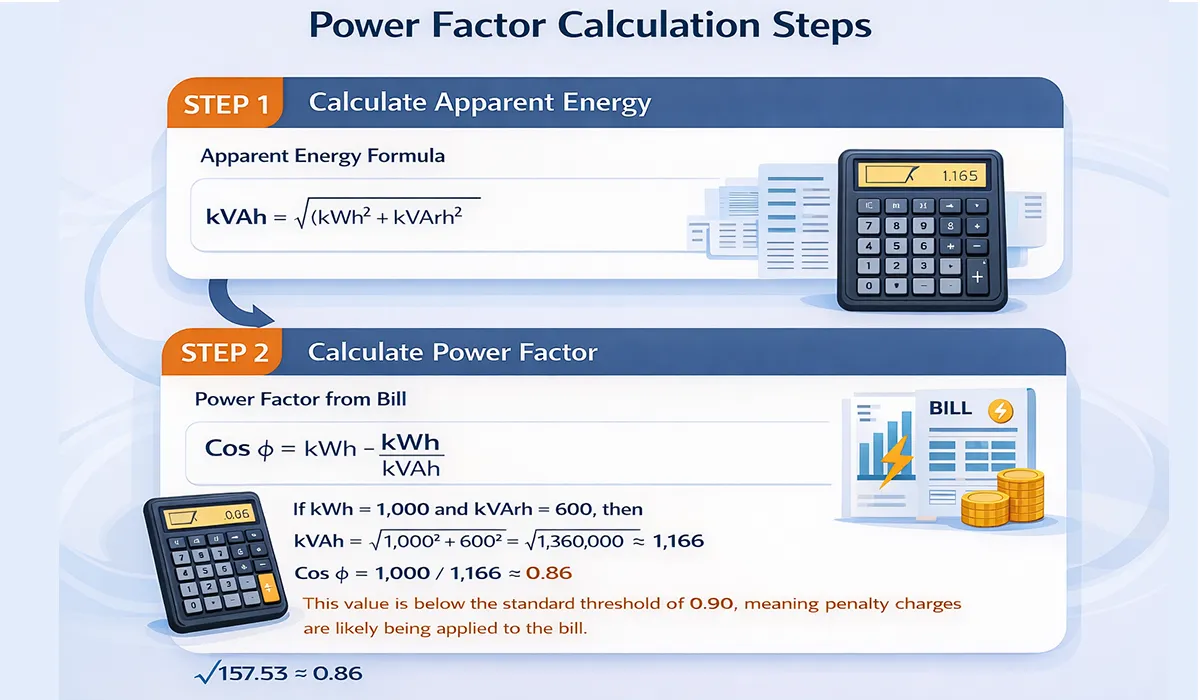
Step 1 — Calculate Apparent Energy
Apparent Energy Formula
This assumes power factor is broadly constant across the billing period. Because kWh and kVArh accumulate over a month of varying load, the result is an approximation — standard practice, and accurate enough for sizing, but not a substitute for a demand recording if your load profile swings widely.
Step 2 — Calculate Power Factor
Power Factor from Bill
Example:
If kWh = 1,000 and kVArh = 600, then
kVAh = √(1,000² + 600²) = √1,360,000 ≈ 1,166, and
Cos φ = 1,000 / 1,166 ≈ 0.86.
This value is below the standard threshold of 0.90, meaning penalty charges are likely being applied to the bill.
Calculating the Required Capacitor Bank Capacity
Once the current power factor is known, the required reactive compensation can be determined using the following formula:
Core Capacitor Sizing Formula
| Description | Symbol |
|---|---|
| Required capacitor bank capacity (kVAR) | Qc |
| Active power (kW) — use **peak demand kW**, not average kW derived from monthly energy | P |
| Angle of the current power factor = Cos⁻¹(current PF) | φ₁ |
| Angle of the target power factor = Cos⁻¹(target PF) | φ₂ |
Example:
Suppose P = 500 kW, current power factor = 0.86, and target power factor = 0.95.
Then φ₁ = Cos⁻¹(0.86) ≈ 30.68° giving tan φ₁ ≈ 0.5936, and
φ₂ = Cos⁻¹(0.95) ≈ 18.19° giving tan φ₂ ≈ 0.3287.
Therefore, Qc = 500 × (0.5936 – 0.3287) = 500 × 0.2649 ≈ 132.5 kVAR.
Practical Calculation Tips
-
Variable Loads: For facilities with fluctuating demand, use average monthly consumption figures or consider a stepped (automatic) capacitor bank that adjusts compensation dynamically.
-
Voltage Variations: Always account for the actual network voltage in your calculations, as deviations from nominal voltage affect capacitor output.
- Sizing margin and over-compensation: Target 0.95, not unity. Correcting to 1.0 risks a leading power factor at light load, which causes overvoltage and is penalised by many utilities. Size against peak demand kW, not the monthly average — sizing from the average under-compensates precisely when the penalty applies. Where load varies, use a stepped automatic bank so compensation tracks demand; that, not extra fixed capacity, is what protects against over-compensation. Add margin for genuine load growth only, and only with automatic switching in place.
-
System Frequency: Standard frequency in most regions is either 50 Hz or 60 Hz. Confirm your local grid frequency and adjust calculations accordingly, as capacitor reactance is frequency-dependent.
-
Harmonic Distortion: In facilities with significant non-linear loads such as variable frequency drives or UPS systems, consult a power quality specialist before sizing capacitors, as harmonics can cause resonance issues.
Return on Investment and Economic Savings
Consider a facility on a $10,000 monthly bill, of which $2,000 is a power factor penalty at 0.85. Correcting to 0.95 eliminates the penalty entirely.
The secondary saving is smaller than often claimed. Correcting 0.85 → 0.95 reduces current by about 11%, so I²R losses fall to roughly 80% of previous — a 20% reduction in losses. Since losses are typically 2–5% of consumption, that works out at around 0.5–1% of the bill, or $40–80 a month in this example.
Realistic total: about $2,050–$2,100 a month, almost all of it penalty elimination.
Payback Period
At a typical installed cost of $8,000–$15,000 for a bank of this size, that gives a payback of roughly 4 to 7 months — which is why capacitor banks remain one of the highest-return electrical investments available to industrial operators. The business case doesn’t need the loss savings to work; the penalty elimination carries it on its own.
Beyond direct savings, improved power factor frees capacity in transformers and feeders, which can defer infrastructure upgrades.

Electricity Billing: USA vs. Europe
Electricity billing systems vary widely between countries, which can affect how power factor is presented and how easily it can be corrected.
-
European Countries: In many European countries, industrial electricity bills provide clear breakdowns of active (kWh) and reactive (kVArh) energy usage. Power factor may be displayed directly on the bill, making it easy for businesses to see where they stand and whether they are at risk of penalty charges. In addition, EU regulations typically impose stricter standards for power factor correction, ensuring that businesses are incentivised to maintain a power factor above the penalty threshold — typically 0.90 or 0.95, rather than unity.
-
United States: In contrast, electricity bills in the USA may not always display kVArh values, and businesses often need to request them from their utility provider or calculate them manually. Although penalty charges for poor power factor are common in the US, the way these penalties are assessed can vary more significantly than in European countries. In many cases, utilities in the US offer incentives for businesses to correct their power factor, but these incentives may not be as regulated or standardized as those in the EU.
By understanding how power factor is reflected on your electricity bill — whether directly or indirectly — you can take the necessary steps to improve your energy efficiency, avoid penalties, and optimize your operations.
Do You Need a Capacitor Bank at Home?
Almost certainly not.
Residential tariffs bill on kWh only. Domestic meters don’t record kVArh, and no residential utility applies a power factor penalty — so there is nothing for a capacitor to save you. Household loads are also mostly resistive (heating, lighting, electronics), and where motors exist — fridge, air conditioner, pump — their reactive draw is small and intermittent.
The plug-in “power saver” devices sold online claim to cut bills through power factor correction. Even if they corrected power factor perfectly, your meter isn’t measuring the thing they’re improving.
Capacitor banks make sense where a utility bills reactive energy or applies a power factor penalty — industrial and larger commercial connections. If your bill shows no kVArh line and no power factor figure, you have nothing to correct.
Conclusion
Calculating and correcting the power factor through a properly sized capacitor bank is one of the most straightforward and financially rewarding steps an industrial or commercial facility can take. By analyzing the kWh and kVArh figures on your electricity bill and applying the formulas outlined in this guide, you can determine exactly how much reactive compensation your system needs — and build a clear business case for the investment.
For complex installations involving variable loads, harmonic distortion, or large-scale distribution systems, it is strongly recommended to engage a qualified power systems engineer to ensure the capacitor bank is designed and integrated safely and effectively.





Rate this article
Choose a rating from 1 to 5 stars.
No ratings yet