


Industrial control panels get rejected for two reasons: they’re unsafe, or they’re unlabeled. The second one is more common, and it can easily be avoided if you choose the right compliance path early.
This guide covers field evaluation in practical terms — what the process involves, what the AHJ wants to see, and what documentation prevents delays — and sets it against UL Listing so you can tell which route your equipment actually needs.
If your goal is simple approval with minimal rework, don’t guess. Build the right evidence package from day one.
Key Differences at a Glance
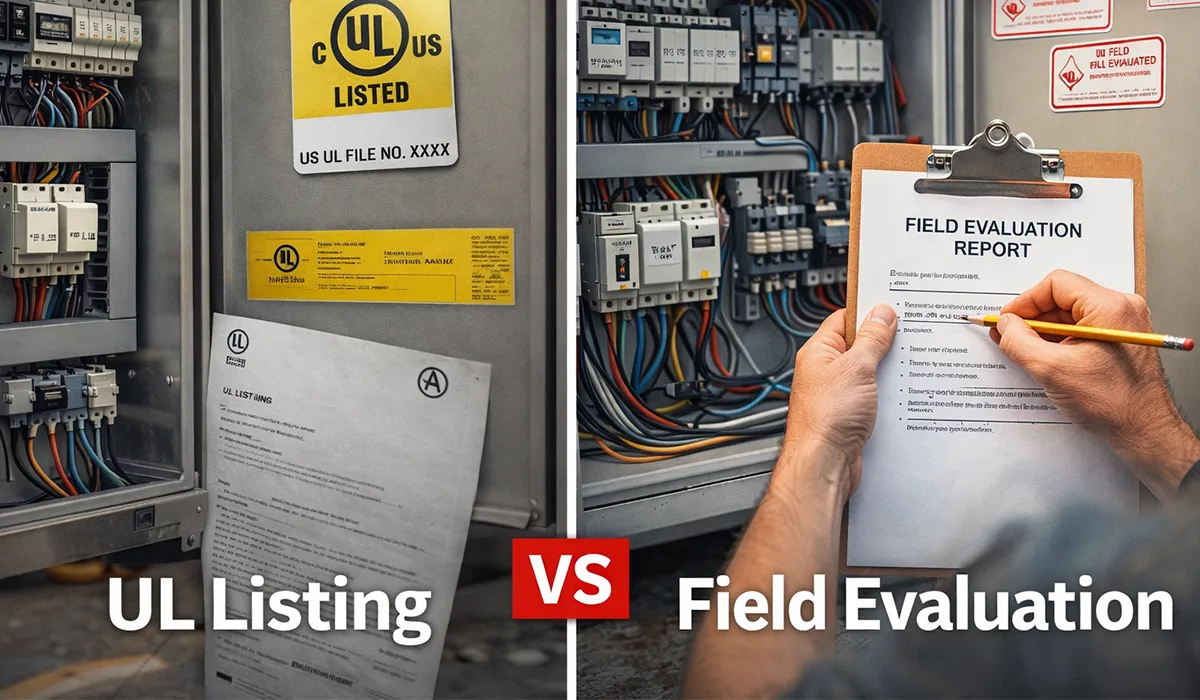
A UL Listing is built for repeatability: you’re establishing a controlled manufacturing process that supports applying a Listing Mark across multiple builds.
UL publishes the requirements for its panel shop program, including qualification and follow-up obligations.
A Field Evaluation (often resulting in “field labeled equipment”) is built for exceptions: one-off builds, prototypes, legacy equipment, site-built assemblies, or modified machines that were never listed in the first place.
Both routes can satisfy an AHJ, but they do it differently. Listing is a program. Field evaluation is a project.
Comparison Table: UL Listing vs Field Evaluation
| Field Evaluation | UL Listing (UL 508A) | |
|---|---|---|
| Best for | One-off, custom, prototype, legacy, modified, imported without a mark, site-built | Repeat production, multiple customers, standardised designs |
| Where verified | On site at the installed location, or on staged equipment | In your shop, under an ongoing program |
| Marking | Field Evaluated / Field Label applied to that specific unit | UL Listing Mark applied to eligible panels under the program |
| Repeatability | None — the label covers the evaluated configuration only | Unlimited within the listed scope |
| Timeline | Fast once scheduled; repeated in full for each unit | Slow to establish; fast for every build after |
| Typical friction | Missing drawings, component evidence gaps, on-site discrepancies | Quality system discipline, controlled revisions, follow-up inspections |
| What the AHJ gets | An evaluation report plus a label tied to that equipment | A recognised mark backed by certification and follow-up |
| Governing documents | NFPA 790 (evaluator competency), NFPA 791 (procedure) | UL 508A |
When to Choose Field Evaluation
Choose field evaluation when the equipment is custom, already installed, modified, imported without a mark, or needed urgently and listing is not realistic for the project timeline.
Pre-Field Evaluation: Finding Problems Before the Evaluator Does
A pre-field evaluation is a preliminary review carried out before the formal evaluation is scheduled. The reviewer looks over drawings, the bill of materials, SCCR evidence and construction, and identifies where the equipment would fail.
The economics are straightforward: a failed evaluation means a discrepancy list, rework, and a return visit — engineering time, travel and site access billed twice. A pre-review costs less than the second visit, and it happens on your schedule rather than the inspector’s.
It’s worth doing when the panel was built without a compliance path in mind, when documentation is incomplete, when components were substituted during the build, or when the equipment was imported without a mark and you have no visibility of how it was constructed.
When to Choose Listing
Choose listing when you are going to build the same panel design repeatedly, sell to multiple customers, or want your shop to apply a UL mark as part of a controlled manufacturing program.
AHJ Approval and Acceptance
The Authority Having Jurisdiction (AHJ) interprets code, approves equipment, and can require additional evidence when a label is missing.
The IAEI publishes guidance on approval and the inspector’s role that explains how AHJs exercise that authority in practice.
Many AHJs accept field evaluation labels and reports for unlabeled, custom, or modified equipment. Some jurisdictions and owners still prefer listed equipment for new installs or standardized specs. Pre-coordinate early: before the panel ships or gets energized, ask the AHJ what evidence they want and which evaluators they accept.
What AHJs Look For
Most AHJs focus on obvious hazards (shock/fire), correct markings, legitimate SCCR evidence when applicable, and an evaluation report that ties construction to the relevant product standard and the installation field an evaluation report that ties construction to the relevant product standard and to the conditions at the installation
Handling Discrepancies On-Site
Field evaluations often result in friction lists. Treat it like a punch list: fix items fast, document corrective actions with photos and revised drawings, and be prepared for targeted re-testing or a re-check visit.
Who Does What: NRTL, UL, OSHA
In the U.S., the OSHA NRTL program recognises organisations that can test and certify products to US consensus-based product safety test standards. Recognition is granted per standard, so an NRTL’s scope matters — always verify the organisation is recognised for the specific standard your equipment falls under before engaging.
UL is an NRTL, but it’s not the only one. Other NRTLs can list products and perform field evaluations depending on their scope and services. A Field Evaluation Body (FEB) performs field evaluations and issues reports and labels for unlabeled equipment.
Component Recognition vs Listing
A Recognized component is intended to be used inside a larger listed product. A Listed product is evaluated as an end-use item suitable for installation under applicable codes. Specifying a Recognized component where a Listed one is required — or applying a Recognized part outside its conditions of acceptability — is one of the most common evaluation failures, and it usually surfaces after the panel is built.
The EU equivalent distinction runs through CE marking for industrial control panels, where the assembly is declared rather than certified by a third party.
Procedure: Listing vs Field Evaluation
Listing and field evaluation share a core idea: construction review plus testing, with documentation to back it up. The difference is where that rigor lives.
With listing, you’re building a repeatable shop process: controlled drawings, controlled parts, controlled changes, and a consistent marking scheme. The inspection is not a one-time event — it’s ongoing oversight.
With a field evaluation, the evaluator reviews the specific unit where it exists, checks construction and markings, performs relevant tests, and issues a report. If it passes, the evaluator applies a field label to that configuration.
UL documents its field evaluation service, including scope and what the engagement covers.
Field Evaluation Steps (NFPA 791 Style)
A common sequence is: intake and scope definition, document review, on-site inspection, targeted testing, discrepancy resolution, final report issuance, then applying a field label to the evaluated unit.
Shop Listing Workflow (UL 508A)
A listing workflow typically includes training and qualification, quality system setup, building to UL 508A requirements, internal recordkeeping, controlled revisions, and follow-up inspections that support applying the Listing Mark to eligible panels.
Documentation Package Checklist
Documentation is what keeps inspection from becoming investigation. The fastest approvals happen when the evaluator and AHJ can verify construction without guessing.
Drawings and Studies to Include
The most missed items are the single-line diagram, an SCCR evidence trail, and site-specific fault current information. If an evaluator has to reverse-engineer your intent, your schedule loses.
Nameplate and Markings
Treat the nameplate as the AHJ’s at-a-glance proof. If SCCR, ratings, and identity are unclear, everything slows down.
Checklist: Markings & Identity
- Draft nameplate: manufacturer, voltage, frequency, full-load current/HP (as applicable), SCCR, environmental rating
- Label map: where each marking will be placed and what it references
- Wire/terminal torque info (on drawing or instructions)
Checklist: Drawings
- Single-line diagram
- Schematic wiring diagram (power + control)
- Layout drawing or clear internal photos (spacing, barriers, wire routing, bonding/grounding)
Checklist: Parts Evidence
- Bill of Materials (BOM)
- Datasheets for critical components (OCPD, contactors, power supplies, transformers, drives)
- Proof of certification status where relevant (Listed vs Recognized) and ratings
Checklist: Ratings & Studies
- SCCR calculation or verification evidence (commonly using UL 508A methods such as Supplement SB)
- Available fault current at the installation location (or project engineer’s AFC note)
- OCPD selection rationale and coordination notes (especially for motor circuits)
Checklist: Build & Test Records
- Assembly/work instructions used
- Functional test checklist (E-stop, interlocks, controls)
- Ground/bonding continuity checks (and any other tests performed)
Technical Checks During Evaluation
Evaluators look for the conditions that create real hazards: overheating, inadequate protection, missing bonding, poor spacings, and misapplied components. For control panels, the high-value checks often land around SCCR, overcurrent protection selection, correct component usage (Listed vs Recognized), and internal spacing/creepage rules.
SCCR and OCPD Coordination
SCCR is a common pass/fail item. Be ready to show component SCCRs, series ratings when used, and how upstream protection supports the marked rating at the panel’s rated voltage.
Where series ratings are used, the combination has to be a tested pair — see overcurrent protection methods for how let-through energy affects what downstream components survive.
Spacings, Creepage, and Wiring
Spacing issues (clearance/creepage), sloppy terminations, missing strain relief, and weak bonding/grounding show up constantly in discrepancy reports. Fixing them in the shop is cheaper than fixing them on-site.
Cost and Lead-Time Ranges (U.S.)
Field evaluations are typically priced as a service engagement: engineering review time, on-site time, travel, testing needs, and how many insufficiencies need rework. Listing costs show up differently: program onboarding, training, quality system discipline, and ongoing follow-up activities. It pays off when you build many panels.
Cost Drivers Explained
Big drivers include panel complexity, missing documentation, site accessibility, travel time, and whether testing becomes destructive or requires specialized equipment.
Lead-Time Comparison
Field evaluations can move quickly once scheduled, and a label is commonly applied once compliance is demonstrated for that unit. Listing is slower to start, but faster for every build after the program is running.
Standards and Governance (U.S.)
Two NFPA documents govern field evaluation, and it’s worth knowing which does what:
- NFPA 790 — Standard for Competency of Third-Party Field Evaluation Bodies. Sets what an FEB must demonstrate: personnel qualifications, quality system, independence, and recordkeeping. This is what you’re checking when you verify an evaluator.
- NFPA 791 — Recommended Practice and Procedures for Unlabeled Electrical Equipment Evaluation. Defines the evaluation procedure itself: scope determination, document review, construction inspection, testing, discrepancy resolution, reporting and labelling. The sequence in the steps section above is NFPA 791’s.
AHJs vary in how explicitly they reference these, but an evaluator working outside them will struggle to produce a report that holds up. When confirming which evaluators a jurisdiction accepts, asking whether they operate to NFPA 790 and 791 is a reasonable question.
For industrial control panels, UL 508A is the construction standard many evaluators and panel shops align to, and NEC installation requirements drive what markings and ratings matter at the jobsite.
NEC Triggers for Panels
The NEC treats industrial control panels as assemblies with installation-related requirements. In practice, that’s why markings like SCCR (when applicable) matter so much at inspection time.
Verifying NRTL Status
Before hiring someone to label equipment, verify recognition and scope, then confirm the AHJ accepts that organization’s mark and reporting for your project type.
Can I Use UL 508A Without Listing?
You can build a panel to UL 508A construction practices without it being UL Listed. That can still help you pass a field evaluation, because you’re aligning to the same construction logic.
But “built to UL 508A” is not the same as “UL Listed.” Listing is about a mark backed by a certification and follow-up program, not just a design intent. If you need a mark for procurement, insurance, or multi-site deployment, “built to” is usually not enough.
“Built to UL” vs Listing
“Built to” is a claim. Listing is third-party certification plus a mark. AHJs and owners usually treat those differently.
Special Inspection vs Field Evaluation
“Special inspection” language varies by project and jurisdiction. Don’t assume it’s interchangeable with a field evaluation. Use the AHJ’s exact wording to pick the right service and deliverables.
Real-World Approval Scenarios (U.S.)
Compliance decisions get real when schedule and equipment reality collide. For new product lines and repeat builds, listing is typically the cleaner long-term play. For installed, customized, imported-without-mark, or modified equipment, field evaluation is often the practical route without redesigning everything.
Legacy/Retrofit Panels
Retrofit panels often fail on missing documentation and mismatched components. A field evaluation paired with a corrected documentation package is usually faster than trying to retroactively list a one-off unit.
Site-Built Custom Equipment
For panels built or assembled on-site, a field evaluation is often the realistic route because the final configuration only exists at the installation location.
Choosing Your Path
There is no single “best” path for every control panel — only the right path for the equipment, timeline, and deployment model. UL Listing is the stronger long-term strategy when you build repeatable designs and need a recognized certification mark across multiple units. Field Evaluation is often the fastest practical path for one-off, modified, legacy, imported-without-mark, or site-built equipment where a listing program is not realistic.
The key to avoiding delays is not waiting until inspection day. Decide your compliance path early, confirm AHJ expectations before shipment or energization, and build a documentation package that proves construction, ratings, and markings without guesswork. In most projects, approval problems are caused less by the hardware itself and more by missing evidence.


Rate this article
Choose a rating from 1 to 5 stars.
No ratings yet