

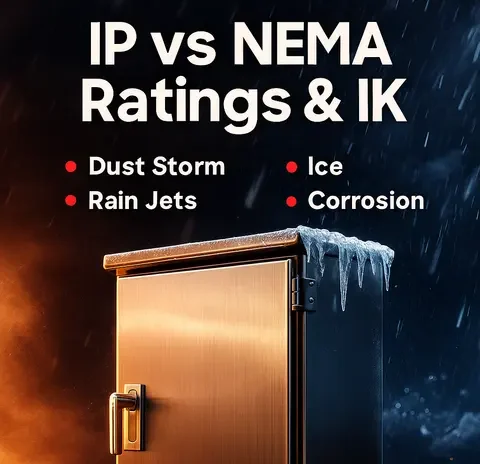

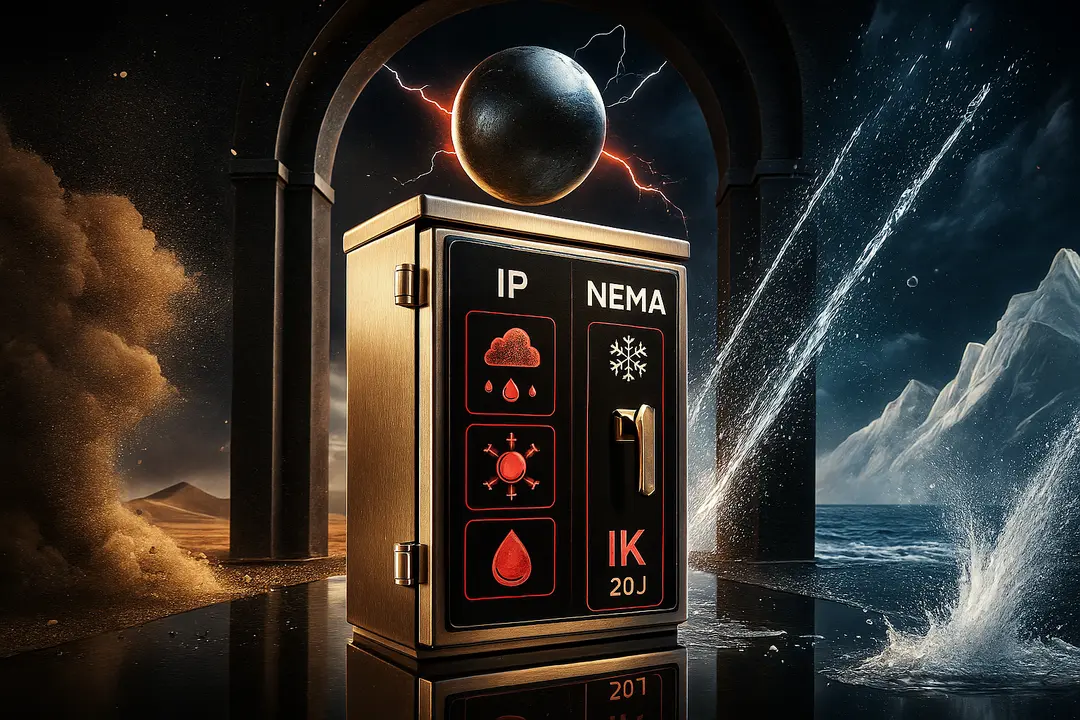
Choosing between IP vs NEMA ratings is one of the most common specification decisions an engineer faces when selecting electrical enclosures — and one of the most misunderstood. IP ratings (IEC 60529) define protection against dust and water ingress. NEMA ratings (UL 50) go further, covering corrosion resistance, icing, and in some Types, hazardous atmospheres. Add IK impact ratings into the mix and the comparison becomes genuinely complex. This guide cuts through that complexity with direct mappings, side-by-side comparisons, and practical guidance for North American, European, and global projects.
IP vs NEMA Ratings & IK — A Practical Engineer’s Guide
What each standard covers
- IP: ingress of dust and water.
• NEMA: ingress + corrosion/ice; some Types for special atmospheres.
• IK: impact resistance in Joules for vandal or industrial risk areas.
For comprehensive insights into IEC, UL, and CE Standards, check out this article.
IP Rating Chart — What Each Digit Means
An IP (Ingress Protection) code is always written as IP followed by two digits. The first digit rates protection against solid objects and dust. The second digit rates protection against liquids. A rating of “X” in either position means that dimension was not tested (e.g., IPX7 = liquid-tested only).
Use the tables below to decode any IP code you encounter on a datasheet or enclosure label.
Table 1 — First Digit: Solid Object & Dust Protection (IEC 60529)
| First Digit | Protection Level | What It Means in Practice |
|---|---|---|
| 0 | No protection | No barrier against contact or ingress of solids |
| 1 | >50 mm | Protected against objects larger than 50 mm (e.g., accidental hand contact) |
| 2 | >12.5 mm | Protected against objects larger than 12.5 mm (e.g., fingers) |
| 3 | >2.5 mm | Protected against tools, thick wires, and objects larger than 2.5 mm |
| 4 | >1 mm | Protected against most wires, screws, and small objects larger than 1 mm |
| 5 | Dust-protected | Ingress of dust is not fully prevented, but cannot enter in amounts that would impair operation |
| 6 | Dust-tight | No ingress of dust whatsoever; complete protection against contact |
Table 2 — Second Digit: Liquid Ingress Protection (IEC 60529)
| Second Digit | Protection Level | Test Conditions | What It Means in Practice |
|---|---|---|---|
| 0 | No protection | — | No barrier against any liquid |
| 1 | Dripping water | 1 mm/min rainfall, vertical, 10 min | Handles condensation and light vertical drips |
| 2 | Dripping water (tilted) | 1 mm/min, enclosure tilted up to 15°, 10 min | Same as above when the enclosure is slightly angled |
| 3 | Spraying water | Up to 60° from vertical, 10 min | Rain, light outdoor spray, or overhead splash |
| 4 | Splashing water | All directions, 10 min | Splash from any angle; typical indoor washdown starting point |
| 5 | Water jets | 6.3 mm nozzle, |
For a more detailed explanation, please check this guide.
NEMA Types
The five types below are the most commonly specified in North American industrial and commercial projects but are absent from the current article. Each entry includes the standard description (drawn from NEMA 250), the primary use case, and the closest IP equivalent with a brief caveat explaining why the mapping is approximate.
| NEMA Type | Indoor / Outdoor | Protection Provided | Approx. IP Equivalent | Key Caveat |
|---|---|---|---|---|
| 2 | Indoor | Protection against limited amounts of falling water and dirt (drip-proof) | IP11 | IP11 allows dripping water at 15° tilt; NEMA 2 is tested vertically only. Not suitable where splashing is possible. |
| 5 | Indoor | Dust-tight; protection against settling airborne dust, lint, fibers, and flyings; dripping and light splashing of non-corrosive liquids | IP52 | Closely matches IP52. NEMA 5 additionally specifies resistance to dust and lint accumulation on internal surfaces, which IP52 does not explicitly address. |
| 7 | Indoor (hazardous) | For use in Class I, Groups A, B, C, or D hazardous locations as defined by the NEC; contains an internal explosion and prevents ignition of the surrounding atmosphere | No direct IP equivalent | IP ratings do not address explosion containment. Specify ATEX / IECEx Zone 1 equipment for the international equivalent, but these are not interchangeable without independent certification. |
| 9 | Indoor (hazardous) | For use in Class II, Groups E, F, or G hazardous locations (combustible dust environments) as defined by the NEC; dust-ignitionproof | No direct IP equivalent | Again, no IP analog. The closest international framework is ATEX / IECEx Zone 21/22, but direct substitution requires separate certification. |
| 13 | Indoor | Oil-tight and dust-tight; protection against lint, dust, seepage, external condensation, and spraying, splashing, or seeping of water, oil, and non-corrosive coolants | IP54 (practical minimum); often closer to IP65 in practice | NEMA 13 is specifically designed for machine tool and manufacturing environments where coolant and cutting oil exposure is routine. IP54 covers dust protection and spray but says nothing about oil resistance; always verify the enclosure gasket material (typically neoprene or silicone) for the specific fluid involved. |
Notes on Types 7 and 9: The absence of an IP equivalent for these two types is an important editorial point worth making explicitly in the article. Engineers specifying hazardous-location enclosures sometimes incorrectly assume a high IP rating (e.g., IP66 or IP68) provides the same level of safety as a NEMA 7 or 9 enclosure. It does not. IP addresses ingress only; NEMA 7 and 9 address the ability to contain an internal arc or explosion and prevent it from propagating to the surrounding atmosphere. This distinction should be called out in a short inline note beneath the table.
NEMA 4X vs IP66 (washdown)
IP66 = dust‑tight + strong jets. NEMA 4X = hose water + dust + ice + corrosion resistance. If chemicals or salt are present, 4X is usually safer.
NEMA 12 vs IP55 — Indoor Industrial Protection
For indoor industrial environments, NEMA 12 protects against dust, lint, dripping liquids, and light exposure to oils or coolants. By contrast, IP55 provides dust protection and resistance to low-pressure water jets. In practical terms, NEMA 12 is often closer to IP52 than IP55 because it emphasizes indoor contaminants rather than jet-water exposure.
NEMA 3R vs IP54 — Basic Outdoor Rain Protection
When basic outdoor rain protection is required, NEMA 3R is designed for rain, sleet, snow, and external ice formation. IP54, on the other hand, provides dust protection and resistance to water spray from multiple directions. The key difference is that NEMA 3R focuses more on weather exposure, while IP54 focuses on dust and spray ingress.
IK impact rating — simple view
IK shows how much impact energy the enclosure can take. For public areas or tough plants, aim for at least IK08.
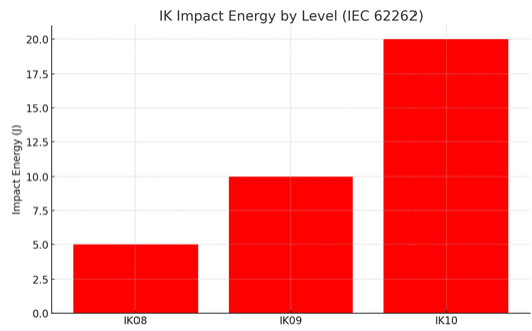
Figure: Red bars show impact energy by IK level (higher Joules = stronger).
| IK level | Impact (J) | Example test (mass × height) |
|---|---|---|
| IK08 | 5 | ≈1.7 kg × 0.3 m |
| IK09 | 10 | ≈5 kg × 0.2 m |
| IK10 | 20 | ≈5 kg × 0.4 m |
If you found this article helpful, you may also want to read our article on IP55 vs NEMA 12.
IP69K vs NEMA 4X (high‑pressure cleaning)
IP69K handles very hot (≈80°C), high‑pressure jets. NEMA 4X covers hose‑down plus corrosion. In food/beverage and CIP/SIP areas, check both the rating and the material (e.g., 316L stainless steel).
Seals, glands, and materials matter
Your rating is only as strong as the weakest opening. Use cable glands with equal or higher IP/NEMA rating, seal unused knockouts, and torque correctly. For coastal or chemical exposure, choose 316L stainless steel or quality polycarbonate and consider NEMA 4X+IP66.
Regional practice: US vs EU
North America usually specifies NEMA Types; Europe and much of Asia use IP + IK. Many products offer dual‑marking (e.g., NEMA 4X / IP66) for easy procurement.
For further reading, visit this resource.
Conclusion: IP vs NEMA Ratings
Understanding IP vs NEMA Ratings is essential when selecting the right electrical enclosure for industrial, commercial, or outdoor applications. While IP ratings clearly define protection against dust and water ingress, NEMA ratings provide a broader view by including additional factors such as corrosion resistance, icing, oil exposure, and hazardous-location requirements.
For simple applications, an IP rating may be enough to describe the required level of ingress protection. However, in harsher environments such as washdown areas, coastal sites, food-processing facilities, machine shops, or chemical plants, NEMA ratings often provide a more complete specification framework. IK ratings should also be considered where impact, vandalism, or heavy industrial use is a concern.
The key takeaway is that IP vs NEMA Ratings should not be treated as direct one-to-one equivalents. Engineers should evaluate the actual operating environment, enclosure material, gasket compatibility, cable glands, certification requirements, and regional code expectations before making a final selection. For global projects, dual-rated enclosures such as NEMA 4X / IP66 with a suitable IK rating often provide the most practical and reliable solution.

Rate this article
Choose a rating from 1 to 5 stars.
No ratings yet