


Why Are Electrical Panels Important?
The electrical panel is arguably the single most important component in a building’s electrical infrastructure. Without it, there would be no organized, safe way to distribute utility power to the dozens — or hundreds — of circuits that modern buildings depend on. Every light switch you flip, every outlet you plug into, and every appliance that runs in your building traces its power back to the electrical panel.
Beyond distribution, the electrical panel is the primary safety device in the building’s electrical system. Each circuit breaker inside the panel is calibrated to monitor the current flowing through its circuit at all times. The moment that current exceeds the safe limit for the wiring on that circuit — due to an overload, a short circuit, or a ground fault — the breaker trips instantly, cutting power before the wiring can overheat and ignite. This automatic protection is the primary reason electrical fires in modern buildings are far less common than they were in the era of unprotected wiring and fuse boxes.
Electrical panels also play a critical role in building code compliance, insurance coverage, and property value. An outdated, undersized, or recalled panel is one of the most common reasons a property fails an inspection, is denied homeowner’s insurance, or loses value relative to comparable properties. Conversely, a modern, correctly sized panel with room for future expansion is a genuine asset — making a building ready for EV charging, electrified HVAC systems, and smart home technology.
How Does an Electrical Panel Work?
Understanding how electricity moves through an electrical panel requires following its journey from the utility connection all the way to the individual circuits that power your lights, outlets, and appliances.
Electricity arrives at the panel from the utility company via the service entrance conductors — large-gauge wires running from the electric meter directly into the top of the panel enclosure. These conductors remain live at all times, even when the main breaker is switched off.
Once inside, incoming power passes through the main breaker, which acts as the master on/off switch for the entire building and defines the maximum total current the panel can safely deliver. From the main breaker, power flows onto the bus bars — flat copper or aluminum conductor bars that run the full length of the panel interior. Individual circuit breakers clip directly onto these bus bars and draw power for their assigned circuits.
Each circuit breaker continuously monitors the current flowing through its circuit. If that current exceeds the breaker’s rated capacity, the breaker trips automatically — cutting power to that single circuit while the rest of the building remains fully powered. Once the underlying cause is resolved, the breaker is reset simply by flipping it back to the ON position.
The neutral bar and ground bar complete the system. The neutral bar collects return current from all branch circuits and routes it back to the utility. The ground bar provides a safe fault current path to earth, ensuring protective devices trip instantly in the event of a wiring fault.
Key Components Inside an Electrical Panel
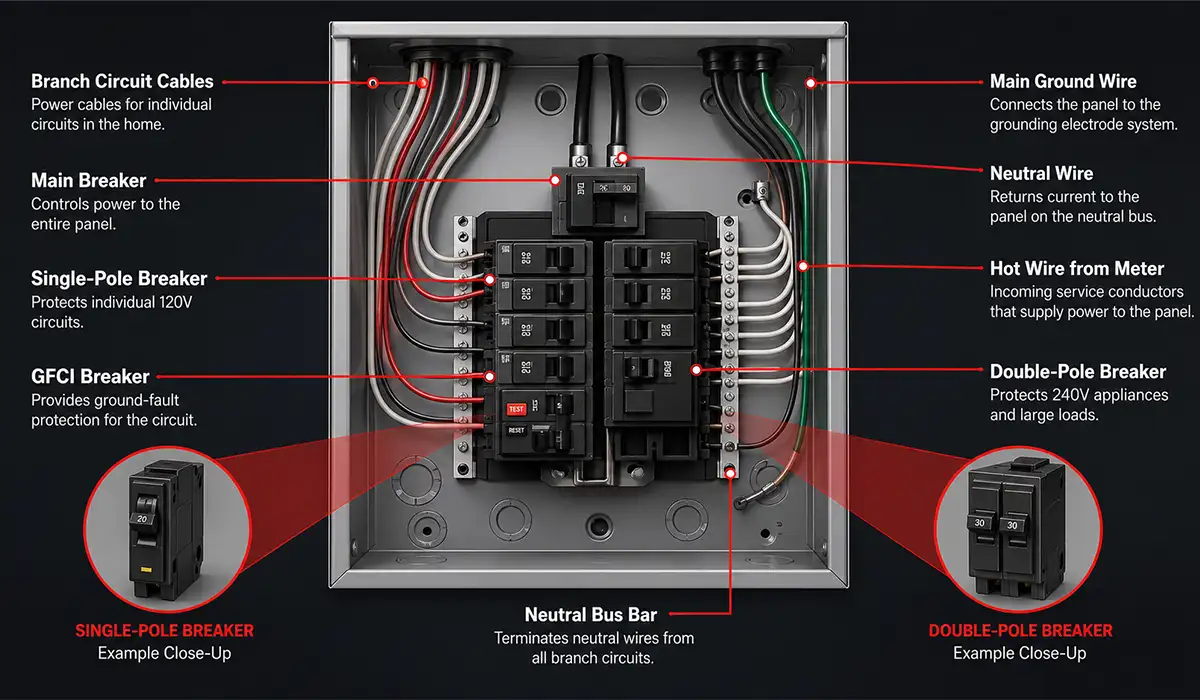
Understanding each component inside an electrical panel helps homeowners identify problems, plan upgrades, and communicate more effectively with electricians.
Main Breaker
The master circuit breaker that controls all power entering the panel. It defines the panel’s total amperage capacity — commonly 100A, 150A, 200A, or 400A in residential applications. Switching it off cuts power to every circuit simultaneously, making it an essential safety tool during maintenance or emergencies.
Busbars
Flat metal conductor bars — typically copper or aluminum — that distribute incoming power from the main breaker to all individual circuit breakers. In a standard residential split-phase 240V system, two hot bus bars each carry 120V relative to neutral.
Circuit Breakers
Individual protective switches that each control one branch circuit. They trip automatically when current exceeds their rated amperage. Single-pole breakers range from 15A to 20A for general circuits; double-pole breakers deliver 240V for high-draw appliances such as electric dryers, ranges, and HVAC units.
Neutral Bar
A metal busbar where all neutral (white) wires from branch circuits terminate. Provides the return current path back to the utility. In a main panel, the neutral bar is bonded to both the ground bar and the enclosure — a critical requirement of the NEC. In a subpanel, the neutral bar must be fully isolated from the ground bar.
Ground Bar
Where all grounding conductors (green insulated or bare copper wires) terminate. Provides a safe fault current path to earth, ensuring protective devices trip instantly in the event of a wiring fault rather than allowing dangerous voltage to appear on exposed metal surfaces.
Service Entrance Conductors
The large-gauge wires that carry utility power from the meter into the panel. They connect directly and permanently to the main breaker terminals and are always live — even when the main breaker is in the OFF position. These conductors must never be handled by anyone other than a licensed electrician or utility technician.
Table 1 — Component Quick Reference
| COMPONENT | FUNCTION | LOCATION IN PANEL |
|---|---|---|
| Main Breaker | Master on/off switch; sets total ampacity limit for the entire building | Top of panel enclosure |
| Bus Bars | Distribute incoming power from main breaker to all individual circuit breakers | Center rail, full panel height |
| Circuit Breakers | Protect individual branch circuits from overcurrent; trip automatically on fault | Clipped onto bus bars |
| Neutral Bar | Return current path from all circuits back to the utility | Side rail inside panel |
| Ground Bar | Safety earth connection; provides fault current path to ground | Side rail (bonded to neutral in main panel) |
| Service Entrance Conductors | Carry utility power from the meter into the panel — always live | Top entry point of enclosure |
Types of Electrical Panels
Electrical panels vary significantly depending on the application, building type, voltage configuration, and position within the distribution system. The five main categories cover everything from a standard home to a heavy industrial facility.
Main Service Panel
The primary electrical panel in any building — the first and most important point of distribution after the utility meter. It houses the main breaker and all primary branch circuit breakers and establishes the maximum electrical capacity available to the entire building. Every structure has at least one main service panel.
Subpanel
A secondary distribution panel fed from the main panel via a dedicated feeder circuit. Subpanels are used when a building has a detached structure, when a large addition requires more circuits than the main panel can accommodate, or when a specific zone needs its own localized distribution point. Per NEC Article 225, the neutral and ground bars in a subpanel must remain isolated from each other.
Residential Panel
Also called a load center. Designed for the voltage and circuit requirements of homes — typically 100A to 200A, with up to 400A for larger properties. Houses both 120V single-pole breakers for general circuits and 240V double-pole breakers for high-draw appliances. Must meet UL 67 panelboard standards.
Commercial Panel
Operates at significantly higher amperage ratings and is frequently supplied with three-phase power at 208V or 480V — far more efficient for large motors, HVAC systems, and high-capacity lighting found in office buildings, retail centers, restaurants, and light industrial facilities.
Industrial Panel
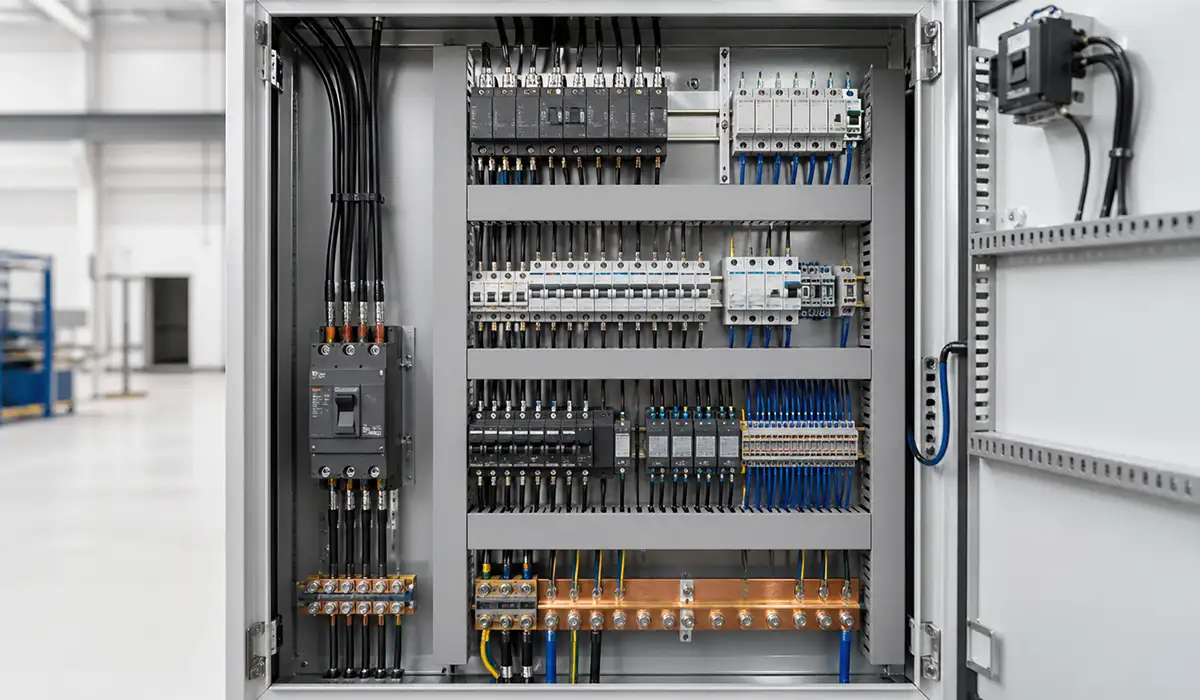
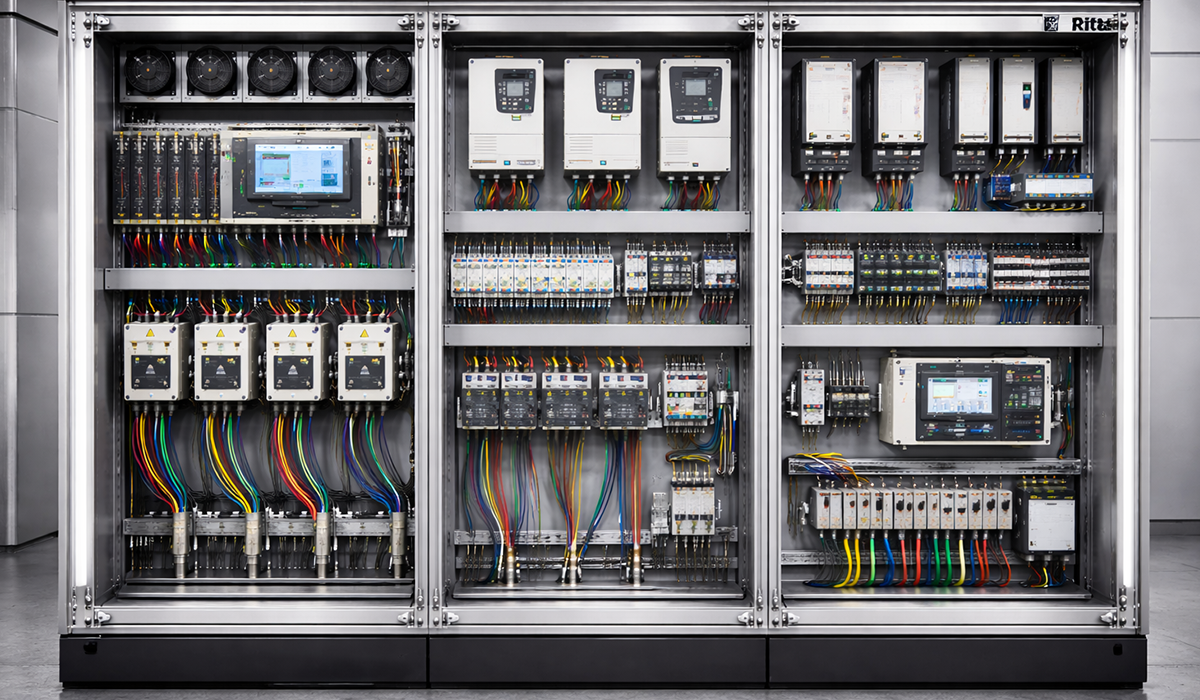
The most complex and highly engineered category. Industrial panels are complete control systems housing motor starters, PLCs, variable frequency drives (VFDs), contactors, relays, DIN rail-mounted components, HMIs, and sophisticated monitoring systems. Built to UL 508A and IEC 60439 standards for specific machine or process control applications.
Table 2 — Panel Type Comparison
| PANEL TYPE | TYPICAL AMPERAGE | VOLTAGE | PRIMARY USE | KEY STANDARD |
|---|---|---|---|---|
| Main Service Panel | 100A – 400A | 120/240V single-phase | Primary feed for any building | UL 67 / NEC |
| Subpanel | 60A – 200A | 120/240V | Secondary zones, detached structures | NEC Article 225 |
| Residential Panel | 100A – 200A | 120/240V | Home circuit distribution | UL 67 |
| Commercial Panel | 200A – 2,000A | 208/480V 3-phase | Office, retail, light industrial | NEC / UL 67 |
| Industrial Panel | Custom | 480V 3-phase+ | Machine control, automation, process | UL 508A / IEC 60439 |
Where Are Electrical Panels Used?
Electrical panels are found in virtually every built environment — from the simplest garden shed to the most complex industrial facility. The type, size, and configuration of the panel changes dramatically depending on the application, but the core function remains the same: safely receive power and distribute it where it is needed.
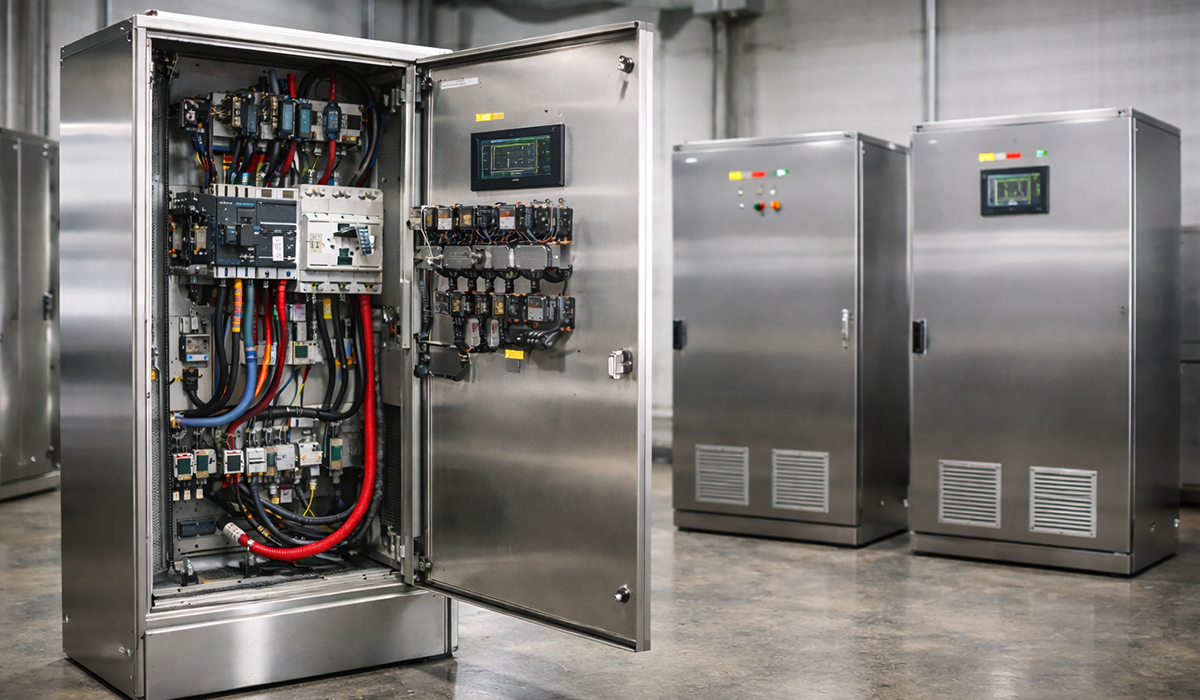
In residential settings, the electrical panel sits at the heart of every home’s electrical infrastructure. In commercial buildings, panels operate on three-phase power at higher voltages to meet far greater electrical demands. Hospitals and data centers add critical load panels, automatic transfer switches, and UPS systems to ensure certain circuits never lose power. In outdoor and utility environments, panels are housed in NEMA-rated weatherproof enclosures — NEMA 3R for outdoor residential, NEMA 4 and 4X stainless steel for harsh industrial and marine environments.
Table 3 — Where Electrical Panels Are Used
| SETTING | PANEL TYPE USED | KEY CHARACTERISTICS |
|---|---|---|
| Single-family home | Residential load center | 100A–200A, 120/240V split-phase, 20–40 circuits |
| Apartment / multi-unit | Residential + subpanels | Individual unit panels fed from a building-level main panel |
| Office building | Commercial panelboard | Three-phase, 208V/480V, higher circuit count |
| Retail / restaurant | Commercial panelboard | High-draw circuits for HVAC, kitchen equipment, signage |
| Hospital / data center | Commercial + redundant UPS | Critical load panels, redundant feeds, backup power systems |
| Factory / manufacturing | Industrial control panel | UL 508A, PLCs, VFDs, motor starters, 480V 3-phase |
| Outdoor / utility | NEMA-rated weatherproof | Sealed enclosures rated for exposure (NEMA 3R, 4, 4X) |
Electrical Panel Amperage — What Capacity Do You Need?
The amperage rating of an electrical panel is the maximum current it can safely handle at any given moment — not a measure of what is constantly flowing. Selecting the correct amperage is one of the most consequential decisions in any electrical installation or upgrade.
- 100A panel: Appropriate for small older homes that rely primarily on gas heating and gas cooking. Increasingly inadequate for modern electrical loads and not compliant with some current local NEC amendments for new construction.
- 200A panel: The current standard for new residential construction across the United States. Comfortably handles full electric appliances, central HVAC, a single EV charger, and typical household circuits with headroom to spare.
- 400A panel: Required for large homes, multi-unit residential properties, or any building with unusually heavy simultaneous electrical loads — multiple EV chargers, a large heat pump system, a home workshop, or a whole-home battery backup installation.
Table 4 — Amperage Sizing Guide
| PANEL SIZE | IDEAL FOR | TYPICAL APPLICATIONS | NEW BUILD STANDARD? |
|---|---|---|---|
| 100A | Small older homes with gas appliances | Basic lighting, outlets, gas HVAC, gas range | No — being phased out |
| 200A | Modern homes — current standard | EV chargers, heat pumps, electric dryers, full HVAC | Yes |
| 400A | Large homes, heavy loads, multi-unit | Multiple EVs, large HVAC, workshops, home additions | Required for large builds |
Note: A licensed electrician must always perform a formal load calculation — defined by NEC Article 220 — to determine the correct panel size for any specific building. The figures above are general guidance only.
Factors to Consider When Choosing an Electrical Panel
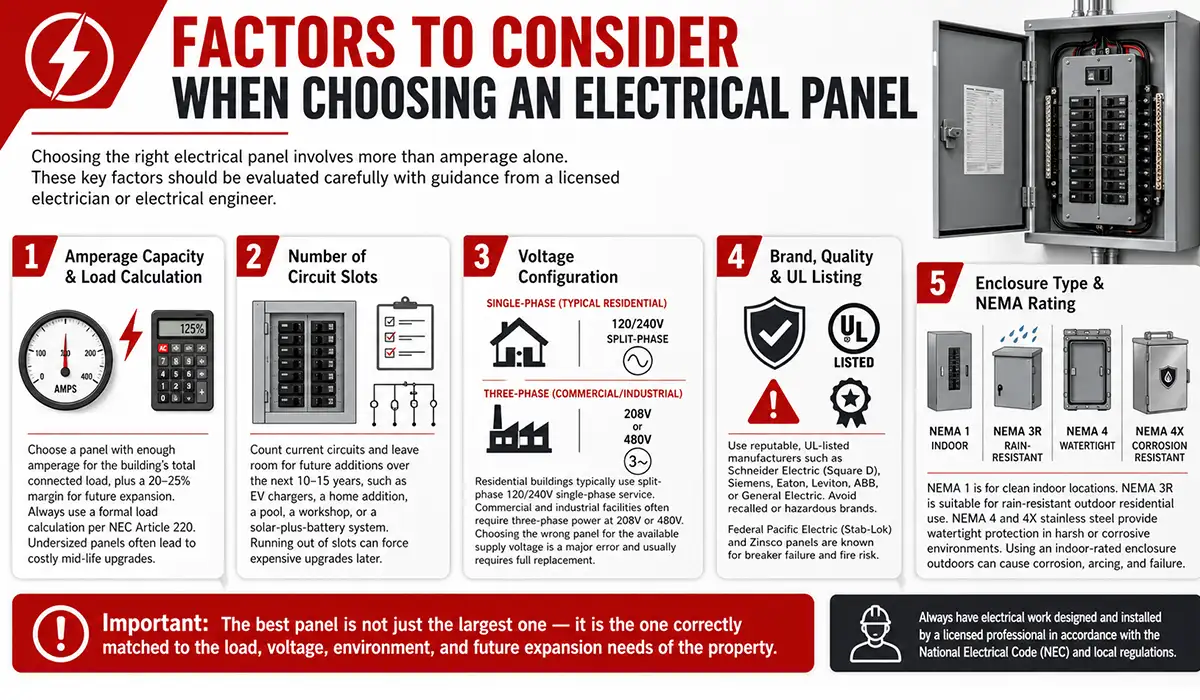
Selecting the right electrical panel requires evaluating far more than just amperage. The following factors should be considered carefully — ideally with the guidance of a licensed electrician or electrical engineer.
Amperage Capacity and Load Calculation
The panel’s amperage rating must be sufficient to handle the building’s total connected load, plus a safety margin of at least 20 to 25 percent for future additions. Always base the decision on a formal load calculation per NEC Article 220, not on a rough estimate. Undersized panels are one of the most common causes of costly mid-life upgrades.
Number of Circuit Slots
Count your current circuits and add room for every circuit you anticipate adding over the next 10 to 15 years — EV chargers, a home addition, a pool, a workshop, or a future solar-plus-battery system all require dedicated circuits. A panel that runs out of slots forces costly additions later.
Voltage Configuration
Residential buildings use split-phase 120/240V single-phase supply. Commercial and industrial buildings typically require three-phase power at 208V or 480V. Installing the wrong panel for the available supply voltage is a fundamental error that cannot be corrected without replacing the panel entirely.
Brand, Quality, and UL Listing
Choose panels from reputable, UL-listed manufacturers such as Schneider Electric (Square D), Siemens, Eaton, Leviton, ABB, or General Electric. Avoid any brand on known recall lists. Federal Pacific Electric (Stab-Lok) panels and Zinsco panels have documented histories of breaker failure and fire hazard and should be replaced whenever encountered.
Enclosure Type and NEMA Rating
NEMA 1 enclosures are for clean indoor locations only. NEMA 3R provides rain resistance for outdoor residential installations. NEMA 4 and 4X stainless steel provide watertight protection for harsh or corrosive environments. Installing an indoor-rated enclosure outdoors leads to corrosion, arcing, and eventual failure.
Code Compliance and Permit Requirements
Any electrical panel installation or upgrade must comply with the current edition of NFPA 70 as adopted and amended by the local Authority Having Jurisdiction (AHJ). This means the work requires a permit, must be performed by a licensed electrician in most jurisdictions, and must pass inspection before the panel is placed in service.
Table 5 — Panel Selection Factors
| FACTOR | WHAT TO EVALUATE | WHY IT MATTERS |
|---|---|---|
| Amperage capacity | Calculate total connected load; add 20–25% growth margin | Undersized panels are the #1 cause of upgrade calls |
| Number of circuit slots | Count current circuits + anticipated additions | Running out of slots requires a subpanel or full replacement |
| Voltage configuration | Single-phase 120/240V vs. three-phase 208V/480V | Wrong voltage configuration cannot power equipment correctly |
| Brand and UL listing | Choose UL-listed manufacturers; avoid recalled brands | Recalled brands (Stab-Lok, Zinsco) create fire risk |
| Enclosure type | Indoor NEMA 1 vs. outdoor NEMA 3R / 4 / 4X | Incorrect enclosure rating causes corrosion and failure |
| Code compliance | Verify panel meets NEC and local AHJ requirements | Non-compliant panels fail inspections and void insurance |
| Future load growth | EV chargers, HVAC upgrades, additions, solar/battery | Panel should be sized for 10–15 years of anticipated growth |
Fuse Box vs. Circuit Breaker Panel — What Is the Difference?
Many older buildings — particularly those built before the 1960s — still rely on fuse boxes rather than circuit breaker panels. While both devices protect branch circuits from overcurrent, they do so in fundamentally different ways with significantly different practical implications.
A fuse box uses fuses — single-use devices containing a metal strip that melts and permanently breaks the circuit when current exceeds the fuse’s rating. Once a fuse blows, it must be physically removed and replaced. A circuit breaker panel uses resettable mechanical switches: when a fault occurs, the breaker trips to OFF and can be reset in seconds once the underlying cause is resolved.
The practical problems with fuse boxes go beyond inconvenience. When a fuse blows at an inconvenient moment, there is a strong temptation to install a higher-rated fuse — a practice known as overfusing — that completely defeats overcurrent protection and creates a direct fire hazard. Fuse boxes are no longer installed in new construction anywhere in the United States, and many insurance carriers charge significantly higher premiums for properties that still have them.
Table 6 — Fuse Box vs. Circuit Breaker Panel
| FEATURE | FUSE BOX | CIRCUIT BREAKER PANEL |
|---|---|---|
| Protection device | Single-use fuse (metal strip melts and breaks circuit) | Resettable mechanical switch — trips and resets |
| After a fault occurs | Must physically remove and replace the blown fuse | Flip breaker back to ON — takes seconds |
| Risk of misuse | Easy to install oversized fuses — bypasses protection | Rated capacity is fixed; cannot easily bypass |
| Typical ampacity | 60A – 100A (older installations) | 100A – 400A+ (modern standard) |
| Insurance impact | Higher premiums or outright refusal in many markets | Standard rates in most jurisdictions |
| Permitted in new builds? | No — not permitted by modern electrical codes | Yes — the universal modern standard |
Signs That Your Electrical Panel Needs Upgrading
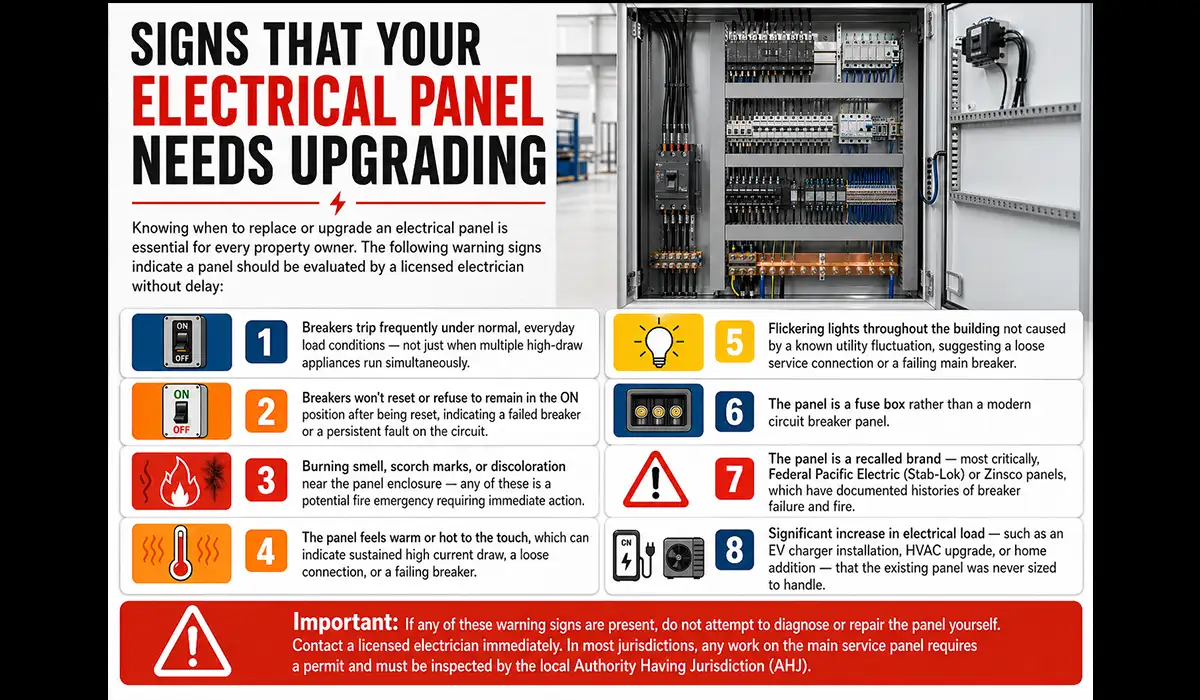
Knowing when to replace or upgrade an electrical panel is essential for every property owner. The following warning signs indicate a panel should be evaluated by a licensed electrician without delay:
- Breakers trip frequently under normal, everyday load conditions — not just when multiple high-draw appliances run simultaneously.
- Breakers won’t reset or refuse to remain in the ON position after being reset, indicating a failed breaker or a persistent fault on the circuit.
- Burning smell, scorch marks, or discoloration near the panel enclosure — any of these is a potential fire emergency requiring immediate action.
- The panel feels warm or hot to the touch, which can indicate sustained high current draw, a loose connection, or a failing breaker.
- Flickering lights throughout the building not caused by a known utility fluctuation, suggesting a loose service connection or a failing main breaker.
- The panel is a fuse box rather than a modern circuit breaker panel.
- The panel is a recalled brand — most critically, Federal Pacific Electric (Stab-Lok) or Zinsco panels, which have documented histories of breaker failure and fire.
- Significant increase in electrical load — such as an EV charger installation, HVAC upgrade, or home addition — that the existing panel was never sized to handle.
Important: If any of these warning signs are present, do not attempt to diagnose or repair the panel yourself. Contact a licensed electrician immediately. In most jurisdictions, any work on the main service panel requires a permit and must be inspected by the local Authority Having Jurisdiction (AHJ).
What Should You Do When Something Goes Wrong in Electrical Panel ?
Electrical problems range from a minor nuisance to a genuine emergency. Knowing how to respond correctly to each situation is essential for every property owner and facility manager.
When a Single Breaker Trips
A single tripped breaker is almost always the result of a momentary overload. First, identify and unplug whatever caused the overload. Then locate the tripped breaker — it will be in a middle position between ON and OFF. Push it firmly to the full OFF position first, then switch it back to ON. If the breaker trips again immediately, there is a fault on the circuit and a licensed electrician must be called before the breaker is reset again.
When Multiple Breakers Trip Simultaneously
Check whether neighboring properties have lost power — if so, the problem is with the utility and will be resolved by the utility company. If your building is the only one affected, check the main breaker. If it has tripped, reset it carefully after switching off all major loads first. If it trips again immediately, call a licensed electrician.
When You Smell Burning or See Scorch Marks
Treat this as an emergency. These signs indicate arcing, an overheating connection, or a failing breaker — all direct fire hazards. Switch off the main breaker immediately if safe to do so, evacuate if there is any sign of active fire or smoke, and call a licensed electrician before restoring power. Do not assume the problem has resolved itself after the smell dissipates.
When the Panel Feels Hot to the Touch
A noticeably hot panel is operating under stress — it can indicate sustained high current draw, a loose internal connection generating heat through resistance, or failing breakers. Switch off non-essential loads and contact a licensed electrician promptly. Panel heat is one of the clearest early indicators of impending failure.
Table 7 — Troubleshooting Quick Reference
| FEATURE | FUSE BOX | CIRCUIT BREAKER PANEL |
|---|---|---|
| Protection device | Single-use fuse (metal strip melts and breaks circuit) | Resettable mechanical switch — trips and resets |
| After a fault occurs | Must physically remove and replace the blown fuse | Flip breaker back to ON — takes seconds |
| Risk of misuse | Easy to install oversized fuses — bypasses protection | Rated capacity is fixed; cannot easily bypass |
| Typical ampacity | 60A – 100A (older installations) | 100A – 400A+ (modern standard) |
| Insurance impact | Higher premiums or outright refusal in many markets | Standard rates in most jurisdictions |
| Permitted in new builds? | No — not permitted by modern electrical codes | Yes — the universal modern standard |
How Much Does It Cost to Change or Upgrade an Electrical Panel?
The cost of replacing or upgrading an electrical panel depends on a large number of variables specific to each property and project. What follows is a realistic framework for understanding the typical cost ranges involved.
A like-for-like panel replacement — removing an old 200A panel and installing a new 200A panel — typically costs $1,000 to $2,500, including labor, materials, the replacement panel, and the required permit and inspection fee. This represents the floor of the cost range.
Upgrading from 100A to 200A service — one of the most common upgrades in older homes — typically costs $1,300 to $3,000, often requiring upgraded service entrance conductors and coordination with the utility company. A full upgrade to 400A service can range from $2,500 to $5,000 or more. Adding a subpanel is typically a less expensive option at $500 to $1,500.
Replacing a fuse box with a modern circuit breaker panel in an older home is the most expensive scenario, ranging from $1,500 to $4,000 or more when all permit fees, code compliance corrections, and possible wiring remediation are included.
Table 8 — Cost Breakdown by Project Type
| WORK TYPE | TYPICAL COST (USD) | KEY VARIABLES |
|---|---|---|
| Replace existing panel (same amperage) | $1,000 – $2,500 | Labor rates, permit fees, panel brand, access difficulty |
| Upgrade 100A to 200A | $1,300 – $3,000 | Includes service entrance upgrade if required |
| Upgrade to 400A service | $2,500 – $5,000+ | Utility coordination, meter upgrade, new conductors |
| Add a subpanel | $500 – $1,500 | Distance from main panel, number of circuits needed |
| Fuse box replacement with breaker panel | $1,500 – $4,000 | Wiring age, permit, inspector fees, code compliance work |
| Permit and inspection fee (typical) | $100 – $500 | Varies significantly by jurisdiction |
Important: Always obtain at least two or three written quotes from licensed electricians before proceeding with any panel work, and ensure every quote explicitly includes permit, inspection, and utility coordination fees — not just labor and materials.
Electrical Panel Safety — What Every Owner Should Know
The electrical panel is one of the most hazardous components in any building when handled incorrectly. High-voltage conductors inside the enclosure can cause fatal electric shock, and improper work can create lasting fire and shock hazards that are invisible from the outside.
- Always hire a licensed and insured electrician for any work inside the electrical panel. This is not a suitable DIY task under any circumstances.
- Never work on the panel yourself without first shutting off the main breaker — and remember that the service entrance conductors above the main breaker are always live regardless of the main breaker position.
- Keep the panel accessible at all times. The NEC requires a minimum clear working space of 36 inches in front of every electrical panel. Never block the panel with furniture, shelving, or storage.
- Label all circuits clearly and accurately in the panel directory. An accurate circuit directory is a safety tool that allows power to be cut quickly and precisely in an emergency.
- Have the panel inspected by a qualified electrician if any of the warning signs described in this article are present — do not wait until a failure occurs.
- Never defeat a tripping breaker by replacing it with a higher-rated one. A tripping breaker signals a problem on the circuit. Identify and fix the cause before restoring power.
- In most jurisdictions, any modification to the main service panel requires a building permit and must pass an inspection by the local AHJ before the work is legally complete.


Rate this article
Choose a rating from 1 to 5 stars.
No ratings yet