



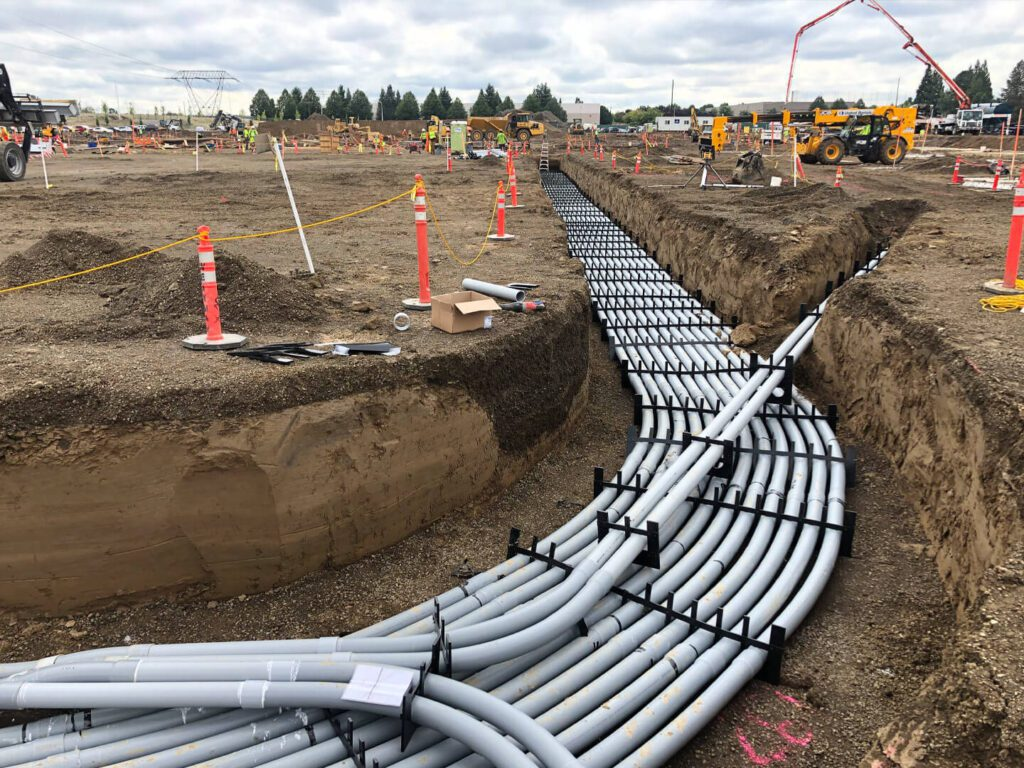

We will look at common underground electrical conduit types (like PVC, RMC/IMC, EMT, HDPE duct, and fiberglass), discuss typical National Electrical Code (NEC) burial depths, compare PVC Schedule 40 vs Schedule 80, and talk about when EMT direct burial makes sense after the 2023 NEC update. I will also explain the difference between direct burial cable and conduit systems, and share some real-world best practices that I learned from projects in residential, commercial, and utility environments.
Prefer listening? You can play the audio version of the rest of this article below.
What Is Underground Electrical Conduit? (And How It Differs From Pipe and Duct)
Underground electrical conduit is a listed raceway buried below grade that carries conductors instead of letting them sit in the soil. You install the empty raceway first, then pull the wire.
Four jobs it does at once:
- Mechanical protection — keeps rocks, compaction load, vehicle wheels and future shovels off the cable jacket.
- Moisture and corrosion control — NEC 300.5(B) classes every underground raceway and enclosure as a wet location, so this is a design input, not a nicety.
- Future access — spare ducts mean the next circuit doesn’t need a new trench.
- Code compliance — NEC 300.5 cover, plus BS 7671 or CSA C22.1 outside North America.
Underground Conduit Pipe vs. Underground Electrical Pipe vs. Duct — the terminology
These get used interchangeably on site and they shouldn’t be. Underground conduit pipe and underground electrical pipe usually mean the same listed raceway — but “pipe” in construction more often means a pressure-rated product for fluid, and a plumbing-grade PVC pipe is not a listed electrical raceway even at the same schedule. Duct normally means HDPE or PVC used in multi-way duct banks for utility and telecom. When specifying, cite the NEC article (352 for PVC, 344 for RMC, 353 for HDPE, 355 for RTRC) rather than the word — that’s what an inspector will read.
Materials in service today:
- PVC (Schedule 40 / Schedule 80) — NEC 352. Non-metallic, corrosion-resistant, the residential and light-commercial default.
- RMC / IMC — NEC 344 / 342. Maximum crush resistance and EMI shielding.
- EMT — NEC 358. Direct burial permitted since the 2023 NEC, with conditions (see below).
- LFMC / LFNC — NEC 350 / 356. Permitted for direct burial where listed and marked.
- HDPE duct — NEC 353. Long coils, HDD crossings, utility and telecom.
- Fiberglass (RTRC) — NEC 355. Aggressive soil, high ambient, long design life.
An underground run is only the route; the power it carries starts and ends at a panel. Our guide to panels and switchgear covers that side of the system.
 Best Conduit for Underground Electrical Work: The Short Answer
 Best Conduit for Underground Electrical Work: The Short Answer
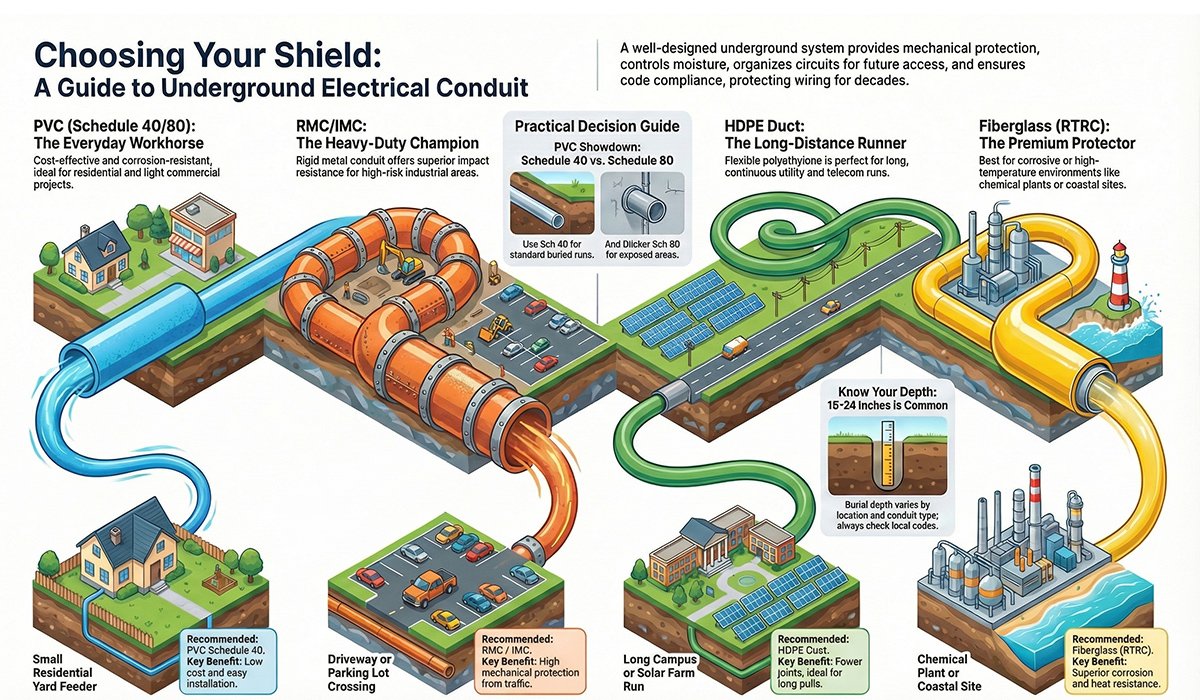
There is no single best underground conduit, but there is a best conduit for each of five situations, and 90% of jobs land in one of them:
| If your run is… | Use | Why |
|---|---|---|
| A residential yard feeder, no vehicle load | PVC Schedule 40 | Cheapest listed option that meets 18 in. cover. Nothing stronger is justified. |
| Exposed where it leaves grade | PVC Schedule 80 or RMC | NEC 300.5(D) requires physical-damage protection at the riser. Sch 40 does not qualify. |
| Under a street, highway or commercial parking lot | RMC/IMC or concrete-encased PVC | 24 in. cover applies to every method here, so buy strength, not depth. |
| A long campus, solar or telecom pull | HDPE duct | Coiled lengths mean fewer joints and it takes HDD. |
| Coastal, chemical or high-ambient soil | Fiberglass (RTRC) | Will not corrode, holds strength above PVC’s softening range. |
If you want one default: PVC Schedule 40 buried, Schedule 80 or RMC at every riser. That combination is code-compliant, cheap, and is what most inspectors expect to see. Upgrade away from it only when soil chemistry, run length, or traffic load gives you a specific reason.
Whichever conduit is chosen, the conductors inside it terminate in an enclosure. If that part is new to you, start with what an electrical panel is and does.
What Type of Conduit Is Approved for Direct Burial?
“Approved for direct burial” means the product is listed and marked for burial in earth without concrete encasement. Under the NEC, that list is:
- PVC Schedule 40 and Schedule 80 (NEC 352.10) — the most common direct-burial raceway in North America.
- RTRC / fiberglass marked for below-ground use (NEC 355.10) — UL 2420 covers Type BG below-ground RTRC.
- HDPE duct (NEC 353.10) — listed for direct burial and encasement.
- RMC and IMC (NEC 344.10 / 342.10) — permitted in earth, with supplementary corrosion protection where the soil is severe (NEC 300.6).
- EMT (NEC 358.10(A)(1)) — permitted since the 2023 NEC, but only with fittings specifically listed for direct burial. Standard set-screw and compression fittings do not qualify.
- LFMC and LFNC (NEC 350.10(3) / 356.10(4)) — permitted where listed and marked; look for “DIR BURIAL” on the jacket.
What is not approved: plain FMC (Article 348 flex), plumbing-grade PVC pipe of any schedule, and any raceway whose listing does not include earth contact. If the marking on the product doesn’t say it, the AHJ will not accept it.
Underground Conduit Types Compared: PVC, RMC/IMC, EMT, HDPE and Fiberglass
Four questions decide it: how much mechanical load will the conduit see, how aggressive is the soil, how long is the pull, and how long does the system need to last. Below is each material against those four, with the NEC article that governs it.
On industrial sites, these runs usually end at the main distribution equipment. See how industrial electrical switchboards are built and what they do.
PVC (Polyvinyl Chloride) – Schedule 40 / Schedule 80
PVC is the everyday workhorse for many underground electrical jobs. It is non‑metallic, electrically non‑conductive, and corrosion‑resistant in most normal soil. It is light, cheap, and easy to cut and glue, which makes it attractive for residential and light commercial work.
Typical advantages of PVC underground conduit include:
- Lightweight and easy to handle, even in tight trenches.
- Fast installation with solvent cement joints.
- Corrosion‑proof in most non‑aggressive soil conditions.
- Low material cost and good availability at most suppliers.
Key limitations you should remember:
- Lower mechanical strength compared with rigid metal conduit.
- Can become brittle in very low temperatures if not rated and handled correctly.
- Softens at high temperature, so above‑ground exposed sections must be checked for derating and UV protection.
In practice, PVC is used for feeders to detached garages, small commercial laterals, parking lot lighting, and many other light‑to‑medium duty installations where the soil is not highly aggressive and heavy traffic is limited.
One number worth knowing: PVC’s cover requirement is 18 inches in Column 3 of Table 300.5(A) for general locations — not 24. The 24-inch figure people quote comes from Column 1, which is direct-buried cable with no raceway at all. Confusing the two is the most common trenching overspend on residential jobs.
RMC and IMC Underground (NEC 344 / 342) — 6-Inch Minimum Cover
Rigid metal conduit is the heavy‑duty champion when it comes to underground mechanical protection. Both RMC and IMC have strong walls that resist crushing and impact much better than PVC, and they also provide excellent shielding against electromagnetic interference.
Main advantages of RMC/IMC underground include:
- Superior crush and impact resistance for high‑risk areas.
- Good EMI shielding when sensitive circuits are nearby.
- Often preferred by inspectors where conduits pass under driveways or loading docks.
But we also pay a price for this strength:
- Higher material cost compared with PVC.
- Heavier weight and slower installation time.
- Need for cutting, reaming, and threading tools, and careful corrosion protection at damaged coating areas.
For exposed risers coming out of the ground, or for industrial yards with forklifts and trucks moving all day, RMC or IMC is usually my first choice.
The headline advantage is code, not just steel: RMC and IMC need only 6 inches of cover in general locations (Column 2, Table 300.5(A)) — the shallowest of any method. On rocky sites or short crossings, the material premium is often cheaper than 12 extra inches of rock excavation. That trade is worth running before you default to PVC.
EMT Underground: What the 2023 NEC Actually Changed
EMT was traditionally kept out of the ground because thin-wall steel corrodes fast in wet soil. The 2023 NEC changed the rule in two places at once: 358.10(A)(1) was revised to permit EMT in concrete, in earth contact, and in direct burial with fittings identified for direct burial — and EMT was added to Column 3 of Table 300.5(A), alongside PVC and RTRC. That gives buried EMT an 18-inch cover requirement.
Three conditions have to be met together:
- Fittings specifically listed for direct burial — standard set-screw and compression fittings do not qualify and are the usual failure point.
- Corrosion protection per NEC 300.6 appropriate to the soil.
- All other underground rules (wet-location conductors, cover, riser protection).
The code permits it; the soil still doesn’t care. If the coating is nicked during handling, corrosion starts at that nick. My rule: short, well-drained, concrete-encased, inspector on board — acceptable. Long duct banks in native soil — use PVC, HDPE, RMC/IMC or RTRC.
Can Flexible Conduit Be Buried? LFMC, LFNC and FMC Underground
Yes — but only two of the three flexible types, and only when the product is marked for it.
LFMC (liquidtight flexible metal, NEC 350.10(3)) and LFNC (liquidtight flexible nonmetallic, NEC 356.10(4)) are both permitted for direct burial where listed and marked for the purpose. Look for “DIR BURIAL” or “DIRECT BURIAL” printed on the jacket. LFNC-B — the integral-wall type — is the variant most commonly carrying that listing, and it is also permitted for encasement in concrete under 356.10(7).
Plain FMC (Article 348 flex) is not permitted underground in any form. This is the mistake that fails inspections.
Two practical constraints even on listed product:
- Straight fittings only. Manufacturers’ direct-burial listings generally exclude 45° and 90° fittings, because the sealing geometry isn’t rated for soil contact. Route the bend in the raceway, not the fitting.
- Keep it short. Flexible conduit costs several times more per metre than PVC and its corrugated bore builds pulling friction fast. Use it where flexibility is genuinely required — vibration at a pump, a condenser, a skid — not to avoid cutting a sweep.
Cover depth follows the same table as any other method: LFMC in Column 2 territory, LFNC in Column 3 as a nonmetallic raceway. Confirm against the product listing.
Pumps and skid-mounted equipment are usually run by a dedicated controller. Our overview of industrial control systems explains the main types.
HDPE Duct (NEC 353) — Long Runs, HDD and Duct Banks
HDPE duct is common in utility and telecom projects where we need long continuous runs. It usually comes in long coils and has a very smooth inner surface, which makes cable pulling easier and reduces the number of joints.
Typical uses for HDPE underground duct are:
- Solar and wind farm collector systems.
- Campus medium‑voltage and low‑voltage distribution.
- Telecom and data fibre routes.
- Road and river crossings with horizontal directional drilling (HDD).
HDPE needs fusion welding or mechanical couplers and some special tools, so it is more common in larger projects handled by specialised contractors than in small residential jobs.
Typical situations where I consider upgrading are:
- Very long pulls where the number of joints should be minimised.
- Road or river crossings done with horizontal directional drilling (HDD).
- Industrial or coastal areas with aggressive soil and high temperature.
- Duct banks for MV or LV feeders that are designed for several decades of service with future capacity built in.
Fiberglass RTRC Conduit (NEC 355) — Corrosive Soil and High Ambient
Fiberglass, or RTRC, is like the premium non‑metallic option. It does not rust, it is lighter than steel, and it keeps its strength at higher temperatures better than PVC. Because of this, it is attractive in aggressive soil or industrial areas.
You will often see RTRC used in:
- Chemical plants and refineries.
- Coastal areas with salty groundwater.
- Large duct banks where engineers expect long service life with little corrosion risk.
Below-ground RTRC is covered by UL 2420 (Type BG), which addresses both direct burial and encased burial for trade sizes ½ through 6. Specify the UL standard, not just “fiberglass” — it’s what separates a compliant submittal from a rejected one.
PVC Schedule 40 vs Schedule 80 Underground: Which to Use Where
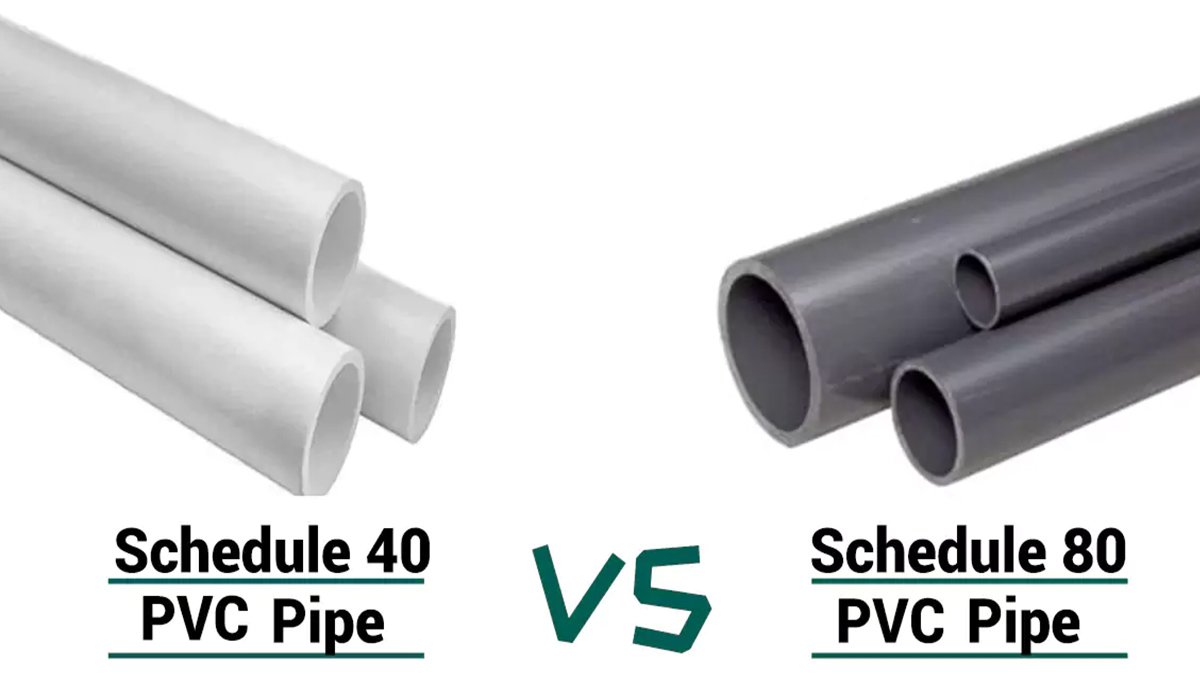
When a younger colleague asks me about PVC underground, usually the first question is: “Should we put Schedule 40 or Schedule 80?” The answer depends mainly on mechanical risk and code requirements. Both can be used for underground electrical conduit where they are listed and permitted, but their wall thickness and strength are different.
When Schedule 40 PVC Is Enough
Schedule 40 is the standard wall thickness and is very common in residential and light commercial work. If the conduit is buried at proper depth, in normal soil, and not exposed to heavy vehicle load, Schedule 40 is usually sufficient.
I normally choose Schedule 40 when:
- The trench is in a garden or yard without heavy truck traffic.
- The conduit will stay buried and not be exposed above ground where it can be hit.
- The project is cost‑sensitive but still needs a clean and safe installation.
When Schedule 80 PVC Is Required
Schedule 80 has a thicker wall, so it gives better impact resistance and higher mechanical strength. It is heavier and slightly more expensive, but in some locations it is clearly the safer choice.
I recommend or use Schedule 80 when:
- The conduit comes out of the ground and is exposed at the side of a building or pedestal.
- The run passes under a driveway, parking area, or place with repeated vehicle load.
- The specification or the local authority explicitly asks for Schedule 80 in exposed or high‑risk areas.
A common and economical design is to use Schedule 40 for the buried horizontal run and Schedule 80 or RMC only for the vertical risers and exposed sections. In this way we keep the cost under control but still protect the weak points.
Note the trench-depth arithmetic people get wrong: cover is measured to the top of the conduit, so a 2 in. Schedule 40 run (2.375 in. OD) at 18 in. cover needs a trench roughly 20.4 in. deep. Digging to 18 in. and calling it done is a failed inspection.
Conduit protects the conductors from physical damage, while breakers protect the circuit from faults. For that second layer, read about arc fault breakers.
How Deep to Bury Electrical Conduit: NEC Burial Depth Requirements
Short answer: 6 to 24 inches, and the number depends on two things — the wiring method and where the run passes. It is not one figure.
NEC Table 300.5(A) sets minimum cover for circuits 0 to 1000 volts. Five wiring-method columns × six location rows = thirty different legal answers. Anyone who quotes you a single number has read one cell.
“Cover” has a specific definition in Note 1: the shortest distance from the top surface of the conduit or cable to the top surface of finished grade, concrete or similar cover. Not the trench bottom, not the conduit centreline. The 2026 edition added a clarifying note on “finished grade” specifically to settle disputes where landscaping is added after backfill and inspection.
NEC Burial Depth Chart — Full Table 300.5(A) Matrix (inches)
| Location of wiring method | Col 1 Direct-burial cable | Col 2 RMC / IMC | Col 3 Nonmetallic raceway (PVC, RTRC, HDPE, EMT) | Col 4 Residential 120 V GFCI, ≤20 A | Col 5 Irrigation / landscape ≤30 V |
|---|---|---|---|---|---|
| All locations not specified below | 24 | 6 | 18 | 12 | 6 |
| In trench below 2 in. concrete or equivalent | 18 | 6 | 12 | 6 | 6 |
| Under a building | 0 (raceway only) | 0 | 0 | 0 | 0 |
| Under min. 4 in. concrete exterior slab, no vehicular traffic, slab extending ≥6 in. beyond | 18 | 4 | 4 | 6 direct / 4 raceway | 6 direct / 4 raceway |
| Under streets, highways, roads, alleys, driveways, parking lots | 24 | 24 | 24 | 24 | 24 |
| One- and two-family dwelling driveways and outdoor parking, dwelling use only | 18 | 18 | 18 | 12 | 18 |
| In or under airport runways, incl. adjacent restricted areas | 18 | 18 | 18 | 18 | 18 |
Values per NEC Table 300.5(A). Cover measured to the top of the wiring method. Unchanged across the 2020, 2023 and 2026 editions; the 2023 edition added EMT to Column 3. Adoption is state-by-state — confirm which edition your AHJ enforces.
Direct Burial Cable Depth vs Conduit Depth — Why They Differ
The two most-quoted figures come from different columns and are not interchangeable.
Direct burial cable depth is 24 inches in general locations (Column 1). UF-B, USE-2 and URD sit in soil with only the jacket between the conductor and a shovel, so the code buys protection with depth.
Conduit depth is 18 inches for nonmetallic and 6 inches for RMC/IMC (Columns 3 and 2). The raceway is doing the protecting, so less earth is required.
That gap has a cost consequence: over a 100 ft run, choosing conduit over direct burial saves 6 inches of excavation across the entire trench. In rocky ground that difference alone frequently pays for the conduit.
On depth requirements for buried electrical cable specifically: all underground conductors must be wet-rated — THWN, THWN-2 or THW — because NEC 300.5(B) makes every underground raceway a wet location. And only cable listed for direct burial may go in without a raceway. NM/Romex underground is a code violation regardless of depth.
Five Table Notes That Legally Change Your Depth
The footnotes do more work than the cells:
- Cover is to the top of the wiring method, to finished grade — add the conduit OD to get trench depth.
- Combined columns take the shallower value. A Column 4 circuit (120 V, GFCI-protected, ≤20 A OCPD) run in a Column 3 raceway may use 12 inches, not 18. This is the most-missed allowance in the table and it is worth real money on residential jobs.
- Solid rock: where rock prevents the listed depth, install in a permitted raceway and cover with at least 2 inches of concrete extending down to rock — 2 in. of cover is then acceptable.
- Lesser depths are permitted where conductors rise for terminations or splices, or where access is required.
- Listed low-voltage lighting systems may go shallower than Column 5 where the manufacturer’s instructions say so; pool, spa and fountain lighting has its own 6 in. footnote.
Burial Depth Above 1000 V (Table 300.50)
Table 300.5(A) stops at 1000 V. Medium-voltage feeders — the ones that terminate in the switchgear this site is otherwise about — fall under NEC Table 300.50, where direct-buried cable in ordinary locations requires 30 inches. Utility-owned lines follow the NESC and the utility’s own standard, usually deeper again.
Note also that the “over 600 V” threshold is retired language. The NEC moved that boundary to 1000 V in the 2014 edition; specifications still citing 600 V are working from a pre-2014 code.
Clearances From Other Buried Utilities
(Retain existing body — the 12 in. vertical separation guidance and sleeve/encasement advice is sound. Add one line:)
Separation from other utilities is generally a local utility or AHJ requirement rather than an NEC minimum — confirm the number with the utility before you set trench elevations, not after.
Cover rules change once a circuit moves above 1000 V. Our comparison explains how voltage levels differ in practice.
Underground Electrical Conduit Requirements Beyond Burial Depth
Cover depth is the requirement everyone checks. These are the ones that actually fail inspections:
- Wet-location conductors — NEC 300.5(B). Every underground raceway and enclosure is a wet location, without exception. THWN-2 or equivalent.
- Physical damage protection at the riser — NEC 300.5(D). Where conductors emerge from grade they must be protected from the minimum cover depth to at least 8 ft above finished grade, using RMC, IMC, RTRC-XW, Schedule 80 PVC or EMT.
- Warning ribbon — NEC 300.5(D)(3). For underground service conductors not encased in concrete and buried 18 in. or more below grade, a warning ribbon is required at least 12 in. above the conductors. This is code, not best practice.
- Raceway sealing — NEC 300.5(G). Underground raceways entering a building must be sealed or plugged at either or both ends to stop moisture migration.
- Backfill — NEC 300.5(F). No large rock, paving material, cinders or corrosive material that could damage the raceway or prevent adequate compaction.
- Splices — NEC 300.5(E). Permitted underground without a box only where made with listed direct-burial splice kits.
- Expansion fittings — NEC 352.44 for PVC. Thermal movement at exposed risers is real; the fitting is not optional on long exposed sections.
The trench inspection is one check; the equipment at the end of the run has its own. See our guide to testing electrical switchboards.
Trenching, Bedding and Warning Tape for Underground Conduit
Even if we select the correct conduit type and burial depth, a poor trench can still destroy the installation. I normally think about three separate steps: excavation, bedding/backfill, and marking.
Excavation and Trench Method
For very short runs you can dig by hand, but for longer distance a trencher or excavator is faster. Near existing utilities, hydro‑vac or vacuum excavation is much safer because it lets us expose pipes and cables without hitting them with a bucket tooth.
The bottom of the trench should be reasonably flat and free of big stones or debris. A sharp stone under the conduit can later press into the wall when the soil is compacted, creating a weak point.
Bedding and Backfill
I like to place a layer of fine sand or granular material under the conduit and then again above it. Many specifications require 4–6 inches (100–150 mm) of fine material below and above the raceway. This helps to distribute load and protect the conduit from point impact.
We should avoid using broken concrete, bricks, or large stones as backfill around the conduit. Frozen soil blocks that later thaw and settle can also create voids and pull on the risers. Compaction in layers helps to control settlement and keep the finished grade stable.
Warning Tape and As-Built Records
For underground service conductors buried 18 in. or deeper and not concrete-encased, warning ribbon at least 12 in. above the conductors is required by NEC 300.5(D)(3) — not a recommendation. For everything else it remains the cheapest insurance on the job. Detectable tape with a metallic strip lets a locator find a non-metallic duct that would otherwise be invisible.
Conductor and Conduit Sizing for Underground Runs
Once the mechanical part of the design is clear, we must think about the conductors inside the conduit. Underground locations are always considered wet, so wire insulation must be suitable for wet conditions and ampacity calculations must respect NEC rules.
Choosing Wire Type for Wet Underground
For most building feeders in North America, the usual answer is THWN or THWN‑2 copper or aluminium conductors. They are rated for wet locations and are widely available. For special high‑voltage or utility projects, other cable types may be used, but THWN‑2 in PVC or HDPE conduit is a very common combination.
Conduit Fill, Ampacity Derating and Voltage Drop
The NEC limits how much conductor cross‑section area can be placed in one raceway. If we exceed this limit, pulling becomes hard and the conductors can overheat during operation. For more than two conductors, the maximum fill is usually 40% of the internal conduit area.
When several current‑carrying conductors share the same conduit, ampacity must be derated. For long feeders, we also check voltage drop and sometimes we choose a larger wire size even if ampacity is technically enough.
The 40% figure is from NEC Chapter 9, Table 1, and applies to more than two conductors. One conductor gets 53%; exactly two get 31% — the two-conductor case is lower than the three-plus case, which surprises people every time. Underground, always size for the future pull, not today’s.
Planning Pulls, Sweeps and Junction Boxes
From a practical point of view, pull points are just as important as calculations. I try to keep the total bend angle between pull points to 360 degrees or less and use long‑radius sweeps instead of tight 90‑degree elbows. This reduces pulling tension and protects the cable jacket.
Insulation type is only one part of choosing a conductor. Our industrial wire selection guide covers the rest.
Worked Example: Sizing Underground Conduit for a 200 A Residential Feeder
As a quick example, imagine a 200 amp single‑phase residential feeder from a meter pedestal to a main panel in the house.
- We select the conductor size (for example 3/0 AWG copper or 4/0 AWG aluminium THWN‑2, depending on local code and temperature ratings).
- We calculate conduit fill and choose a raceway size that keeps the fill under 40% including phase, neutral, and equipment grounding conductors.
- We check voltage drop and, if the distance is long, we consider upsizing the conductors or conduit.
- We think about the future: will the owner later want an EV charger, workshop, or extra building? If yes, we may install a slightly larger conduit or add one spare conduit now.
- We confirm the cover depth against the actual route: 18 in. through the lawn (Column 3), but 24 in. if it crosses the commercial-side apron, or 18 in. if it crosses only the dwelling’s own driveway. One run, potentially three different depths.
Exactly the same logic applies to commercial feeders and campus duct banks. The only difference is scale: more conductors, more parallel conduits, and usually more spare capacity built into the design.
The feeder in this example ends at the main panel. For what sits inside it, see our guide to electrical panel equipment.
Underground Conduit Selection Table by Project Type
| Project type | Recommended conduit | Min. cover (Table 300.5(A)) | Reason |
| Small residential yard feeder | PVC Schedule 40 | 18 in. | Lowest cost listed option that meets Column 3. |
| Exposed riser at building corner | PVC Schedule 80 or RMC | n/a — 8 ft above grade | NEC 300.5(D) physical damage protection. |
| Dwelling’s own driveway | PVC Sch 40 or 80 | 18 in. (12 in. if 120 V GFCI ≤20 A) | Dedicated table row; shallower than a public street. |
| Commercial driveway / parking lot | RMC/IMC or concrete-encased PVC | 24 in. all methods | Depth is fixed, so buy strength. |
| Long campus or solar farm run | HDPE duct | 18 in. | Coils reduce joints; suits HDD. |
| Chemical plant or coastal site | RTRC (UL 2420 Type BG) or PVC-coated steel | 18 in. / 6 in. | Corrosion resistance over decades. |
Selection does not stop at the raceway. The same project-by-project thinking applies to switchgear selection.
How to Install Underground Electrical Conduit: Step by Step
Installing underground electrical conduit goes wrong in the decisions, not in the digging. The sequence below is the order that avoids rework on a typical PVC run, from the first measurement to the first power-up.
Step 1: Confirm the Wiring Method and Cover Before You Dig
The most common first mistake is assuming one trench depth fits every job. Before any soil moves, answer five questions:
- What exact wiring method is going in: PVC, metal conduit or direct burial cable?
- What type of circuit will it carry?
- What does the local authority require, including its amendments?
- Where does the run pass: lawn, driveway, slab?
- What is the cover, and what trench depth does that cover actually need?
Step 2: Walk and Mark the Route
A straight line from point A to point B rarely survives a walk across the site. Look for walkway edges, drainage paths, tree root zones, fence post footings and any area that is likely to be dug again later. Mark the path with spray paint and stakes, measure it with a tape, and decide where the sweeps go so that no tight bends are needed.
Step 3: Trench in Sections
Digging the run in sections keeps the depth consistent and the site manageable. Expect the soil to change along the route: compacted, gravel-filled ground near paving, and softer but root-filled ground elsewhere. A trenching shovel and a digging bar handle what an ordinary shovel will not. After wet weather, trench walls can start to slough in, so work in shorter sections, clean the base and set the conduit before the walls crumble further.
Step 4: Prepare the Bed and Dry-Fit the Whole Run
Remove sharp rocks from the conduit bed, then dry-fit every section before any solvent cement is opened. The hardest point to align is the transition where the conduit leaves the ground and meets the building entry. A joint glued before that final angle is confirmed puts the run under tension, and the only fix is to cut it back, add a coupling and rebuild the transition. Where earth movement or frost heave is expected, review the exposed and transition sections and fit expansion fittings where they are required.
Step 5: Glue, Re-Check Cover and Pause Before Backfill
Glue the joints, keep the bends gentle, and check the cover repeatedly as the run goes in. Then resist the urge to close the trench straight away. Re-measure, photograph the run, and check every joint and entry one more time. Where an inspection is required, the AHJ needs to see the work before the trench is closed. Backfill first with sand or selected material, and lay warning tape above the conduit.
Step 6: Pull the Conductors
Conductors do not glide through a buried raceway on their own. Work from fish tape to pull string, use proper pulling lubricant, and have one person feed while the other pulls smoothly without jerking. Five habits save trouble later:
- Do not overfill the conduit just because the conductors fit.
- Use wet-location rated conductors; a closed conduit underground still collects moisture and condensation.
- Label both ends immediately.
- Leave extra length at both ends.
- Pull in an extra string for future upgrades.
Step 7: Test Before You Call It Finished
Once the terminations are made safely and in line with the code and inspection requirements, check continuity, verify the run and only then energise the circuit. A clean first test is the real end of an underground conduit installation, and it depends on every earlier step having been done without shortcuts.
Energising a new run safely depends on the switching and protection upstream. Our article on the purpose of switchgear explains that role.
Underground Conduit Installation Best Practices
Good underground conduit systems do not happen by accident. They are the result of careful planning and disciplined execution. Here are some simple habits that help a lot in the field:
- Mark the route clearly before digging and check for existing services.
- Avoid unnecessary bends and keep enough straight length before and after each sweep.
- Use proper primer and solvent cement for PVC joints, and listed fittings for metal conduit.
- Pull in a rope or jet line first to confirm the path is open before pulling heavy cables.
- Use suitable cable lubricant and control pulling tension to stay inside manufacturer limits.
- Seal all entries to buildings and boxes to keep water, insects, and rodents out.
- Call 811 before any excavation in the US, or the local equivalent. Utility strikes are the leading cause of trenching injuries and the fines dwarf the job value.
- Prove the duct before you pull. A mandrel or duct rodder through the finished run catches a crushed section while it’s still cheap to fix.
The same discipline applies inside the enclosure. Our guide to switchgear components shows what each part does.
Direct Burial Cable vs Conduit: Cost, Depth and Lifetime Compared
Sometimes running UF or USE cable directly in the soil is allowed and gives the lowest first cost. In other cases, a full conduit system is clearly the smarter decision. The right choice depends on run length, risk level, and how much flexibility we want in the future.
Direct Burial Cable (UF, USE, URD)
Main advantages:
- Lowest material cost and fewer installation steps.
- Fast for simple, short runs in low‑risk areas.
Main disadvantages:
- Limited mechanical protection – cable jacket and soil must do all the work.
- Any future repair or upgrade requires new excavation.
- Not very flexible if the owner later wants more circuits or higher load.
Conduit Systems (PVC, HDPE, RMC, RTRC)
Main advantages:
- Higher mechanical protection and more control over routing.
- Possibility to pull new cables later without digging again.
- Option to include spare ducts for future circuits or data cables.
Main disadvantages:
- Higher initial cost for materials and labour.
- More design work to select conduit size, type, and installation details.
The comparison people skip: direct burial needs 24 in. of cover, PVC conduit needs 18 in., RMC needs 6 in. Direct burial saves on material and loses on excavation. Over a long run in anything harder than topsoil, the “cheaper” option often isn’t.
For very short and simple residential runs, direct burial may be acceptable. For anything strategic – workshops, commercial buildings, campuses, EV charging, or solar plants – I personally recommend investing in a proper underground electrical conduit system. Over the life of the installation, the extra flexibility usually pays back many times.
Where a buried feeder serves a backup supply, the changeover happens in a dedicated panel. See how emergency electrical panels work.
NEC Standards and Documentation for Underground Conduit
- NEC 300.5 — underground installations: cover (Table 300.5(A)), wet locations, riser protection, warning ribbon, backfill, sealing.
- NEC 300.50 — cover requirements above 1000 V.
- NEC 300.6 — protection against corrosion and deterioration.
- NEC 342 / 344 — IMC and RMC.
- NEC 350 / 356 — LFMC and LFNC, including the direct-burial permissions.
- NEC 352 — rigid PVC conduit, including 352.44 expansion fittings.
- NEC 353 — HDPE conduit.
- NEC 355 — RTRC; see also UL 2420 for below-ground Type BG.
- NEC 358 — EMT, including the 2023 direct-burial revision at 358.10(A)(1).
- NEC Chapter 9, Table 1 — conduit fill percentages.
Which edition applies is a state-level question. The 2026 NEC is published, but adoption lags by years and varies jurisdiction to jurisdiction — several states still enforce 2020. Confirm the edition with your AHJ before you specify to it. Outside North America, BS 7671 (UK) and CSA C22.1 (Canada) cover the same ground with different numbers.
Finish with as-built drawings recording route, depth, size and type of every duct, plus GPS coordinates or offsets from fixed site features. The next crew to dig there will either have this or guess.


Rate this article
Choose a rating from 1 to 5 stars.
No ratings yet