





From managing peak consumption in manufacturing facilities to supporting renewable energy systems, supercapacitors play a pivotal role. But why are supercapacitors an enticing alternative to traditional batteries? Ultra-fast charging speed, exceptional lifespan, and superior safety are just some of the answers. However, this technology is not without its challenges.
In this comprehensive guide, we will explore the applications, advantages, technical specifications, and challenges of supercapacitors to give you a better understanding of their potential in transforming the electrical industry.
What is a Supercapacitor? Understanding the Technology
A supercapacitor — also written <em>super capacitor</em>, and known as an ultracapacitor or electric double-layer capacitor (EDLC) — is an advanced energy storage device that offers unique features compared to traditional capacitors and batteries. In simple terms, a supercapacitor is a type of capacitor that can store and release a large amount of electrical energy in a very short period.
Unlike regular capacitors that have limited capacity, supercapacitors can store energy on a much larger scale due to their high energy density and unique design. While conventional capacitors store energy in the range of microfarads to millifarads, supercapacitors can achieve capacitances ranging from 1 farad to over 5,000 farads.
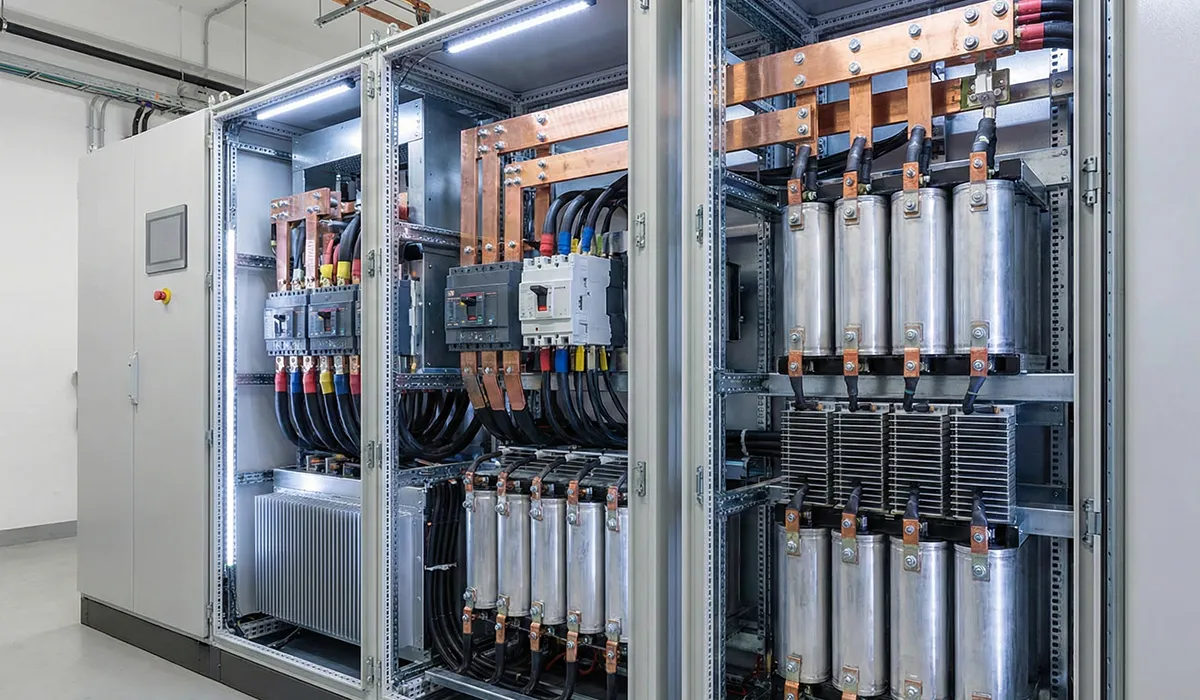
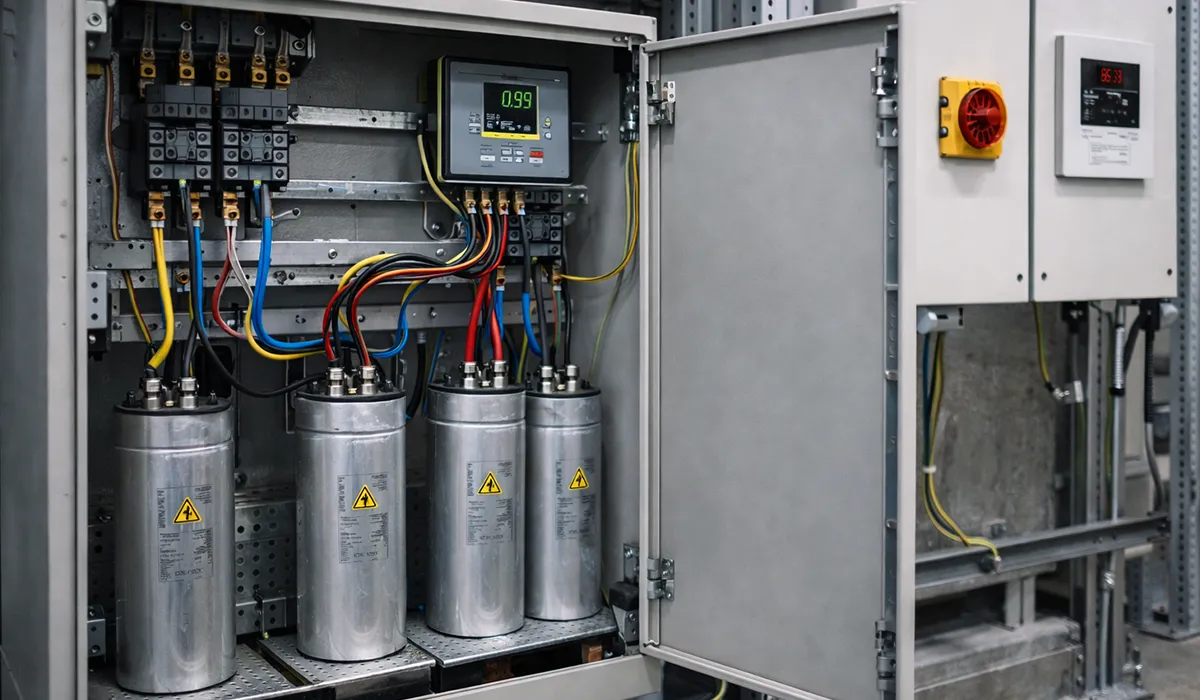
Conventional power-factor correction uses a different device entirely — see how industrial capacitor banks supply reactive power rather than storing energy.
How Do Supercapacitors Work?
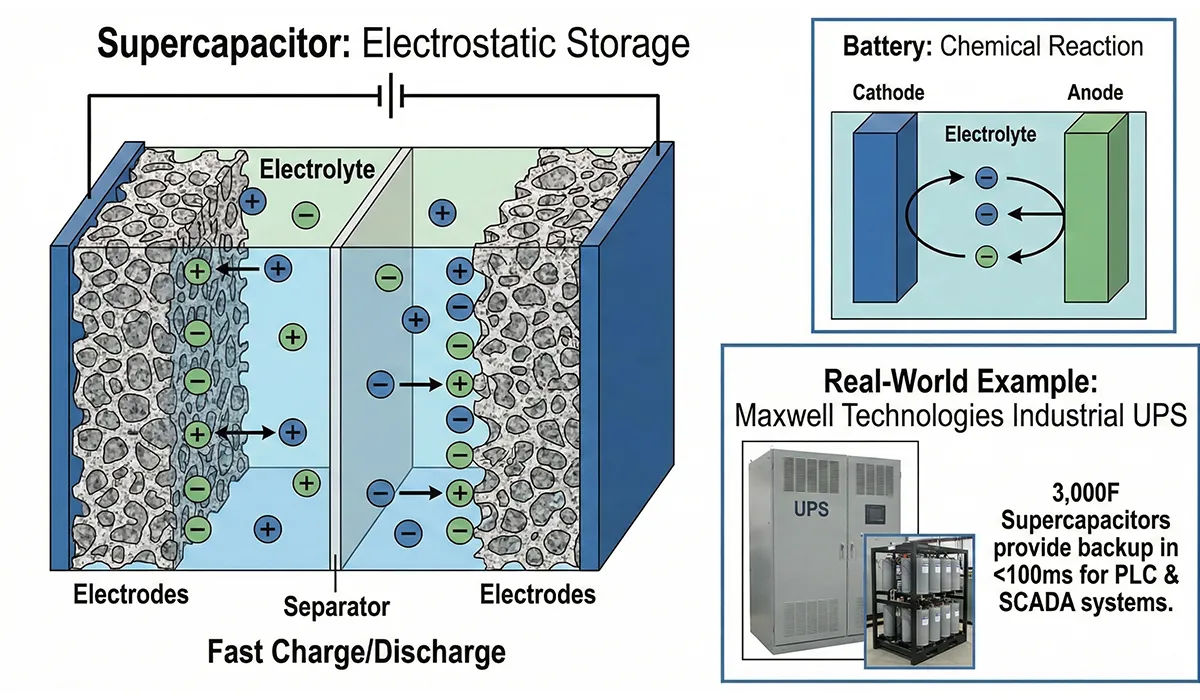
Supercapacitors store energy electrostatically on the surface of porous electrodes, unlike batteries which store energy through chemical reactions. This fundamental difference enables supercapacitors to charge and discharge much faster than batteries.
Internal Structure of a Supercapacitor
Imagine a supercapacitor as an “electrical sandwich” consisting of:
- Two porous electrodes (typically made of activated carbon with extremely high surface area—up to 2,000 m²/g)
- Electrolyte layer (liquid or solid) separating the electrodes
- Separator membrane preventing short-circuits while allowing ion flow
- Current collectors (usually aluminum or copper foils) for electrical connection
This structure creates an electric double layer at the electrode-electrolyte interface, where charge separation occurs. The extremely high surface area of the porous electrodes allows for massive charge storage—the key to supercapacitors’ high capacitance.
Types of Supercapacitors: A Detailed Comparison
Supercapacitors are divided into three main categories, each optimized for specific applications:
1. Electric Double-Layer Capacitors (EDLC)
The most common type, utilizing carbon-based materials with extremely high surface area, such as activated carbon, carbon nanotubes, or graphene. EDLCs store charge purely through electrostatic means without chemical reactions.
Key Characteristics:
- Capacitance: 1-5,000 farads per cell
- Energy density: 5-10 Wh/kg
- Power density: 10,000+ W/kg
- Cycle life: 1,000,000+ cycles
- Applications: UPS systems, voltage stabilization, consumer electronics
2. Pseudocapacitors
These capacitors use fast surface chemical reactions (Faradaic processes) to increase capacity. They employ materials like metal oxides (RuO₂, MnO₂), conducting polymers, or transition metal compounds.
Key Characteristics:
- Capacitance: 100-15,000 farads per cell
- Energy density: 10-30 Wh/kg
- Power density: 5,000-10,000 W/kg
- Cycle life: 100,000-500,000 cycles
- Applications: Hybrid vehicles, medical devices, power tools
3. Hybrid Supercapacitors
A combination of EDLC and pseudocapacitor technologies, or battery-capacitor hybrids (lithium-ion capacitors), designed to achieve a balance between energy density and power density.
Key Characteristics:
- Capacitance: Variable (500-10,000 farads)
- Energy density: 15-40 Wh/kg
- Power density: 8,000-15,000 W/kg
- Cycle life: 500,000+ cycles
- Applications: Renewable energy storage, electric buses, grid stabilization
| Specification | EDLC | Pseudocapacitor | Hybrid |
|---|---|---|---|
| Energy Density (Wh/kg) | 5-10 | 10-30 | 15-40 |
| Power Density (W/kg) | 10,000+ | 5,000-10,000 | 8,000-15,000 |
| Cycle Life | 1,000,000+ | 100,000-500,000 | 500,000+ |
| Charge Time | 1-10 seconds | 10-60 seconds | 10-30 seconds |
| Operating Temperature | -40°C to +70°C | -20°C to +60°C | -30°C to +65°C |
| Cost (Relative) | Medium | High | Medium-High |
| Primary Applications | UPS, Consumer Electronics | EVs, Medical Devices | Renewable Energy, Transit |
| Self-Discharge Rate | 10-40% per month | 5-20% per month | 3-15% per month |
Supercapacitor Energy Density: The Defining Limit
Energy density is the single specification that decides where a supercapacitor can and cannot be used. It measures how much energy is stored per unit of mass, in watt-hours per kilogram.
Supercapacitors store roughly 5 to 40 Wh/kg depending on type, against 150 to 250 Wh/kg for lithium-ion. That is a gap of five to fifty times, and it is the reason supercapacitors supplement batteries rather than replace them.
The physics behind the gap is straightforward. A battery stores energy in chemical bonds throughout the bulk of the electrode material. A supercapacitor stores charge only on the electrode surface. Even with activated carbon reaching 2,000 m²/g of surface area, a surface can hold far less than a volume.
What energy density means in practice:
- Duration — supercapacitors deliver seconds to minutes, not hours. A UPS bridging until a generator starts is a good fit; overnight backup is not.
- Mass and volume — for the same stored energy, a supercapacitor bank is substantially larger and heavier.
- Cost per kWh — high energy-density devices are cheaper per unit of energy stored. This is why supercapacitors are specified on power, never on energy.
The counterpart specification is power density, where the relationship reverses: supercapacitors deliver 5,000–20,000 W/kg against 500–2,000 W/kg for lithium-ion. Choose on whichever of the two your application is actually limited by.
Supercapacitors vs Lithium-Ion Batteries: Complete Comparison
The key difference between supercapacitors and batteries lies in how they store energy and their performance characteristics.
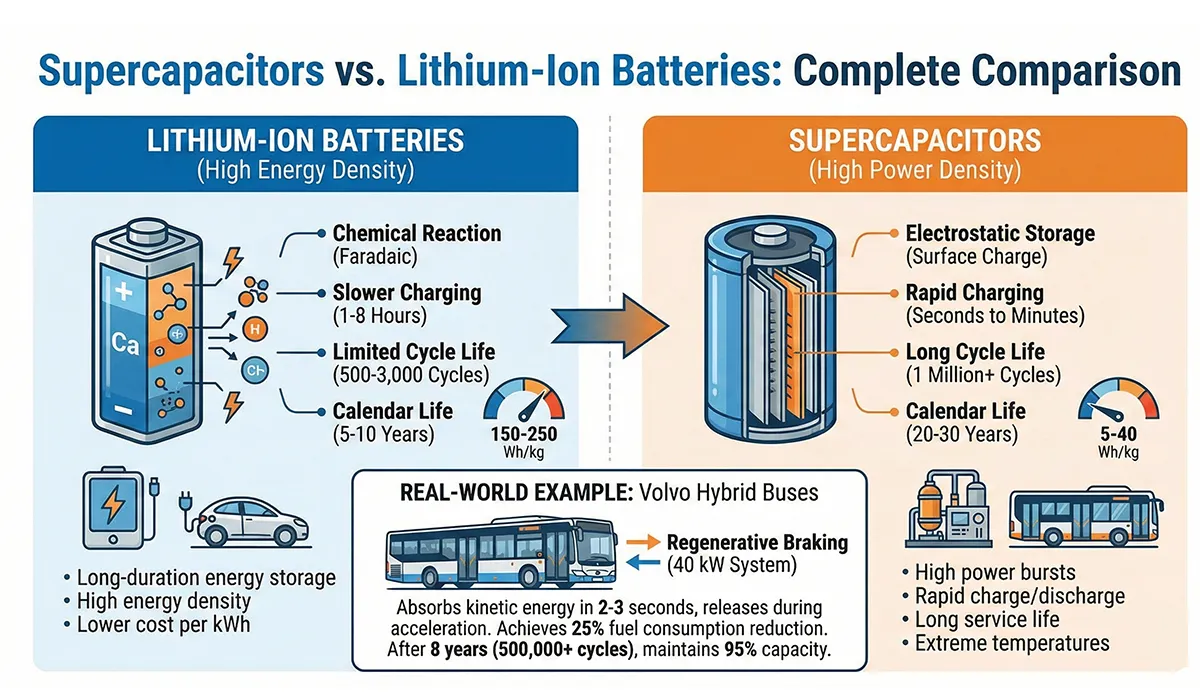
Batteries, especially lithium-ion batteries, have higher energy density (150 to 250 watt-hours per kilogram) and can store more energy for a given volume and weight. In contrast, supercapacitors have lower energy density (5 to 40 watt-hours per kilogram depending on type) but offer significantly higher power density, meaning they can release or absorb large amounts of energy in very short time periods.
Storage Mechanism Differences:
- Batteries: Store energy through chemical reactions (Faradaic processes) involving ion intercalation into electrode materials. This is slower but allows higher energy density.
- Supercapacitors: Store energy electrostatically by holding electric charge on electrode surfaces. This is much faster but provides lower energy density.
Charging and Lifespan:
- Charging Speed: Supercapacitors can be charged or discharged in seconds to minutes, whereas fully charging a lithium-ion battery typically takes 1-8 hours. This makes supercapacitors invaluable for energy recovery systems like regenerative braking.
- Cycle Life: Supercapacitors can withstand up to 1 million charge/discharge cycles without significant capacity loss, while lithium-ion batteries typically have a limited lifespan of 500 to 3,000 cycles. This makes supercapacitors ideal for applications requiring frequent charging and discharging.
- Calendar Life: Supercapacitors can last 20-30 years in industrial applications, while lithium batteries typically degrade after 5-10 years even with minimal use.
When to Use Supercapacitors vs Batteries:
Choose Supercapacitors for:
• High power bursts (starting motors, pulse loads)
• Rapid charge/discharge cycles (regenerative braking)
• Long service life requirements (industrial equipment)
• Extreme temperature environments (-40°C to +70°C)
• High reliability/safety critical applications
Choose Batteries for:
• Long-duration energy storage (hours to days)
• High energy density requirements (portable devices)
• Lower cost per kWh stored
• Gradual discharge applications
| Parameter | Supercapacitor | Lithium-Ion Battery |
|---|---|---|
| Energy Density | 5-40 Wh/kg | 150-250 Wh/kg |
| Power Density | 5,000-20,000 W/kg | 500-2,000 W/kg |
| Charge Time | 1-30 seconds | 1-8 hours |
| Discharge Time | Seconds to minutes | Minutes to hours |
| Cycle Life | 500,000 – 1,000,000+ | 500 – 3,000 |
| Calendar Life | 20-30 years | 5-10 years |
| Operating Temperature | -40°C to +70°C | -20°C to +60°C |
| Safety | Very High (no explosion risk) | Moderate (thermal runaway risk) |
| Efficiency | 95-98% | 85-95% |
| Self-Discharge | 10-40% per month | 2-5% per month |
| Cost per kWh | $10,000 – $30,000 | $100 – $300 |
| Environmental Impact | Lower (carbon-based, recyclable) | Higher (mining, disposal challenges) |
| Maintenance | None required | Battery management system needed |
Industrial Electrical Panel Applications: Why Contractors Need Supercapacitors
In industrial electrical systems, supercapacitors play a vital role in improving stability, reliability, and efficiency. Here’s why electrical contractors and facility managers are increasingly specifying supercapacitors in electrical panel designs:
1. UPS (Uninterruptible Power Supply) Systems
Supercapacitors can supply energy in a fraction of a second to prevent power outages and protect sensitive equipment. Unlike battery-based UPS systems that take 20-50 milliseconds to activate, supercapacitor UPS systems respond in under 5 milliseconds.
Technical Specifications for Industrial UPS:
- Typical capacitance: 500-3,000 farads per module
- Voltage range: 48V DC to 400V DC
- Backup time: 10-60 seconds (bridging time until generators start)
- Response time: < 5 milliseconds
- Service life: 15-20 years without replacement
Where the supercapacitor module sits inside the assembly, and how it is protected, follows the same rules as any other of the industrial electrical panel components around it.
2. Voltage Stabilization and Power Quality
In stabilizers and power conditioning equipment, supercapacitors control fluctuations and stabilize voltage during transient events, motor starting, or sudden load changes.
3. Peak Power Management and Demand Charge Reduction
A standout application is peak consumption management in factories and power grids. By storing energy during off-peak hours and releasing it during peak demand, supercapacitors reduce energy costs and relieve pressure on the grid.
Financial Impact: Where a facility’s demand charge is driven by short peaks — motor starts, press strokes, crane lifts — shaving those peaks can reduce the demand component of the bill. The saving depends entirely on the local tariff structure and the shape of the load, so it has to be calculated from actual interval data rather than estimated from a percentage.
Why Electrical Contractors Need Supercapacitors in Control Panels:
1. Reduce Maintenance Costs by 30-40%
• 10x longer lifespan than batteries (20 years vs 2-5 years)
• No battery replacement labor or disposal costs
• Zero maintenance requirements
2. Prevent Million-Dollar Losses
• In sensitive industries (data centers, petrochemical, hospitals), every second of downtime can cost thousands
• <5ms response time prevents equipment damage and production losses
• Critical for PLC, SCADA, and process control systems
3. Increase System Reliability
• Stable operation from -40°C to +70°C (battery UPS limited to -20°C to +40°C)
• No degradation in extreme temperatures
• 98% round-trip efficiency vs 85-90% for batteries
4. Save Panel Space
• 50% smaller footprint than equivalent battery systems
• Lighter weight (important for wall-mounted panels)
• Can be mounted in any orientation
5. Meet Modern Codes and Standards
– UL 810A (Electrochemical Capacitors) listing available
– IEC 62391-1 and -2 govern fixed electric double-layer capacitors for electronic equipment
– IEC 62576 covers EDLCs for hybrid electric vehicle applications
– No special ventilation requirements, unlike battery rooms
– Safer chemistry — no thermal runaway or explosion risk
| Application in Electrical Panels | Typical Capacitance | Response Time | Primary Benefit |
|---|---|---|---|
| UPS Backup Power | 500-3,000F | < 5ms | Equipment Protection |
| Voltage Stabilization | 100-500F | < 1ms | Power Quality |
| Motor Starting / Peak Shaving | 1,000-5,000F | 10-100ms | Cost Reduction |
| Regenerative Drive Systems | 200-1,000F | < 10ms | Energy Recovery |
| Grid Frequency Regulation | 2,000-10,000F | < 20ms | Grid Stability |
Sustained power quality problems need a different remedy from transient ones — distortion is handled by harmonic filters, not by energy storage.
Electric and Hybrid Vehicle Applications
The primary use of supercapacitors in transportation is in regenerative braking systems. When a vehicle brakes, kinetic energy is converted to electrical energy, which supercapacitors can quickly absorb and store. This energy is then reused during acceleration, increasing the overall efficiency of the vehicle.
Why Supercapacitors Excel in Automotive Applications:
- High peak power: Can deliver 10-20 kW for acceleration boost in hybrid vehicles
- Cold weather performance: Unlike lithium batteries, supercapacitors maintain full performance at -40°C
- Extended battery life: Reducing peak loads on batteries extends their service life by 40-60%
- Fast energy capture: Can absorb 80-90% of regenerative braking energy vs 40-60% for batteries alone.
| Vehicle Type | Supercapacitor Application | System Capacity | Efficiency Gain |
|---|---|---|---|
| Hybrid Cars | Regenerative braking, power assist | 0.5-2 kWh | 10-15% fuel saving |
| Electric Buses | Fast charging stations, braking recovery | 5-20 kWh | 25-30% energy recovery |
| Rail/Metro | Station braking energy capture | 50-200 kWh | 30-40% energy recovery |
| Racing Vehicles | KERS (Kinetic Energy Recovery) | 2-8 MJ | 500+ HP boost |
| Forklifts/Industrial | Start-stop cycles, lifting | 1-5 kWh | 20-35% efficiency gain |
Renewable Energy Storage Applications
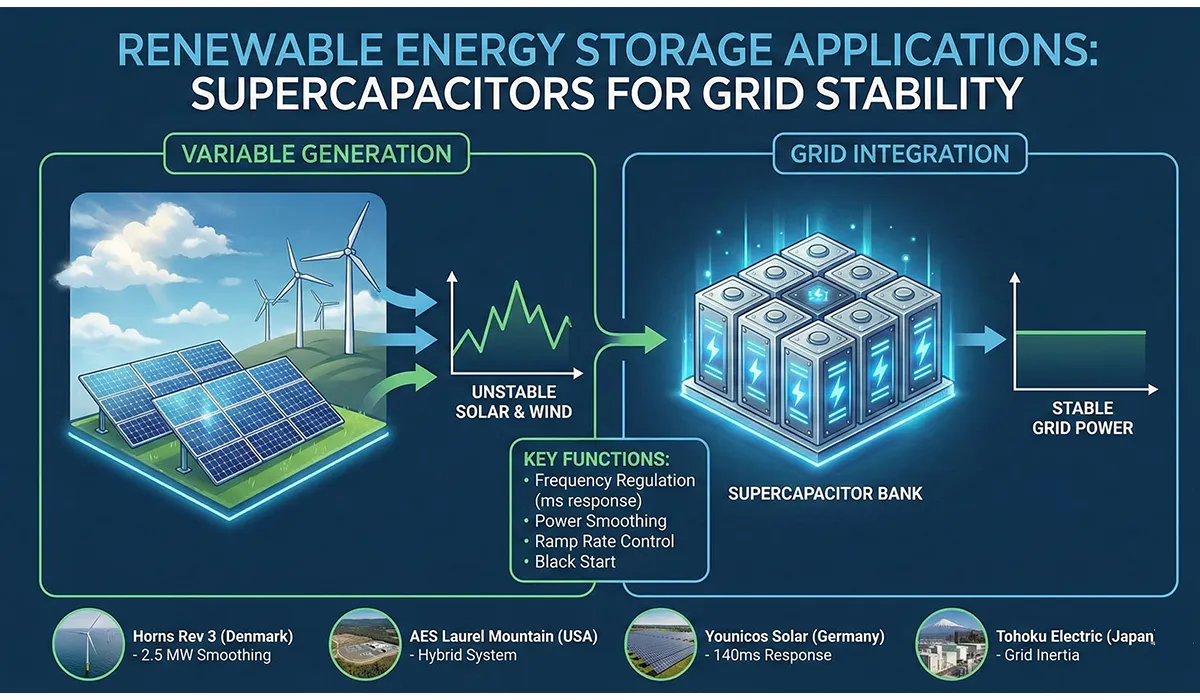
In solar and wind energy systems, power production is unstable and variable. Supercapacitors can serve as intermediaries to stabilize fluctuations and provide instant power when needed.
Key Renewable Energy Applications:
- Grid Frequency Regulation: Respond to frequency deviations in milliseconds, much faster than batteries (seconds) or generators (minutes)
- Power Smoothing: Filter out rapid fluctuations in wind/solar output to deliver stable grid power
- Ramp Rate Control: Manage rapid changes in renewable output during cloud cover or wind gusts
- Black Start Capability: Provide initial power to restart grid sections after blackouts
Technical Advantages in Renewable Energy:
- Can cycle 100,000+ times per year without degradation (batteries limited to 5,000-10,000 cycles/year)
- Operate efficiently in outdoor temperature extremes (-40°C to +70°C)
- Provide both energy storage AND grid services (frequency regulation, voltage support)
- 25-year lifespan matches solar panel warranties
Consumer Electronics Applications
In devices like digital cameras, mobile phones, wearable devices, and flashlights, supercapacitors are used for backup power or fast charging.
Heavy Industry and Industrial Machinery
In cranes, forklifts, trains, and mining machinery, supercapacitors provide high instantaneous power when starting large motors or lifting heavy loads.
Military and Aerospace Applications
In defense industries, supercapacitors supply quick energy for radars, lasers, and communication systems. In spacecraft, they are an ideal choice due to their performance in extreme temperatures and unique conditions.
Advantages and Challenges of Supercapacitors
Key Advantages:
- Ultra-Fast Charging: 10-30 seconds compared to 1-8 hours for batteries
- Exceptional Lifespan: Up to 1 million cycles (20-30 years operational life)
- Superior Safety: No explosion or fire risk, no thermal runaway
- Extreme Temperature Performance: -40°C to +70°C operation
- High Instantaneous Power: Up to 10-20x higher than batteries
- Zero Maintenance: No replacement or servicing required
- High Efficiency: 95-98% round-trip efficiency
- Environmentally Friendly: Carbon-based, fully recyclable, no heavy metals
- Predictable Performance: Linear voltage discharge, simple state-of-charge monitoring
Current Challenges:
- Low Energy Density: 10-20x lower than lithium-ion batteries (limits use in long-duration storage)
- High Initial Cost: $10,000-$30,000 per kWh vs $100-$300 for batteries
- Self-Discharge: Higher rate than batteries (10-40% per month vs 2-5%)
- Voltage Management: Requires sophisticated control circuits for voltage balancing
- Limited Energy Storage Duration: Best for seconds to minutes, not hours to days
- Size and Weight: For equivalent energy storage, much larger and heavier than batteries
Total Cost of Ownership (TCO) Analysis:
While supercapacitors have 100x higher upfront cost per kWh than batteries, the TCO over 20 years often favors supercapacitors for high-cycle applications:
The shape of the comparison is what matters. Supercapacitors cost far more per kWh upfront but require no replacement, while a battery UPS needs replacing every three to five years. In a high-cycle application over a twenty-year horizon, the replacement cycles can outweigh the initial premium. Whether they do in your case depends on your cycle count, your labour rates and your disposal costs — it is a calculation, not a rule.
Plus reduced downtime risk, no disposal costs, and zero maintenance labor.
Future of Supercapacitors: Emerging Technologies
With the development of nanomaterials and hybrid designs, supercapacitors are expected to play an increasingly significant role in the future energy supply chain:
Breakthrough Technologies in Development:
- Graphene Supercapacitors: Energy density 5x higher with 1-second charge times. Curved-graphene electrodes are the most advanced commercial route, though published energy densities vary widely between laboratory results and shipping product. Treat any single headline figure with caution until it appears on a datasheet.
- Hybrid Battery-Supercapacitor Systems: Combining advantages of both technologies. Nanotechnology-enabled lithium-ion capacitors achieve 40-50 Wh/kg with 100,000+ cycle life.
- Printed Supercapacitors: For smart clothing and IoT devices. Flexible, thin-film supercapacitors can be printed on fabric or plastic substrates.
- Self-Healing Supercapacitors: Using polymer electrolytes that automatically repair micro-damage, extending cycle life to 2+ million cycles.
- Solid-State Supercapacitors: Eliminating liquid electrolytes for higher energy density and improved safety in extreme conditions.
- Asymmetric Supercapacitors: Combining battery-like and capacitor-like electrodes to optimize both energy and power density.
Market Projections:
- Graphene-based supercapacitors expected to reach mass production by 2027-2028
Conclusion: The Future of Energy Storage
Supercapacitors, with their combination of high power, rapid charging, and exceptional lifespan, are transforming various industries from industrial electrical panels to electric vehicles. While they cannot completely replace batteries, they demonstrate clear superiority in applications requiring high instantaneous power and rapid charging.
The combination of supercapacitors with batteries can enhance system efficiency and lifespan, bringing transformation to sectors like transportation, energy storage, and consumer electronics. As nanomaterial technology advances and costs decrease, supercapacitors will become even more prevalent in the global energy infrastructure.

Rate this article
Choose a rating from 1 to 5 stars.
No ratings yet