



If you’d rather listen than read, feel free to play the audio file below for the rest of this article.
What Is a Withdrawable Circuit-Breaker Part?
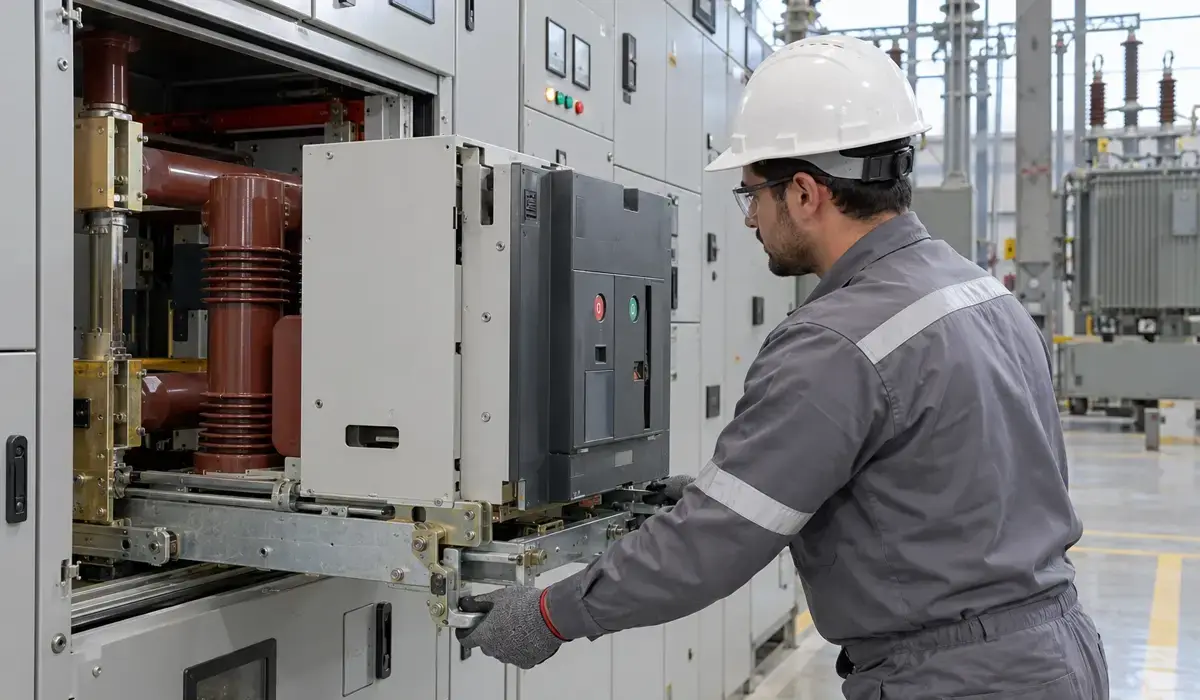
A withdrawable circuit-breaker part is a circuit breaker, usually a vacuum circuit breaker in MV switchgear, mounted on a wheeled carriage called the truck. The truck plugs into the busbar and cable sides through isolating contacts, so it moves out without unbolting anything.
US documents call the same design a drawout circuit breaker. So what is a drawout circuit breaker? It is this withdrawable circuit breaker truck under the ANSI name. In a withdrawable VCB, the truck carries:
-
- the breaker poles with their vacuum interrupters;
- the operating mechanism;
- the isolating contacts, often called tulip contacts;
- the auxiliary plug for control wiring.
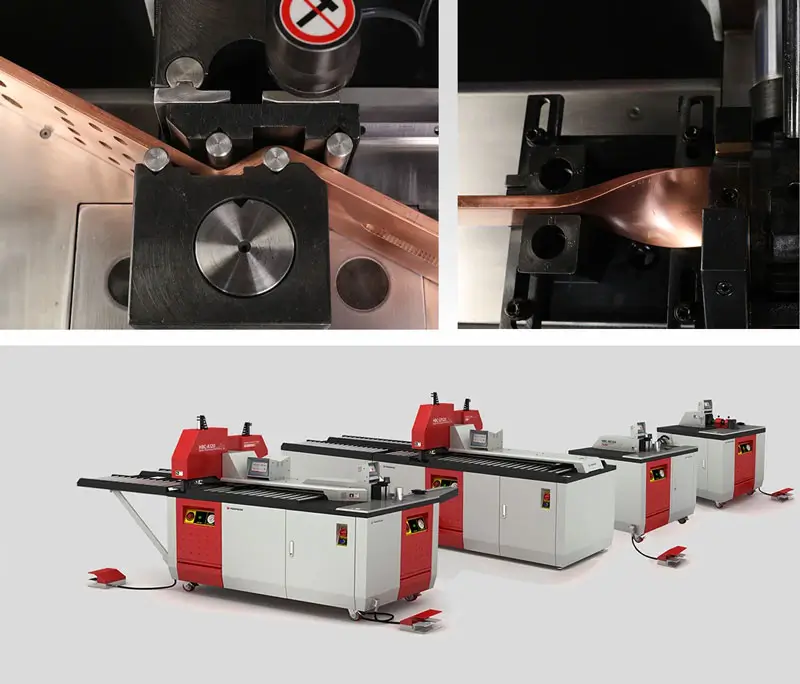
The HBC-B120 machine combines three essential fabrication processes in a compact industrial system. Designed for busbars up to 120 × 12 mm, it provides a practical solution for workshops requiring sequential operations.
The Three Positions of the Truck
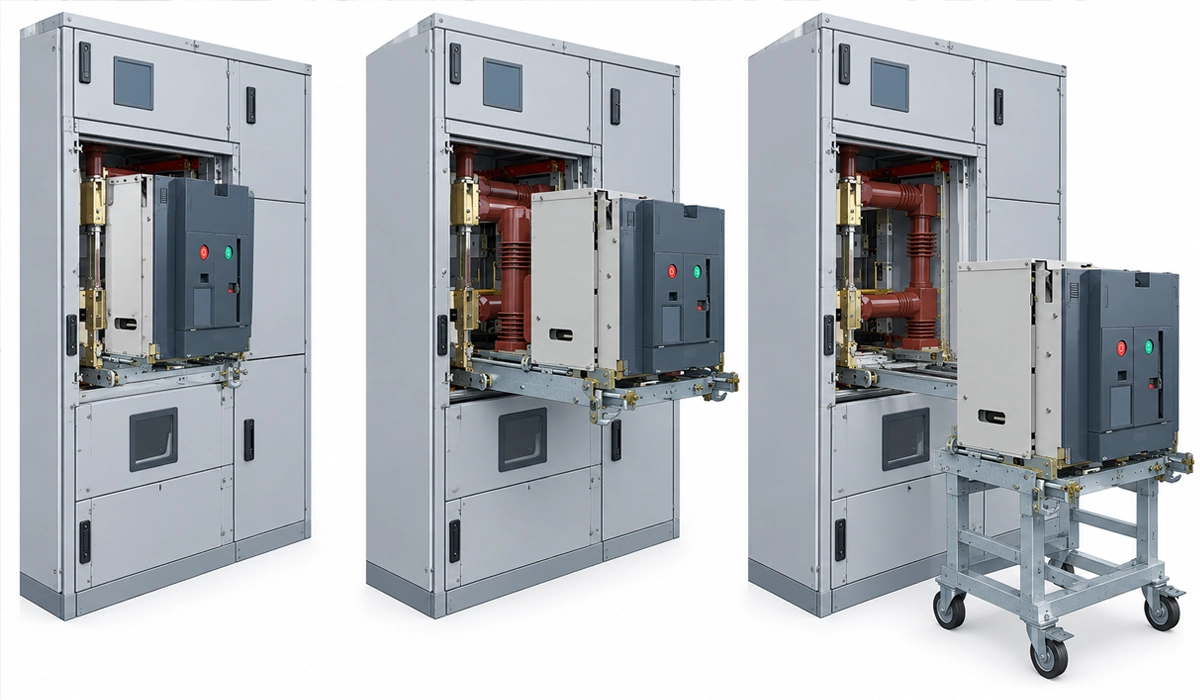
The racking mechanism moves the truck between fixed, interlocked positions along short guide rails. Each position decides what stays connected, as the table below shows.
| Position | Main circuit | Auxiliary circuits | Typical use |
|---|---|---|---|
| Service | Connected | Connected | Normal operation |
| Test | Isolated | Connected | Function checks |
| Disconnected | Isolated | Isolated | Safe parking |
| Removed | Out | Out | Maintenance |
The withdrawable truck is only one building block of a complete medium-voltage assembly. For the wider picture, start with our guide to switchgear basics.
Service Position
In the service position, the operator has racked the truck fully in. Its isolating contacts, typically silver-plated, grip the fixed contacts on both the busbar and cable sides, and the auxiliary plug links the control wiring. Therefore, the breaker can close and carry load, while the compartment door stays shut.
One rule matters most here. The breaker can only close once the truck reaches the end of its travel, never part of the way in. Otherwise, the isolating contacts could make or break current, a job their makers never intended. In practice, a position switch confirms full travel before it releases the closing circuit.
The IEC vocabulary ties the term to one test: the part must reach a position with an isolating distance in the main circuit. Electropedia gives the official wording in its withdrawable part definition.
Test Position
In the test position, the main contacts sit apart by the isolating distance, and the shutters cover the live side. However, the auxiliary plug stays connected.
As a result, engineers can open, close and trip a test position circuit breaker electrically. They use this to check protection relays, control wiring and indication lamps without energising the feeder. In other words, the breaker works as normal, but no load current can flow to the cables. For this reason, crews use the test position for commissioning and routine function checks, and often for charging the closing springs and reading the operation counters before energising.
Real interlock tables follow this logic closely, although the position names vary by maker. For example, an ABB catalogue lists the conditions for racking, unplugging and earthing in its UniGear ZS1 catalogue.
Disconnected and Removed Positions
In the disconnected position, both the main and auxiliary circuits stay open. However, the truck still sits inside the compartment, behind a closed door. In many designs, test and disconnected share one physical spot, and only the auxiliary plug makes the difference.
In the removed position, by contrast, the withdrawable part rolls out on its service trolley for maintenance. Alternatively, crews swap it for a spare truck of the same rating. That swap can restore a feeder in minutes, which is a major reason buyers choose this design. Interchangeability, however, depends on the rating and the maker.
Each truck position only makes sense alongside the busbars, spouts and relays around it. Our breakdown of switchgear components shows how these parts work together in one panel.
Shutters and Interlocks That Make Racking Safe
So what does the shutter do in a withdrawable breaker compartment? Shutters are metal plates in the circuit-breaker compartment that cover the fixed contacts as the truck moves out. The truck itself drives them open, and they close automatically when it leaves. In most designs, crews can also padlock them shut for maintenance.
Interlocks control the order of every move. The four that matter most typically work like this:
- The truck cannot move unless the breaker is open. So can you rack out a closed breaker? No, because the isolating contacts would break load current.
- The breaker cannot close between positions.
- The earthing switch cannot close while the truck is in service, and the truck cannot rack in while the earthing switch is closed.
- The auxiliary plug cannot be removed in service.
The standard sets the rules for metal-enclosed panels above 1 kV, including interlock tests. The IEC catalogue page summarises the scope and the 2021 changes in its IEC 62271-200 overview.
Well-maintained shutters and interlocks also keep the panel reliable over its service life. Our article on switchgear performance covers the maintenance habits that protect both people and equipment.
Withdrawable vs Fixed Circuit Breakers
So what is the difference between fixed and withdrawable circuit breakers? The table compares the two designs in a fixed vs withdrawable circuit breaker check.
| Criterion | Withdrawable | Fixed |
|---|---|---|
| Maintenance with busbar live | Yes, truck out | Usually needs outage |
| Replacement time | Minutes with a spare | Hours |
| Visible isolation | Clear gap | Via disconnector |
| Footprint and cost | Larger, higher | Smaller, lower |
| Moving contacts | Extra isolating contacts | Fewer |
| Typical use | Primary distribution | Secondary units |
Why are switchgear breakers withdrawable, then? Withdrawable designs are standard in air insulated switchgear and metal clad switchgear for primary distribution. In contrast, many compact secondary units, such as a ring main unit, and gas-insulated designs use fixed breakers with a separate disconnector.
Still, fixed breakers have real strengths. They have fewer contacts to maintain, fewer statuses to monitor and fewer racking steps that could go wrong.
A balanced choice weighs site safety practice and outage cost against extra parts and price. Eaton engineers set out the trade-offs for both designs in their switchgear design comparison.
Withdrawable breakers are a defining feature of one construction type in particular. Read our explainer on metal-clad switchgear to see how it differs from other metal-enclosed designs.
Racking Out a Breaker: The Safe Sequence
What is racking a breaker? Racking a breaker means moving the truck between positions with a crank or motor. A typical sequence runs as follows:
- Open the breaker.
- Check the open indication, and discharge the spring-charged mechanism if the manual says so.
- Insert the racking handle.
- Rack to the test position.
- Continue to the disconnected position.
- Unplug the auxiliary plug.
- Roll the truck out on its trolley.
- Padlock the shutters if work follows.
Racking is a known arc-flash exposure, however, because the operator stands right at the panel face. For that reason, many sites use a remote racking device, so the operator stands outside the arc-flash boundary.
Remote operation moves the person away from the panel face during the riskiest step. An ABB product note explains the operating distance and safety warnings in its remote racking note.
Remote racking and interlock options are far easier to specify before the order is placed. Our guide to choosing the right switchgear lists what to confirm with the manufacturer.
Conclusion: What Is a Withdrawable Circuit-Breaker Part
A withdrawable circuit breaker is a truck that plugs into the busbars. It moves through service, test and disconnected positions, and shutters and interlocks keep that sequence safe under IEC 62271-200. As a result, crews can isolate one feeder without a shutdown.
The withdrawable truck is one step in a long line of switchgear design improvements. Follow that story in our article on the evolution of modern switchgear.
Rate this article
Choose a rating from 1 to 5 stars.
No ratings yet
0 Comments
No comments yet. Be the first to comment.