




If you’d rather listen than read, feel free to play the audio file below for the rest of this article.
What is Outdoor Switchgear?
Outdoor switchgear is switching and protection equipment built to sit in open air, and the standards treat it as a distinct case rather than an indoor panel with a lid. The busbars and connections inside this equipment follow the same design logic as our broader guide to busbars for power distribution, just under harsher outdoor conditions.
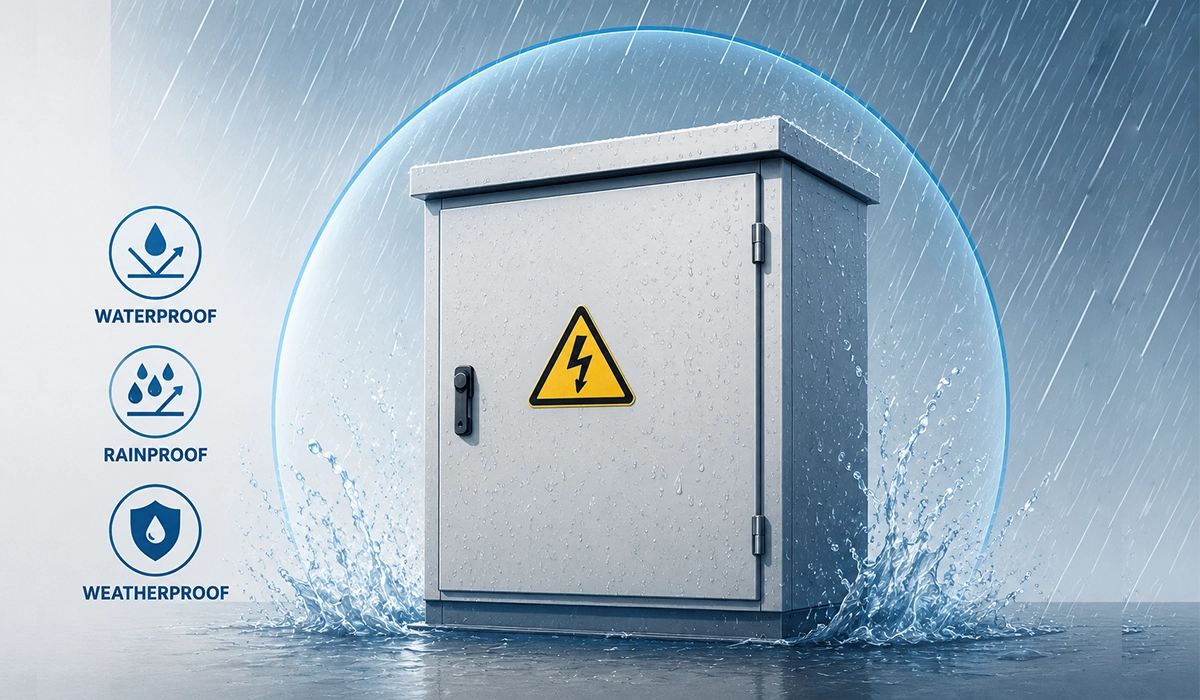
Weatherproof electrical switchgear is that same equipment inside a shell rated for the site. Outdoor switchgear and weatherproof enclosures are therefore specified together, never separately.
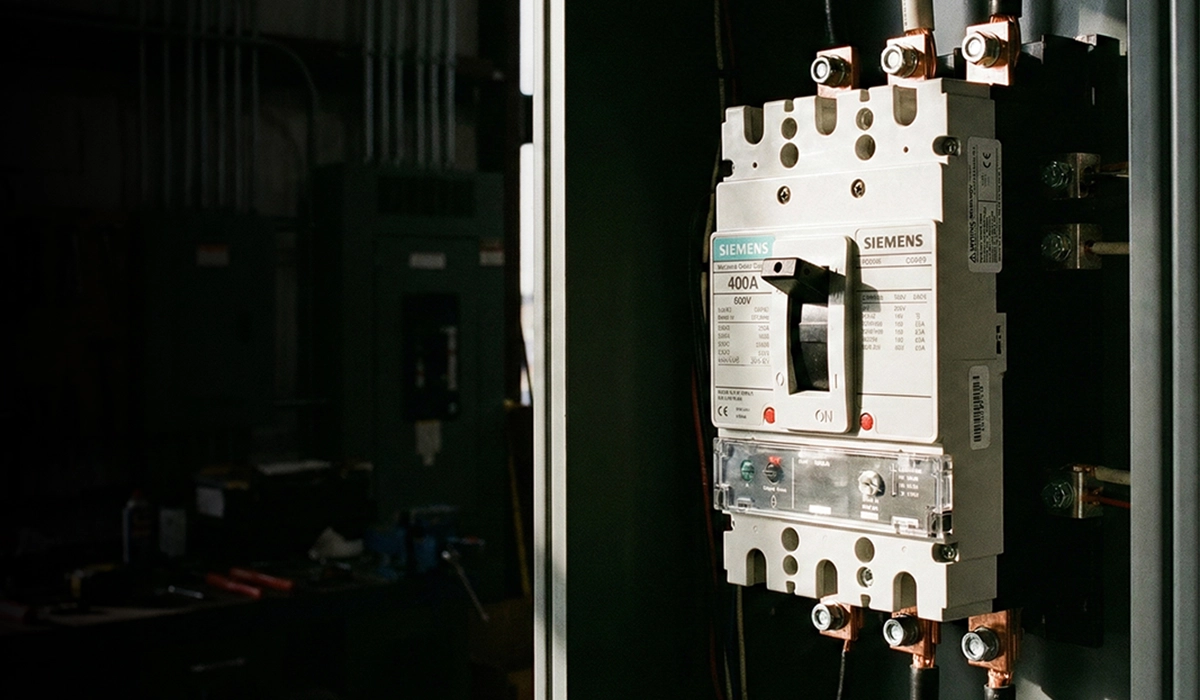
The equipment itself is familiar. Load-break switches, fuses, circuit breakers, disconnectors, instrument transformers and protection relays. What changes outdoors is everything around them: solar gain, wind-driven rain, ice, ultraviolet exposure, airborne salt and daily temperature swings.
Medium-voltage assemblies rated above 1 kV and up to 52 kV fall under IEC 62271-200, which covers indoor and outdoor installation in the same document. Low-voltage outdoor switchgear systems fall under the IEC 61439 series instead.
Applications and Benefits of Outdoor Switchgear
You gain siting freedom, and the standard sets the price of it. Outdoor assemblies for public networks may be installed where ordinary persons have access. They must therefore resist interference as well as weather.
Typical applications are distribution substations, wind and solar plant, pumping stations, ports, mining sites and outdoor electrical distribution systems on large industrial estates. Outdoor switchgear for substations is the largest single group.
The benefit is straightforward. You avoid building and heating a switchroom, you shorten cable runs to the load, and you can extend the installation later without touching the building.
The switchgear inside these enclosures still depends on properly designed busbar connections regardless of where it sits. Our guide to busbars in LV switchgear covers that internal design.
Types of Weatherproof Enclosures for Switchgear
Weatherproof enclosures for switchgear divide by three variables only: material, ingress rating and whether air moves through them. Everything else in a catalogue follows from those three.
Materials come down to painted or galvanised steel, stainless steel, aluminium and glass-reinforced polyester. Steel is cheap and strong. Stainless resists chlorides. Aluminium is light and will not rust, but it is softer. Glass-reinforced polyester is non-conductive and immune to rust, though it chalks under long ultraviolet exposure.
Weather-resistant electrical enclosures are sold in two formats. Modular outdoor switchgear enclosures let you add bays later. Custom-built units fit an awkward site better, but cost more and take longer to replace.
Materials, IP Ratings, and Ventilation Considerations
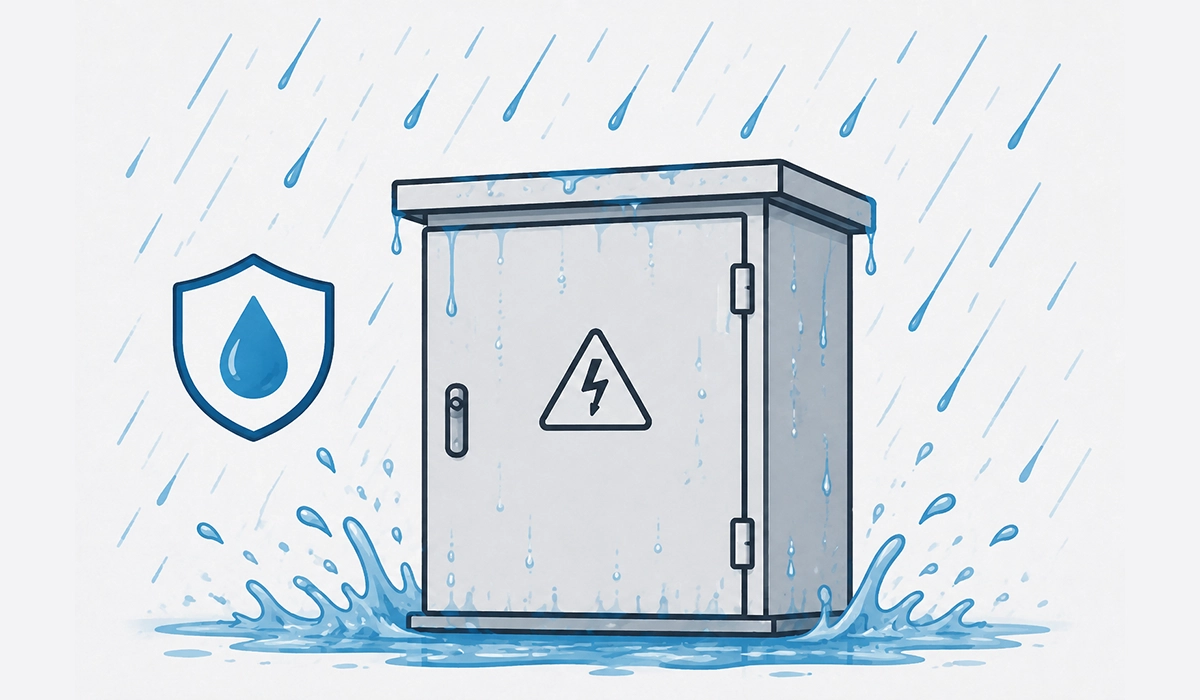
Sealing an enclosure tighter does not make it safer, and the second IP digit proves it. IP54 resists splashing water, IP65 resists jets and IP66 resists powerful jets. None of them removes heat.
That is the trade-off nobody explains well. A ventilated enclosure with filtered fans sheds heat cheaply, but the filters block and the openings admit dust and insects. A sealed enclosure keeps everything out and then cooks the equipment inside, unless you fit an air-to-air exchanger or a cooling unit.
IP ratings for outdoor enclosures usually start at IP54 for sheltered positions. Specify IP65 as the working minimum where wind-driven rain reaches the enclosure. Step up to IP66 where hose-down cleaning happens.
Heating matters as much as cooling. An anti-condensation heater with a hygrostat keeps the internal surface temperature above the dew point, which is where condensation and the corrosion that follows actually begin.
To make sure that no step is forgotten, you can follow this simple checklist while you work.
Enclosure sizing also has to account for how much clearance the busbars inside actually need. Our guide to busbar clearances covers those minimum distances.
Selecting the Right Weatherproof Enclosure for Outdoor Switchgear
Match the enclosure to a corrosivity category before you match it to a price. ISO 12944 grades sites from C1 up to C5, and its 2018 revision added CX for offshore exposure.
The categories do the selection work for you. C3 covers urban and industrial air with low salinity. C4 covers industrial areas and coastal sites with moderate salinity. C5 covers coastal and offshore areas with high salinity. CX covers extreme offshore and salt-spray exposure.
From C4 upward, painted steel stops being a sensible answer. Specify corrosion-resistant enclosures for switchgear in stainless steel or glass-reinforced polyester, and check the fasteners, hinges and gland plates as carefully as the body.
Sizing, Capacity, and Environmental Factors
Size the enclosure on heat, not on how the equipment fits. A busbar’s current rating is set by the highest working temperature it may reach, so a hot box quietly derates the switchgear inside it.
Add up the watts. Every breaker, relay, transformer and heater dissipates heat, and the manufacturer publishes those figures. Then add solar gain, which on a dark south-facing door in summer can exceed the internal load.
Now check the environment against the equipment’s rated service conditions: ambient temperature range, altitude, humidity, pollution and ultraviolet exposure. Outdoor enclosures for power distribution frequently fail this check on ambient temperature alone.
The result is a heat balance, and it decides whether you need natural ventilation, forced ventilation, a heat exchanger or active cooling. Getting outdoor switchgear enclosures design wrong here is expensive to correct after commissioning.
Getting the heat balance right depends heavily on how the busbars themselves were sized in the first place. Our guide to busbar sizing covers that calculation.
Installation Best Practices for Outdoor Switchgear
Outdoor switchgear installation stands or falls on two details: the earthing arrangement and the cable entries. Switchgear installation for outdoor environments is otherwise conventional, but those two are cheap now and expensive later.
Earthing comes first. The enclosure, gland plates, door bonds and any separate structure must connect to a properly sized protective conductor and a designed earth electrode. Corroded or painted-over bonds are among the most common findings on a first inspection.
Cable entry is the other half. Every entry must be glanded, sealed and, wherever possible, made from below. A single unsealed knockout turns a certified IP66 enclosure into a rain collector.
Site Preparation, Mounting, and Weatherproofing Techniques
Specify impact resistance alongside ingress protection, because the IK code test requires the enclosure to keep its IP rating and dielectric strength after impact. A dented door that leaks is a failed enclosure.
Prepare the site first. A level plinth above the local flood line, with drainage away from the base, prevents most standing-water problems. Keep the base clear of vegetation and stored material.
Choose the mounting deliberately. Wall-mounted units suit a small weatherproof switchgear box and save ground space. Free-standing units suit larger assemblies, allow rear access and let you route cables underneath.
Then weatherproof the details. Fit rain hoods over ventilation openings. Use a canopy or light-coloured finish to cut solar gain. Keep drain holes at the lowest point, and check that door gaskets compress evenly.
Earthing an outdoor enclosure properly starts with a correctly sized earth busbar at the connection point. Our guide to ground bus bars covers that requirement.
Maintaining Outdoor Switchgear and Weatherproof Enclosures
Inspection is a legal duty in the EU, not a nicety. Employers must inspect work equipment after installation and after assembly at a new site, inspect it periodically using competent persons, and keep the records.
Build the schedule around that. Check gaskets, drains, locks, hinges and paintwork at every visit. Thermographic surveys under load find loose or corroding connections before they fail. Clean filters on any ventilated enclosure to a fixed interval, not on complaint.
Safety governs the sequence. Isolate, lock off, prove dead and earth before opening a medium-voltage enclosure, and treat every visit as arc-flash work.
Inspection, Cleaning, and Troubleshooting
Most outdoor faults trace back to one root cause: a surface fell below the dew point and stayed wet. Fix the cause, not the symptom.
Corrosion inside a sealed enclosure. Condensation, not leakage. The cure is an anti-condensation heater controlled by a hygrostat, plus a breather drain at the lowest point.
Tracking or flashover on insulators. Damp plus surface pollution. Clean to a schedule and reconsider the ventilation strategy if deposits keep returning.
Lost IP rating. Aged or unevenly compressed gaskets, or an unsealed entry added after handover. Replace the seal and audit every penetration.
Overheating trips in summer. Blocked filters or solar gain nobody counted. Restore the airflow path and shade or repaint the enclosure.
Loose earth bonds. Corrosion at the bonding face. Clean, remake and protect the joint, then record the reading.
Many of the loose connections a thermographic survey finds trace back to the terminal hardware itself. Our guide to terminal busbars covers what to check there.

Benefits of Weatherproof Enclosures for Outdoor Switchgear
A correctly specified enclosure converts an uncontrolled outdoor environment into a controlled one, and that single change is what extends service life.
The protection is layered. The shell excludes rain, windblown dust and ultraviolet light. The corrosion system handles salt and pollution. The climate control keeps internal surfaces above the dew point and below the equipment’s maximum ambient rating.
Reliability follows from that. Industrial weatherproof enclosures reduce unplanned outages because the two dominant failure mechanisms outdoors, moisture ingress and thermal stress, are both designed out rather than managed.
The cost case is simple. An electrical equipment weatherproof enclosure is paid for once, in stainless steel, a heater and a proper gland plate. You pay repeatedly for corroded terminations, emergency call-outs and lost production.
These reliability gains compound as busbar technology itself keeps evolving toward smarter, more compact designs. Our overview of future trends in busbar systems covers where that is headed.
Industry Standards and Compliance for Switchgear Enclosures
Never convert an IP rating into a NEMA Type. The crosswalk runs one way only, because NEMA 250 adds corrosion, icing and oil tests that IEC 60529 does not perform at all.
| Standard | What it covers | What you specify |
|---|---|---|
| IEC 60529 | Ingress of solids and water | IP54, IP65 or IP66 |
| IEC 62262 | Impact energy withstand | IK08 or IK10 |
| ANSI/NEMA 250 | Water, dust, ice and corrosion below 1,000 V | Type 3R, 4 or 4X |
| ISO 12944 | Atmospheric corrosivity of the site | C3, C4, C5 or CX |
| IEC 61439-1 and -5 | Low-voltage assembly design verification | Outdoor assembly |
| IEC 62271-200 | Metal-enclosed switchgear, 1 kV to 52 kV | IAC class, kA and duration |
Two entries deserve attention. NEMA does not test or certify enclosures itself, so a Type marking is a manufacturer declaration unless a listing body has verified it. And internal arc classification under IEC 62271-200 is a mandatory type test, marked with the protected sides, the fault current and the duration.
If you need something you can print and use offline, the printable version is available here.
Conclusion about Outdoor Switchgear and Enclosures
Specify the site before you specify the box. A corrosivity category, an ingress rating, an impact rating and an honest heat balance settle most of the decision. The rest is detailing the earthing and cable entries properly.
You are now equipped to make two calls: which material and IP grade the site actually demands, and whether the enclosure needs ventilation, exchange or active cooling.
Once the enclosure is specified, the busbar layout inside an LV panel is the next decision worth getting right. Our LV panel busbar selection guide covers that step.

Rate this article
Choose a rating from 1 to 5 stars.
No ratings yet