



If you’d rather listen than read, feel free to play the audio file below for the rest of this article.
The Withdrawable Circuit Breaker in Brief
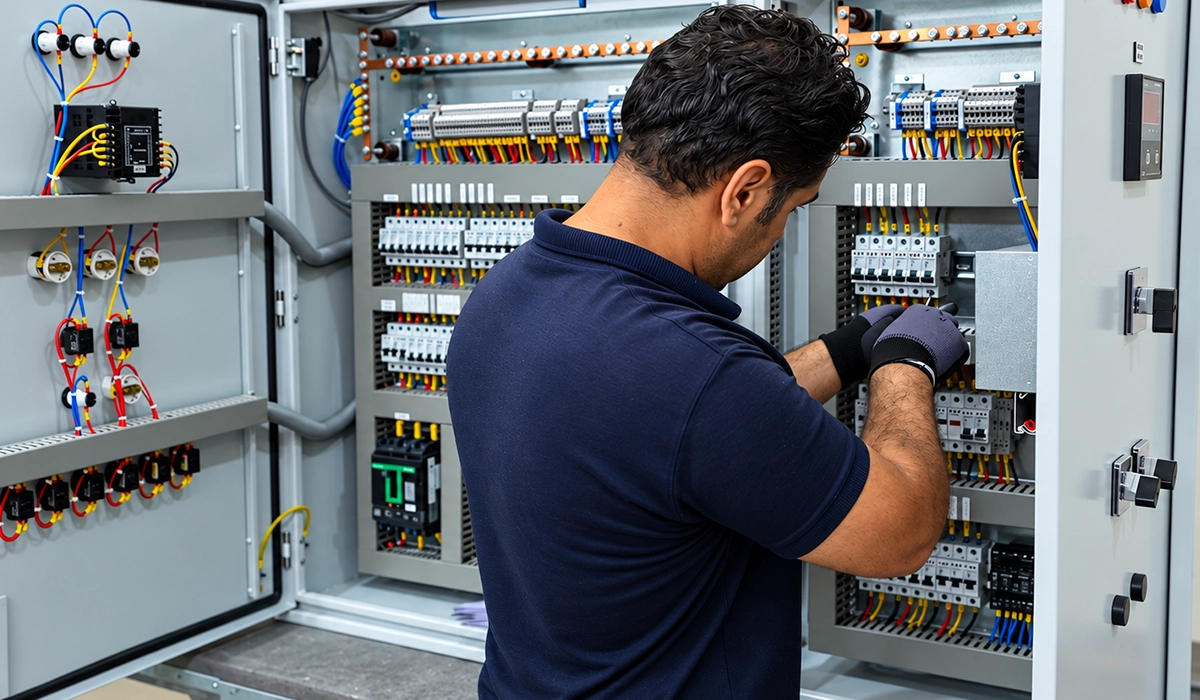
In ABB’s ZS3.2, the withdrawable part is a sheet-steel structure carrying the breaker poles, with contact arms and spring-loaded contact systems that make the connection to the panel’s fixed contacts. This kind of mechanical detail sits within the broader fundamentals covered in our guide to electrical panels and switchgear basics.
It moves between the service position and the test/disconnected position with the doors closed, so the travel happens behind the panel front. ABB earths the withdrawable part through earthing contacts and an earthing rail.
In the field, most confusion comes from treating an open breaker as an isolated one. They are different states. An open breaker has simply interrupted the circuit, while position decides whether the main circuit is connected at all.
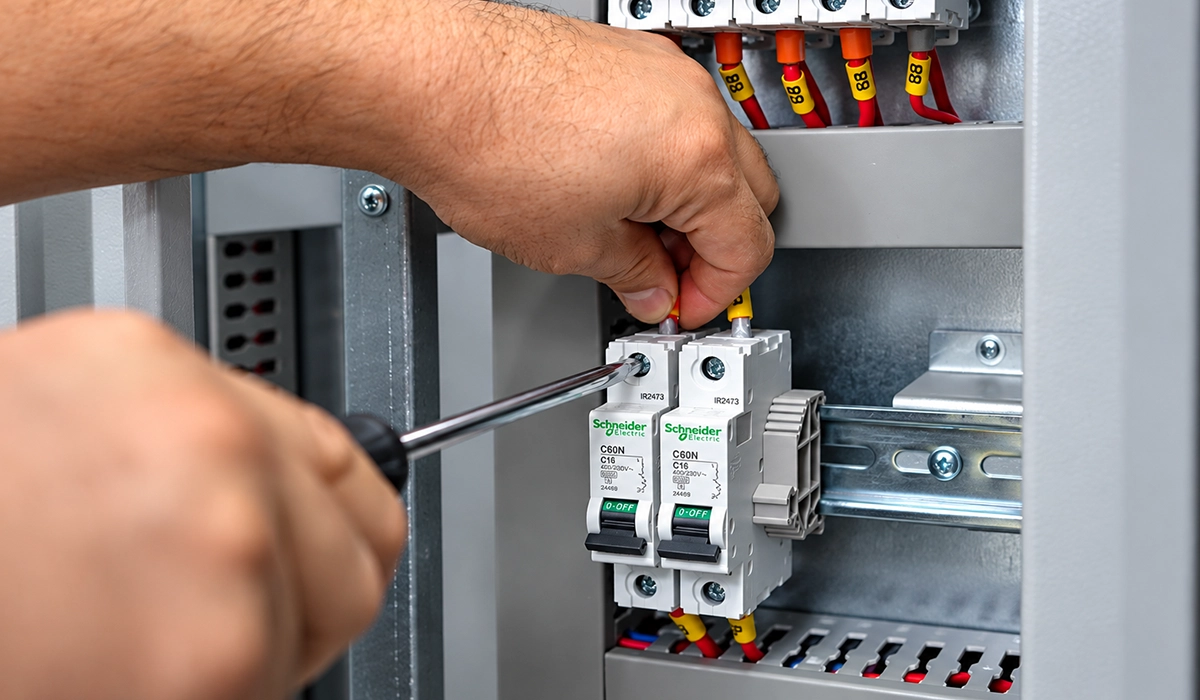
A withdrawable breaker is just one of many components that have to work together correctly inside the assembly. Our guide to switchgear components covers the rest of that system.
Service Position vs Test Position
A test position circuit breaker is still completely inside the panel with the door closed. What has changed is the main circuit.
In service, the contact arms engage the fixed contacts and connect the main circuit. The breaker is doing its real job.
In test/disconnected, ABB’s ZS1 manual describes a separation in the main circuit, while the control wiring needed for testing can stay connected. The breaker is isolated from the feeder but still reachable by its own controls. That combination is why the test position exists: the mechanism and controls can be exercised with nothing live on the primary side.
As the part moves back, metal shutters cover the fixed contacts automatically, one of the features of the metal-clad construction around it.
Take the part out of the panel altogether and ABB’s ZS3.2 manual calls that the removed position. It is a third state, not another name for test.
Knowing exactly which breaker sits in a given lineup matters before any of these position rules can be applied correctly. Our circuit breaker finder can help confirm that.
What Each Position Allows
ABB ties five actions to position, and each one is either allowed or blocked depending on where the part sits.
| Action | Test/disconnected | Service |
|---|---|---|
| Close the circuit breaker | Allowed | Allowed |
| Insert or remove the control wiring plug | Allowed | Blocked |
| Close the earthing switch | Allowed | Blocked |
| Switch the breaker without primary voltage, for testing (ZS1) | Allowed, with the plug fitted | — |
| Racking circuit breaker to the other position | Breaker and earthing switch open | Breaker and earthing switch open |
Between the two positions, the breaker cannot close at all. ABB interlocks it until the part sits precisely in one defined position or the other.
The earthing switch row has more conditions than a table can hold, and they have their own article.
Auxiliary switches tell the control circuit where the part is: S8 reports the test position, and S9 reports service.
On commissioning, these rules are worth checking one by one rather than assuming. A panel that lets the plug come out in service, or lets the breaker close mid-travel, has an interlock fault, whatever the drawing says.
You can also save a copy for later, which is helpful if you plan to return to this more than once.
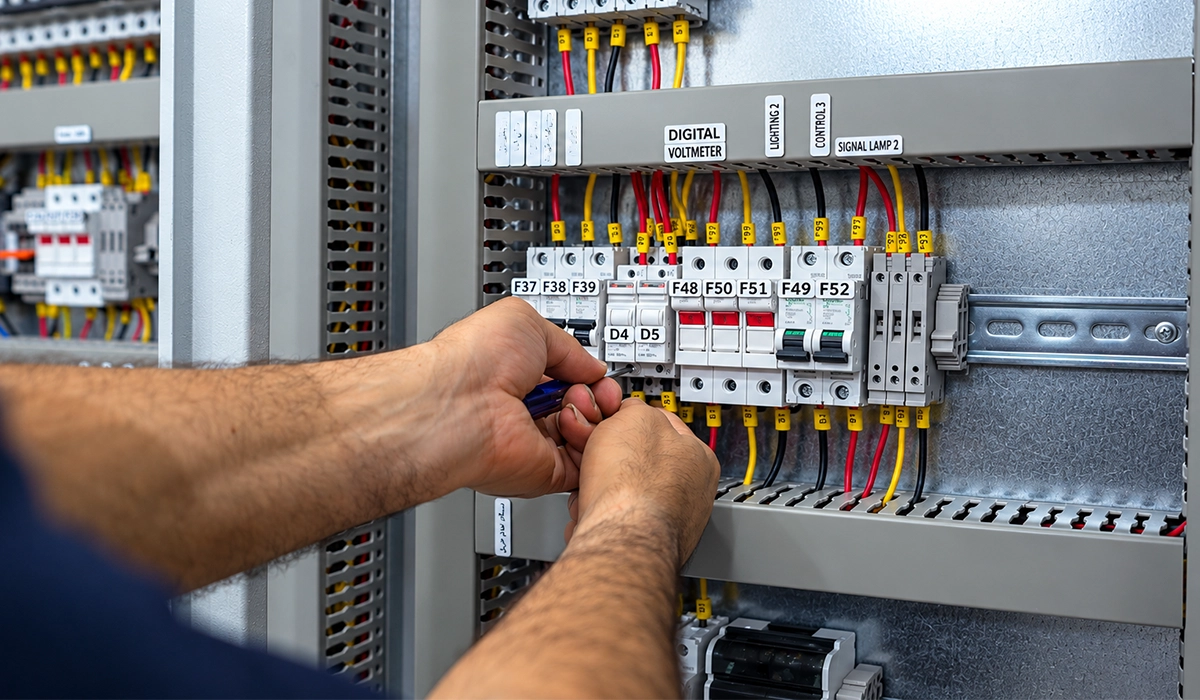
Auxiliary switches reporting position back to the control circuit are part of a much larger control system working behind the panel. Our overview of industrial control systems covers that wider layer.
Moving Between Positions
Moving the part is counted in crank turns: about 45 in ZS3.2 and about 20 in the 12/17.5 kV ZS1, clockwise towards the service position. What follows explains ABB’s design; it is not a work instruction.
The hand crank fits a square spigot on the spindle mechanism, and the travel ends at a stop in each direction.
ABB is explicit on one point: the part must not be left anywhere in the travel between the two positions. Stopped halfway, it is neither connected nor isolated, which is exactly the state the interlocks are built to avoid.
Where a blocking magnet is fitted, a loss of control voltage can block the part. ABB’s instruction is plain: do not force it.
A blocking magnet losing control voltage is one example of how every component inside the panel depends on the others working correctly. Our guide to industrial panel components covers that interdependence.

Conclusion about Service Position vs Test Position
The service position is where the breaker does its work, and the test position is where it can be checked safely. Both rely on contacts that meet exactly.
Zooming out, breaker positioning is just one detail in the much larger job of specifying a panel correctly. Our holistic review of steel panels covers that bigger picture.


Rate this article
Choose a rating from 1 to 5 stars.
No ratings yet