




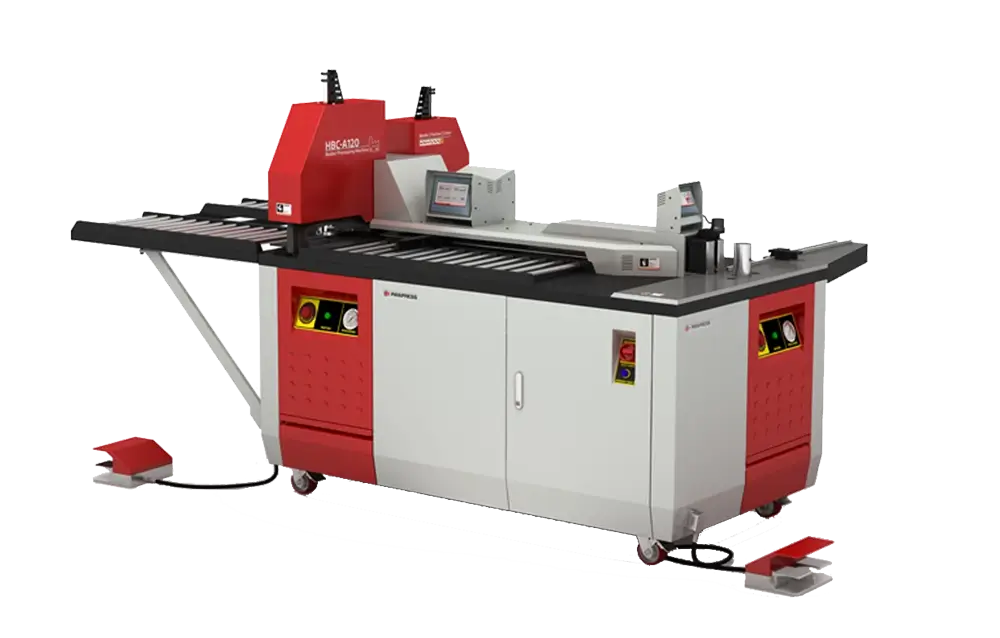
What Is a Busbar in Switchgear? Role and Function in a Low Voltage Panel
A busbar in switchgear is a rigid conductor—normally flat copper or aluminium bar—that gives every circuit in the panel one shared, low-impedance path instead of dozens of point-to-point cables.
That shared path is what makes switchgear busbars so consequential. One bar feeds the incomer, the bus-coupler, and every outgoing way. A hotspot, a loose joint, or an undersized section does not affect one feeder; it affects the whole board.
Temperature rise is the governing design limit. IEC 61439-1 sets 70 K for terminals intended for external conductors. For the busbars themselves, the standard does not give one universal number — the limit is set by the mechanical strength of the conductor, the insulation in contact with it, and the effect on adjacent equipment. In practice, most manufacturers work to a 105 K rise for bare copper, giving about 140 °C at a 35 °C reference ambient.
| What Is Being Measured | Typical Design Limit | Reference Ambient |
|---|---|---|
| Bare Copper Busbar | 105 K Rise (~140 °C) | 35 °C |
| Terminals for External Conductors | 70 K Rise (~105 °C) | 35 °C |
| Accessible Manual Operating Means (Metal) | 15 K Rise | 35 °C |
| Enclosure Surfaces Accessible to Touch (Metal) | 30 K Rise | 35 °C |
Always confirm the exact figure against the current edition of IEC 61439-1 Table 6 and against the manufacturer’s declared data for your enclosure.
Download this file to keep the key data, tables, and recommendations in one place.
The Three Jobs of a Switchgear Busbar
A switchgear busbar does three jobs at the same time:
| Job | What It Means in the Panel | Why It Matters |
|---|---|---|
| 1. Carry | Transfers incoming current from the supply to the main distribution zone | Sets the cross-section and the material |
| 2. Connect | Links incomers, bus-couplers, and outgoing feeders without separate cable runs | Cuts joint count, assembly time, and future failure points |
| 3. Isolate | Creates defined points where a section can be dead and worked on | Makes safe fault clearance and maintenance possible |
A note on design targets. IEC 61439-1 sets the maximum permitted temperature rise. Many panel builders design well below it — a house target of 30 K rise is common — because a cooler bar means lower I²R losses, slower insulation ageing, and headroom when the site ambient runs above the assumed 35 °C. Treat 30 K as a good engineering target and 105 K as the compliance ceiling, not the design point.
A clean bar system also reduces the number of bolted joints in the panel. Every joint is a place that can loosen, oxidise, and overheat, so fewer joints is a reliability decision as much as a cost one.
For additional technical context, refer to this page.
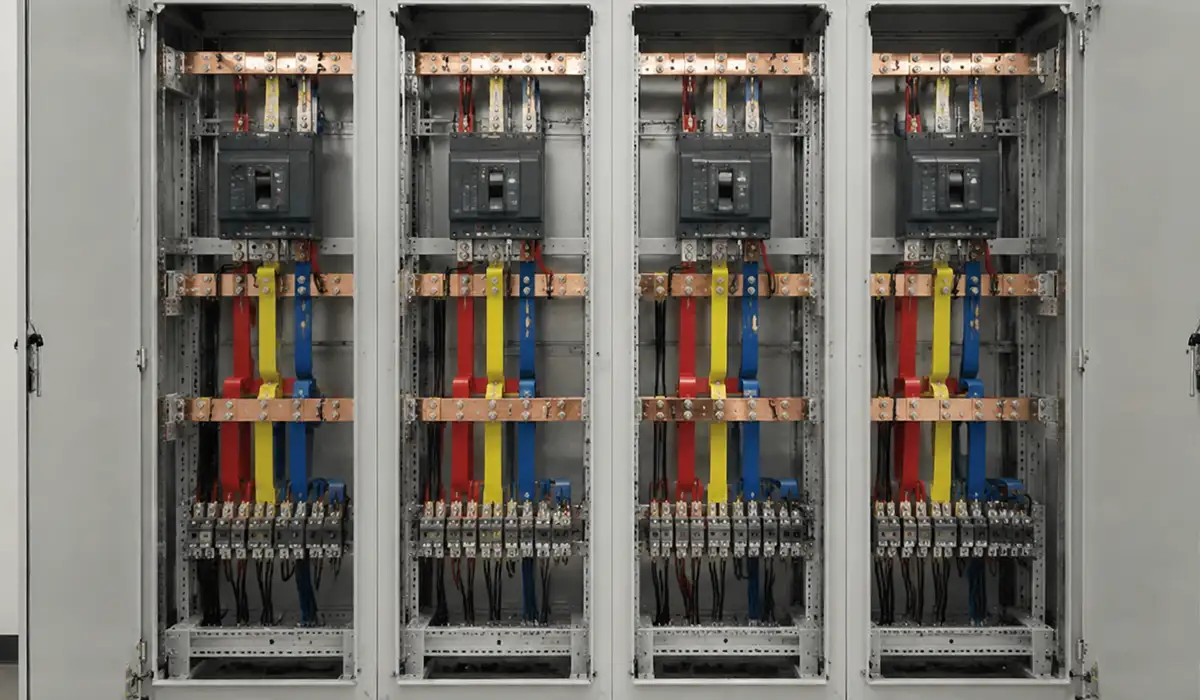
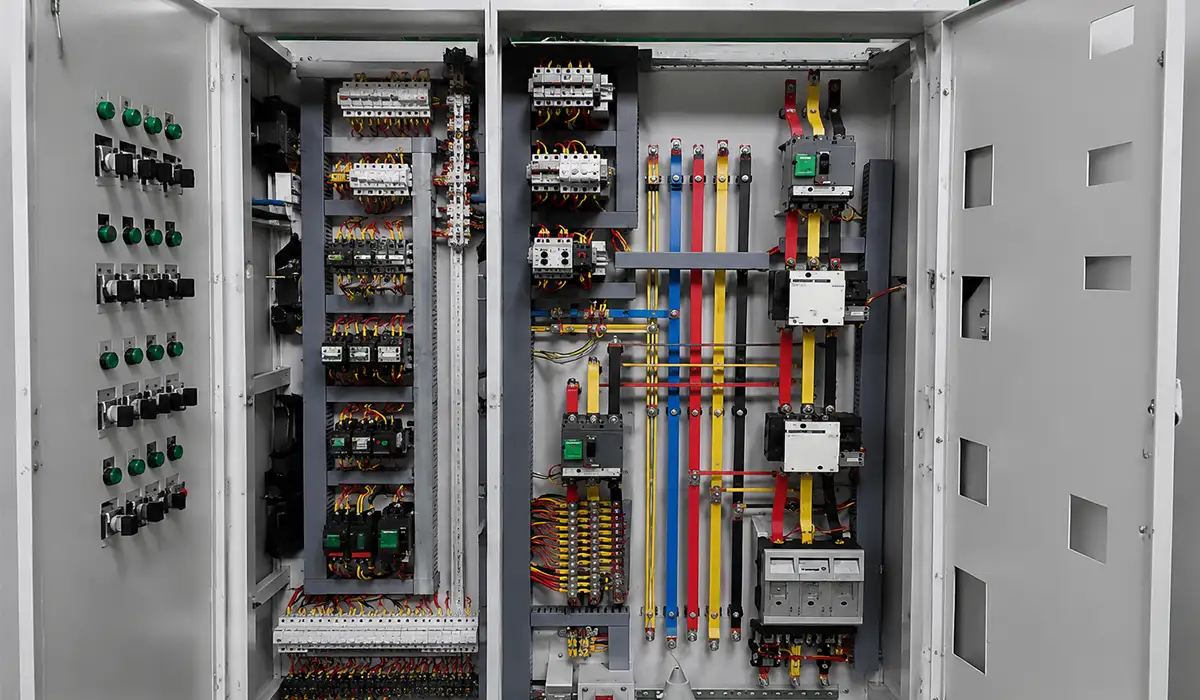
What Busbars Look Like Inside an LV Panel (Labelled Diagram)
Most LV switchgear follows the same internal arrangement, and seeing it laid out makes the design rules easier to follow.
A typical LV panel busbar layout has four zones:
| Zone | What Sits There | Typical Position |
|---|---|---|
| Main Horizontal Busbar | The full-rated bars (L1, L2, L3, N) running panel to panel | Top or rear, in its own compartment |
| Vertical Droppers | Bars branching down to each functional unit | Rear of each cubicle |
| Branch Connections | Links from droppers to breaker upper terminals | Behind the device compartment |
| Earth / PE Bar | Continuous protective bar bonded to the frame | Bottom, running the full length |
The main busbar compartment is normally separated from the device compartment by solid barriers. This is what allows a breaker to be worked on while the main bars stay live, and it is one reason panel form of separation (Form 1 to Form 4b) is specified on almost every project.
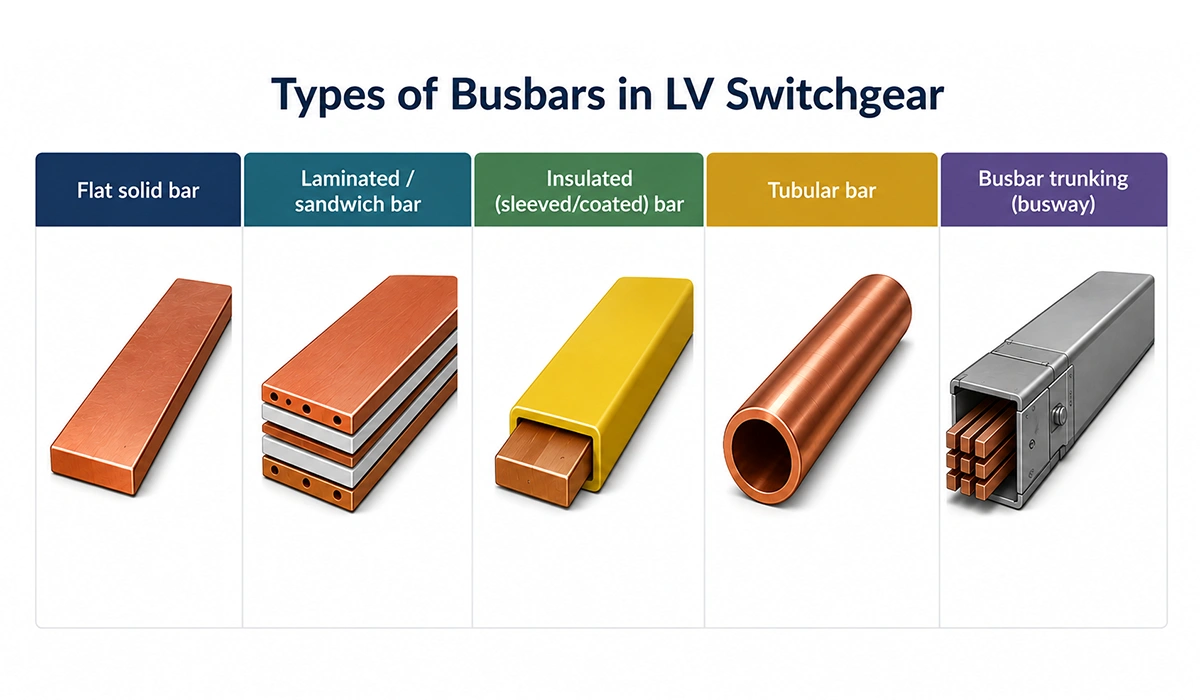
Types of Busbars Used in LV Switchgear Panels
Match the busbar type to the duty. Flat solid bar covers most LV panels up to a few thousand amperes; laminated and shrouded bars trade cost for compactness and touch safety; busbar trunking carries power along a route rather than within a panel.
The choice is rarely about conductivity alone. It is about footprint, fault behavior, and how easily the bar can be inspected and modified later.
| Type | Typical Range | Strengths | Watch-Outs / Best Fit |
|---|---|---|---|
| Flat Solid Bar | Up to a Few Thousand A | Simple, low cost, easy to fabricate and joint | Bulkier; higher inductance at high current |
| Laminated / Sandwich Bar | High Current, Compact Builds | Low inductance, even current sharing, space-saving | Higher cost; hard to modify in the field |
| Shrouded / Insulated Bar | Any Rating | Smaller clearances, touch-safe, dust-tolerant | Surface prep critical; harder to inspect visually |
| Tubular Bar | Very High Current | Good strength-to-weight, lower skin effect | More complex jointing; needs space |
| Busbar Trunking (Busway) | Distribution Along a Route | Flexible tap-offs, fast install, reconfigurable | Joint quality along the run; higher cost |
Shrouded Bus Bar Systems: Touch-Safe Options for LV Panels
A shrouded bus bar is a conductor fitted with an insulating cover or housing, so that no live metal is exposed. An open or bare bar has no such protection and is only acceptable inside a closed, controlled compartment.
| Bare Copper Bar | Shrouded / Insulated Bar | |
|---|---|---|
| Exposed Live Metal | Yes | No |
| Phase-to-Phase Clearance Needed | Full Air Clearance Per Uimp | Reduced — Insulation Supplements Air |
| Dust and Debris Tolerance | Low | High |
| Accidental Contact Risk | Present When Compartment Is Open | Very Low |
| Visual Inspection of the Bar | Easy | Restricted — Relies on IR and Resistance Testing |
| Typical Cost | Lower | Higher |
Three ways a bar is shrouded, in ascending order of integrity:
- Heat-shrink sleeving. Cheapest and most common. Be aware that a skin-tight PVC or heat-shrink sleeve can crack or split while being slid over a bar, and any trapped air pocket restricts heat dissipation. Inspect the sleeve after fitting, not before.
- Powder or epoxy coating. Bonded to the bar, so no air gap and better heat transfer. Requires factory application.
- Moulded shroud or touch-protection housing. A separate dielectric enclosure that clips over the bar system, often with cut-outs for adapters. This is the standard approach for touch-safe distribution blocks and adapter-based systems.
Where shrouded bars earn their cost: panels with reduced phase spacing, sites with high dust or humidity, boards where live work or live inspection is permitted, and any assembly where the form of separation would otherwise need extra barriers.
The trade-off to accept: you lose visual inspection. Discoloration and arcing marks — the first warning signs on a bare bar — are hidden. Compensate with a stricter infrared thermography schedule and contact-resistance trending at the joints.
Standard Busbar Sizes and Current Ratings for LV Panels
LV panel busbars are supplied in a set of standard rectangular sizes. Working from this list — rather than a calculated cross-section — saves cost, shortens lead time, and matches the support hardware that is already on the shelf.
The table below gives indicative continuous ratings for a single bare copper bar, edgewise, at 35 °C ambient. It also gives the value most panel builders actually need: the same bar inside a closed enclosure, where airflow is restricted.
| Size (mm) | Area (mm²) | Free Air, Single Bar (A) | Enclosed Panel, ×0.70 (A) |
|---|---|---|---|
| 20 × 5 | 100 | ~250 | ~175 |
| 25 × 5 | 125 | ~290 | ~205 |
| 30 × 5 | 150 | ~330 | ~230 |
| 40 × 5 | 200 | ~415 | ~290 |
| 50 × 5 | 250 | ~500 | ~350 |
| 50 × 10 | 500 | ~830 | ~580 |
| 60 × 10 | 600 | ~960 | ~670 |
| 80 × 10 | 800 | ~1220 | ~855 |
| 100 × 10 | 1000 | ~1470 | ~1030 |
| 120 × 10 | 1200 | ~1700 | ~1190 |
Indicative values for concept design only. Confirm against manufacturer data and the applicable standard before issuing a design.
Four things this table teaches:
- The enclosure costs you about 30%. This is the single most common sizing error — buying to a free-air nameplate and installing in a sealed panel. The bar that passes on the bench overheats in service.
- Thin and wide beats thick and narrow. A 100 × 10 mm bar and a 50 × 20 mm bar have the same 1000 mm² area, but the 100 × 10 has over a third more cooling surface. This is why standard bars rarely exceed about 20–25 mm thickness — engineers add width or add parallel bars instead.
- Parallel bars do not double the rating. Two bars side by side typically give around 1.7–1.8 times a single bar, not 2.0, because they heat each other and current does not share perfectly.
- Above about 12 mm thickness, skin effect starts to matter. At 50/60 Hz it adds only a few percent for typical bar thicknesses, but it grows quickly on very thick bars and on VFD output bars.
For full ampacity tables, mounting factors, and a step-by-step worked sizing example, see our dedicated guide to copper busbar current ratings.
How to Size a Low Voltage Switchgear Busbar: Two Duties, Both Mandatory
Two duties size every LV busbar: continuous current within the temperature-rise limits, and short-circuit withstand against the peak fault force. Verify both, because the larger requirement governs.
Many in-service failures trace to designing for the first duty and forgetting the second. The three sections below take sizing, fault withstand, and material in turn.
Proper design of busbars requires referencing established guidelines and selection criteria specific to LV panel applications.
Sizing for Continuous Current: Current Density, Derating, and RDF
Size the busbar by holding the temperature rise inside the permitted limits, then work back to a cross-section.
The controlling variable is temperature rise (ΔT) — the difference between conductor and ambient temperature — not the absolute reading. A bar at 90 °C in a 25 °C room is fine; the same bar at 90 °C in a 55 °C switchroom is not.
Current density as a starting point:
| Installation Condition | Typical Copper Current Density |
|---|---|
| Open Busbar, Good Airflow | 2.0–3.0 A/mm² |
| Ventilated Enclosure | 1.6–2.0 A/mm² |
| Sealed or IP54+ Enclosure | 1.0–1.6 A/mm² |
Use current density for a first pass only. It is a shortcut, not a verification method.
Then apply the derating factors that actually bite:
| Factor | Typical Effect |
|---|---|
| Enclosed Mounting | ×0.70 |
| Vertical Edgewise vs Horizontal Flatway | ×0.85 |
| Ambient Above 35 °C | Reduce Roughly 1.5% per °C |
| Altitude Above 2000 m | Reduce for Reduced Cooling |
| Grouped or Stacked Bars | ×0.85 to ×0.90 per Additional Bar |
Finally, apply the rated diversity factor (RDF). IEC 61439 recognises that not every outgoing circuit runs at full load at once. A worked example: 22 outgoing circuits with a total connected demand of 2700 A, at an RDF of 0.6, gives a main busbar requirement of 1620 A, not 2700 A. Typical RDF values run from 0.8 to 1.0 for small circuit counts and drop toward 0.6 as the number of ways rises.
The most common mistake we see on the shop floor is buying to nameplate amperes without derating for the enclosure. The bar passes on the bench and overheats in the sealed panel.
For a practical approach to calculating busbar dimensions, this article on busbar sizing offers step-by-step guidance.
Short-Circuit Withstand: Icw, Ipk, and Support Spacing
Design the bar and its supports for the peak fault, not just the rms current — the force between parallel bars rises with the square of peak current (per IEC 60865-1), and verification is mandatory unless Icw is ≤ 10 kA or a current-limiting device caps let-through current at ≤ 17 kA.
Two ratings describe the fault duty. The short-time withstand current (Icw) is the rms current the bar carries for a defined time, usually one second, while the peak withstand current (Ipk) is the instantaneous crest the bars must survive mechanically. Because the electrodynamic force on busbars scales with Ipk², a modest rise in fault level produces a large rise in force. Two outcomes follow: the bar must resist the thermal I²t energy without annealing, and the supports must resist the mechanical force without deflecting into adjacent phases. Busbar short-circuit testing, or calculation to IEC 60865-1, confirms both. A current-limiting circuit breaker that cuts off the peak can reduce the force several-fold, which is often cheaper than a heavier bar.
A worked example of what support spacing means in practice. On a main busboard fed from a 2000 kVA transformer, an Icw of 50 kA is typical. Reaching that figure on a standard bar system may require busbar holders at a maximum spacing of around 425 mm. Widen the pitch to 600 mm on the same fault level and the force each insulator sees rises sharply — often past its rating.
This is why support pitch must be re-checked every time the fault level changes, even if the bar size does not. Copying a support pitch from a lower-fault job is one of the most common causes of busbar failure under fault.
For a more detailed breakdown, download the complete guide here.
Copper vs Aluminium Busbar: Which to Specify and When
Choose copper for compact, high-duty LV busbars and aluminium where weight or cost dominates — aluminium needs roughly 1.6× the cross-section of copper for the same current, plus bimetallic hardware to prevent galvanic corrosion at joints.
Material choice is a balance of conductivity, strength, corrosion behavior, and cost. The matrix below sets out the options and when each one wins.
| Criterion | Copper (Cu-ETP) | Aluminium (EN AW-1350) | Tinned copper |
|---|---|---|---|
| Conductivity | Highest (~58 MS/m, ~101% IACS) | ~61% IACS → ~1.6× section needed | As copper |
| Section for same current | Smallest | ~1.6× larger | As copper |
| Weight / material cost | Heavier, costlier | Lighter, cheaper | Slightly above bare copper |
| Corrosion / oxidation | Good; oxide stays conductive enough | Oxide is insulating — needs careful prep | Best surface protection |
| Jointing | Simple, standard hardware | Needs bimetallic hardware + anti-oxidant | Simple; suits humid conditions |
| Best fit | Compact or high-duty panels | Weight- or cost-driven, larger enclosures | Marine, humid, high-pollution sites |
Selection rule: default to copper for compact or high-duty LV panels; choose aluminium when the enclosure can accept the larger section and weight or budget dominates; specify tinned copper for humid, marine, or high-pollution environments. Always state the grade and temper in the purchase order, never leaving it open.
Material selection for busbars is a foundational decision that affects both performance and long-term reliability.
Switchgear Busbar Connections: Bolted Joints, Torque, and Contact Resistance
Every busbar joint carries the same current as the bar but adds contact resistance. That makes joints the hottest, most failure-prone points in the whole system — and the part most often specified by habit rather than by calculation.
The failure mechanism is a loop that feeds itself:
Higher contact resistance → more heat → faster oxidation and bolt relaxation → higher contact resistance.
Once it starts, it does not stabilise. It ends at burnout. Everything below is about stopping that loop before it begins.
How to Prepare and Bolt a Busbar Joint
A sound switchgear busbar connection depends on three things: contact area, contact pressure, and surface condition. Get all three right and the joint resistance will be lower than an equal length of the bar itself.
1. Contact area. For a straight lap joint between bars of equal width, the standard rule is an overlap length of at least the bar width, giving a contact area of at least the bar’s cross-sectional area. On wide bars, use two bolt rows rather than one.
2. Surface preparation. Abrade both mating faces to bright metal, wipe clean, and bolt promptly. Copper oxide is only mildly resistive, so a short delay is tolerable. Aluminium is different — its oxide is an insulator and re-forms within seconds, so aluminium faces must be abraded under a film of joint compound and bolted immediately.
3. Contact pressure. Bolt to a defined torque, and use Belleville (disc spring) washers on every bolt. As the joint heats and cools through daily load cycles, copper creeps slightly and a plain flat washer loses clamping force. The disc spring keeps pressure on the interface across thousands of cycles. This single component prevents more joint failures than any other detail.
Indicative bolt torque for copper busbar joints (steel bolts, property class 8.8):
| Bolt Size | Typical Torque | Typical Bar Width |
|---|---|---|
| M6 | 8–10 N·m | Up to 30 mm |
| M8 | 20–25 N·m | 30–50 mm |
| M10 | 40–45 N·m | 50–80 mm |
| M12 | 70–80 N·m | 80–100 mm |
| M16 | 155–170 N·m | 100 mm and Above |
Indicative values. Always use the busbar or hardware manufacturer’s stated torque, and mark each bolt after tightening so re-checks are auditable.
Verify, do not assume. After assembly, measure the joint with a micro-ohmmeter. A good bolted copper joint should read no higher than the resistance of an equivalent length of the bar. Record the reading — it becomes the baseline for every future maintenance visit.
Joint Plating and Dissimilar-Metal Connections
Plating protects the contact interface over the panel’s 25 to 30 year life.
| Finish | Best For | Notes |
|---|---|---|
| Bare Copper | Dry, Clean Indoor Panels | Cheapest; Oxide Stays Conductive Enough |
| Tin-Plated Copper | Humid, Marine, or Polluted Sites | Best General-Purpose Protection; Standard for Most Projects |
| Silver-Plated Copper | High-Temperature or High-Duty Joints | Retains Low Resistance at Elevated Temperature; Higher Cost |
| Nickel-Plated | Corrosive Process Environments | Harder Surface, Needs Higher Contact Pressure |
Copper-to-aluminium joints need special care. The two metals sit far apart on the galvanic series, so in the presence of moisture the aluminium corrodes preferentially and joint resistance climbs. Use one of:
- Bimetallic transition washers or plates between the faces
- Tin-plating on the copper side to reduce the galvanic couple
- A sealed joint with anti-oxidant compound and a wrap to exclude moisture
Never bolt bare copper directly to bare aluminium in an environment that sees condensation. It will look fine at handover and fail within a few years.
Copper Busbar Marking and Phase Colour Codes
Correct busbar marking is what lets a technician identify L1, L2, and L3 without a meter, and it is what prevents a reversed phase rotation from reaching a motor. It is also one of the first things an inspector checks.
An important clarification: IEC 61439 does not mandate a specific busbar colour. What it requires is that conductors be identifiable. The colour codes below come from IEC 60445 (which absorbed the former IEC 60446) and from national wiring rules. In practice, busbars are marked with coloured heat-shrink sleeve, coloured tape at intervals, painted bands, or labels at every joint and termination.
Phase Colour Codes by Region
NEW BODY:
| Region / Standard | L1 | L2 | L3 | Neutral | Earth (PE) |
|---|---|---|---|---|---|
| IEC 60445 (Current) | Brown | Black | Grey | Blue | Green/yellow |
| UK, Pre-2004 (Still in Service) | Red | Yellow | Blue | Black | Green/yellow |
| India and Several IEC Markets | Red | Yellow | Blue | Black | Green |
| NEC 208/120 V | Black | Red | Blue | White | Green |
| NEC 480/277 V | Brown | Orange | Yellow | Grey | Green |
| NEC High-Leg Delta | — | Orange (High Leg) | — | White | Green |
Two rules that prevent most site incidents:
- Mark at every interface. Where an old red/yellow/blue board meets a new brown/black/grey installation, label both sides of the transition clearly. Mixed schemes in one building are common and are a recognised hazard.
- Never assume rotation from colour alone. Verify with a phase rotation tester before connecting any motor, regardless of what the marking says.
Grade, Label, and Nameplate Marking
Beyond phase colours, three further markings should appear on a compliant LV panel:
| Marking | Where It Goes | Why |
|---|---|---|
| Conductor Grade and Temper | Purchase Order and Material Certificate | Cu-ETP (EN 13601 / CW004A) or C11000 to ASTM; EN AW-1350 for Aluminium. Never Leave the Grade Open on the PO |
| Assembly Nameplate | Panel Door or Inside Face | Rated Current, Icw (IEC) or SCCR (UL), Rated Voltage, IP Rating, Standard, Manufacturer, Serial Number |
| Torque Marking on Joints | Paint Mark Across Bolt and Bar | Lets Any Later Inspection See Instantly Whether a Bolt Has Moved |
Under UL 508A, the SCCR must be marked on the nameplate, and under NEC Article 409 the installation must keep available fault current at or below that mark. A missing or wrong SCCR marking is one of the most common reasons a North American panel fails inspection.
Installing Busbars in an LV Panel: Supports, Clearances, and Phase Arrangement
Installation decides whether the design survives reality: correct support spacing, phase arrangement, and clearances turn a paper rating into a panel that holds both its temperature rise and its fault withstand on site.
A bar sized perfectly on paper still fails if the supports are too far apart, the phases are crowded, or the spacings are short. The three sections below cover supports, configuration, and spacing.
Installation quality is directly linked to compliance with clearance and creepage requirements. Understanding these spatial constraints early in the design process helps avoid costly rework on site. This resource on busbar clearances covers the key requirements in detail.
Busbar Support Systems and Insulator Spacing
Space busbar supports so they carry the peak short-circuit force without resonance or permanent deflection — the force scales with peak current squared and inversely with support spacing, so closer supports cut the load each insulator sees.
Supports and bracing hold the bars in position and transfer the fault force into the structure. Two failure modes matter. The first is overstress, where a single insulator sees more force than it can take and cracks. The second is resonance, where the bar’s natural frequency sits near the network frequency or its harmonics and the bar flexes into fatigue. In the field, supports — not the bars — are often the weak link, because builders copy a support pitch from a lower-fault job. Re-check the pitch whenever the fault level rises, and torque every mounting to specification.
Busbar support systems must be evaluated alongside the overall panel busbar design to ensure mechanical integrity under fault conditions.
Busbar Configuration: Phase Order, Neutral Sizing, and Harmonics
Arrange the phases and neutral for balanced current sharing and low loss — a tidy three-phase layout with a correctly sized neutral handles non-linear loads, where harmonic currents can push neutral current toward, or beyond, phase current.
Busbar configuration in switchgear ranges from single-phase feeders to three- and four-pole main bars with a neutral and protective bar. Spacing, phase order, and parallel-bar sharing all affect loss and temperature rise. The classic procurement error is an undersized neutral: on loads with switch-mode supplies or LED drivers, triplen harmonics add in the neutral and can drive it to phase-current levels or higher. Where such loads dominate, size the neutral equal to — or larger than — the phases, and keep the layout symmetrical so the phases share current evenly.
Busbar Systems and IEC 61439 Standards: What You Must Verify
Compliance under IEC 61439 is verification, not paperwork. The standard removed the old split between Type-Tested (TTA) and Partially Type-Tested (PTTA) assemblies. Every assembly now meets the same benchmark, but you may reach it by any of three equivalent routes.
| Verification Route | What It Means | When to Use It |
|---|---|---|
| Testing | Physical Test of the Assembly | New Designs; Highest Confidence |
| Calculation / Measurement | Derived from Validated Formulas | Variations Within a Proven Family |
| Design Rules / Comparison | Compared Against a Tested Reference Design | Standard Products from a Verified Range |
What must be verified for the busbars specifically:
| Verification | What It Proves | Key Clause Area |
|---|---|---|
| Temperature Rise | The Bar Carries Rated Current Within Limits, With RDF Applied | IEC 61439-1 §10.10 |
| Short-Circuit Withstand | Bar and Supports Survive Icw and Ipk | IEC 61439-1 §10.11 |
| Dielectric Strength | Clearances and Creepage Hold at Rated Impulse Voltage | IEC 61439-1 §10.9 |
| Protection Against Electric Shock | PE Continuity and Touch Protection | IEC 61439-1 §10.5 |
The relevant parts of the standard for LV work are IEC 61439-1 (general rules), IEC 61439-2 (power switchgear assemblies), and IEC 61439-6 (busbar trunking systems).
Compliance is verification, not paperwork: IEC 61439 and UL 508A both require documented proof — temperature-rise, short-circuit, and dielectric verification — that the busbars in LV switchgear panels meet their stated ratings.
The two frameworks pursue the same goal through different routes. The sections below separate the technical standards from the regional rules that wrap around them.
Understanding which standards govern busbar design and testing is essential for any LV panel project. For a comprehensive review of the applicable international and regional requirements, this article on busbar standards is an important reference.
IEC 61439 vs UL 508A: Icw and SCCR Are Not Interchangeable
Meet IEC 61439’s verified ratings in IEC markets and UL 508A’s marked SCCR in North America — and remember that under UL 508A the panel’s short-circuit current rating equals its lowest-rated power component.
IEC 61439 replaced the old type-tested versus partially-type-tested split with three equivalent verification routes: testing, calculation, and comparison with a tested reference design. It verifies temperature rise (with the RDF), short-circuit withstand, and dielectric strength, and IEC 61439 busbar requirements flow from those checks. UL 508A takes a different path: Supplement SB builds the panel’s SCCR from the weakest power-circuit component, and the rating must be marked on the nameplate. The contrast matters at procurement — an IEC Icw rating and a UL SCCR are not interchangeable, and exporting between regions usually means a second verification.
Applying IEC 61439 and UL 508A correctly requires a solid understanding of how busbar ratings are established and verified. For engineers who want to go deeper into the fundamentals, this introductory article on what is busbar provides a strong foundation.
| IEC 61439 | UL 508A | |
|---|---|---|
| The Rating | Icw — Short-Time Withstand Current | SCCR — Short-Circuit Current Rating |
| How It Is Set | Verified for the Assembly as a Whole | Built from the Weakest Power-Circuit Component (Supplement SB) |
| Duration | Defined, Usually 1 Second | Instantaneous Let-Through Basis |
| Marking | Declared in Technical Documentation | Must Be Marked on the Nameplate |
| Improving It | Heavier Bar, Closer Supports, Current-Limiting Device | Replace the Weakest Component |
The practical consequence at procurement: an IEC Icw and a UL SCCR cannot be converted into each other. Exporting a panel between the two regions almost always means a second, separate verification. Budget for it at tender stage, not at shipment.
You can review the original source here to verify the technical details.
LV Busbar Maintenance: Thermography, Joint Testing, and Fault Diagnosis
Adopt the regional flavor of the standard — EN IEC 61439 with national deviations across Europe, UL 508A and NEC Article 409 in North America — and make sure the assembly’s Icw or SCCR equals or exceeds the site’s prospective fault current.
Beyond the base standards, local codes decide what an inspector or insurer will accept. In Europe, the LV Directive and harmonized EN IEC 61439 parts apply, with national deviations layered on top. In North America, NEC Article 409 requires an SCCR marking on industrial control panels, and the installation must keep the available fault current at or below that mark. The practical takeaway for EPCs and consultants is simple: pin down the site’s prospective short-circuit current early, because every busbar, support, and protective device is then sized against it.
Maintenance and Troubleshooting of Busbars in LV Switchgear
Catch busbar problems before they trip the panel: NFPA 70B (2023) now requires infrared thermography of electrical equipment at least every 12 months, and a rising joint temperature difference is the earliest reliable warning.
Maintenance of busbars in switchgear is condition-based, not calendar-only. Because the joints carry the same current as the bar but add contact resistance, they are where heat and degradation concentrate. The two sections below cover how to inspect and what typically goes wrong.
Effective maintenance of busbars in LV switchgear starts with understanding the components that make up the busbar connection system.
This website offers useful supporting information for understanding the subject more clearly.
Inspection Guidelines
Run a three-layer inspection — visual, infrared thermography under load, and electrical tests — comparing each joint’s temperature rise against similar joints and ambient, with thermography performed at least annually per NFPA 70B.
Start with a visual check for discoloration, looseness, and signs of arcing. Then scan under a representative load with an infrared camera, because a cold panel hides every joint problem. NFPA 70B works on Delta-T: compare similar joints under similar load, and flag the outliers. Finish with electrical tests — contact resistance at each joint with a micro-ohmmeter, and insulation resistance across the bar system. Trend the readings over time. A single snapshot tells you less than a joint that has crept up 10 K since the last visit.
Common LV Busbar Faults: Symptoms, Causes, and Fixes
Most LV busbar faults come back to the joints: oxidation, under-torque, overload, and corrosion drive contact resistance and temperature up — so fix the root cause by cleaning, re-torquing, and re-rating rather than resetting and re-energizing.
The failure loop is self-reinforcing: higher resistance makes more heat, more heat accelerates oxidation and loosening, and resistance climbs again until the joint burns out. The table links each symptom to its cause, the consequence of ignoring it, and the corrective action.
| Symptom | Likely cause | Consequence if ignored | Corrective action |
|---|---|---|---|
| Hotspot at a joint (on IR) | Oxidation or under-torque | Runaway resistance, eventual burnout | Clean faces, re-torque to spec, re-scan ΔT |
| General overheating | Undersized section, overload, poor ventilation | Insulation ageing, capacity loss | Re-rate the load, improve cooling, resize the bar |
| Discoloration or odor | Sustained overtemperature | Dielectric breakdown, fire risk | Investigate load and joints; replace degraded parts |
| Corrosion or oxidation | Humidity, dissimilar metals | Rising resistance, mechanical weakening | Use tinned bars and bimetallic hardware; reseal |
| Loose support or vibration | Inadequate bracing, prior fault | Fatigue, deflection, raised fault risk | Re-torque, add supports, recheck spacing |
Common maintenance issues in LV busbars are often linked to how the busbar trunking system is integrated into the panel. Understanding the characteristics and vulnerabilities of trunking systems can help teams prevent recurring faults. This article on busbar trunking is a recommended resource.
Busbars in LV Switchgear: Key Takeaways
Busbars decide how much current an LV panel can carry, how well it survives a fault, and how safely it ages. Treat them as a two-duty problem — continuous current within the IEC 61439-1 temperature-rise limits, and short-circuit withstand against the peak electrodynamic force — and most failures never start. From there, the decisions are clear: choose the material for the duty, brace the bars for the fault, set clearances by Uimp and creepage by pollution degree, and verify by test, calculation, or design rules. Then keep the system healthy with annual infrared thermography and routine joint checks. For final sizing and ratings, always confirm against manufacturer data and the current editions of IEC 61439 and UL 508A.
The eight-point LV busbar check, in order:
- Establish the site’s prospective short-circuit current — everything else is sized against it.
- Size for continuous current with the enclosure derate applied, not free-air values.
- Apply the rated diversity factor to the main bar.
- Verify short-circuit withstand for both Icw (thermal) and Ipk (mechanical).
- Set support pitch for the actual fault level — never copy from a previous job.
- Set clearances by Uimp and creepage by pollution degree.
- Specify joint plating, torque, and Belleville washers explicitly on the drawing.
- Record baseline joint resistances and thermography at handover.


Rate this article
Choose a rating from 1 to 5 stars.
No ratings yet