
If you’d rather listen than read, feel free to play the audio file below for the rest of this article.
What Is a Busbar Trunking System?
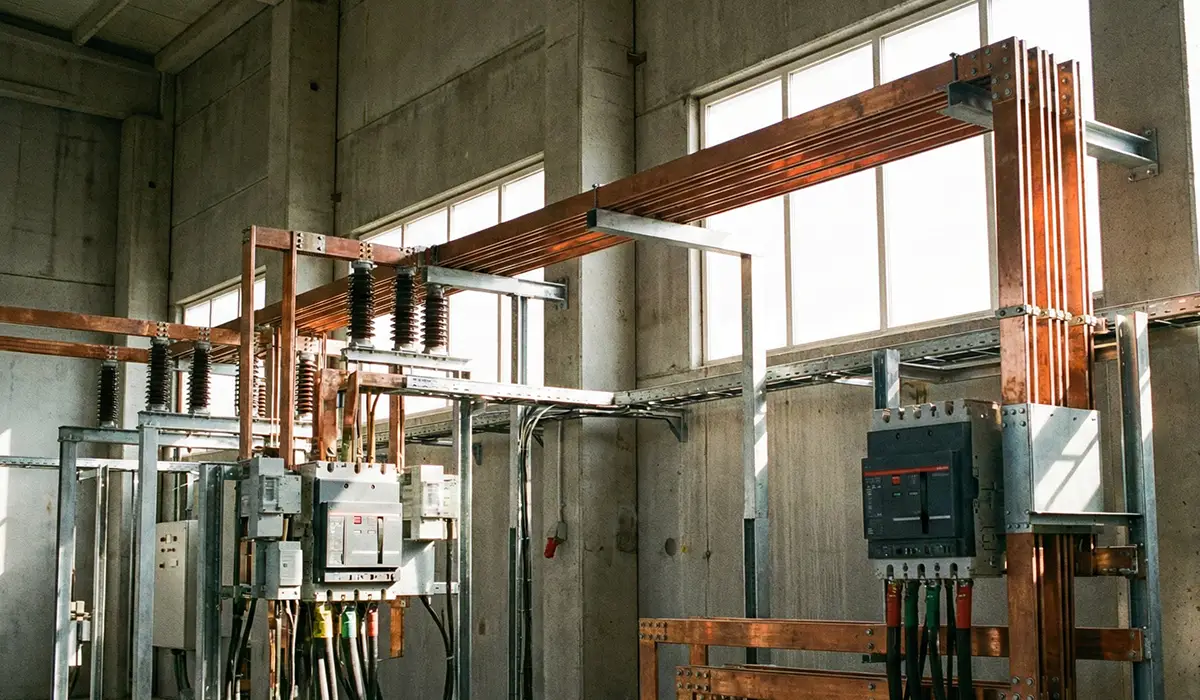
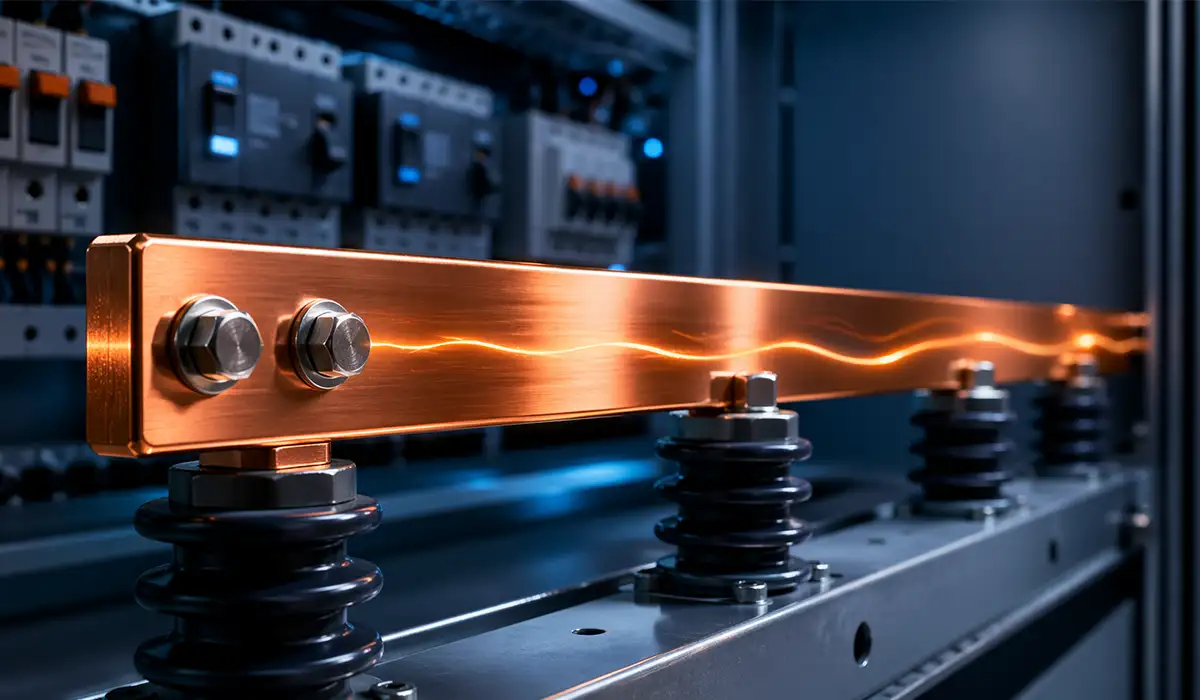
To understand the advantages of busbar trunking systems, start with the assembly itself: a prefabricated low-voltage distribution system using insulated conductors inside a protective enclosure, manufactured and verified as a complete assembly rather than pieced together on site.
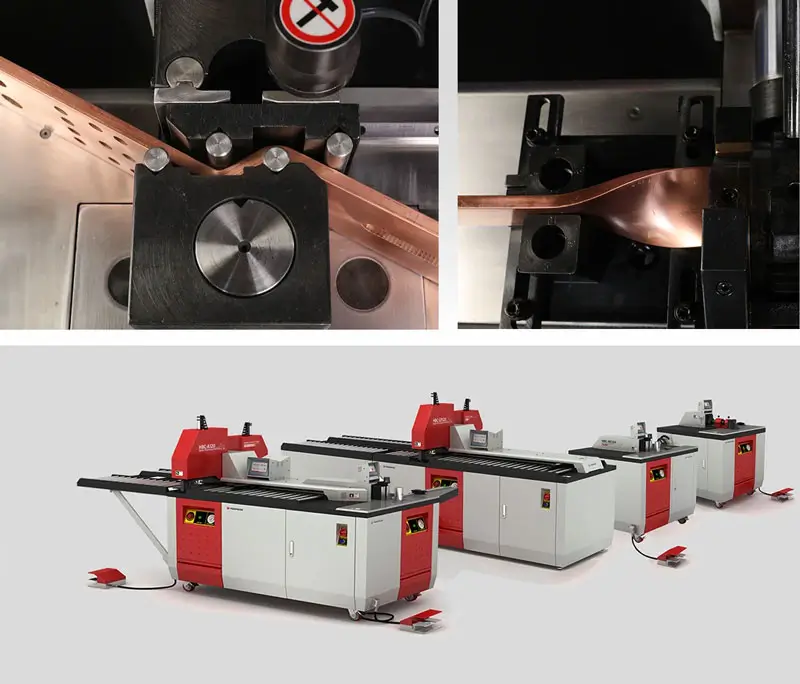
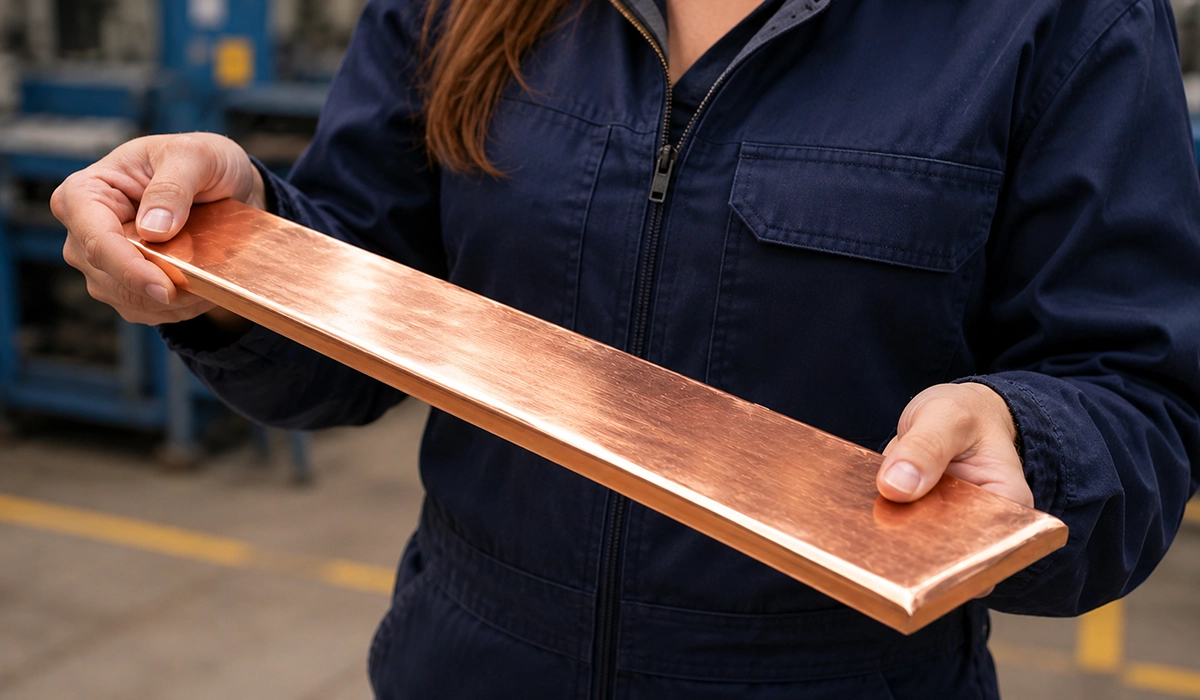
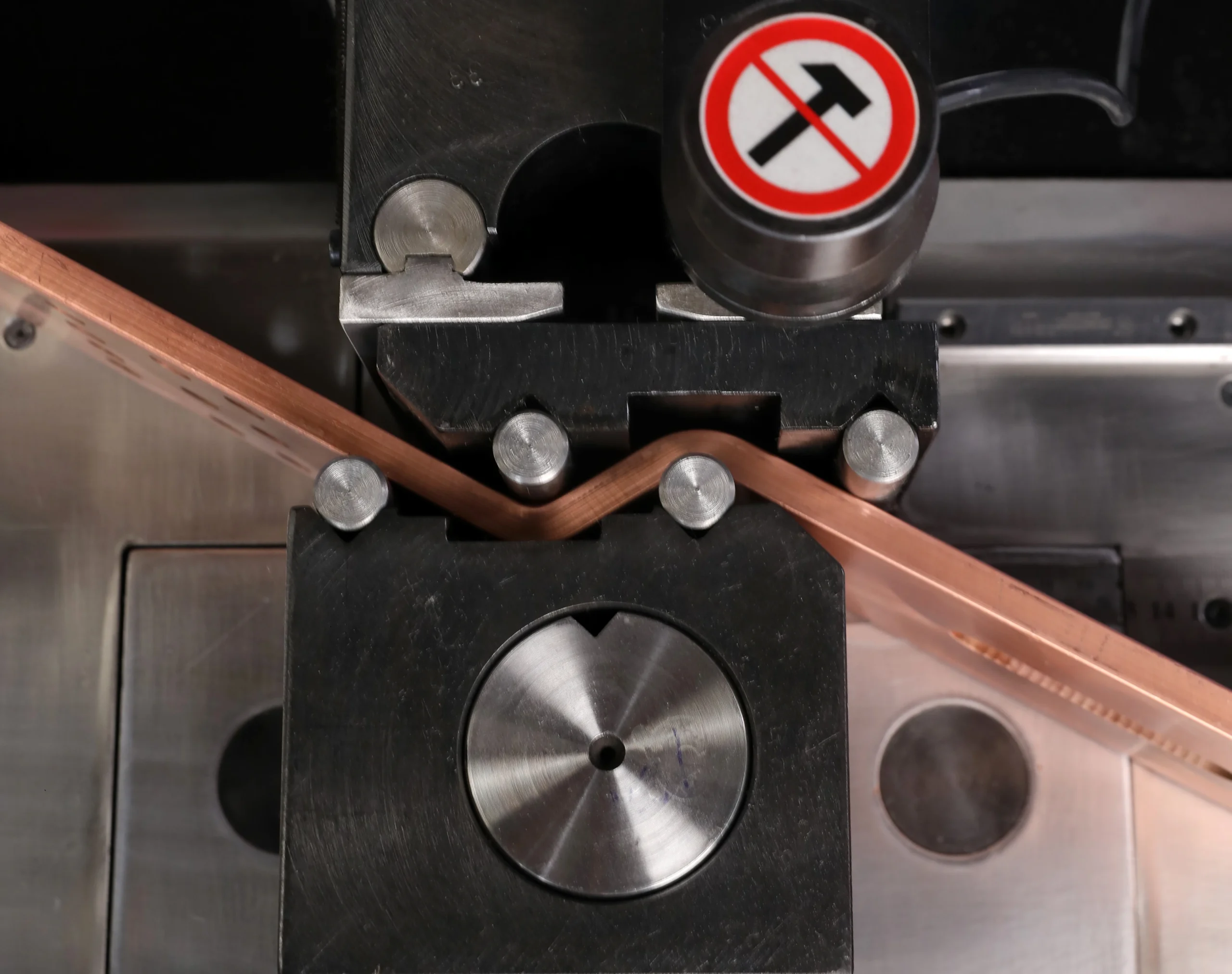
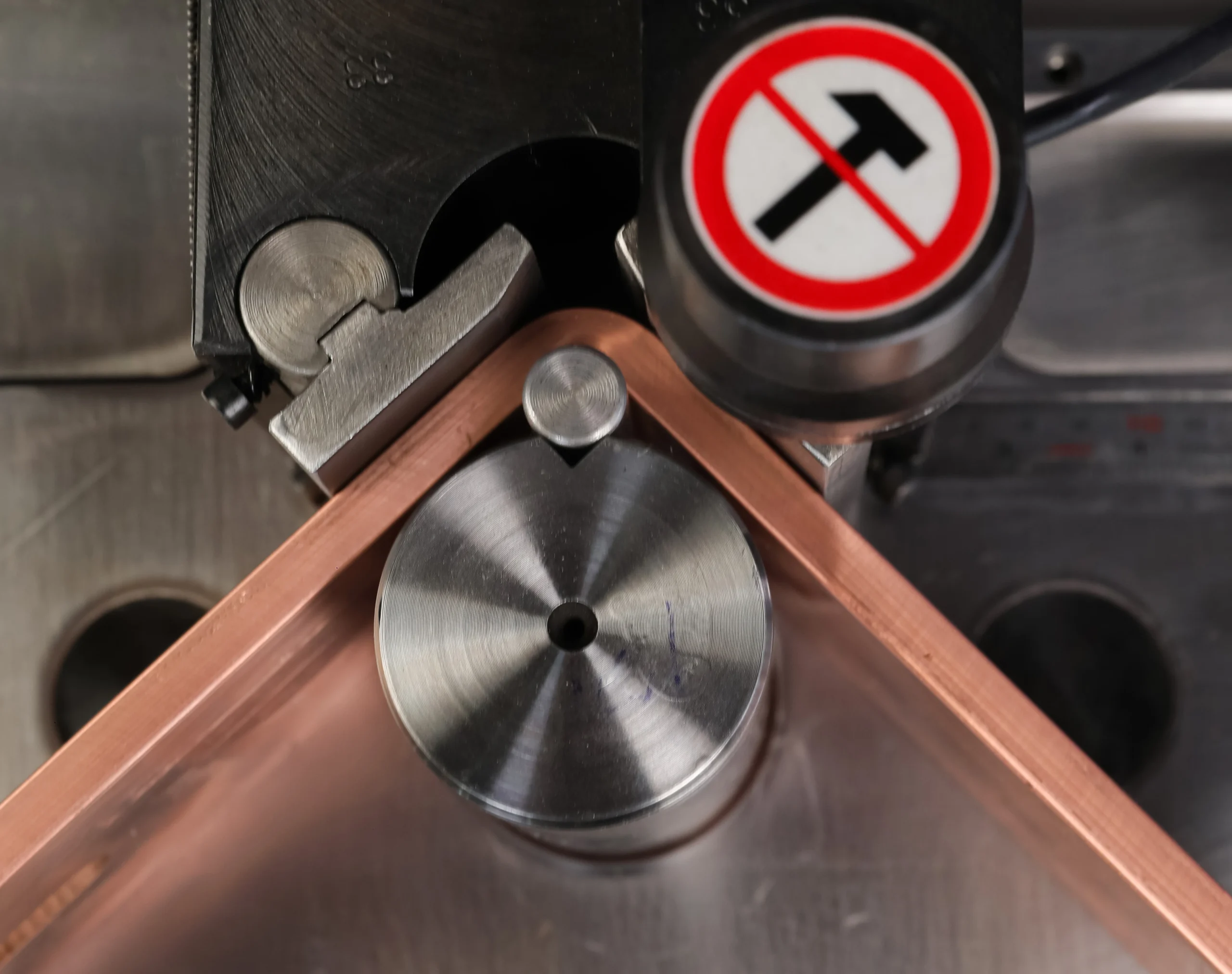
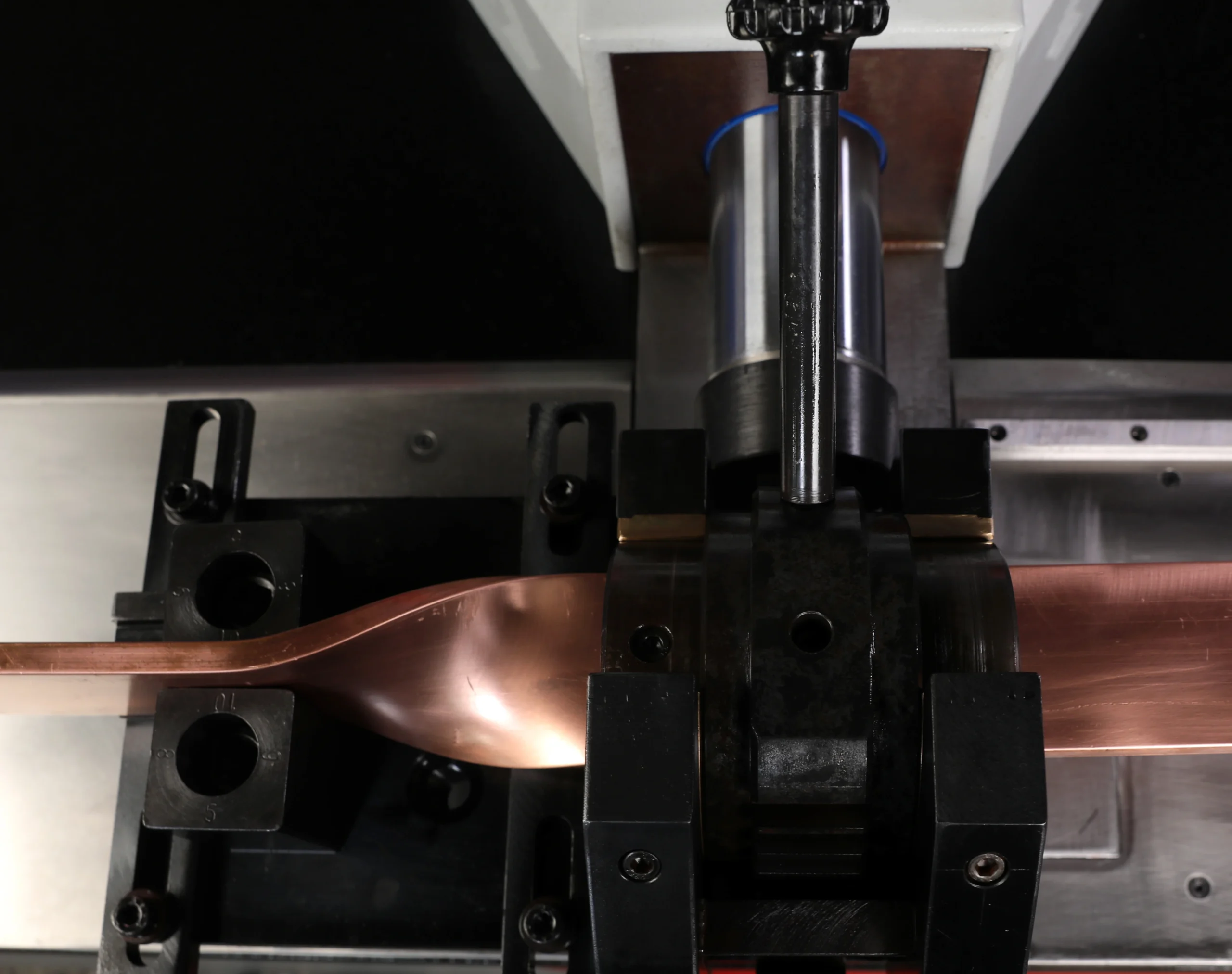
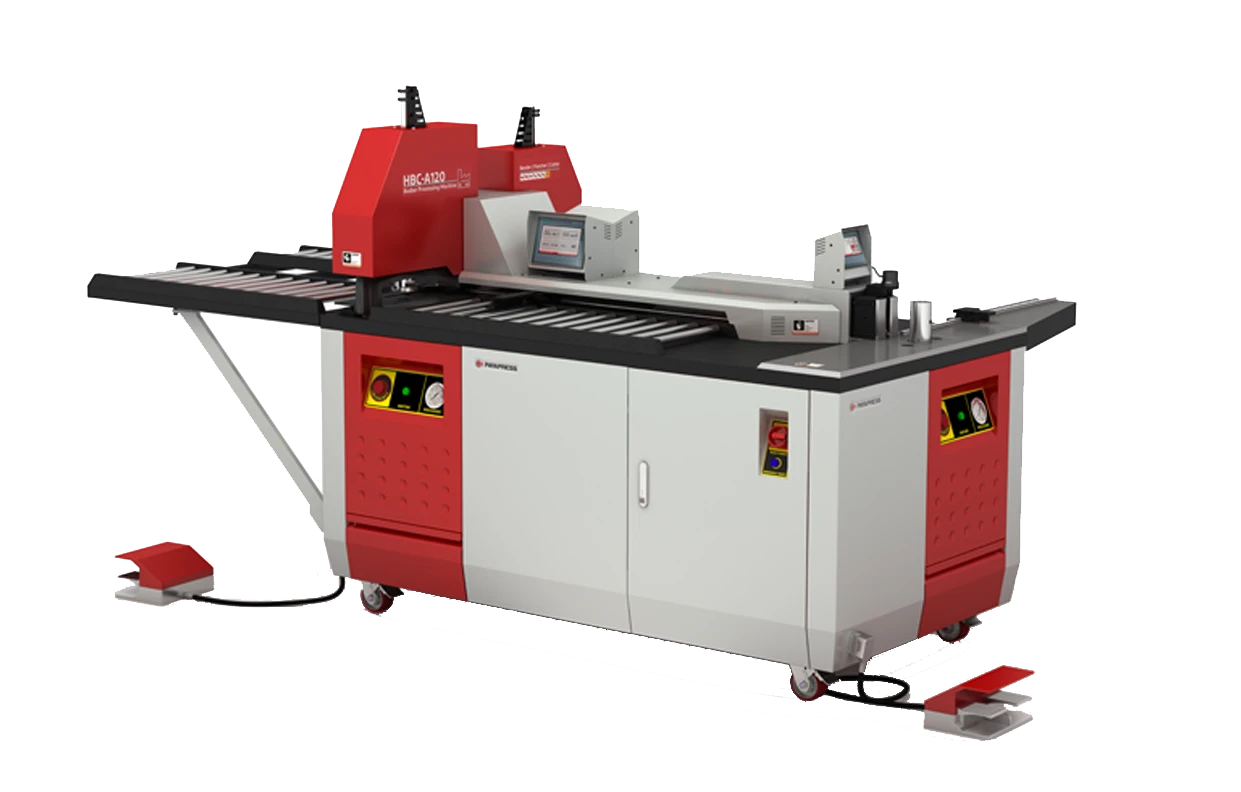
In practice, the conductors are usually copper or aluminum For custom or non-standard installations, these copper and aluminum conductors are often fabricated on-site or by panel builders using a busbar machine before being assembled into the distribution system and the enclosure is metallic. Joints are standardized, mechanical support points are defined, and electrical performance is verified for temperature rise, dielectric strength, and fault withstand.
Two common functional types matter early in design: feeder busbar for point-to-point transfer, and plug-in busbar for distributed loads using tap-off units. That feeder-versus-plug-in distinction drives later decisions about flexibility, maintenance, and fit-out speed.
If you are looking for more information about topic Power Distribution Systems, it is recommended not to miss reading this article.
That is also why use busbar trunking instead of cable is really a system question. Engineers are comparing a factory-built power busway with a field-installed cable network, not just one conductor shape against another.
Download the IEC 61439-6:2012 PDF.
| System type | Main purpose | Typical strength |
|---|---|---|
| Feeder busbar trunking | Point-to-point power transfer | Compact high-current transport |
| Plug-in busbar trunking | Distributed branch supply | Fast tap-off reconfiguration |
Advantage 1 — Faster Installation Compared to Cable Systems
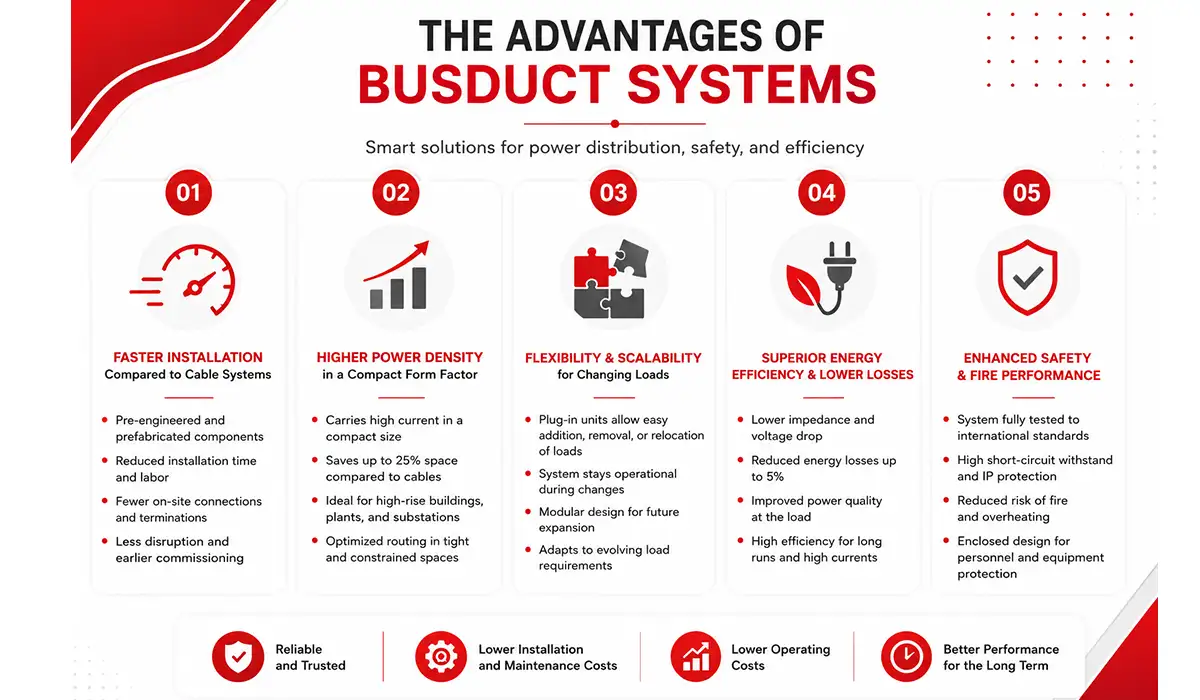
Among the advantages of busbar trunking systems, installation speed is usually the first commercial win. When teams ask how does busbar trunking reduce installation time compared to cables, the answer is simple: sections arrive pre-engineered, then get lifted, aligned, supported, and joined.
Cable systems usually need tray or conduit, multiple cable pulls, dressing, cleating, bending radius control, termination, phase identification, and far more repetitive labor. Busbar replaces much of that field work with a prefabricated assembly approach.
For a comprehensive understanding of What is a busbar?, we highly recommend reviewing this article.
Manufacturers consistently describe busbar or busway as a faster installation route, especially where the current is high and parallel cable sets would otherwise be needed. The labor saving grows as designs move from low current to high current.
That speed matters commercially. Shorter installation windows reduce crane time, floor disruption, temporary works, and commissioning congestion, so the busbar trunking system benefits are often strongest on large projects with tight delivery dates.
Access the Canalis KT Busbar Trunking System – Installation Manual document.
Advantage 2 — Higher Power Density in a Compact Form Factor
If the question is why is busbar trunking better than cable for high current distribution, power density is a major reason. Busbar carries large current in one enclosed run, while cable solutions usually expand into wider trays, more supports, and multiple parallel sets.
ABB states footprint reduction of up to 25% versus alternative designs, while Siemens positions sandwich busbar systems up to 6300 A specifically for compact high-current transfer with low space requirements. That is a real shaft-space advantage.
This matters most for advantages of busbar trunking in high-rise buildings, where riser space is scarce, and for plants or substations where wide tray systems compete with mechanical services, ducts, or access routes.
It also improves coordination. A single enclosed bus duct system is easier to route cleanly than dense cable bundles, especially when vertical space, bending room, and fire-stopping details are already tight.
Download the full Medium power busbar system document.
| Current rating | Typical cable-based approach | Typical busbar approach |
|---|---|---|
| 800 A | Several parallel LV cable sets | Single compact trunking run |
| 1600 A | Larger parallel cable groups and more terminations | Single trunking unit, often about 150–200 mm class |
| 3200 A | Numerous parallel cable groups plus complex tray loading | Single high-capacity busbar run |
| 5000 A | Very large cable banks, difficult to coordinate | Standard product family range in major busbar lines |
Advantage 3 — Flexibility and Scalability for Changing Loads
Flexibility is where busbar trunking system advantages over cable wiring become obvious to operators. Plug-in systems use defined socket or slot positions, so loads can be added, removed, or moved along the run without rebuilding the whole distribution path.
Legrand’s track busway documentation explicitly describes loads fed by plug-in units being added or removed without shutting power down to the busway. That is a major difference from cable systems, where every new branch usually means new cable pulling.
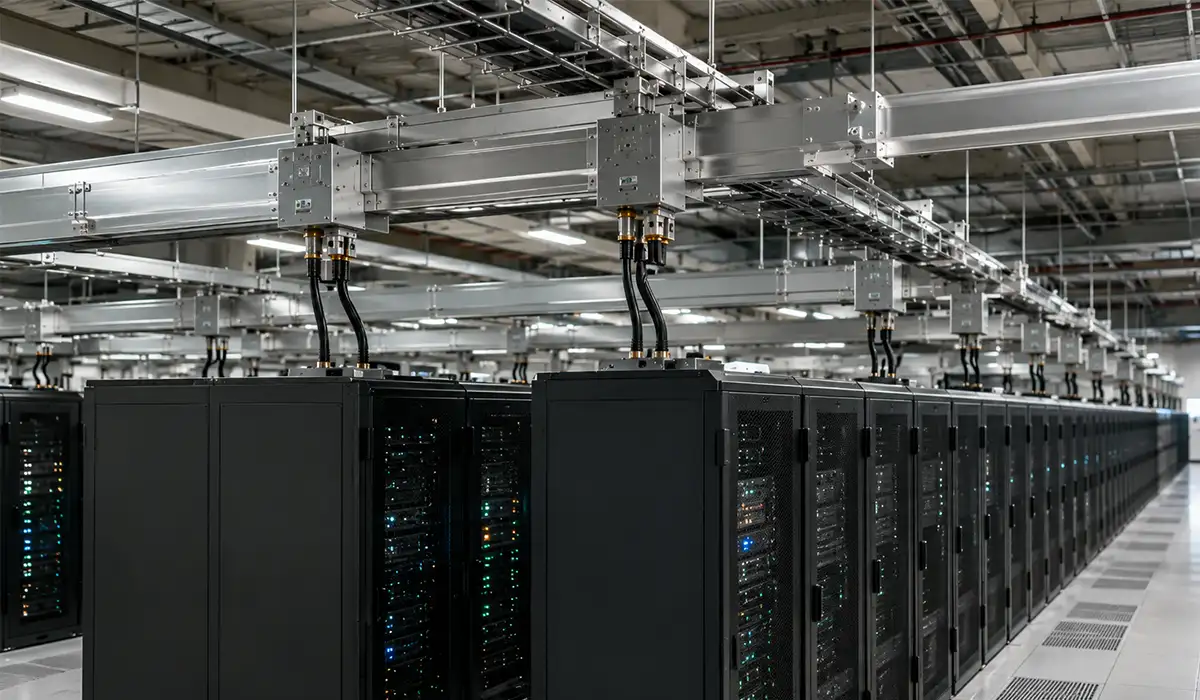
This is especially valuable for office floors, retail, labs, and the busbar trunking benefits for data centers use case, where rack layouts, tenant areas, or equipment density can change faster than the building shell.
So, the comparison is not only busbar versus cable; it is also modular versus fixed. A plug-in busbar system lets infrastructure stay in place while tap-off configuration evolves with the load map.
Access the Track Busway Product Selection Guide reference document.
Modular Design and Prefabrication Accuracy
Modular design is not just convenience. Siemens highlights modular tap-off units and junction units, while Legrand states that straight elements and other components are supplied with a factory pre-installed monobloc to reduce installation time.
That factory prefabrication improves dimensional accuracy, reduces field variability, and cuts the number of improvised site-made connections. In reliability terms, fewer joints and better repeatability usually mean fewer hidden defects.
Open the SIVACON 8PS BUSBAR TRUNKING SYSTEMS guide (PDF).
Advantage 4 — Superior Energy Efficiency and Lower Losses
Energy performance is another strong busbar trunking system benefits argument. Legrand positions XCP-HP as a busbar system with higher performance on energy saving, while Siemens describes sandwich high-current systems as supporting low voltage drop and high energy efficiency.
The reason is geometric as much as material. Flat conductors, compact spacing, and engineered enclosure design can lower impedance and manage heat better than equivalent multi-cable arrangements, especially when currents are high and runs are long.
Lower impedance means lower voltage drop, and lower voltage drop improves delivered power quality at the load. That matters in data halls, motor systems, and other installations where voltage stability affects equipment behavior.
This does not mean every busbar run always beats every cable run. But at higher ratings, optimized conductor geometry and low-loss enclosure design make busbar trunking energy efficiency a serious design advantage, not a marketing slogan.
Advantage 5 — Enhanced Safety and Fire Performance
Safety begins with verification. IEC 61439-6 requires the complete busbar trunking assembly to be verified, and ABB lists rated short-time withstand current, peak withstand current, and enclosure degrees of protection as declared system values.
That system-level approach differs from open cable tray practice. In a busbar run, the conductors, joints, housing, and supports are intended to work together under thermal and fault withstand stress rather than relying on many separate site-installed elements.
Fire performance also improves in many cases. Siemens offers tested fire-barrier options and functional endurance claims on some systems, while ABB’s cast-resin busway uses non-toxic, non-flammable insulation and can reach IP68 in severe environments.
For designers, that means clearer choices between indoor versus outdoor duty, standard indoor IP levels versus sealed systems, and ordinary wiring routes versus high-integrity enclosed busbar system solutions.
Advantage 6 — Simplified Maintenance and Fault Finding
Maintenance is where structured hardware pays back over years. Legrand states that XCP systems are designed to be maintenance-free apart from periodic inspections required by IEC 60364, which is already a lighter burden than complex cable bundles.
Fault finding is also cleaner. Busway service documents emphasize thermally scanning joints and connections, because the defined enclosure and joint locations make hotspots easier to inspect systematically than crowded cable trays.
That supports predictive maintenance. Instead of tracing many parallel cables, teams can inspect a known route, review a thermography report, and isolate a suspect section or tap-off faster. The workflow is more modular and less disruptive.
Section replacement is another benefit. If a busbar trunking unit is damaged, the affected section can usually be replaced as a module, whereas damaged cable often means re-pulling much longer lengths through the entire route.
Read StarlinePower‘s guide to Preventative Maintenance Plans and IR Scanning.
Advantage 7 — Lifecycle Cost Advantages Over Cable Systems
Reference: Canalis KTC 1000 – 6300 A — Includes Schneider cost-comparison context for equipment, labor, and branch distribution.
The advantages of busbar trunking systems become strongest when cost is judged over service life rather than by material price alone. Low-current cable is often cheaper up front, but that first-cost view gets weaker as current rises and layouts become more changeable.
Lifecycle cost combines installation labor, support infrastructure, terminations, energy losses, maintenance, and reconfiguration effort. Busbar usually improves several of those at once, which is why it can outperform cable even before energy savings are counted.
The break-even point is not universal. It depends on current rating, route complexity, labor cost, change frequency, and service life. Still, the economic case usually strengthens as projects move from low current to high current.
That is the practical meaning of cost advantages of busbar sizing over lifecycle: higher initial hardware cost can be offset by lower installation time, lower losses, lower maintenance effort, and cheaper future reconfiguration.
| Cost element | Cable system | Busbar trunking | Usual advantage |
|---|---|---|---|
| Material cost at low current | Lower | Higher | Cable |
| Material cost at high current | Often rises sharply | More competitive | Busbar trunking |
| Installation labor | Higher | Lower | Busbar trunking |
| Cable management infrastructure | Required | Minimal | Busbar trunking |
| Reconfiguration cost | High | Low | Busbar trunking |
| Energy losses over long life | Higher | Lower | Busbar trunking |
| Maintenance effort | Higher | Lower | Busbar trunking |
| Residual value | Lower | Moderate | Busbar trunking |
Key Applications Where Busbar Trunking Advantages Are Most Significant
Busbar trunking is not automatically the right answer everywhere. It becomes most attractive where current is high, layout clarity matters, or future load changes are expected. That is why busbar trunking applications and advantages tend to cluster in a few recurring sectors.
High-rise risers benefit from low space use and clean vertical distribution. Data centers benefit from modular tap-off strategy and power density. Industrial plants benefit from robust high-current transfer and easier inspection access.
Hospitals and shopping centers also appear repeatedly in manufacturer application lists because reliability, reconfiguration speed, and compartmentalized distribution matter there. That is a strong example of busbar duct benefits in buildings.
Substations, tunnels, and infrastructure lighting add another angle: high short-circuit duty, enclosure protection, and ruggedness. In those cases, an enclosed busbar system may outperform open tray cabling on both protection and service life.
| Application | Primary advantages driving selection |
|---|---|
| High-rise building risers | Space efficiency, weight, installation speed |
| Data centers | Flexibility, power density, tap-off reconfigurability |
| Industrial manufacturing plants | High current capacity, robustness, maintenance access |
| Hospitals and healthcare facilities | Reliability, fire performance, system integrity |
| Shopping centers and retail | Flexibility for tenant changes, installation speed |
| Power generation and substations | High current, short-circuit withstand, compact form |
| Tunnel and infrastructure lighting | IP rating, robustness, ease of tap-off connection |
Limitations to Consider Alongside the Advantages
A credible design review also needs the constraints. Busbar follows a defined path, so irregular routing is usually less forgiving than cable. Starline explicitly advises keeping runs as straight as possible because tees and elbows add cost and complexity.
Planning accuracy matters too. Standard lengths are available in fixed increments, while custom lengths can increase lead time and complicate layout. That means late geometry changes are usually more painful than with cable.
First cost is another limit. At lower ratings, especially below a few hundred amps, cable often remains the cheaper choice on a pure material basis.
The busbar value case improves as current, density, and change frequency increase.
So, the smart comparison is not busbar versus cable in the abstract. It is fixed route versus flexible route, higher current versus lower current, and lifetime value versus first-cost bias.
Learn more about Canalis KTC 1000 – 6300 A in this detailed walkthrough by Schnider Electrical.
Conclusion about Busbar Trunking
In practice, the advantages of busbar trunking systems are most convincing above several hundred amps, in buildings with repeated load changes, or wherever riser and tray space is commercially valuable. That is where the system approach beats the wiring approach.
But the technology should still be chosen selectively. Low-current simple routes may favor cable, while high-current, high-density, or frequently changing installations often favor busbar. Good specification work is about fit, not slogans.