


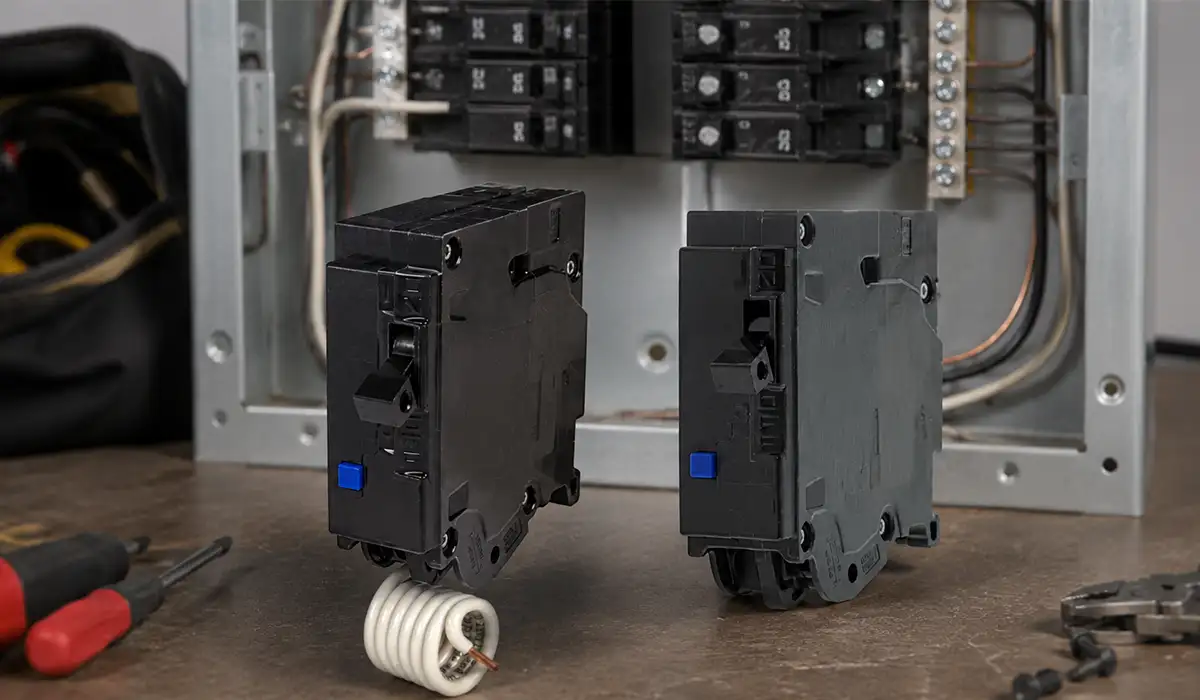





I will also compare AFCI protection with GFCI protection, clarify important arc fault requirements, and explain when to use AFCI breaker protection according to common NEC-based applications. By the end of this article, you will have a clearer understanding of how an arc fault breaker works, where it is typically required, what causes nuisance tripping, and why proper installation is essential for safe and compliant electrical systems.
If you are looking for more information about electrical panels and their types, it is recommended not to miss reading this article about what is an electrical panel.
Alternatively, an audio version of this article is available below for your convenience
What Is Arc Fault Breaker Protection?
An arc fault breaker, more accurately called an AFCI breaker or Arc Fault Circuit Interrupter, is a protective device designed to reduce the risk of electrical fires caused by dangerous arcing conditions. Unlike a standard circuit breaker, which mainly responds to overloads and short circuits, an arc fault protection breaker monitors the electrical circuit for abnormal arc signatures that may occur when wiring insulation is damaged, a conductor becomes loose, or a connection begins to deteriorate. In simple terms, an AFCI breaker is used because it detects hazardous arcing patterns that conventional overcurrent protection may not recognize quickly enough.
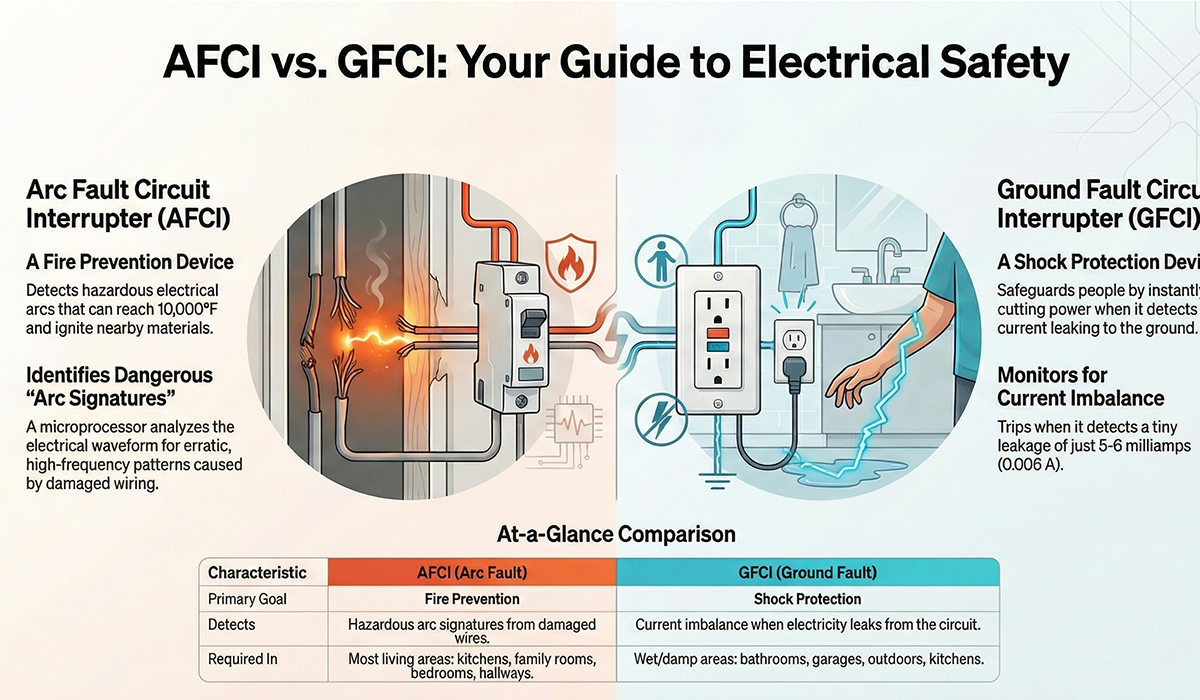
The purpose of arc fault breaker protection is especially important in residential and light commercial electrical systems because many wiring faults do not immediately create a high-current short circuit. A loose terminal, crushed cable, pierced wire, or aging conductor may continue to energize the circuit while producing heat at the fault point. Over time, this localized heating can damage insulation and ignite nearby combustible materials. This is why AFCI technology is focused on fire prevention rather than shock protection; GFCI devices protect people from ground-fault shock, while AFCI devices protect wiring systems from arc-related fire hazards.
From a technical standpoint, an AFCI breaker works by analyzing the current waveform of the circuit. Normal electrical activity, such as switching a light or starting a motor, can create harmless arcs for a very short time. However, a hazardous arc fault produces a more irregular and persistent signal. The internal electronics of the breaker evaluate these patterns and, when a dangerous condition is identified, open the circuit to stop current flow before the fault can continue developing into a fire risk. UL describes AFCIs as devices that de-energize the circuit when an arc fault is detected, reducing the effects of arcing faults that may create ignition hazards.
Understanding what is arc fault breaker protection also helps clarify when to use AFCI breaker devices. In NEC-based installations, arc fault requirements generally apply to many 120-volt, single-phase, 15- and 20-amp branch circuits supplying outlets and devices in dwelling areas. Exact requirements depend on the adopted code edition and local authority having jurisdiction, so AFCI protection should always be specified according to the applicable electrical code and project conditions.
For a comprehensive understanding of electrical panels and switchgear basics, we highly recommend reviewing this article on electrical panels and switchgear basics.
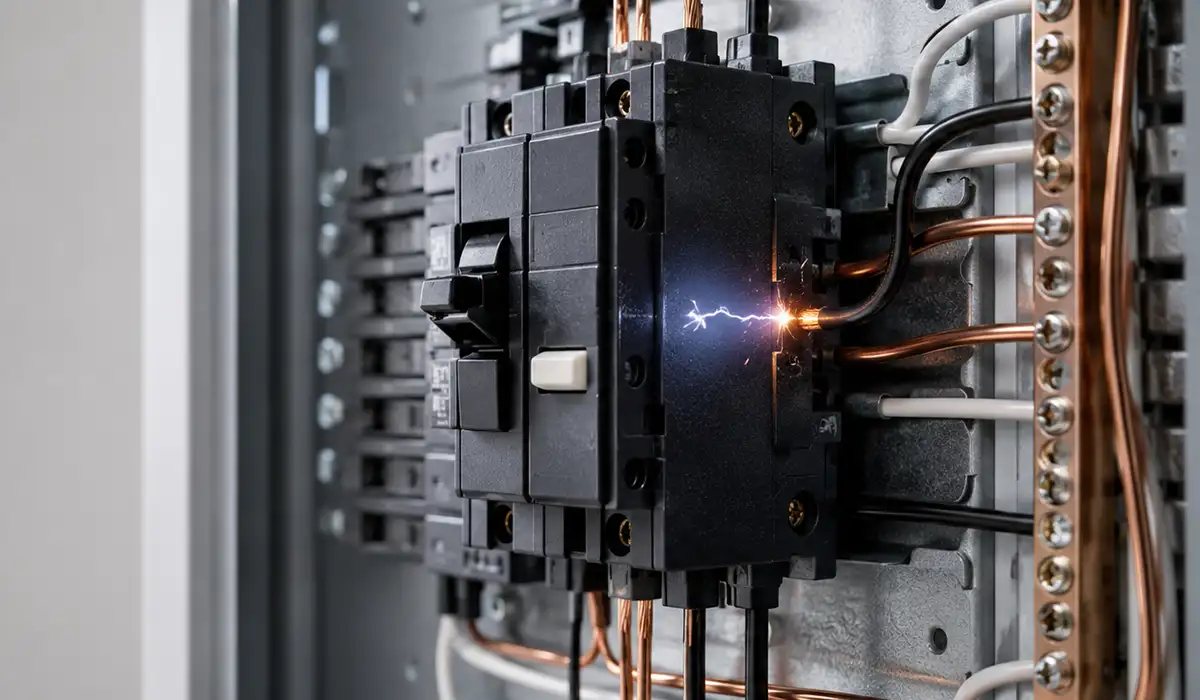
How an AFCI Breaker Detects Dangerous Arc Faults
An AFCI breaker protects a circuit by continuously monitoring the electrical waveform while the circuit is operating. Instead of reacting only to excessive current like a standard breaker, it analyzes the behavior of the current over time. When wiring is healthy and connections are secure, the current pattern remains relatively stable. However, when a damaged conductor, loose terminal, or deteriorated insulation creates an arc fault, the waveform becomes irregular, unstable, and electrically noisy.
Inside the AFCI breaker, electronic sensing and signal-processing circuits evaluate these waveform changes. The device is designed to recognize the difference between normal operating arcs and hazardous arc faults. For example, a brief arc may occur when a switch opens, a plug is inserted, or a motor starts. These events are usually short, predictable, and not considered dangerous. A real arc fault, by contrast, produces a more persistent and erratic signature that indicates unwanted current movement through air or across damaged insulation.
This distinction is critical because the breaker must avoid unnecessary tripping while still responding quickly to fire-risk conditions. To do this, the AFCI breaker measures patterns such as current distortion, high-frequency noise, repetition, duration, and waveform instability. When the internal electronics determine that the detected signal matches a hazardous arc pattern, the breaker opens its contacts and de-energizes the circuit. This rapid interruption helps stop the arc before it can continue generating heat and potentially ignite nearby materials.
In practical terms, the value of an AFCI breaker is not only that it detects an arc, but that it evaluates whether the arc behavior is abnormal enough to represent a fire hazard. This makes AFCI technology especially important in branch circuits where damaged wiring or loose connections may not produce enough current to trip a conventional breaker, yet can still create dangerous heat at the fault location.
Further exploration of wiring selection for electrical systems can be found in the following recommended reading: which wire is suitable for industrial electricity.
Types of Arc Faults an AFCI Breaker Must Detect
To understand the real purpose of arc fault breaker protection, it is important to separate arc faults into two main categories: series arc faults and parallel arc faults. Both can create fire risk, but they occur in different parts of the circuit and behave differently from an electrical standpoint. This is why a modern AFCI breaker must be capable of identifying more than one type of arcing condition instead of reacting to only one fault pattern.
A series arc fault occurs along a single conductor path, often at a loose terminal, damaged wire strand, worn connection, or partially broken conductor. Because the arc is in series with the connected load, the current may stay relatively low and may not be high enough to trip a standard circuit breaker. This is one reason an AFCI breaker is used because it detects arcing behavior that may exist below the normal overcurrent trip level.
A parallel arc fault occurs when current jumps between two different conductors, such as line-to-neutral or line-to-ground. These faults are often caused by damaged insulation, crushed cable, nail penetration, or conductor contact inside an electrical box. Parallel arcs can produce higher fault current than series arcs, but they may still create unstable arcing before a conventional breaker responds. In this case, an arc fault protection breaker adds another layer of safety by recognizing the abnormal arc signature and disconnecting the circuit.
When evaluating arc fault requirements, this distinction matters because older AFCI devices were more limited in the types of faults they could detect. Modern combination-type AFCI protection is designed to respond to both series and parallel arc faults, which makes it more suitable for today’s dwelling-unit branch circuits. This is also why understanding when to use AFCI breaker protection depends not only on code compliance, but also on the actual fire risks created by damaged wiring, loose terminations, and hidden conductor faults.
Parallel Arc Faults: How an AFCI Breaker Responds to Line-to-Neutral and Line-to-Ground Arcing
A parallel arc fault occurs when electrical current jumps between two different conductors, most commonly from line to neutral or from line to ground. This type of fault can happen when cable insulation is damaged, a nail or screw penetrates wiring, conductors are crushed inside a wall, or wires become exposed inside an electrical box. Because the current is no longer following its intended path through the load, the fault can create a violent arc with intense localized heat.
From a protection standpoint, this is one of the most important reasons an AFCI breaker is used in modern branch circuits. In a parallel arc, the fault current may become very high because it is limited mainly by conductor resistance, circuit impedance, and the available source current rather than by the connected appliance. This can lead to rapid insulation breakdown, carbon tracking, conductor damage, and ignition risk. An arc fault protection breaker helps reduce this hazard by identifying the abnormal arcing signature and disconnecting the circuit before the fault develops into a more serious fire condition.
Series Arc Faults: Why an Arc Fault Breaker Must Detect Low-Current Arcing
A series arc fault occurs along one conductor in the same current path as the connected load. Common causes include a loose terminal screw, a damaged wire strand, a frayed conductor, a poor splice, or a partially broken cable. Unlike a parallel fault, the current still passes through the load, which means the fault current is usually much lower and may remain below the trip threshold of a standard thermal-magnetic circuit breaker.
This is where the purpose of arc fault breaker technology becomes especially important. A series arc may not create enough current to activate conventional overcurrent protection, but it can still generate continuous heat at the damaged connection point. Over time, that heat can carbonize insulation, weaken surrounding materials, and create conditions for a more severe fault. A modern AFCI breaker evaluates the waveform behavior of the circuit and can detect these low-current arcing patterns before they escalate.
This article serves as a valuable resource for those seeking detailed information on busbar systems and their role in electrical distribution: the role of busbars in modern electrical systems.
Combination AFCI Protection: Detecting Both Series and Parallel Arc Faults
Modern arc fault requirements generally favor combination-type AFCI protection because electrical fire risks are not limited to one fault type. Parallel arcs can be more aggressive and high-current, while series arcs can be more hidden and persistent. Both can damage insulation and create ignition hazards if they remain energized long enough.
A combination AFCI breaker is designed to detect both series and parallel arc faults, making it more complete than older branch/feeder AFCI devices that were mainly focused on parallel arcing. This distinction matters when deciding when to use AFCI breaker protection in dwelling-unit branch circuits. In practical terms, an AFCI breaker is used because it detects dangerous arcing behavior that may not be handled adequately by a standard breaker alone, especially where wiring damage, loose connections, or hidden conductor faults could create fire risk.
AFCI Breaker Types and Functions
AFCI devices are available in several forms, and each one provides arc fault protection in a different part of the circuit. Understanding these types helps clarify when to use AFCI breaker protection and how modern arc fault requirements are met in residential electrical systems.
Combination AFCI Breaker
A combination AFCI breaker is the most common modern option. It detects both series and parallel arc faults, making it more complete than older branch/feeder AFCI devices. This type of arc fault protection breaker is widely used for branch circuits where fire prevention from damaged wiring, loose terminals, or deteriorated insulation is required.
If you are looking for more information about GE breakers and their specifications, it is recommended not to miss reading this article on GE breakers.
Outlet Branch-Circuit and Dual-Function AFCI Devices
An outlet branch-circuit AFCI is installed at the receptacle and protects the downstream wiring from arc faults. A dual-function AFCI/GFCI breaker combines arc fault and ground fault protection in one device, making it useful where both fire protection and shock protection are required, such as kitchens, laundry areas, basements, or similar NEC-regulated locations.
To gain a more comprehensive understanding of electrical panels and their various types, as well as how they play a crucial role in electrical safety and circuit protection, we highly recommend exploring this detailed guide on all types of electrical panels. This guide covers essential information about different panel configurations, including the necessary safety protocols and standards for proper installation.
For a comprehensive understanding of Rittal electrical panels and their industrial applications, we highly recommend reviewing Rittal electrical panels.
Where AFCI and GFCI Protection Is Required by NEC
The NEC separates AFCI and GFCI protection because each device addresses a different hazard. AFCI requirements under NEC 210.12 focus on reducing electrical fire risk from arc faults in dwelling-unit branch circuits, especially in common living areas such as bedrooms, kitchens, family rooms, dining rooms, closets, hallways, laundry areas, and similar spaces.
GFCI requirements under NEC 210.8 focus on shock protection in locations where moisture or grounding risk is higher. These typically include bathrooms, garages, outdoor areas, crawl spaces, basements, kitchens, laundry areas, and other wet or damp locations. In some areas, both protections may be required on the same circuit, which is why dual-function AFCI/GFCI breakers are often used for code-compliant installations.
Because NEC adoption and amendments vary by jurisdiction, final installation decisions should always be checked against the locally adopted code and the Authority Having Jurisdiction.
AFCI Requirements Under NEC 210.12
Under NEC 210.12, AFCI protection is generally required for 120-volt, single-phase, 15- and 20-amp branch circuits that supply outlets or devices in many dwelling-unit areas. These requirements are intended to reduce fire risk from hazardous arc faults in everyday residential circuits.
Typical AFCI-protected areas include kitchens, family rooms, living rooms, dining rooms, bedrooms, closets, hallways, laundry areas, recreation rooms, libraries, dens, parlors, and similar habitable spaces. The protection usually applies to the entire branch circuit, not only to receptacles. This means lighting outlets, hardwired devices, and connected equipment on the same circuit may also fall under the arc fault requirements.
For accurate compliance, installers should check the locally adopted NEC edition and any amendments from the Authority Having Jurisdiction, because AFCI rules can vary by project type and location.
Further exploration of switchgear systems and their functionality can be found in the following recommended reading: switchgear secrets.
GFCI Requirements Under NEC 210.8
Under NEC 210.8, GFCI protection is required in areas where the risk of electric shock is higher due to moisture, grounding paths, or contact with energized equipment. In dwelling units, this commonly includes bathrooms, garages, outdoor locations, crawl spaces, laundry areas, kitchens, and both finished and unfinished basements. Recent NEC updates also expanded GFCI coverage for kitchen receptacles, not only countertop locations.
Kitchens require special attention because receptacles near sinks, food preparation areas, and cooking zones can create higher shock risk. Receptacles within 6 ft of a sink generally require GFCI protection, and laundry areas also require GFCI protection because washers, utility sinks, and damp conditions increase the possibility of ground-fault current.
This article serves as a valuable resource for those seeking detailed information on capacitor switchboards and power factor correction: capacitor switchboard guide.
AFCI Compliance in Remodeling and Circuit Extensions
AFCI protection is also required when branch-circuit wiring is extended, modified, or replaced in areas covered by NEC 210.12. In existing homes, this often means using a listed combination AFCI breaker or an outlet branch-circuit AFCI device when receptacles or wiring are replaced as part of a remodel. Because enforcement can vary, the final method should always be confirmed with the local AHJ.
If you are looking for more information about underground electrical conduit installation, it is recommended not to miss reading underground electrical conduit.
Typical current levels associated with AFCI and GFCI protection, based on NEC-related values from this article.
| Criterion | Dedicated Cutter | Saw (Hacksaw / Cold Saw) |
|---|---|---|
| Cut Quality | Burr-free, precise | Requires deburring |
| Setup Time | None | Low–Medium |
| Cost | Medium–High | Low |
| Safety | High | Medium |
| Volume Suitability | High | Low–Medium |
| Portability | High | Medium |
| Skill Required | Low | Medium |
AFCI Breaker Installation and Troubleshooting Guide
Correct AFCI breaker installation is essential for reliable arc fault protection and stable circuit operation. Because an AFCI monitors both the ungrounded conductor and the neutral conductor, the wiring method inside the panel must match the breaker design. Most modern installations use either a pigtail-style AFCI breaker or a plug-on neutral AFCI breaker.
Poor neutral routing, loose terminations, mixed neutrals, or incompatible loads can cause nuisance tripping. For this reason, installation quality is just as important as selecting the right arc fault protection breaker for the circuit.
For a comprehensive understanding of how modern electrical panels are crafted and designed, we highly recommend reviewing this article on panel pioneers crafting the heart of electrical systems.
Pigtail AFCI Breaker Installation
A pigtail-style AFCI breaker includes a factory-attached white neutral lead. This lead connects from the breaker to the panel’s neutral bar. The circuit hot conductor connects to the breaker’s hot terminal, while the circuit neutral connects directly to the breaker’s neutral terminal.
This wiring arrangement allows the AFCI breaker to monitor current behavior across the circuit and detect abnormal arc fault signatures. The main disadvantage is panel congestion. Each breaker adds an extra neutral conductor, which can make the wiring space more crowded, especially in panels with several AFCI or dual-function breakers.
For best results, the conductors should be routed cleanly, terminals should be tightened to the manufacturer’s specified torque, and each branch-circuit neutral should remain isolated from neutrals belonging to other circuits.
Plug-On Neutral AFCI Breaker Installation
A plug-on neutral AFCI breaker is a newer design that simplifies installation in compatible panels. Instead of using a separate pigtail wire, the breaker connects to the neutral bar through an integrated contact on the back of the device. When the breaker is seated onto the panel bus and neutral rail, the neutral connection is made automatically.
This design reduces wire clutter and makes the panel easier to organize. The circuit hot and neutral conductors still connect to the breaker terminals, but there is no additional pigtail wire running to the neutral bar. This can improve installation speed and create a cleaner panel layout.
However, plug-on neutral breakers must only be used with panels specifically designed for that system. If the panel is not compatible, the neutral connection will not be established correctly, and the AFCI breaker may not function as intended.
Further exploration of the Sivacon electrical panel system and its applications can be found in the following recommended reading: what is the Sivacon electrical panel.
Common Causes of AFCI Breaker Nuisance Tripping
Nuisance tripping usually happens when the AFCI breaker detects an abnormal signal that resembles an arc fault, or when the circuit wiring is not arranged correctly. One of the most common causes is neutral miswiring. Shared neutrals, crossed neutrals, or neutrals from different circuits connected incorrectly can cause immediate or repeated tripping.
Loose connections are another frequent cause. A loose terminal at the breaker, receptacle, switch, junction box, or first outlet on the circuit can create unstable current behavior. Since the purpose of arc fault breaker protection is to detect dangerous arcing patterns, poor terminations can trigger the device.
Some loads may also create electrical noise that interferes with AFCI operation. Older motors, vacuum cleaners, treadmills, laser printers, dimmers, and certain electronic power supplies can produce waveform patterns that resemble arc activity. External disturbances, such as surge events, lightning-related transients, or radio-frequency interference, may also contribute to unwanted trips in sensitive circuits.
This article serves as a valuable resource for those seeking detailed information on harmonic filters and power quality improvement: harmonic filter guide.
Professional AFCI Troubleshooting Steps
When troubleshooting an AFCI breaker, start with the wiring before blaming the device. First, inspect the circuit for damaged insulation, pinched cords, overheated receptacles, backstabbed outlets, loose splices, or signs of arcing. Any visible discoloration, melting, or burning should be treated as a serious fault condition.
Next, verify every termination. Check that the circuit neutral is connected to the correct breaker terminal, the breaker pigtail is connected properly if used, and all terminals are tightened to the manufacturer’s torque specification. In multi-wire branch circuits, confirm that the correct two-pole AFCI breaker is used where a shared neutral is present.
After the wiring inspection, isolate the load. Unplug all connected devices, reset the breaker, and observe whether it holds. If it does, reconnect one device at a time until the trip returns. This helps identify whether the issue is caused by a connected appliance, a damaged cord, or the fixed wiring.
If electrical noise appears to be the cause, the solution may involve replacing the incompatible device, correcting wiring defects, using listed filtering or surge-protection equipment, or separating sensitive loads onto a different circuit. The final goal is not simply to stop the breaker from tripping, but to confirm that the circuit is safe, correctly wired, and compliant.
AFCI vs AFDD: International Arc Fault Protection Standards
In U.S. electrical terminology, the device is commonly called an AFCI breaker or arc fault circuit interrupter. In many IEC-based markets, the equivalent technology is known as an AFDD, or Arc Fault Detection Device. Both devices serve the same core purpose: detecting hazardous arcing conditions and disconnecting the circuit to reduce the risk of electrical fire.
The main difference is terminology and standards framework. AFCI requirements are commonly discussed in relation to the NEC, while AFDD requirements are linked to IEC-based systems and national wiring rules. IEC 62606 applies to AFDDs for household and similar AC circuits and describes device configurations such as standalone devices, integrated protective devices, or units assembled with a declared protective device.
AFDDs are especially relevant in markets that follow IEC, EN, or BS wiring practices, including parts of Europe and the UK. The IET describes AFDDs as devices that detect hazardous arc faults to reduce electrical fire risk, although final use depends on the applicable national wiring regulation, installation type, and risk assessment.
From a technical perspective, the protection goal remains consistent: whether the device is called an AFCI breaker or an AFDD, it uses arc detection logic to identify abnormal electrical behavior that conventional overload protection may not clear in time. This global terminology matters for engineers, panel builders, and buyers who compare U.S. NEC-based products with IEC-compliant electrical protection.
Conclusion about Arc Fault Breaker
From my technical point of view, understanding the role of an AFCI breaker is essential for designing safer and more reliable electrical systems. Standard circuit breakers protect against overloads and short circuits, but they are not designed to recognize every hazardous arcing condition that can develop from damaged wiring, loose terminals, or deteriorated insulation. This is where arc fault protection becomes critical.
In this guide, I explained what an arc fault breaker does, how AFCI technology detects dangerous arc signatures, the difference between series and parallel arc faults, and how AFCI protection compares with GFCI shock protection. I also covered NEC-based requirements, installation methods, nuisance tripping causes, and the international AFDD standard.
My main recommendation is simple: never treat AFCI protection as only a code requirement. It is a practical fire-prevention measure that depends on correct device selection, proper wiring, and careful troubleshooting. When specified and installed correctly, AFCI breakers provide an important layer of protection for modern residential and light commercial circuits.
Further exploration of how busbars conduct electrical harmony in switchgear systems can be found in the following recommended reading: how busbars conduct electrical harmony.


Rate this article
Choose a rating from 1 to 5 stars.
No ratings yet