



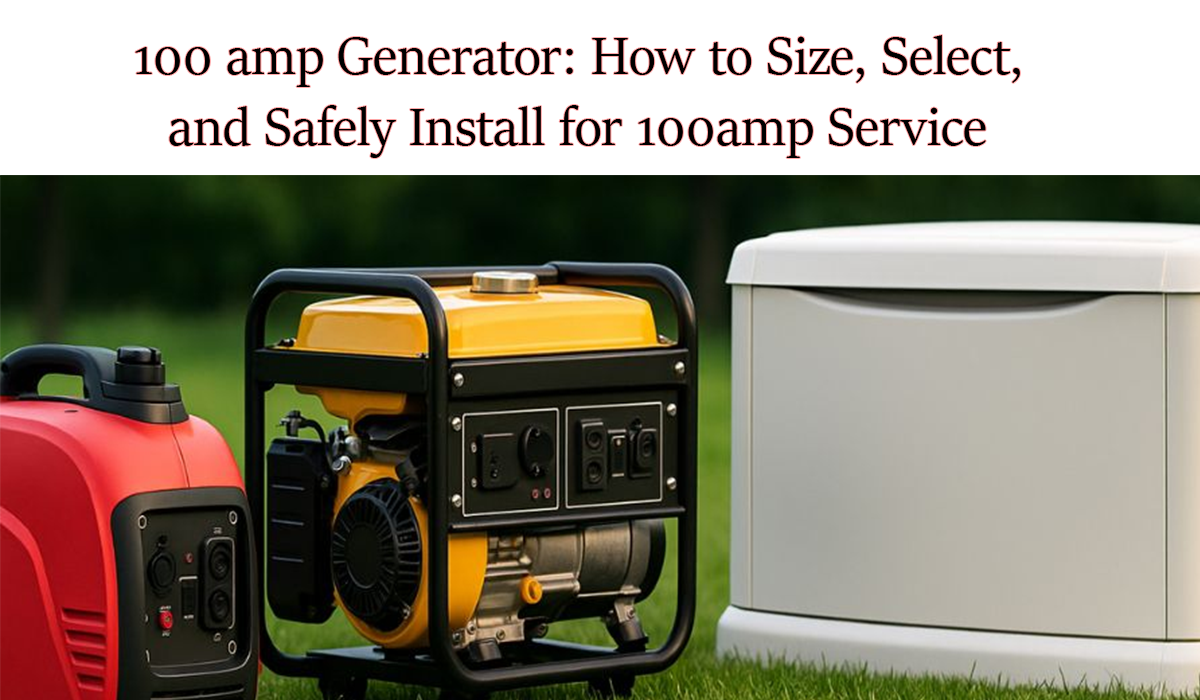

We will focus on realistic 100 amp service backup power options: typically a 10–14 kW standby generator bundled with a 100 amp automatic transfer switch (ATS), or a properly connected 100 amp portable generator using an interlock. Along the way, I will show residential and light-industrial case studies, explain the difference between single-phase and three-phase 100A systems, and highlight the most important safety mistakes to avoid.
Alternatively, an audio version of this article is available below for your convenience.
100 Amp Generator Size Chart: kW Rating vs Usable Running Load
Standby generators are rated at peak output, not at the load you should plan around. Sizing to 100% of the nameplate leaves no surge headroom and no margin for the load you forgot. The 70–80% loading guideline below is what the rest of this guide sizes against.
Table — add a fourth column and normalise the 8 kW row to 80% for internal consistency:
| Generator size | Usable continuous load (80%) | Approx. amps at 240 V | Typical 100 A application |
|---|---|---|---|
| 8 kW | 6.4 kW | 33 A | Smaller 100 A homes — essential circuits only |
| 10 kW | 8.0 kW | 42 A | Average 100 A homes — essentials plus a few comfort loads |
| 12 kW | 9.6 kW | 50 A | Managed whole-home backup for many 100 A residences |
| 14 kW | 11.2 kW | 58 A | Larger 100 A homes with more simultaneous loads |
| 20 kW | 16.0 kW | 83 A | All-electric 100 A homes with minimal load shedding |
| 24 kW | 19.2 kW | 100 A | Full unmanaged 100 A service capacity |
The amps column is new and does real work: it shows the reader why a 24 kW unit is the point at which “100 amp generator” becomes literally true, which is the exact confusion the next section resolves.
What Does “100 Amp Generator” Actually Mean?
The phrase gets used three different ways, and only one of them describes the generator:
- A generator that can deliver ~100 A at 240 V continuously. That is a 24 kW machine. Rare in residential work.
- A generator-plus-transfer-switch bundle sized for a house with a 100 A panel. This is what retail listings almost always mean — typically a 10–14 kW unit with a 100 A ATS.
- The rating of the transfer switch alone. The ATS is matched to the service, not to the generator. A 100 A ATS on a 12 kW generator is normal and correct.
To tell them apart you need one formula:
Power (W) = Voltage (V) × Current (A)
240 V × 100 A = 24,000 W = 24 kW at unity power factor.
So a true 100 amp generator is a 24 kW machine. Retail “100A service” packages are 10–14 kW standby units bundled with a 100 A service-disconnect ATS. The ATS matches the house service rating; the kW rating matches the load that will realistically run during an outage. “100 amp generator kit” is shorthand for a system designed to back up a 100 amp service — not a promise of 24 kW output.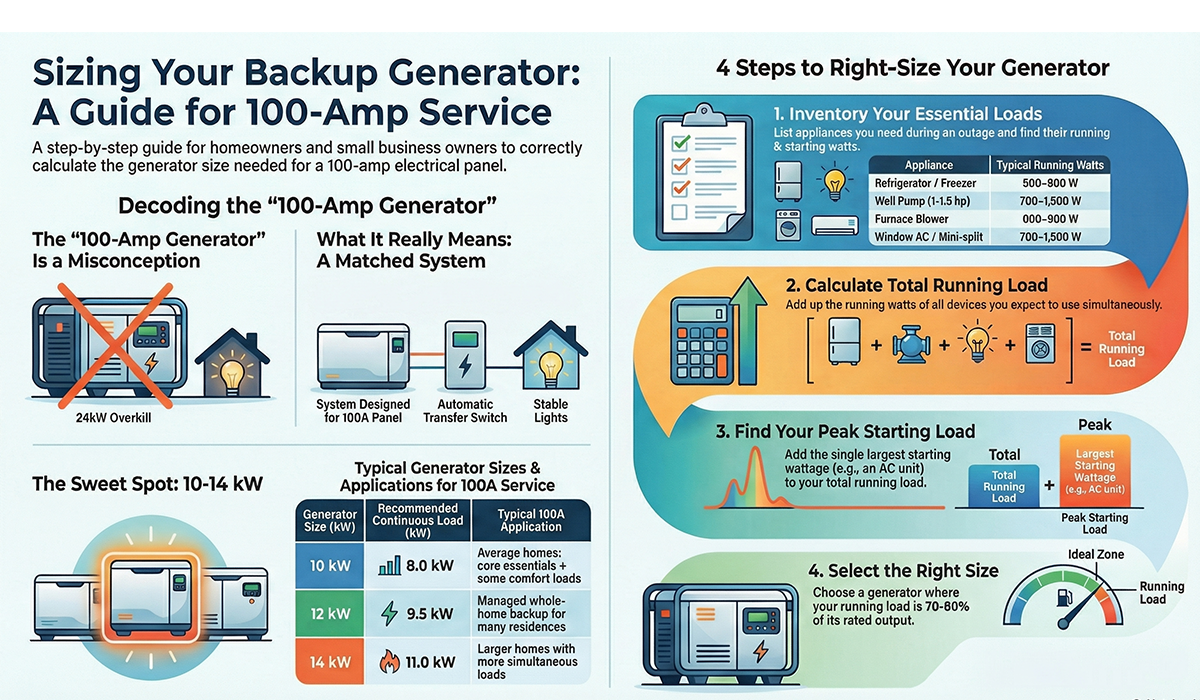
How Many Watts Is 100 Amps? 100A to kW and Watts Conversions
Watts = volts × amps. At 100 A the answer depends entirely on the voltage and, for three-phase, on power factor.
How Many kW Is 100 Amps at 240V?
24 kW. 240 V × 100 A = 24,000 W = 24 kW at unity power factor. This is also the answer to “how many kW does a 100-ampere, 240-volt, single-phase residential service use when fully loaded?” — 24 kW, or 24 kVA in apparent power terms. In practice a house with a 100 A service never draws this; NEC Article 220 demand calculations for a typical 1,500–2,000 sq ft home usually land between 40 and 80 A.
100 Amp Conversion Table (Watts, kW and kVA)
| System | Calculation | Apparent power | Real power at PF 1.0 | Real power at PF 0.8 |
|---|---|---|---|---|
| 120 V, 1-phase | 120 × 100 | 12.0 kVA | 12.0 kW | 9.6 kW |
| 240 V, 1-phase | 240 × 100 | 24.0 kVA | 24.0 kW | 19.2 kW |
| 208 V, 3-phase | 208 × 100 × 1.732 | 36.0 kVA | 36.0 kW | 28.8 kW |
| 400 V, 3-phase | 400 × 100 × 1.732 | 69.3 kVA | 69.3 kW | 55.4 kW |
| 480 V, 3-phase | 480 × 100 × 1.732 | 83.1 kVA | 83.1 kW | 66.5 kW |
Generators are usually rated in kVA at 0.8 PF, which is why the last column matters when you are reading a genset spec sheet rather than a homeowner appliance label.
How Many Watts Can a 100 Amp Panel Handle?
A 100 A, 120/240 V panel has a 24,000 W (24 kVA) theoretical capacity — but that is the busbar rating, not what you may continuously draw through it. What the panel is permitted to serve is set by the NEC Article 220 calculated load, and what the main breaker may continuously carry is set by the 80% rule below.
How Many Watts Can a 100 Amp Breaker Handle? (The 80% Rule)
19,200 W at 240 V.
A standard-rated overcurrent device may carry only 80% of its nameplate rating for a continuous load — one that runs for three hours or more. NEC 210.20(A) and 215.3 express this from the other direction: the breaker must be sized at not less than 100% of the noncontinuous load plus 125% of the continuous load. Same arithmetic, inverted.
- 100 A × 0.80 = 80 A continuous
- 80 A × 240 V = 19,200 W continuous at 240 V
- 80 A × 120 V = 9,600 W continuous on a single 120 V leg
The 100% figure (24 kW) applies only to short-duration, non-continuous loads. This is why a “100 amp generator” sized at 24 kW is over-specified for almost every real installation — you can never legally use the top 20% continuously anyway.
Amps vs Watts vs kVA: What Generator Specs Actually Tell You
Watch the units on any spec sheet. A genset advertised as 30 kVA delivers 24 kW of real power at 0.8 PF. Comparing a kVA-rated diesel genset against a kW-rated air-cooled standby unit without converting first is the most common specification error in this size class.
What Size Generator for 100 Amp Service? Step-by-Step Load Calculation
Short answer: 10–14 kW for most 100 A homes with managed loads; 16–24 kW for all-electric homes or unmanaged whole-house coverage. The number that applies to your house comes from a load calculation, not from the panel rating.
Undersize and the unit overloads every time two motors start together. Oversize and you pay twice — once at purchase, then continuously in fuel, and on diesel units in wet stacking from chronic light loading.
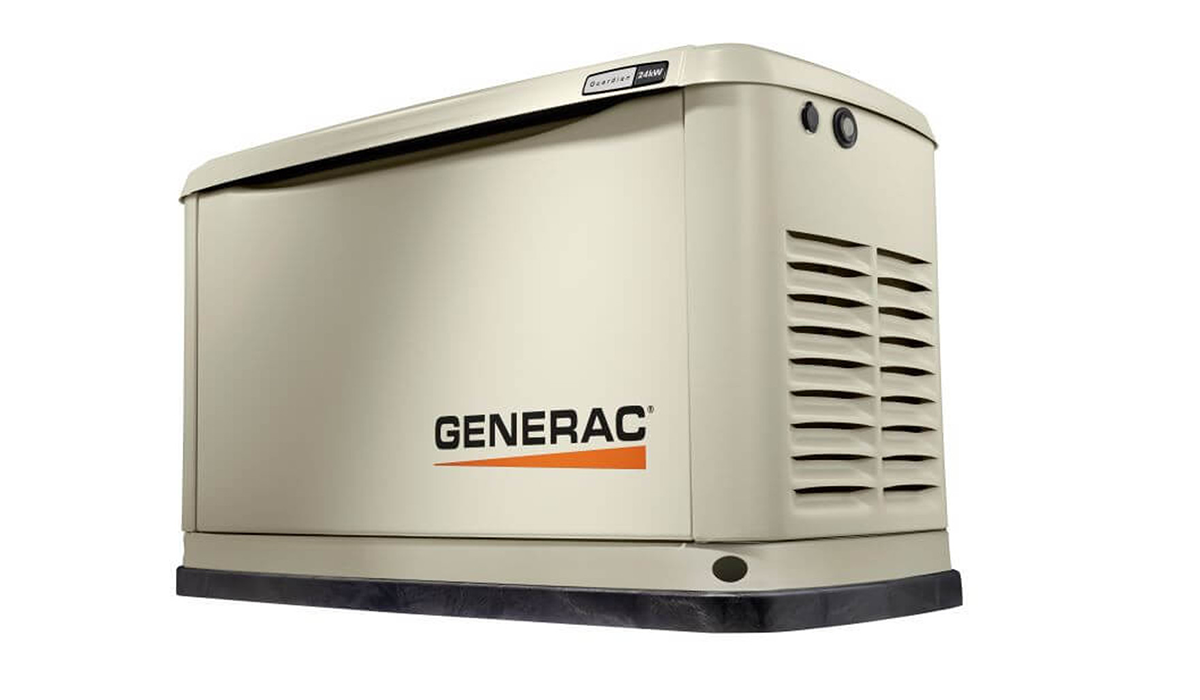
Step-by-step generator sizing method for 100 amp service:
- Inventory essential and desired loads.
Walk room by room and list the appliances, equipment, and circuits that must stay powered during an outage. Typical essentials include refrigerators, freezers, well pumps, gas furnaces or boilers (for their control and fans), sump pumps, key lighting, networking equipment, and sometimes a small air-conditioning unit or mini-split. - Gather running watts and starting watts.
For each item on your list, write down the running watts from the nameplate or the user manual. For motor loads, also record the starting watts if the manufacturer provides them. If starting watts are not listed, you may assume 2–3× the running watts as a rough estimate. - Decide which loads can operate together.
Imagine a realistic worst-case scenario: evening time, with lights on, refrigerator cycling, internet router and PCs running, and maybe a well pump starting. Do you really need all heavy loads (like electric oven and dryer) at the same time? Many households can accept some manual management—for example, not running the oven during a storm outage—so that the generator size stays reasonable. - Calculate total running load and peak starting load.
Add up the running watts of all loads you expect to be on at the same time. Then find the single largest starting watt value and add it once to the running total (excluding that device’s own running watts while you do this step). The result is a good approximation of the maximum surge the generator needs to handle. - Target 70–80% of rated kW at typical running load. Below roughly 30% sustained load, diesel units accumulate unburned fuel and carbon in the exhaust — wet stacking — which fouls injectors and turbochargers. Air-cooled gas and LP units tolerate light loading better but still lose efficiency.
- Select the generator kW rating.
Using the peak starting load and the preferred operating range (around 70–80% loading at typical use), choose a generator whose continuous kW rating fits your needs. For many 100A homes, this ends up in the 10–14 kW range if you are willing to manage large loads, or 16–24 kW if you want a more carefree, whole-house experience.
Worked Example: Sizing a Generator for a 100 Amp Home
Let us walk through a realistic example for a detached house with 100 amp service. The homeowner wants to cover all essential loads plus allow limited comfort loads during an outage. After a walk-through, the list of important items looks like this:
- Refrigerator and freezer in the kitchen.
- A 1 hp well pump supplying domestic water.
- A gas furnace with an electric blower motor.
- Lighting circuits for main living areas and hallways.
- Internet router, a small switch, and one PC (for remote work).
- A small 9,000–12,000 BTU mini-split in the living room for summer comfort.
- Miscellaneous receptacles for phone chargers and small kitchen appliances.
| Load | Running Watts (approx.) | Starting Watts (approx.) |
| Refrigerator / Freezer | 700 W | 2,000 W |
| Well Pump (1 hp) | 1,000 W | 2,500 W |
| Furnace Blower | 800 W | 1,200 W |
| Lighting + Electronics | 1,000 W | 1,000 W |
| Mini-split AC | 1,200 W | 3,000 W |
Now we calculate the total running load if all of these are on at once:
700 + 1,000 + 800 + 1,000 + 1,200 = 4,700 W (4.7 kW).
The largest starting surge is the mini-split AC at around 3,000 W. For a realistic worst case, we take the total running load plus this largest starting surge, minus the mini-split’s own running watts (because we already counted them in the running total):
Peak starting load ≈ 4,700 W (running) + 3,000 W (mini-split surge) – 1,200 W (mini-split running) = 6,500 W.
So a generator needs to handle roughly 4.7 kW continuously with occasional peaks near 6.5 kW. If we want to keep our continuous loading in the 70–80% range, we divide the running load by 0.8:
4.7 kW ÷ 0.8 ≈ 5.9 kW.
In theory, a 7–8 kW generator could support this list if the homeowner is very careful with timing and does not add big extra loads.
On paper a 7–8 kW unit covers this list: 5.9 kW required continuous, 6.5 kW peak. In practice most installers step up to 10–12 kW, for two reasons. First, surge headroom — a 7 kW standby unit meeting a 6.5 kW peak has almost none, and a second motor starting during that window will trip it. Second, the price gap between 8 kW and 12 kW is small relative to total installed cost, and 12 kW lets you add a 240 V water heater or a second mini-split on a managed basis later without replacing the machine.
12 kW vs 14 kW on a 100 A panel: 12 kW gives 9.6 kW usable, 14 kW gives 11.2 kW. Choose 14 kW if you have central air rather than a mini-split, or electric water heating you do not want to shed.
Worked Example: 100 Amp Three-Phase Workshop
Now consider a small metal workshop with a 100 amp three-phase service. The owner operates a 5 hp air compressor, a few small CNC machines, welding equipment, and office computers. During an outage, the goal is to keep one compressor, basic lighting, a single CNC, and the office running so that urgent orders can continue.
Because of the heavier motor loads and the preference for long runtime, the owner and engineer select a 100 amp diesel generator system. Diesel gensets in this size range are often rated in kVA and configured for 120/208V or 277/480V three-phase operation.
- 5 hp air compressor: about 4 kW running, 12–14 kW starting surge for a short moment.
- One small CNC machine: 3–4 kW running, small surge.
- Lighting and small office loads: 1–2 kW combined.
- Miscellaneous tools and receptacles: 1–2 kW allowance.
At first glance, the total running load might be around 8–10 kW, but the starting surge of the compressor is the real challenge. In many cases, engineers specify a 25–30 kVA three-phase 100 amp generator so that the compressor can start without dimming lights or tripping breakers. They also pay attention to balancing loads across the three phases to avoid overloading any single leg.
Note what dominates: an 8–10 kW running load requiring a 25–30 kVA genset, purely because of one compressor’s starting surge. In three-phase work the surge, not the running total, sets the machine size. Soft starters or VFDs on the largest motor will often let you drop a full frame size.
What Size Generator for 150, 200 or 300 Amp Service?
The method does not change with service size — only the ceiling does. Service rating sets the maximum a generator could ever need to supply; the load calculation sets what it actually needs.
| Service | Full-load capacity at 240 V | Typical managed backup | Typical unmanaged whole-house |
|---|---|---|---|
| 100 A | 24 kW | 10–14 kW | 20–24 kW |
| 150 A | 36 kW | 14–18 kW | 22–26 kW |
| 200 A | 48 kW | 18–22 kW | 24–26 kW |
| 300 A | 72 kW | 25–35 kW | 38–48 kW |
Two things to notice. Managed backup barely scales — a 300 A house does not need three times the generator a 100 A house needs, because the essential-load list is similar and only the comfort loads grow. Unmanaged whole-house scales hard, because NEC 702.4(A)(2)(a) requires the source to supply everything the transfer equipment connects. Above 200 A, load management stops being an economy measure and becomes the only affordable path.
100 Amp Transfer Switch vs Interlock Kit: Which You Need
Any safe generator installation must include a reliable method to switch the building’s wiring between utility power and generator power. For a 100 amp service, this usually means either a 100 amp transfer switch or a properly installed generator interlock kit. Without such a device, there is a serious risk of backfeeding the electric utility lines, which is both illegal and extremely dangerous for line workers.
There are two main approaches for 100A systems:
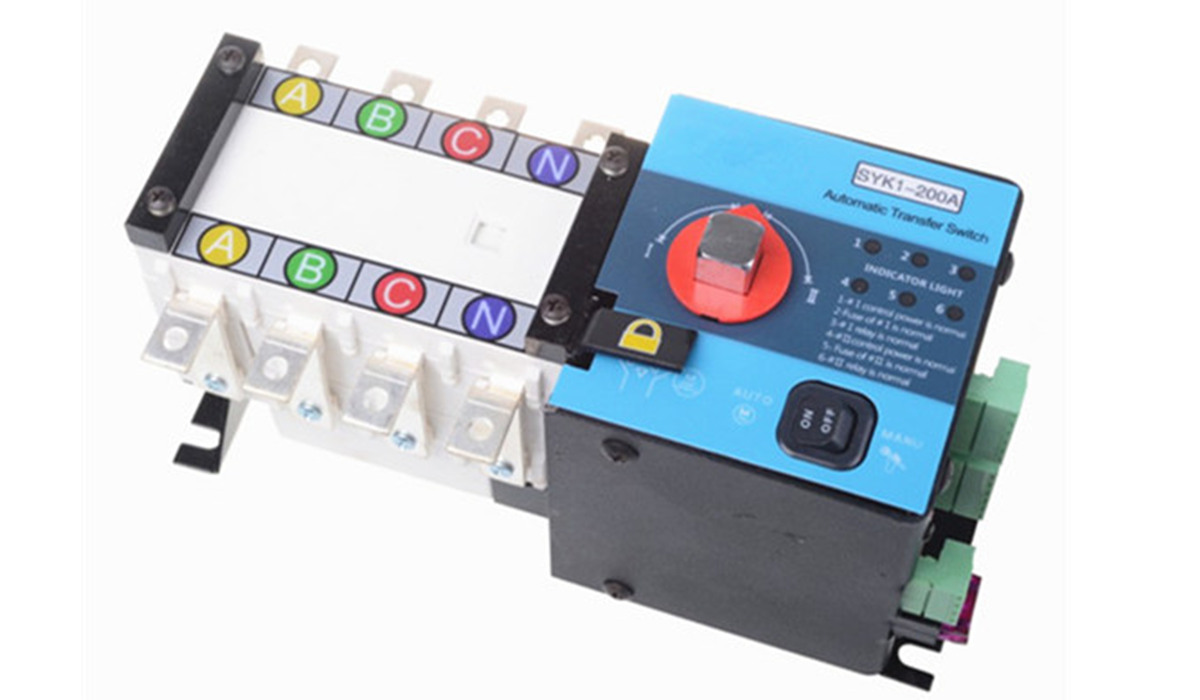
- Automatic Transfer Switch (ATS): A dedicated switch that constantly monitors utility power. When it detects an outage, it starts the standby generator automatically and transfers the load from the grid to the generator. When utility power returns and stabilizes, it switches back. For a 100 amp service, a 100 amp automatic transfer switch is common, especially when using a 10–14 kW standby generator.
- Manual Interlock Kit: A more economical option often used with a 100 amp portable generator. A mechanical sliding plate installed on the panel’s front cover prevents the main utility breaker and the backfeed generator breaker from being on at the same time. The homeowner must start the generator and move the interlock manually, but the safety principle is the same: only one source feeds the panel at any moment.
A common question is whether a 100 amp transfer switch is adequate for a 15 kW generator. In most load-side applications, the answer is yes. The key idea is that the current through the ATS is limited by the generator’s kW rating, not by the full 100A service rating of the home. For example, a 15 kW generator at 240V produces around 62.5A at full output (15,000 W ÷ 240 V). A 100A-rated switch can easily handle this current, provided it is properly installed and listed to the correct standards.
The reverse question also comes up: can the ATS be larger than the service? Yes. The switch only needs to be rated for the conductors and the overcurrent device protecting it. A 200 A ATS fed by a 100 A breaker is legal and is sometimes specified deliberately when a service upgrade is planned.
Service-Entrance vs. Load-Side ATS
When we talk about generator transfer equipment, it is important to distinguish between service-entrance applications and load-side applications.
- Service-entrance rated ATS: This device takes the place of the main service disconnect. For a home with 100 amp service, the ATS must be listed as suitable for service-entrance use, comply with UL 1008, and be rated for 100A. It is installed between the utility meter and the main panel. When the generator runs, the entire panel is supplied through this switch.
- Load-side or subpanel ATS: In many homes, only selected critical loads are backed up. In this design, a 100 amp ATS feeds a smaller subpanel that contains only prioritized circuits. The original main panel remains the service disconnect, while the ATS is simply a load-side device, still subject to code but not replacing the main service switch.
Both types must be installed in accordance with local electrical codes and inspected by the Authority Having Jurisdiction (AHJ). Correct neutral switching, grounding, and bonding depend on whether the generator is treated as a separately derived system, so it is not a casual DIY decision.
100 Amp Whole House Generator: How Load Shedding Makes It Work
Because most 100 amp service backup power options use a 10–14 kW standby generator instead of a full 24 kW unit, smart load management is very important. Load shedding for 100 amp generators relies on small electronic modules installed on selected high-demand circuits, such as large air conditioners, water heaters, or electric dryers.
These smart management modules (SMMs) continuously watch the generator’s output. When the total load approaches a set limit, the module temporarily disconnects its managed circuit. This frees up capacity for critical loads. Once the heavy device is no longer needed or the total demand drops, the module automatically reconnects it.
This is not just a convenience — it is what makes the installation legal. NEC 702.4(A)(2) requires that where load connection is automatic, the standby source must either:
- (a) Full load — be capable of supplying the entire load that is automatically connected; or
- (b) EMS — where an energy management system per NEC 750.30 automatically manages the connected load, have capacity sufficient for the maximum load the EMS will connect.
There is also an exception for one- and two-family dwellings, where manual management of the connected load is permitted.
The practical consequence: a 12 kW generator on a 100 A service-entrance ATS with no load management does not satisfy 702.4(A)(2)(a), because the ATS transfers the whole panel. It becomes compliant when you add listed smart management modules — or, in a one- or two-family dwelling, when the load is manually managed. Discuss which path your AHJ accepts before the equipment is ordered. This is the single most common plan-review comeback on residential standby projects.
100 Amp Diesel Generator: When Diesel Makes Sense
Diesel is rarely the right answer for a 100 A house and often the right answer for a 100 A workshop. The dividing line is load factor and runtime.
Choose diesel when:
- The unit will regularly see 60–80% of rated output. Diesel efficiency and engine life both depend on this.
- Runtime measured in days matters more than noise. Diesel is typically 5–10 dB louder than an equivalent air-cooled gas unit.
- You need heavy motor-starting capability. Diesel gensets in the 25–40 kVA class start compressors and CNC spindles that a 14 kW air-cooled unit cannot.
- No natural gas supply exists at the site.
Avoid diesel when:
- The unit will idle at 20–30% load. Wet stacking will cost you more in service than you save in fuel.
- The site is residential and noise-sensitive.
- On-site fuel storage triggers spill containment, permitting, or fire-code requirements you would rather avoid.
A 100 A three-phase workshop typically lands on a 25–30 kVA (20–24 kW) diesel genset — see the worked commercial example above. A 100 A single-phase house almost always lands on natural gas or propane instead.
100 Amp Portable Generator: Interlock Setup and Safe Operating Sequence
A portable unit connected to the panel through an interlock kit is the low-cost route to backing up a 100 A service. Realistic expectations: portable generators in the 7,500–12,000 W class are what pair sensibly with a 100 A panel and a 30–50 A inlet. Anything larger and you are into the cost band where a permanently installed standby unit with an ATS is the better buy.
The interlock is the entire safety case. Without it — or a transfer switch — you are backfeeding, which is illegal and can kill a lineworker on what they believe is a de-energised circuit.
Fuel Type, Runtime, Noise and Placement
After you know the correct kW range and have chosen the right 100 amp transfer switch strategy, the next big decision is fuel type. Fuel choice will strongly affect runtime, maintenance, cost, and system complexity.
Here is a quick comparison of the most common fuel options for 10–24 kW standby generators and 100 amp portable generator systems:
| Fuel Type | Key Advantages | Key Disadvantages |
| Natural Gas (NG) | No on-site storage, long runtime, clean burning. | Depends on gas pipeline, slightly lower output than LP. |
| Liquid Propane (LP) | Stored on-site, long shelf life, clean. | Requires tank, higher consumption for large units. |
| Diesel | High efficiency, strong under heavy load, long engine life. | Higher emissions, more maintenance, fuel storage rules. |
| Gasoline | Easy to find, low initial cost for portable units. | Short fuel shelf life, poor for continuous heavy use. |
For a permanently installed whole-house generator, natural gas or propane are the most common choices. They allow the system to run for many hours or days without refueling. A 100 amp diesel generator is popular in light-industrial applications where fuel efficiency and heavy-duty performance are more important than quiet operation or ultra-clean emissions.
Runtime is only one side of the story. Noise and placement are also critical. Most modern residential standby generators operate in the range of 60–70 dB at a few meters, similar to a typical air-conditioning unit. Even so, local noise ordinances may limit where you can place the unit.
General placement guidelines include:
• Install the generator outdoors in a well-ventilated area.
• Keep at least 5 feet (or local code distance) from windows, doors, and air intakes to avoid carbon monoxide (CO) hazards.
• Set the unit on a level, solid base such as a concrete pad.
• Leave enough clearance around all sides for cooling air and maintenance access, typically 18–36 inches.
• Consider your neighbors and bedroom windows when choosing the location, to reduce noise complaints.
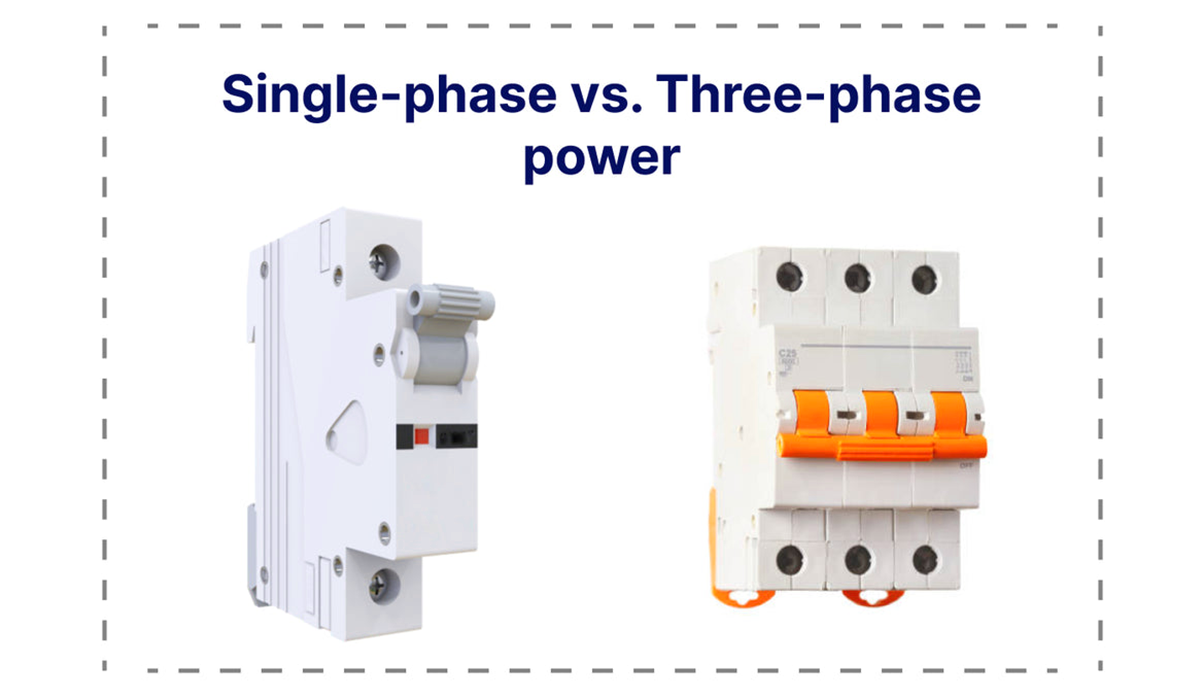
Single-Phase vs Three-Phase 100 Amp Generators
Most homes in North America use single-phase 120/240V service. A generator for 100 amp service in this context is usually a single-phase unit that feeds two 120V legs in the panel, providing both 120V circuits and 240V for larger appliances.
Small factories, workshops, and commercial buildings often use three-phase service, such as 120/208V or 277/480V. In that case, a single-phase 100 amp generator will not be appropriate. Instead, you need a three-phase 100A generator sized for the expected kVA and designed to start large motors without excessive voltage drop. Proper load balancing across all three phases is essential to avoid overheating conductors and breakers..
The capacity difference is larger than people expect: 100 A at 240 V single-phase is 24 kVA, while 100 A at 208 V three-phase is 36 kVA and at 480 V is 83 kVA. A “100 A three-phase service” is a fundamentally bigger service than a “100 A residential service”, which is why the workshop example above needs a 25–30 kVA machine where the house needs 12 kW.
How to Choose Between 100 Amp Generator Packages
Once you know your approximate kW requirement, service type, and fuel preference, it is time to evaluate specific products. Here are key factors that engineers and experienced contractors examine when comparing the best 100 amp home standby generators:
- Rating type: Check whether the generator is rated for standby, prime, or continuous duty. For residential backup, a standby rating with conservative assumptions is preferred.
- Total Harmonic Distortion (THD): Low THD (typically under 5%) is important for sensitive electronics such as computers, networking gear, LED lighting, and medical devices.
- Alternator and controller quality: A good alternator maintains stable voltage and frequency, while a robust controller manages starting, fault detection, and exercise mode.
- Monitoring features: Many modern 10–14 kW standby generators support Wi-Fi or cellular monitoring so you can see status, alarms, and run hours from a phone app.
- Warranty and local service: A long warranty is only valuable if local technicians and spare parts are readily available. Check the service network coverage in your area.
In the retail market, typical 100 amp generator bundles include a 10–13 or 14 kW air-cooled standby generator with a matching 100 amp ATS. These packages are popular because they give a balanced solution: enough power for essential loads or managed whole-home use, without the extreme cost and fuel consumption of a much larger 24 kW unit.
100 Amp Generator Installation: Cost Drivers and Timeline
A complete generator project involves much more than simply buying a box and placing it on a pad. Electrical work, fuel piping, permits, inspections, and commissioning all add to the total cost. For a typical 10–14 kW standby system with a 100 amp transfer switch, professional installation often falls in the range of several thousand dollars.
Major cost drivers include:
- Generator unit cost: Larger kW ratings and premium brands cost more. A 10 kW air-cooled unit is significantly cheaper than a 24 kW liquid-cooled model.
- Transfer switch type: A manual interlock plus inlet is the least expensive, while a service-entrance rated 100A ATS with load shedding modules costs more.
- Fuel system: For natural gas, the gas line may need to be upsized and extended; for propane, you must install and connect a storage tank; for diesel, you may need a day tank and spill containment.
- Electrical infrastructure: Costs for trenching, conduit, heavy-gauge copper or aluminum conductors, concrete pad, and any panel upgrades or breaker replacements.
- Permits and inspections: Local code requirements from the AHJ, including electrical, building, and sometimes zoning or environmental permits.
- Commissioning and testing: Final checks, simulated outage tests, and optional load bank testing to verify performance under realistic load.
From start to finish, a straightforward residential installation may take a few days of on-site work spread over several weeks, depending on permit timelines and utility coordination. Complex light-industrial projects can take longer, especially if utility protection studies and selective coordination studies are required.
NEC Requirements for 100 Amp Generator Installations (Article 702)
Permanently installed optional standby systems fall under NEC Article 702. Portable generators arranged for connection to premises wiring are covered too; portables not connected to premises wiring are not.
- Capacity — NEC 702.4(A)(2). With automatic transfer, the source must supply the full automatically connected load, or an EMS per NEC 750.30 must limit it. One- and two-family dwellings may use manual load management under the exception.
- Backfeed prevention. Never connect a generator to a panel or receptacle without transfer equipment. A listed transfer switch or interlock is mandatory.
- Transfer switch listing — UL 1008 for automatic transfer equipment. Service-entrance rated where the ATS replaces the main disconnect.
- Grounding and bonding. Whether the generator is a separately derived system depends on whether the ATS switches the neutral. This determines where the system bonding jumper and grounding electrode conductor go — and it is the detail most often got wrong on DIY installs.
- Generator construction and protection — NEC Article 445, including overcurrent protection and the disconnecting means.
- Signage. A permanent plaque at the service equipment indicating the type and location of on-site standby sources.
- Wire sizing. See the section below — the dwelling rule differs from the general rule.
For industrial assemblies, designers may additionally apply IEC 61439 for low-voltage switchgear and controlgear assemblies, and perform an arc-flash study to establish approach boundaries and PPE categories. Even a modest 100 A standby system should be reviewed by a licensed electrician or PE before energisation.
100 Amp Generator Maintenance Schedule
A standby generator is only useful if it starts and carries load when the lights go out. Regular maintenance and testing are therefore just as important as proper installation. Many problems that cause generators to fail during real outages are simple issues like old fuel, weak batteries, or overdue oil changes.
Good practice for generator maintenance schedule and reliability includes:
- Exercise mode: Configure the generator to run automatically once a week for a few minutes. This keeps oil distributed, charges the battery, and reveals obvious faults.
- Oil and filter changes: Follow the manufacturer’s hour-based schedule, often every 100–200 hours or annually, whichever comes first.
- Fuel care: For diesel and gasoline, use clean, fresh fuel and consider additives or fuel polishing for long-term storage. For propane and natural gas, periodic leak checks are important.
- Load testing: At least once or twice a year, run the generator under real or simulated load to confirm that it can carry the intended circuits without unstable voltage or frequency.
- Recordkeeping: Maintain a simple log of service, tests, and repairs. This is helpful for warranty claims and for diagnosing recurring problems.
Advanced Installation and Electrical Integration Details
For many homeowners, choosing a generator and having a licensed contractor install it is enough. However, for engineers, electricians, and technical managers, it is useful to look deeper into wire sizing, subpanel design, and safe operating procedures for portable units.
Wire Size for a 100 Amp Service, Feeder and Generator Circuit
There are two different correct answers, and using the wrong one either fails inspection or wastes money.
General rule (NEC Table 310.16, 75 °C): a 100 A circuit needs #3 AWG copper or #1 AWG aluminium. This applies to the generator feeder, a critical-loads subpanel that does not carry the entire dwelling load, and all commercial work.
Dwelling rule (NEC 310.12 and Table 310.12): for a single-phase 120/240 V dwelling service, or a feeder supplying the entire load of a dwelling unit, rated 100–400 A, conductors may be sized at 83% of the rating. For 100 A that is 83 A, which permits #4 AWG copper or #2 AWG aluminium. Two conditions: no ambient or bundling adjustment factors may apply, and ampacity is read from the 75 °C column even with 90 °C-rated insulation.
Where installers go wrong: applying 310.12 to a generator feeder or a partial-load subpanel. The 83% allowance exists because a whole-dwelling service sees load diversity — a subpanel serving selected circuits does not qualify, and neither does the conductor between the generator and the ATS.
Final selection still depends on run length and voltage drop, ambient temperature, installation method, terminal temperature ratings, and conductor material.
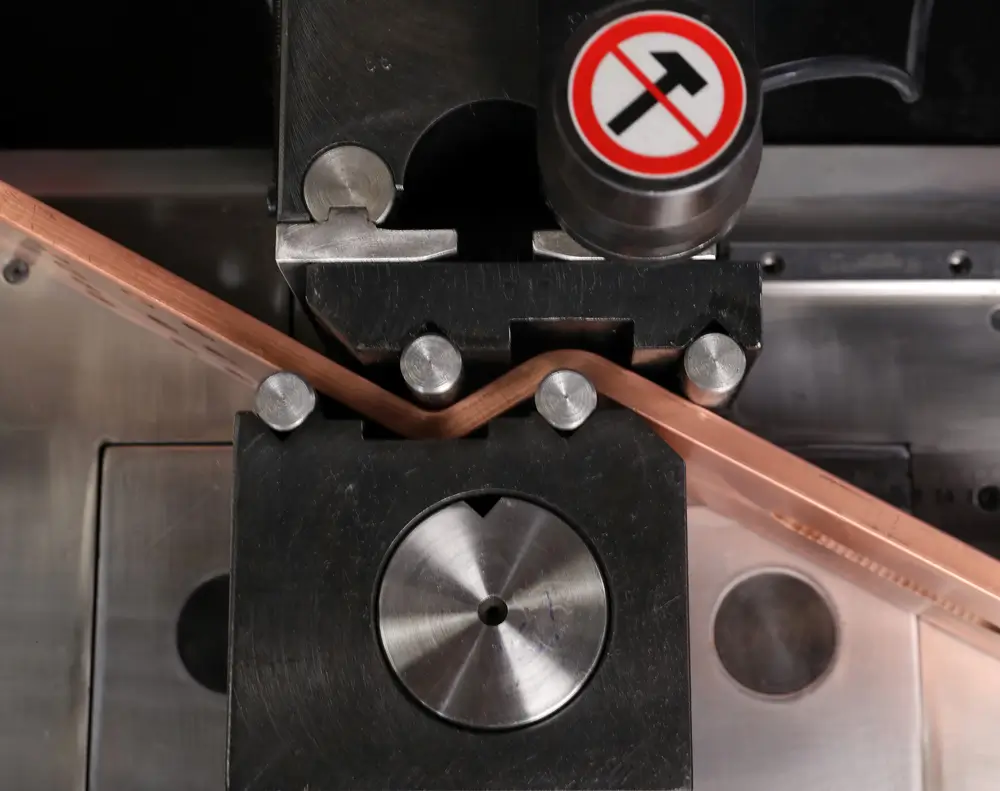
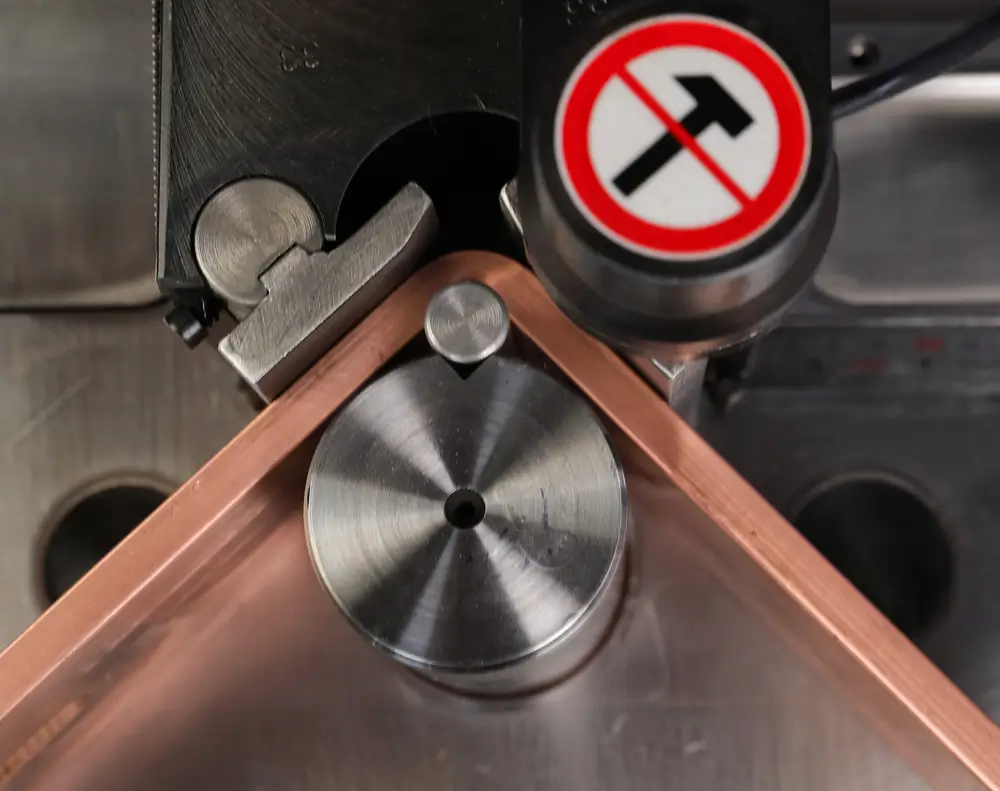
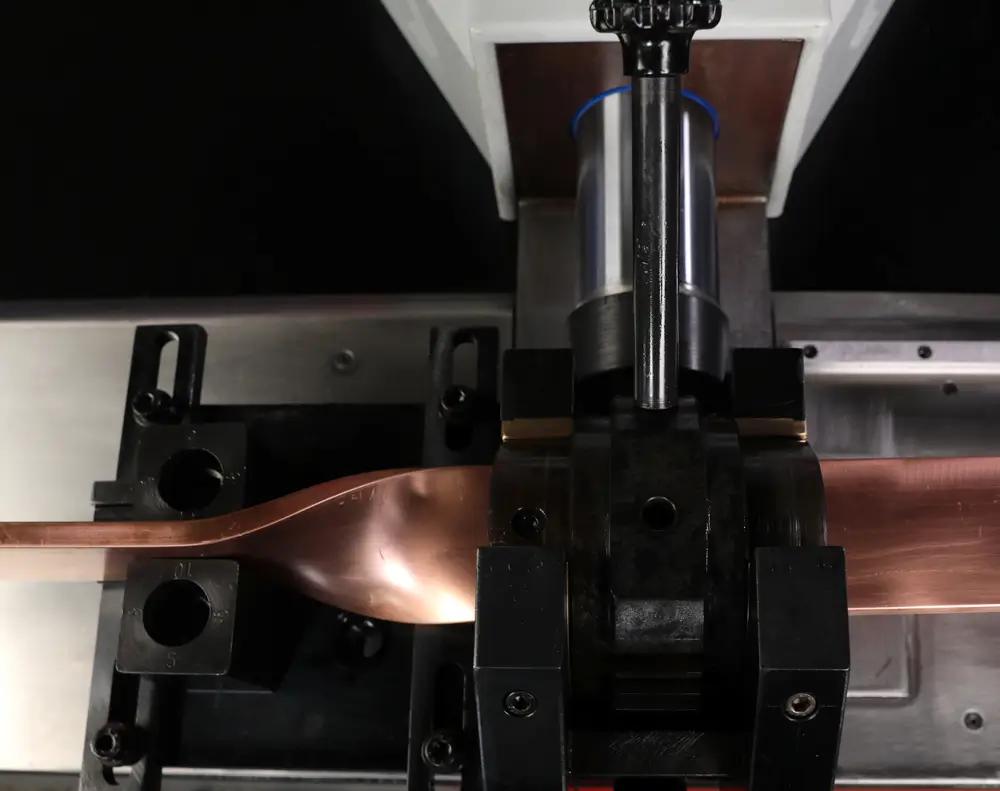
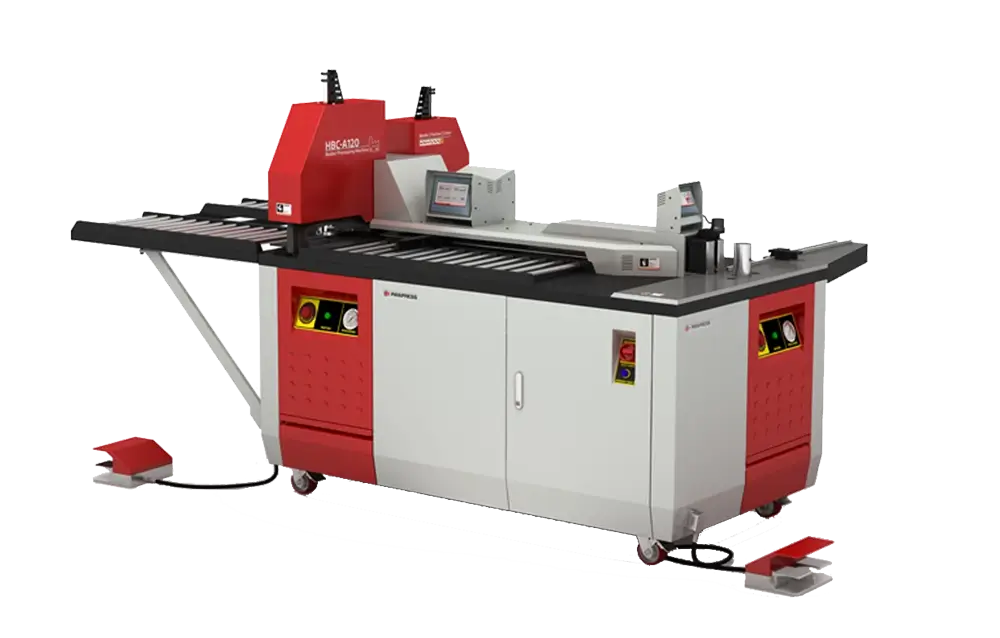
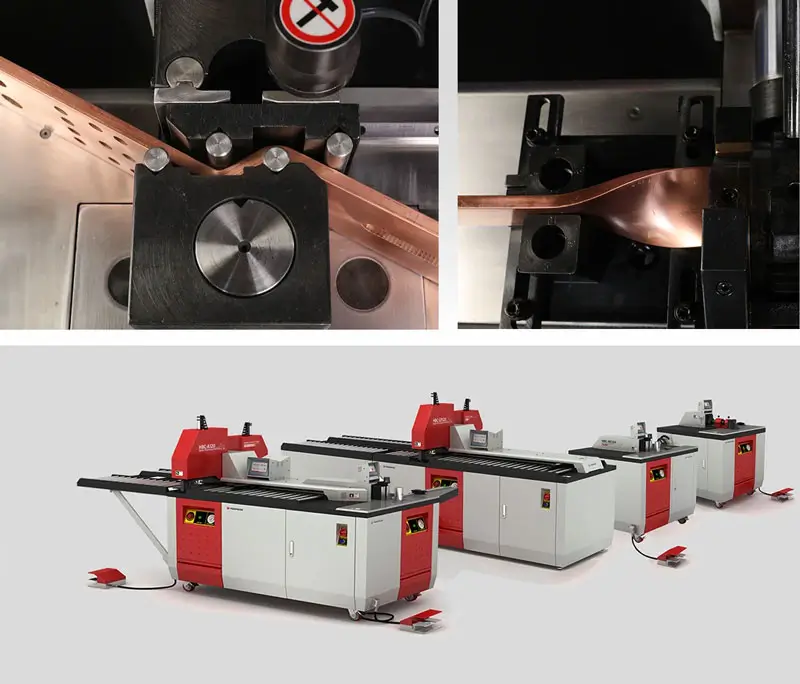
Panel busbars that distribute this current internally are precision-formed using professional busbar fabrication and processing systems to maintain consistent cross-section and hole alignment.
Critical-Loads Subpanel Design
One common design for 100 amp portable generator setups is to use a dedicated subpanel for critical loads. In this arrangement, selected circuits are moved from the main panel into the subpanel, which can then be energized either by the utility (through a feeder breaker) or by the generator (through a transfer switch or interlock).
Important points for subpanel design include:
- Neutral and ground separation: In a subpanel, neutrals and grounds must remain isolated. The neutral bus must not be bonded to the panel enclosure; that bond exists only at the main service disconnect.
- Feeder breaker sizing: The breaker feeding the subpanel must be correctly sized for the feeder conductors and the subpanel rating.
- Circuit relocation: Critical circuits are carefully moved from the main panel to the subpanel, so that the generator only powers selected loads when in backup mode.
- Clear labeling: Both panels should be clearly labeled so that anyone servicing the system understands which circuits are backed up and how the transfer mechanism works.
Safe Operation Using Portable Generator and Interlock
When using a 100 amp portable generator with an interlock kit, the user must follow a clear and disciplined operating sequence to avoid dangerous situations and accidental overloads. A typical safe sequence is:
- Turn off or disconnect all large loads in the house.
- Move the interlock so that the main breaker can be switched OFF before the generator breaker is turned ON.
- Connect the generator to the exterior inlet box with the properly rated cord.
- Start the generator and let it warm up for several minutes until it reaches stable speed and voltage.
- Turn ON the generator backfeed breaker (now allowed by the interlock) to energize the panel or subpanel.
- Bring loads back online one by one, starting with the smallest and leaving heavy motor loads for last.
Following this procedure reduces the risk of tripping the generator breaker with a large simultaneous inrush of starting current. It also reinforces the habit that the main utility breaker must always be off whenever the generator is backfeeding the panel.
Efficient power management and integration are key when sizing your generator. Similarly, combining multiple functions in a single busbar machine maximizes productivity and reduces space. Explore the advantages of this approach in our Benefits of Combining Multiple Functions in a Single Busbar Machine article.
The Engineer’s View: Why Oversizing Costs More Than Undersizing
From a professional engineering point of view, the most common mistake in generator projects is oversizing. Many owners believe that “bigger is always safer,” so they jump to a much larger kW rating than needed. In reality, this can be a poor investment: fuel consumption rises sharply at low load factors, and diesel engines in particular suffer from wet stacking and carbon buildup if they seldom see 60–80% of rated output.
On the other hand, undersizing the generator for 100 amp service is also dangerous. A small unit that is constantly overloaded will trip, stall, and eventually wear out. Critical loads may drop unexpectedly during storms, exactly when they are most needed.
The best strategy is simple but requires a bit of discipline: perform a realistic load calculation, identify what is truly essential, and then choose a generator size that allows a comfortable 70–80% loading during typical use. Combine this with a well-designed 100 amp transfer switch, proper wiring and grounding, and a routine maintenance plan. With that approach, a 10–14 kW standby generator or a carefully selected 100 amp diesel generator can deliver reliable backup power for 15–20 years or more, protecting both your electrical equipment and your peace of mind.
Choosing the Right Generator for Your 100 Amp Service
Three numbers decide this project. Your calculated running load — from a real appliance-by-appliance walk-through, not the panel rating. Your largest single starting surge — usually the AC compressor or well pump. And 80%, the loading target that keeps the machine efficient and gives you surge headroom.
For most 100 A homes those numbers point at a 10–14 kW standby generator with a 100 A ATS and smart load management. For all-electric homes, 16–24 kW. For a 100 A three-phase workshop, a 25–30 kVA diesel genset sized around compressor inrush.
Then confirm the two things that fail plan review: whether your load-management approach satisfies NEC 702.4(A)(2), and whether your conductors are sized under the general rule or the 310.12 dwelling rule. Get those right and a well-maintained unit will carry your critical loads for 15–20 years.

Rate this article
Choose a rating from 1 to 5 stars.
No ratings yet