




If you’d rather listen than read, feel free to play the audio file below for the rest of this article.
What Is Switchgear Maintenance?
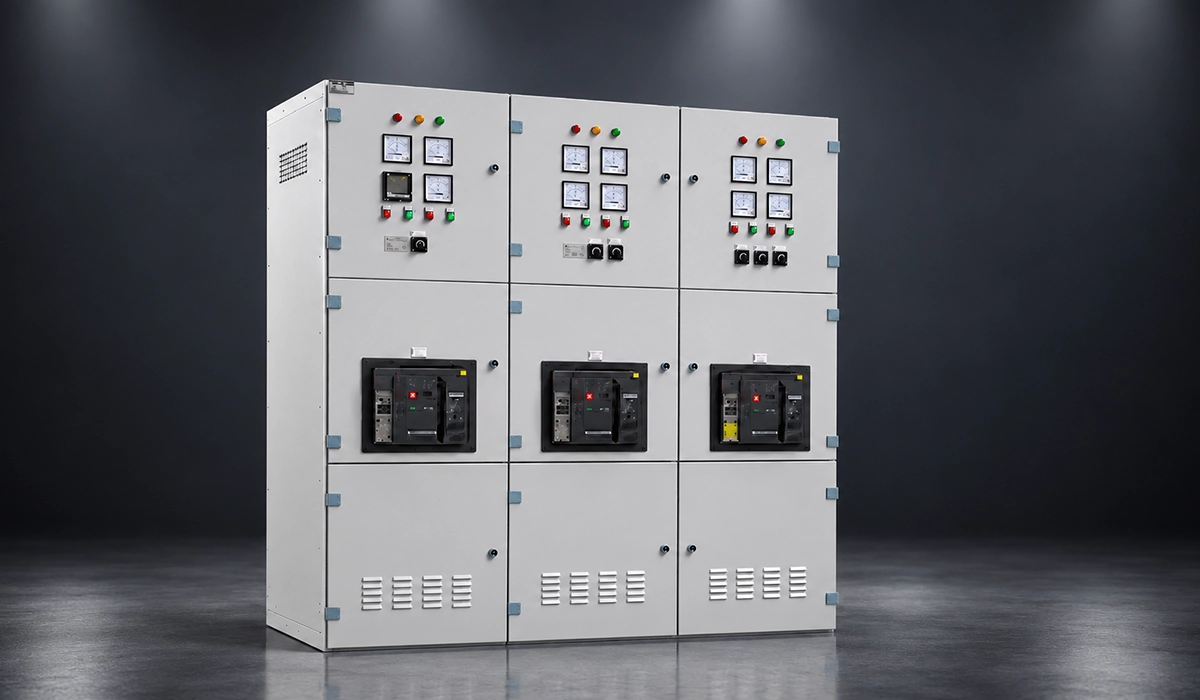
The work covers inspection, cleaning, testing, adjustment, lubrication, documentation and corrective repair across every component in the assembly. That work sits within the wider fundamentals covered in our guide to electrical panels and switchgear basics.
That means circuit breakers, busbars, relays, switches and fuses. It also means instrument transformers, insulation systems, control wiring, enclosures, grounding components and protective devices — each with its own failure mode and its own test.
The distinction worth holding: NFPA 70B tells you what to maintain and how often; ANSI/NETA MTS-2023 tells you how to test it and what result is acceptable.
Each component named above — breakers, busbars, relays, switches and fuses — has its own maintenance profile worth understanding on its own terms. Our guide to switchgear components covers what each one actually does.
Why Switchgear Maintenance Matters in Industrial Facilities
The business case is not about compliance, though compliance follows from it.
A maintained switchgear lineup reduces unplanned downtime, detects faults before they become failures, and extends equipment life. It supports insurance expectations and improves power system reliability, and it cuts emergency repair costs.
Above all it protects production continuity. NFPA reports that a majority of industrial fires are electrical in nature, which puts electrical equipment maintenance in a different category from most preventive work.
Understanding why this equipment needs this level of care starts with understanding what switchgear is actually protecting against. Our overview of the purpose of switchgear covers that role.
Common Causes of Switchgear Failure
Twelve causes account for most failures, and they cluster into three groups.
Connection and thermal. Loose electrical connections, overheating, and improper load conditions. These feed each other — a loose joint runs hot, heat accelerates oxidation, oxidation raises resistance, and resistance produces more heat.
Environmental. Dust, dirt and contamination; moisture and corrosion; insulation breakdown; environmental stress.
Mechanical and organisational. Mechanical wear, lack of breaker exercising, ageing components, failed protective relays, and poor maintenance records. The last is not a physical cause, but it is why the others go undetected.
Anyone asking how to prevent switchgear failure should start with the first group, because it is the one thermography finds early.
Loose busbar connections are named as the top failure driver here, and the busbar’s role in the system explains why. Our article on how busbars conduct covers that connection.
Switchgear Maintenance Best Practices
Ten practices, in the order a programme should build them.
To confirm the accuracy of what is written here, you can check the original source directly.
1. Follow Manufacturer and Applicable Standard Requirements
A switchgear maintenance program takes its frequency and procedure from four inputs: manufacturer instructions, equipment condition, operating environment, and criticality.
NFPA 70B Chapter 4 now requires facilities to have a documented electrical maintenance programme. Chapter 9 sets scopes of work and intervals by equipment type and condition. Any NFPA 70B switchgear maintenance requirements discussion starts there rather than with a generic annual interval.
2. Perform Regular Visual Inspections
Cheap, fast, and the most under-used tool in the programme.
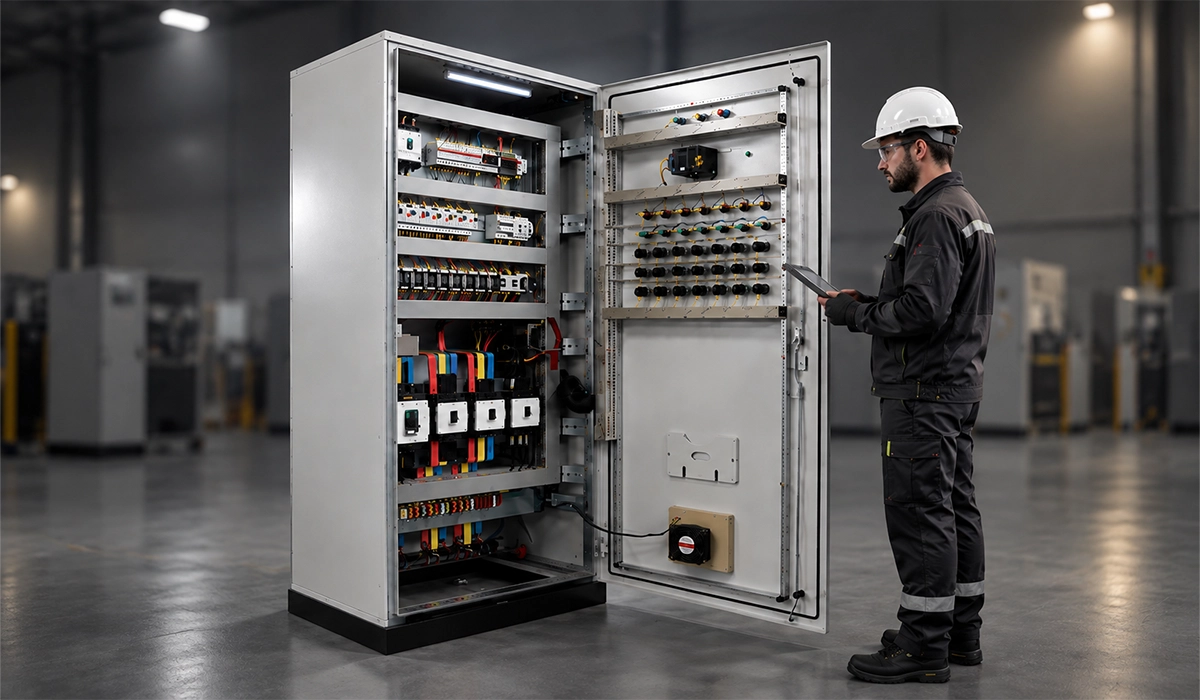
Look for signs of overheating and discoloration. Odour. Corrosion and dust buildup. Damaged insulation, loose hardware, moisture intrusion, abnormal noise and mechanical wear. A switchgear inspection that finds nothing still establishes a baseline for the next one.
3. Use Infrared Thermography
Infrared finds loose connections, overloaded circuits and abnormal heating before anything fails.
Two conditions make it useful rather than decorative. Survey under representative load, and record the load with the image. A differential against nearby equipment at similar load tells you far more than an absolute temperature.

4. Clean and Decontaminate Switchgear
Dust, debris, carbon tracking, moisture and conductive contamination all reduce insulation performance.
Carbon tracking matters most because it is progressive — a tracking path grows toward flashover rather than staying put.
5. Test Circuit Breakers
Circuit breaker maintenance is where most testing budget goes, and rightly so.
Verify mechanical operation, contact resistance, timing, insulation resistance and trip function. Primary or secondary injection testing applies where the protection scheme warrants it. A breaker that has not operated in years is a breaker of unknown condition.
6. Inspect and Test Protective Relays
Relays are the decision layer. If they do not operate correctly, every other protective element downstream is irrelevant.
Test to the settings actually in service rather than to the design study, because the two diverge over a lineup’s life.
7. Check Torque, Connections, and Busbar Condition
Loose connections create heat, resistance and failure risk, in that order.
Current practice has shifted here. Indiscriminate annual re-torquing disturbs sound joints, and field data suggests only a minority of loose connections improve from re-torquing alone. Most need disassembly, cleaning and reassembly. Thermographic survey with repairs triggered by findings has largely replaced calendar re-torquing.
8. Verify Grounding and Bonding
Grounding integrity decides both personnel safety and fault clearing time.
Measure continuity on the assembled lineup rather than assuming it from the drawings. A painted bolted joint is not conductive because the fastener is metal.
9. Keep Accurate Maintenance Records
Records are what turn individual tests into trend data, and trend data is what predicts failure.
Capture inspection dates, test results, technician notes, corrective actions, parts replaced, thermal images and recommended follow-up. Under the 2023 edition, the documentation is part of the requirement rather than good housekeeping.
10. Plan Maintenance Around Scheduled Outages
Most meaningful switchgear testing requires de-energised equipment, which means lockout/tagout and an outage window.
Plan the scope before the window rather than during it. An outage that finds a problem it cannot fix has consumed the shutdown without resolving anything.
Circuit breaker testing is named as where most of the maintenance budget goes, so knowing which breaker is actually in the lineup matters. Our circuit breaker finder can help confirm that.

Switchgear Maintenance Checklist
A preventive maintenance checklist for switchgear, in working order:
- Review safety procedures and arc flash labels
- Confirm lockout/tagout requirements
- Review drawings and previous test reports
- Perform visual inspection
- Inspect enclosure and ventilation
- Check for moisture, dust and corrosion
- Inspect busbars and connections
- Test circuit breakers
- Test protective relays
- Perform insulation resistance testing
- Perform contact resistance testing
- Conduct infrared inspection under load
- Clean equipment
- Lubricate mechanical parts as required
- Verify grounding
- Document findings
- Recommend corrective actions
Compare every test result against the ANSI/NETA MTS minimum values rather than against last year’s number alone.
Reviewing arc flash labels is the first item on this checklist, and it depends entirely on the protective devices actually installed. Our guide to arc fault breakers covers that protection layer.
How Often Should Switchgear Be Maintained?
There is no universal interval, and any provider quoting one without asking questions has not read the equipment.
Frequency depends on manufacturer recommendations, equipment age, voltage class and operating environment. Load profile, criticality, maintenance history, condition assessment and facility risk tolerance complete the list.
Anyone asking how often should switchgear be inspected in a harsh environment should assume more frequently. Heat, dust, moisture, chemicals, vibration and continuous operation all shorten the interval.
Voltage class is named as one of the factors that shortens or lengthens the maintenance interval. Our guide to the differences between high and low voltage covers why that distinction matters.
Preventive vs. Predictive Switchgear Maintenance
| Approach | Basis | Strength | Limitation |
|---|---|---|---|
| Preventive | Calendar or runtime interval | Predictable, easy to schedule and budget | Services equipment that does not need it |
| Predictive | Condition data and trends | Finds problems early, targets effort | Requires instrumentation and baseline history |
The preventive approach is scheduled inspection, cleaning, testing and service. The predictive one uses condition data — infrared imaging, test trends, partial discharge monitoring and performance history.
Neither alone is sufficient. Prediction tells you what needs attention; scheduled work keeps the baseline data coming that makes prediction possible.
Both approaches ultimately serve the same goal of keeping the lineup performing at its rated capability over time. Our guide to optimizing switchgear performance covers that outcome.
Signs Your Switchgear Needs Immediate Attention
Some findings do not wait for the next scheduled outage.
Burning smell. Visible arcing. Unusual noise. Overheating. Frequent breaker trips. Discoloration, corrosion, moisture inside the enclosure, or damaged insulation.
Two more are organisational rather than physical: inconsistent test results across surveys, and missing maintenance records on equipment of unknown history.
When switchgear does fail without warning, having a plan for emergency power distribution becomes critical. Our guide to emergency electrical panels covers that contingency.
When to Repair, Retrofit, or Replace Switchgear
Three decisions, with a clear boundary between each.
Repair when the issue is isolated and components remain supportable by the manufacturer.
Retrofit when the structure and bus are sound but breakers, relays or controls are obsolete. This is often the best value, because the enclosure and bus represent most of the original cost.
Replace when equipment is obsolete, unsafe, unreliable, unsupported, or no longer suitable for the connected load.
Retrofitting obsolete breakers and controls is often the better value here, and it reflects how far switchgear technology has moved on. Our article on the evolution of switchgear covers that shift.
Choosing a Switchgear Maintenance Provider
Ten criteria, useful whether the work goes in-house or out.
Industrial electrical experience, with genuine medium-voltage and low-voltage capability. Familiarity with NFPA 70B and ANSI/NETA MTS specifically, not electrical standards generally. Testing capability in-house rather than subcontracted. Qualified and certified technicians.
Then the documentation side: safety documentation, and detailed reporting with results against NETA values. Add the ability to recommend repairs, retrofits and upgrades rather than only reporting findings.
Finally the practical two: emergency support availability, and demonstrated experience working within planned shutdowns.
The same due diligence applies when evaluating who actually builds and services industrial switchboards in the first place. Our guide to industrial electrical switchboards covers that side of the decision.
Conclusion about Switchgear Maintenance
A maintained lineup protects safety, uptime, asset life and production continuity, in roughly that order of consequence.
The regulatory position has moved. A documented electrical maintenance programme is now an expectation rather than a discretionary practice. The standards that define it — NFPA 70B for the framework, ANSI/NETA MTS for the test values — are specific enough to be audited against.
The practical starting point is smaller than any of that. Find out when the switchgear was last tested, and against which specification.
Zooming out, maintenance is just one piece of keeping a panel reliable across its full service life. Our holistic review of steel panels covers the rest of that picture.



Rate this article
Choose a rating from 1 to 5 stars.
3.0 out of 5 — 1 vote