


What Switchboard Maintenance Involves
An industrial electrical switchboard is a floor- or wall-mounted assembly housing protective devices, metering and busbar, distributing power from an incoming supply to downstream feeders. In North America they’re built to UL 891; in IEC markets the equivalent framework is IEC 61439-2 for power switchgear and controlgear assemblies.
Maintenance on one splits into three activities that are often conflated:
- Inspection — visual, thermographic and partial discharge assessment, performed with the board energised and under load. Non-invasive.
- Testing — insulation resistance, contact resistance, primary and secondary injection, protective device functional tests. Requires the board de-energised.
- Servicing — cleaning, re-torquing where justified, lubrication, component replacement. De-energised.
Getting the sequence right matters: the energised inspection tells you where to focus the de-energised work, so an outage scheduled before a thermal survey usually wastes half its value.
Before You Open the Board: Establishing an Electrically Safe Work Condition
Nothing below this line should be attempted on a live board by anyone who isn’t a qualified person with the right PPE and a current arc-flash assessment.
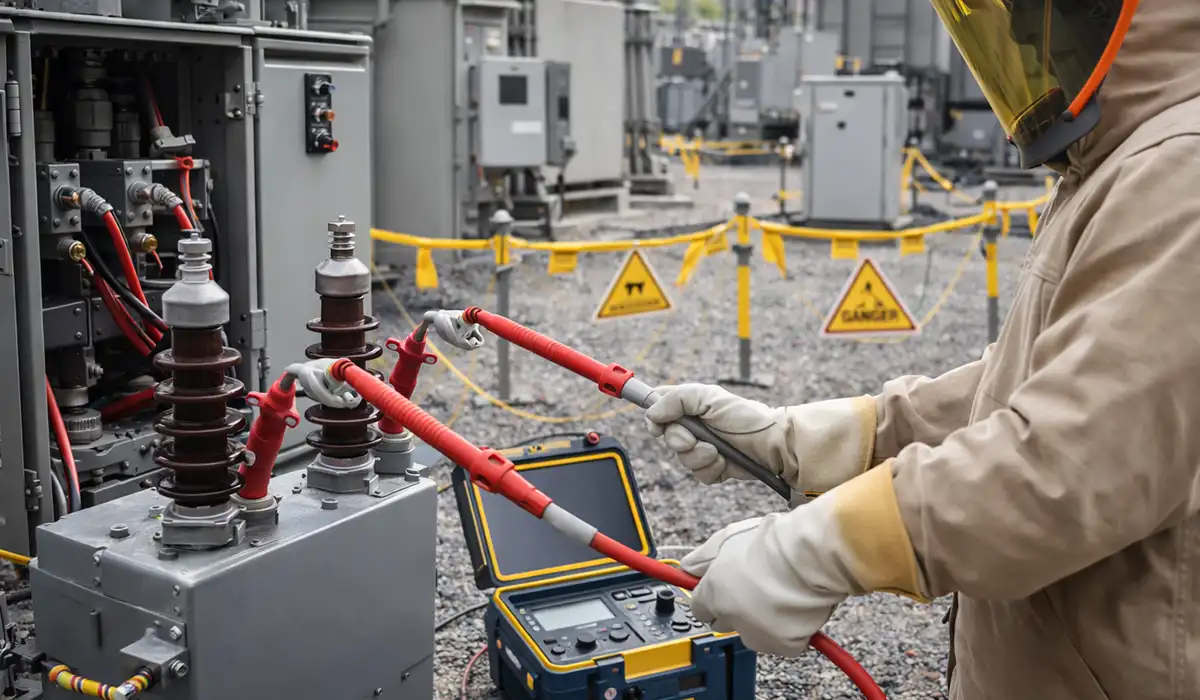
NFPA 70E Article 120 defines the process for establishing an electrically safe work condition. In short: determine all possible sources, open the disconnecting devices, verify visually where possible, release stored energy, apply lock/tag, then test before touch — verify absence of voltage with a tester proven live-dead-live on a known source.
Two points specific to switchboards:
- Test-before-touch means the whole board. A switchboard can be back-fed from a downstream generator, UPS or PV inverter. Opening the main does not guarantee the bus is dead.
- Condition of maintenance changes the arc-flash assessment. Under NFPA 70E, equipment must be properly maintained to be treated as being in normal operating condition. A board with no maintenance records may have to be treated as having exposed energised parts — which changes the boundary, the PPE and sometimes whether the task can be done at all. This is the direct, practical link between maintenance and safety, and it is the reason NFPA 70B exists.
Work that genuinely must be done energised requires an energized electrical work permit and a documented justification. “It was inconvenient to shut down” is not one.
10 Tips for Maintaining Industrial Electrical Switchboards
-
Start With a Full Condition Assessment
Before scheduling any work, establish where the board actually is. A complete assessment covers visual inspection, infrared thermography under load, partial discharge measurement on MV equipment, and contact or connection resistance where accessible. The output isn’t a pass/fail — it’s a prioritised list that tells you what the outage window should be spent on.
-
Control the Environment Before You Blame the Equipment
Most insulation failures are environmental before they are electrical. Humidity combined with conductive dust — carbon, metal fines, salt near coastal sites, agricultural residue — creates surface tracking paths across insulators and between phases. Once tracking starts, it carbonises and becomes permanent.
Practical controls: verify the enclosure’s IP or NEMA rating still matches the environment it ended up in, check gasket condition at doors and cable entries, confirm filters and forced ventilation are working, and confirm any anti-condensation heaters are actually energised. Heaters that were switched off during a summer shutdown and never switched back on are a recurring finding.
-
Run Thermography Under Load, and Act on the ΔT
Two things determine whether a thermal survey is worth doing.
Load. Heating rises roughly with the square of the current. A survey on a lightly loaded board will miss defects that are obvious at full load. NFPA 70B and NETA both direct surveys to be performed during periods of maximum possible loading. Record the load at the time of survey — a report without it can’t be compared against the next one.
Criteria. “It looks hot” is not a finding. ANSI/NETA MTS Table 100.18 gives the thresholds:
ΔT vs similar component, similar loading ΔT vs ambient air Action 1–3 °C 1–10 °C Possible deficiency — investigate 4–15 °C 11–20 °C Probable deficiency — repair as time permits — 21–40 °C Monitor until corrective measures can be made >15 °C >40 °C Major discrepancy — repair immediately The left column is the more reliable one: comparing the A-phase joint against B and C under the same load removes ambient and emissivity as variables. Use IR windows where fitted so the survey can be done without opening doors — that’s a safety improvement, not just a convenience.
-
Exercise Breakers on a Planned Outage — Not Ad Hoc
Breaker mechanisms that never move seize. Lubricant migrates or hardens, latches stiffen, and the first time the mechanism is asked to operate is during a fault — when a slow trip means more energy released into the fault.
Exercising the mechanism annually addresses this, but cycling a main breaker de-energises everything downstream. It belongs in a planned outage, with LOTO applied, coordinated with operations, not slotted into a routine inspection round. Where the board has drawout breakers, rack out and exercise on the test position or the bench instead — see the switchgear section below.
While you have it out: record the operation counter, check the charging motor and closing/tripping coil currents if the trip unit supports it, and verify the mechanical trip indicator. A mechanism that is slowing down shows up in coil current signature long before it fails to operate.
-
Decide What Stays In-House and What Goes to a Testing Contractor
Visual inspection, cleaning, thermography and record-keeping are reasonable in-house activities for a competent maintenance team. Primary injection testing, insulation power factor, contact resistance at MV, partial discharge measurement and protective relay testing generally are not — they need calibrated instruments, current test standards and technicians who do it regularly.
When contracting out, specify the test standard. ANSI/NETA MTS is the reference for maintenance testing; ANSI/NETA ATS for acceptance testing on new equipment. A quotation that doesn’t name one is quoting an undefined scope.
-
Keep Records — NFPA 70B Now Requires Them
Single readings tell you almost nothing. Insulation resistance of 200 MΩ means little in isolation; 200 MΩ where last year’s reading was 900 MΩ is a finding. The same applies to contact resistance, thermal ΔT and breaker operation times. Trend is the diagnostic, not the value.
This is no longer discretionary. NFPA 70B requires a documented electrical maintenance program with retained records, and those records are what substantiate the “normal operating condition” determination in your arc-flash assessment. A facility with no maintenance history has a harder safety case, a harder insurance case, and a harder OSHA case.
At minimum, retain: test results with dates and instrument used, thermal images with load conditions, breaker operation counts, torque values applied and by whom, and every corrective action with its closeout.
-
Add Continuous Monitoring Where the Board Justifies It
Periodic inspection samples the equipment a few times a year. Continuous monitoring watches it constantly, and catches the intermittent conditions periodic inspection structurally cannot — a joint that only runs hot at peak load, a partial discharge event that appears at high humidity.
Worth instrumenting on critical boards: wireless thermal sensors on busbar joints and cable terminations, continuous partial discharge monitoring on MV equipment, and breaker trip unit data where the device supports it. Justify it by criticality — the cost only makes sense where an unplanned outage is expensive.
-
Know When to Retrofit and When to Replace
The realistic trigger is usually parts availability, not age. When breakers for an installed board are obsolete and only available refurbished, you are one failure away from an unplanned replacement on someone else’s schedule.
Two paths. Retrofit keeps the existing structure and bus and installs modern breakers via adapter cradles — cheaper, faster, shorter outage, but it inherits the original bus rating and bracing. Replacement is the honest answer when the available fault current at the board has grown past its rating, which happens quietly whenever a utility upgrades the supply transformer.
Confirm the board’s short-circuit rating against a current study before choosing. A retrofit into an under-rated structure solves the parts problem and leaves the dangerous one in place.
-
Keep the Short-Circuit and Coordination Studies Current
Two related studies, both of which go stale.
Short-circuit study establishes the prospective fault current at the board and confirms every device is rated to interrupt it. This changes whenever the utility upgrades the service transformer, a generator or large motor is added, or the site is reconfigured — none of which triggers a review automatically.
Coordination study sets the protective device curves so the nearest upstream device clears the fault and nothing above it does. Incorrect settings cause both failure modes: nuisance trips that take out production, and delayed clearing that raises incident energy.
NFPA 70E requires the arc-flash risk assessment to be reviewed at least every five years or when a major modification occurs. In practice, treat the short-circuit study, the coordination study and the arc-flash study as one package that gets revisited together.
-
Build the Program Around NFPA 70B and NFPA 70E Together
The relationship is more specific than “70E recommends 70B”, and it runs both ways.
NFPA 70B tells you what maintenance to do and how often. NFPA 70E tells you how to work safely, and depends on 70B being followed — because condition of maintenance determines whether equipment can be treated as being in normal operating condition during a risk assessment.
Neither is optional in the way they used to be. Full detail in the next section.
NFPA 70B for Switchboards: What Changed When It Became a Standard
Most maintenance guidance online still describes NFPA 70B as a recommended practice. That stopped being accurate in January 2023.
From “Should” to “Shall”
The 2023 edition converted NFPA 70B from Recommended Practice for Electrical Equipment Maintenance to the Standard for Electrical Equipment Maintenance, replacing advisory language with mandatory language throughout. NFPA 70B is not adopted into law the way the NEC is, but it is a consensus standard — which means AHJs, insurers and OSHA can all reference it when assessing whether a facility’s maintenance was adequate.
The Electrical Maintenance Program (EMP)
The core requirement is a documented EMP. Not a spreadsheet of past work — a defined program covering equipment inventory, assigned maintenance tasks and intervals, qualified personnel, test procedures, record retention, and periodic audit and review of the program itself.
How Intervals Are Set: Equipment Condition Assessment
This is the part worth understanding, because it replaces fixed intervals with a condition-based approach. Three factors are assessed:
- Equipment condition — physical state, age, observed deterioration
- Criticality — consequence of failure to the facility
- Operating environment — temperature, humidity, contamination, vibration
Each is rated, and the worst of the three governs the interval. A board in excellent condition serving a non-critical load, but sitting in a dusty, humid environment, takes the environment’s interval. This catches the common failure mode where equipment is assessed on its own condition and the room it lives in is ignored.
How NFPA 70B Connects to NFPA 70E
Chapter 5 of NFPA 70B addresses personnel safety and points to NFPA 70E as the governing electrical safety standard. Running the other way, NFPA 70E requires condition of maintenance to be considered when determining whether equipment is in normal operating condition — and equipment that isn’t may have to be treated as having exposed energised parts.
The practical consequence: poor maintenance doesn’t only raise failure risk, it raises the PPE category and can make routine tasks impermissible. NFPA 70B is also designed to work alongside ANSI/NETA standards, which supply the actual test values and acceptance criteria.
Switchgear vs Switchboard Maintenance: What Actually Differs
The terms get used interchangeably; the maintenance workflows are genuinely different.
Switchboards (UL 891) typically use fixed or group-mounted molded-case and insulated-case breakers, and are often front-accessible only. Maintaining a device usually means de-energising at least that section, and frequently the whole board. Outage planning dominates the schedule.
Switchgear (ANSI/IEEE C37.20.1 for LV, C37.20.2 for MV metal-clad) uses drawout power circuit breakers. You rack a breaker out, shutters close over the live bus stabs automatically, and the breaker is maintained on a bench or in the test position while the rest of the board stays in service. That single design difference is why switchgear is specified for facilities that can’t take outages.
MV metal-clad switchgear adds tests a switchboard doesn’t need:
- Partial discharge measurement — TEV, HFCT, UHF or acoustic sensing, plus checking for ozone as a corroborating sign
- Vacuum interrupter integrity testing on VCBs, verifying the bottle still holds vacuum
- Insulation power factor / tan delta on primary insulation
- Contact resistance across the main contacts, compared to the manufacturer’s limit
If you’re writing a maintenance specification, name the construction standard. “Switchgear” and “switchboard” written loosely into a scope of work produce quotations that aren’t comparable.
Main Switchboard (MSB) Maintenance
The main switchboard is the single point everything downstream depends on, which creates a specific problem: the equipment most in need of maintenance is the equipment hardest to take out of service.
Three practical approaches:
- Non-invasive first. Thermography, partial discharge and continuous monitoring all run energised. On an MSB, extract everything possible from these before booking an outage, so the outage is spent on work that genuinely requires de-energisation.
- Plan the outage around the study, not the calendar. Sequence the intrusive work by what the energised inspection found, and have parts on site before the shutdown starts.
- Consider temporary or alternate supply. On sites where a full MSB outage isn’t feasible, a tie arrangement or temporary generation may be the only way maintenance ever happens. If neither exists, that’s a design finding to escalate — an MSB that can never be maintained will eventually be maintained by failure.
Marine and large commercial installations often carry additional MSB inspection requirements from class societies or the insurer. Check those alongside NFPA 70B rather than assuming one covers the other.
Switchboard Maintenance Checklist
NEW BODY:
id=”switchgear_maintenance_schedule_tbl”
| Item | Check | Typical interval |
|---|---|---|
| Enclosure | Gaskets, door seals, cable entries, corrosion, IP/NEMA integrity | Annual |
| Thermography | Full survey under maximum available load, ΔT per NETA 100.18 | 6–12 months |
| Busbar joints | Millivolt drop or thermal comparison; torque only where indicated | Annual (energised methods) |
| Insulation resistance | Phase-to-phase and phase-to-earth, trended against history | 1–3 years, de-energised |
| Breakers | Mechanism exercise, operation count, trip unit function test | Annual / per manufacturer |
| Protective relays | Secondary injection, settings verified against coordination study | 1–3 years |
| Earthing | Continuity of bonding, earth electrode resistance | Annual |
| Ventilation | Fans, filters, anti-condensation heaters energised | 6 months |
| Cleanliness | Dust and contamination removal, insulator surfaces | Per environment |
| Labelling | Arc-flash labels current against the latest study, single-line accurate | Annual |
| Documentation | EMP records updated, findings closed out | Continuous |
Intervals shown are typical starting points. Under NFPA 70B, the governing interval comes from the equipment condition assessment — take the worst of condition, criticality and environment.
Note on re-torquing: the article doesn’t mention it, but it’s worth a line here — blanket annual re-torquing of previously torqued connections is discouraged by most manufacturers and by NETA, because repeated torquing can damage the joint and relax the belleville washer. Verify by millivolt drop or thermal comparison first; torque only what those findings indicate.
Maintenance Tips for Industrial Control Panels
Proper maintenance of electrical control systems is critical to ensure stable, safe, and efficient operation of electrical equipment and facilities. This process includes preventive and periodic actions that prevent sudden failures and increase equipment lifespan.
Why Control Panel Maintenance Matters
- Longer equipment life: Identifying and fixing issues early prevents major damage.
- Lower repair costs: Preventive maintenance reduces unexpected repair expenses and avoids production or service downtime.
- Improved safety: Addressing safety issues helps prevent accidents and electric shock.
- Better efficiency: Adjusting and calibrating equipment improves performance and reduces energy consumption.
- Standards compliance: Regular maintenance keeps systems aligned with safety and performance standards.
Control Panel Inspection and Service Actions
- Periodic inspection:
- Visual checks for corrosion, physical damage, and loose connections
- Measuring electrical parameters such as voltage, current, and insulation resistance
- Functional testing of breakers, contactors, and other control devices
- Checking the grounding system and equipment grounding connections
- Verifying the condition of terminals and connections
- Cleaning:
- Removing dust and contamination from equipment
- Cleaning contacts and terminals
- Calibration: Calibrating measurement and control devices
- Repair and replacement of faulty parts: Identifying and replacing worn or defective components on time
- Software updates: Updating controller software and monitoring systems
Control Panel Maintenance Checklist
- Protective devices: fuses, miniature circuit breakers, relays, current and voltage transformers
- Control equipment: contactors, timers, thermal relays, PLCs
- Measuring instruments: ammeters, voltmeters, frequency meters
- Cables and connections: insulation condition, terminals, and connection integrity
- Grounding system: ground resistance and grounding connections
- Switchboards: cleaning, connection checks, functional tests
- Ventilation systems: fan operation and cooling system performance
How Often Should a Switchboard Be Serviced?
There is no single interval, and under the current NFPA 70B framework there isn’t supposed to be. Intervals come from the equipment condition assessment, with the worst of three factors governing.
Reasonable defaults before you’ve done that assessment:
- Thermography: 6–12 months, more often on critical or heavily loaded boards
- Visual inspection: annually, quarterly in dusty or humid environments
- Full de-energised testing: every 1–3 years depending on criticality
- Protective device testing: every 1–3 years, or after any settings change
- Arc-flash study review: at least every 5 years, or on major modification
Shorten all of these where the board is in poor condition, serves a critical load, or sits in a hostile environment — and remember that only one of those three needs to be bad for the shorter interval to apply.
Factors That Affect Maintenance Frequency
- Equipment type: different equipment requires different maintenance intervals
- Environmental conditions: temperature, humidity, and contamination affect frequency
- Usage level: heavily used equipment needs more frequent maintenance
- Safety standards: specific standards define or influence maintenance frequency
Building a Switchboard Maintenance Program That Holds Up
Three things separate a maintenance program that survives an audit from a folder of invoices.
It’s documented as a program, not as history. NFPA 70B requires a defined EMP with scope, intervals, procedures, qualified personnel and a review cycle — not just evidence that work happened.
Intervals are justified. Condition, criticality and environment, with the worst governing. If someone asks why a board is on an eighteen-month cycle, there should be an assessment to point at.
Findings close out. A thermal survey that identifies a 20 °C ΔT and produces no work order is worse than no survey — it documents that you knew.


Rate this article
Choose a rating from 1 to 5 stars.
No ratings yet