





If you’d rather listen than read, feel free to play the audio file below for the rest of this article.
The Two-Minute Arithmetic That Starts the Argument
Ten minutes versus two, per door. Five times on the operation, and that ratio is where every corner forming machine cost case begins.
Convert it to worker-days and it lands harder. On a thousand-door order, the welded route is about 21 worker-days on corners alone. Cold corner forming is about four.
Now the caveat, and it belongs here rather than buried in a footnote. That is five times faster on the corner operation — not on the door, and not on the enclosure. Blanking, punching, bending, hardware, coating and assembly are unchanged. A reader who spots that omission unaided stops reading. Told up front, the rest of the model earns its trust.
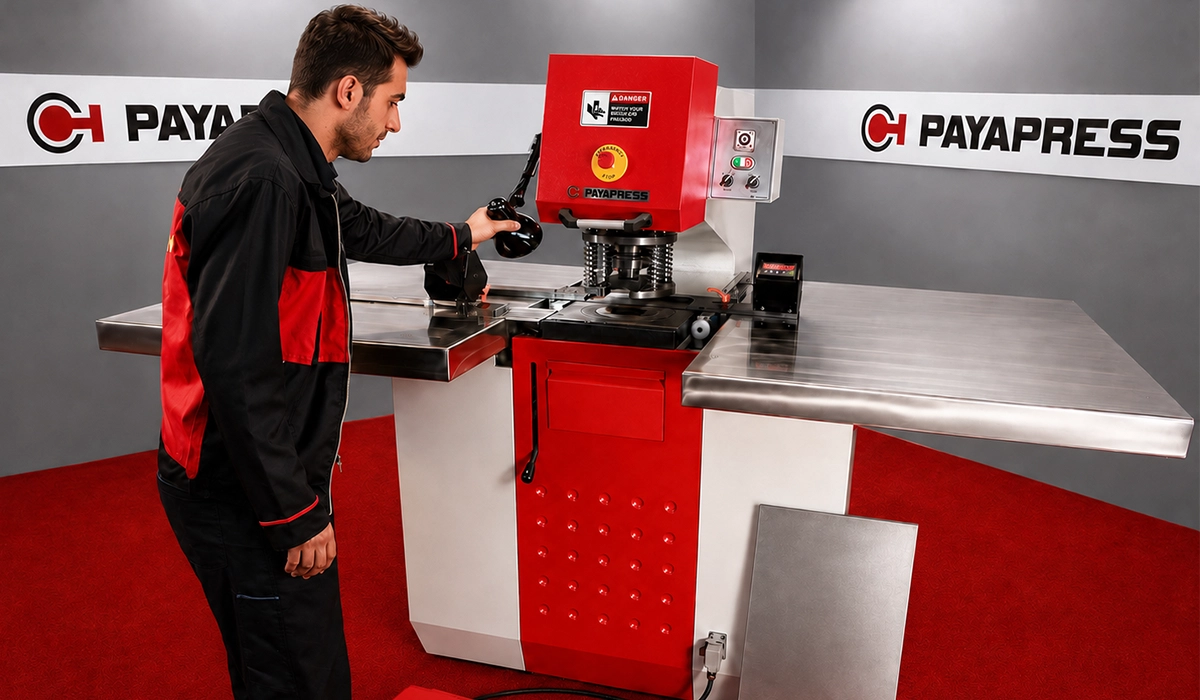
The same weld-free logic drives our wider sheet-metal line, including the punching and notching machine built for clean, repeatable panel work.
Reading the Real Invoice: The Five Lines Welding Adds
Labor is line one of five, and it is not the most interesting one.
Here is the model, stated before any number appears. A US shop. One enclosure door, four corners. Fully burdened labor at $35 per hour.
That rate deserves its own sentence. BLS OEWS May 2025 puts the median wage for welders, cutters, solderers and brazers at $53,750 a year — about $25.84 an hour. Adding payroll burden and overhead absorption at roughly 1.35× gives $35. That is a deliberately conservative multiplier; many shops carry more. Substitute your own figure and every line below moves with it.
Before trusting that two-minute figure, it helps to see the cycle itself — our guide walks through the full operating sequence corner by corner.
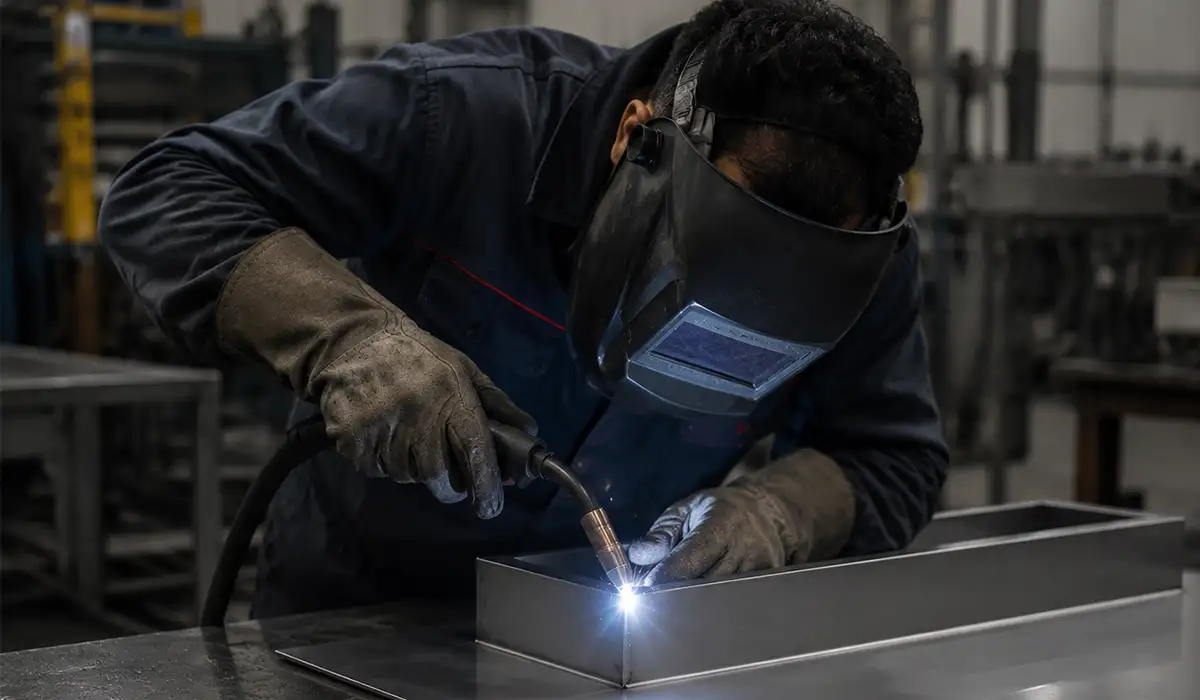
Line 1: Direct Labor
Eight minutes saved per door at $35 an hour is $4.66.
There is a structural point underneath that number. The cold former runs with a trained operator, not a certified welder, so the real welding labor cost gap in a working shop is wider than the model shows.
The model holds the same rate for both routes anyway. A conservative model that still works is worth more than an aggressive one you have to defend in a capex meeting.
For anyone who wants to go deeper, this further reading provides a much wider view.
The same weld-free logic drives our wider sheet-metal line, including the punching and notching machine built for clean, repeatable panel work.
Line 2: Consumables
Wire and shielding gas are pennies on a 1.5 mm corner. The money is in abrasives.
Flap discs, backing pads and polishing compound run about $0.45 per corner, so $1.80 per door.
Cold forming is not free on this line either. Die wear is real, and consumables cost on the formed route runs about $0.10 per door in tooling amortization. That is a small number, but leaving it out would make the rest of the model look like advocacy.
Line 3: Coating and Finishing
A dressed weld leaves level variation and micro-porosity. Shops bury both under heavier film build and touch-up time.
The model puts that at $0.75 per door.
It is also the softest line here, and worth saying so plainly. 2026 US powder rates run roughly $1.75 to $4.50 per square foot. The corner is a small share of total panel area. That $0.75 is an estimate, not a measurement. If your coater can give you a real figure, use theirs.
If this article has been helpful to you, we recommend reading the article on topic Corner Forming Machine Applications for more detailed and accurate information.
Line 4: Rework, Warp and Scrap
Burn-through and distortion on thin sheet, both of which are easier to cause than to fix.
The model runs about 1.5% of welded doors needing rework at 25 minutes each, against about 0.3% on the formed route. Net: $0.22 per door.
Small, and deliberately so. The point is that this line exists and gets left off quotes, not that it wins the argument. Most shops treat rework as an overhead rather than a per-part cost, which is precisely why it never appears in a comparison.
Line 5: The Skill Dependency
Not a currency line. A risk line, and it should be labeled as one.
Welded corner quality tracks the welder’s skill and the welder’s day. A matched die does not have days.
Read the certified welder shortage as production continuity rather than as an HR problem. A shop with one welder has one point of failure on every enclosure it ships.
| Cost line (per door, 4 corners) | Welded + polished | Cold formed | Difference |
| Direct labor (10 min vs 2 min at $35/h) | $5.83 | $1.17 | $4.66 |
| Consumables (wire, gas, abrasives / die wear) | $1.80 | $0.10 | $1.70 |
| Coating: extra powder and touch-up | $0.90 | $0.15 | $0.75 |
| Rework, warp and scrap | $0.28 | $0.06 | $0.22 |
| Skill dependency | Certified welder | Trained operator | Risk, not currency |
| Total per door | $8.81 | $1.48 | $7.33 |
The data above is estimated.
What That Adds Up To Over a Year
Three numbers. A cost per enclosure door difference of $7.33. $1.83 per corner. At 400 doors a month, $2,932 a month and $35,184 a year.
The labor share converts into something a plant manager can picture. About 640 hours a year — roughly a third of a full-time position — going back into the shop instead of into dressing corners. That is not a headcount reduction. It is the same people doing work that was queued behind the finishing bench.
Return to the order from the intro. One thousand doors, $7,330 on a single purchase order, and none of it visible on the quote that won the job. That is the question stated the other way round — not what a machine costs, but what the current cost per enclosure already is.
Payback: How Fast the Machine Clears
Any corner forming machine payback calculation is one line: machine price divided by monthly saving equals payback in months.
Three price scenarios, so you can find your own quote rather than trusting one figure.
| Doors per month | Saving per month | Payback at $45,000 | Payback at $55,000 | Payback at $65,000 |
| 100 | $733 | 61 months | 75 months | 89 months |
| 200 | $1,466 | 31 months | 38 months | 44 months |
| 300 | $2,199 | 20 months | 25 months | 30 months |
| 400 | $2,932 | 15 months | 19 months | 22 months |
| 600 | $4,398 | 10 months | 13 months | 15 months |
| 800 | $5,864 | 8 months | 9 months | 11 months |
| 1,200 | $8,796 | 5 months | 6 months | 7 months |
The data above is estimated.
Read out loud: at 400 doors a month a $55,000 machine clears in about 19 months. At 800 it clears inside a year. Below 300 the picture changes character entirely, which is the subject of the next section.
One correction before this goes into a capital equipment justification. The table ignores financing cost, operator training time and the first month of slower cycle times. Add a quarter to whatever it says, and present that adjusted figure rather than the raw one — a number that survives scrutiny is worth more than a number that impresses. Where the machine sits in the wider process is covered in our corner forming machine applications article.
The Volume Floor: When the Numbers Say Wait
Below roughly 200 doors a month, payback runs past three years and the case gets weak. That is the honest breakeven volume, and it is worth stating in those words.
At that level you have two reasonable options.
Subcontract the corner operation to a shop that already runs a former, and keep the capital. Or keep welding and revisit when the order book changes — corner forming machine cost does not improve with time, but your volume might.
Neither is a failure. A machine that clears in five years is a machine bought too early.
What Actually Changes at the Corner
Welding melts and re-solidifies the parent metal. That leaves a heat-affected zone, distortion on thin sheet, and a bead that has to be ground back until it looks like a corner again.
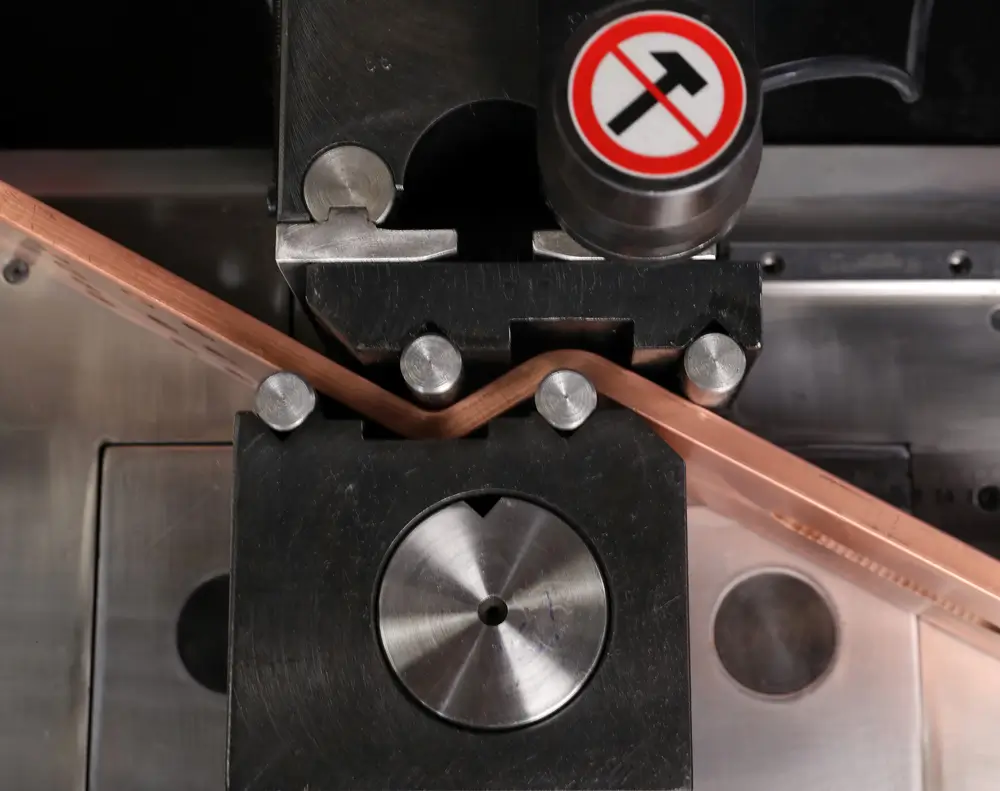
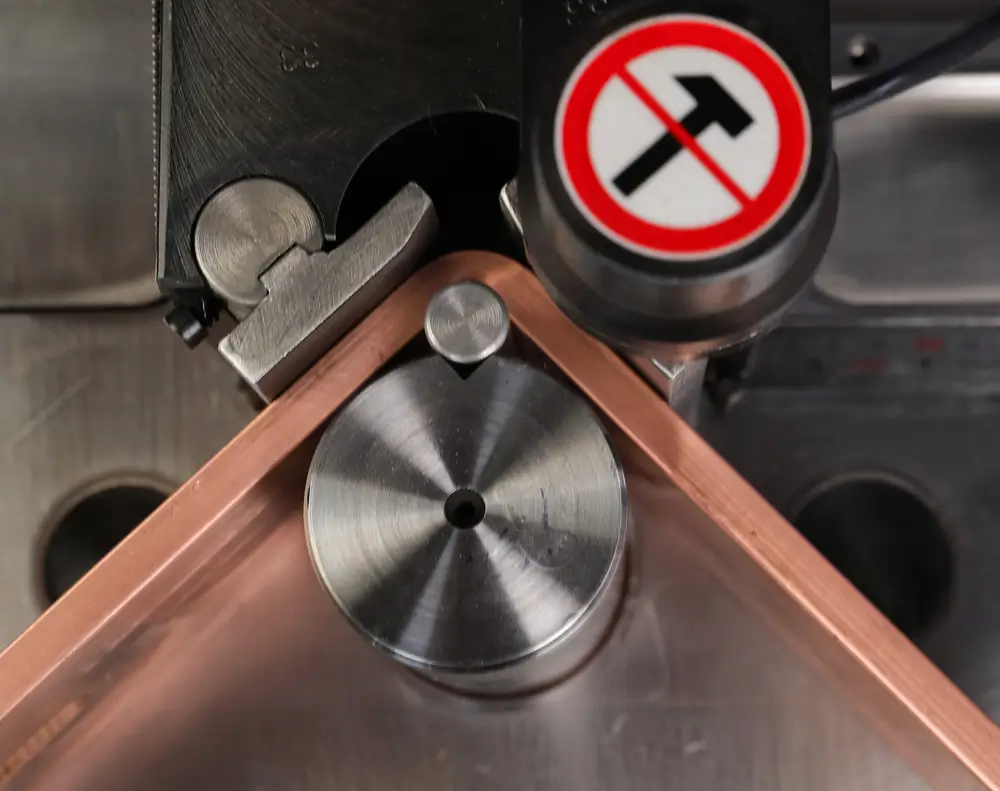
Cold forming never separates the material. A weld-free corner is produced by controlled plastic deformation around a matched die, with springback compensation, so it arrives closed, level and ready for pretreatment.
Three consequences follow for a buyer. Gasket seating is consistent because the geometry comes from the die. Coating film thickness is uniform because there is no dressed bead to bury. And there is no heat-affected zone sitting under the powder waiting to corrode.
The full process comparison between welded and cold-formed corners lives in its own article.
| At the corner | Welded and dressed | Cold formed |
| Material state | Melted and re-solidified, heat-affected zone | Never separated, plastic deformation only |
| Distortion on thin sheet | Present, corrected by hand | Controlled by springback compensation |
| Surface before coating | Ground and polished, level varies | Sealed and level, ready for pretreatment |
| Gasket seating | Depends on how the bead was dressed | Repeatable from the die geometry |
| Unit-to-unit consistency | Tracks the welder’s skill and the day | Identical within tooling tolerance |
What the Spreadsheet Misses
Four things the model above cannot capture.
Floor space. The weld, grind and polish stations come out. That is square footage returned to production rather than to finishing.
Work in progress. Parts currently sit between those three stations. Remove the stations and the queue goes with them.
Quoting confidence. A two-minute operation is a number you can quote against. A ten-minute one that varies with the operator is a hedge built into every price you send.
Lead time as a commercial weapon. The shop quoting three days shorter wins work it never had to discount for. Corner geometry also drives sealing at the corner, which matters where a rating is specified.
Run It On Your Own Numbers
Six inputs. Gather these and the question answers itself.
- Doors or enclosures per month.
- Corners per unit.
- Your fully burdened labor rate, not the wage.
- Your measured weld-and-dress time per corner — measure it, do not estimate it.
- Your monthly abrasive and consumable spend divided by corners produced.
- Your quoted machine price landed, including tooling, freight and commissioning.
Then two lines of arithmetic:
(welded cost per unit − formed cost per unit) × units per month = monthly saving
machine price ÷ monthly saving = payback in months
Conclusion about Corner Forming Machine Cost
The model above is not the answer. It is a template with our inputs in it.
Replace the labor rate, the volume and the measured corner time with yours, and the payback period either clears inside two years or it does not. If it does not, the return on investment is not there yet and the table said so plainly.

Rate this article
Choose a rating from 1 to 5 stars.
No ratings yet