





.svg)



Prefer listening? You can play the audio version of the rest of this article below.
What a Corner Forming Machine Does in One Cycle
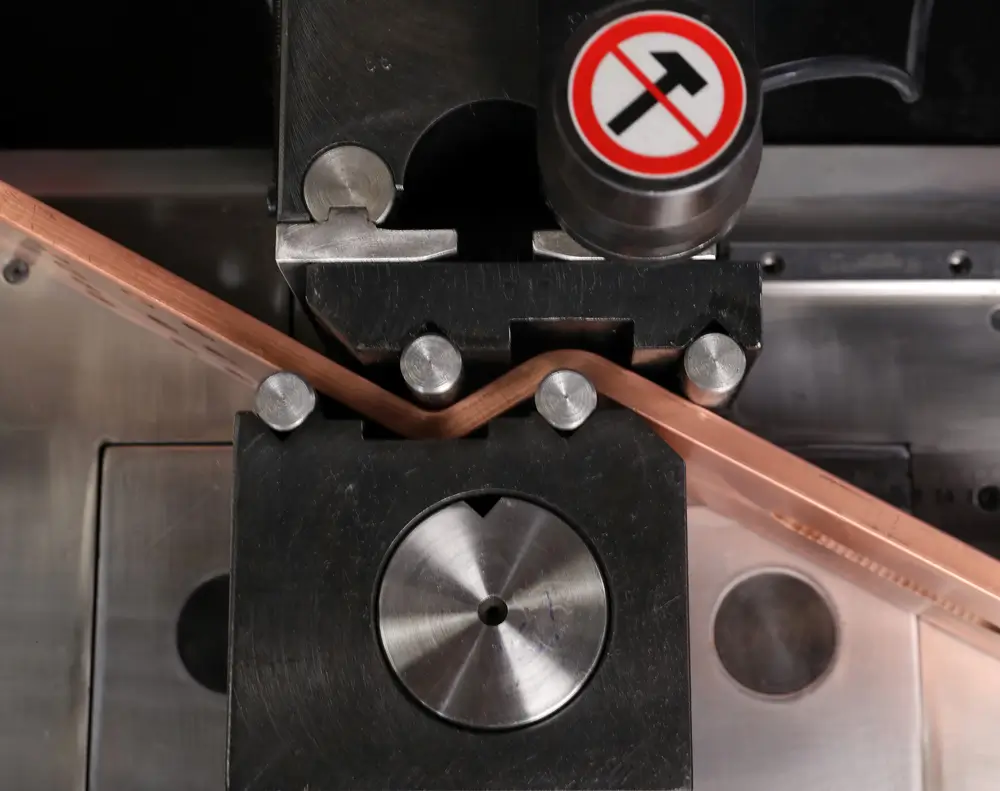
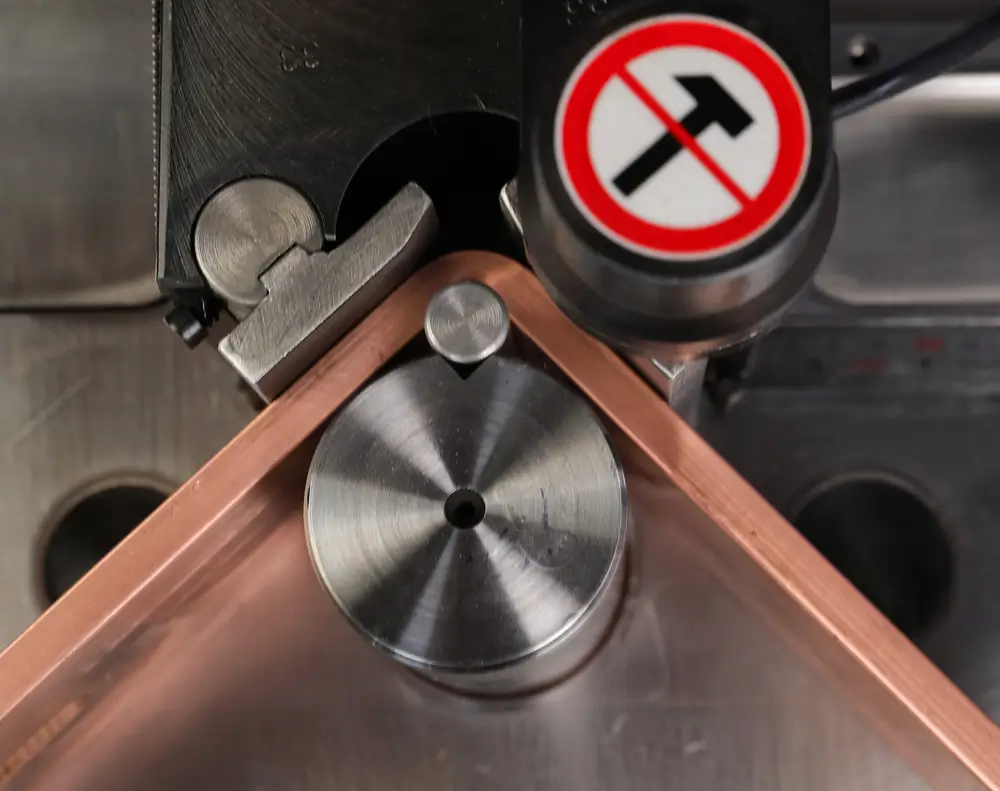
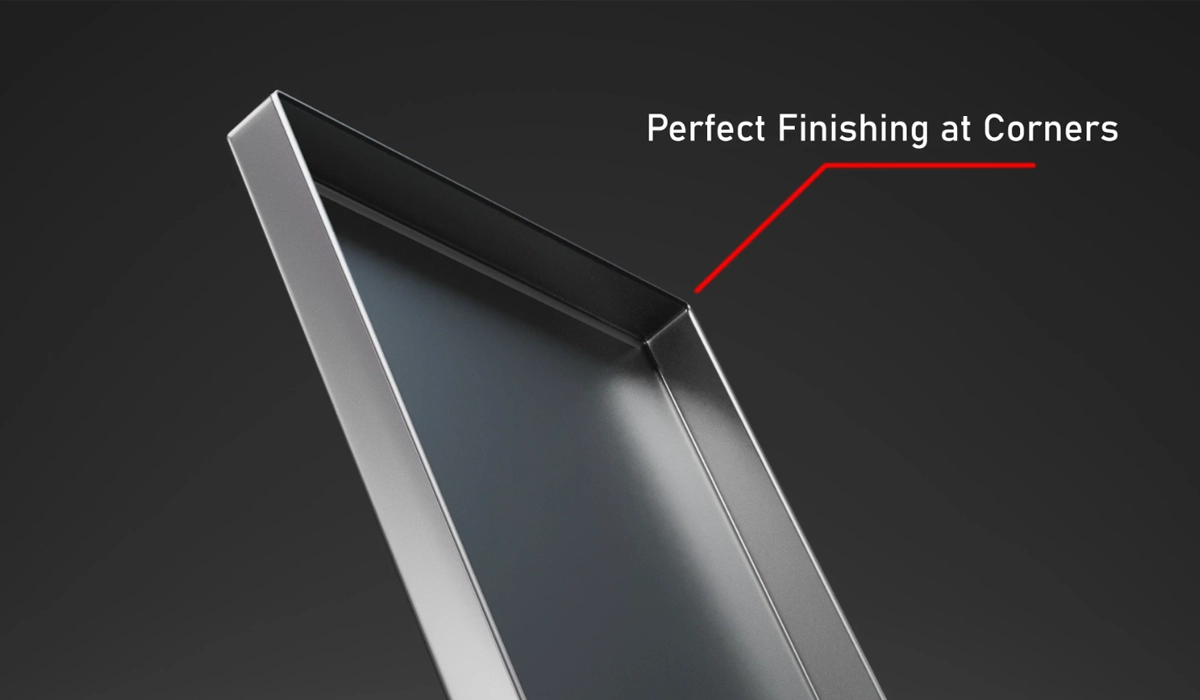
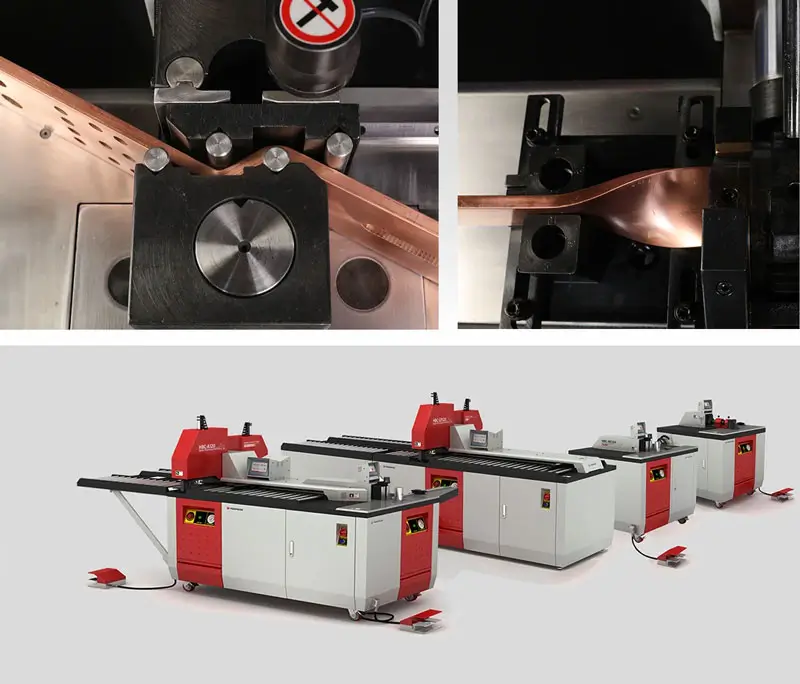
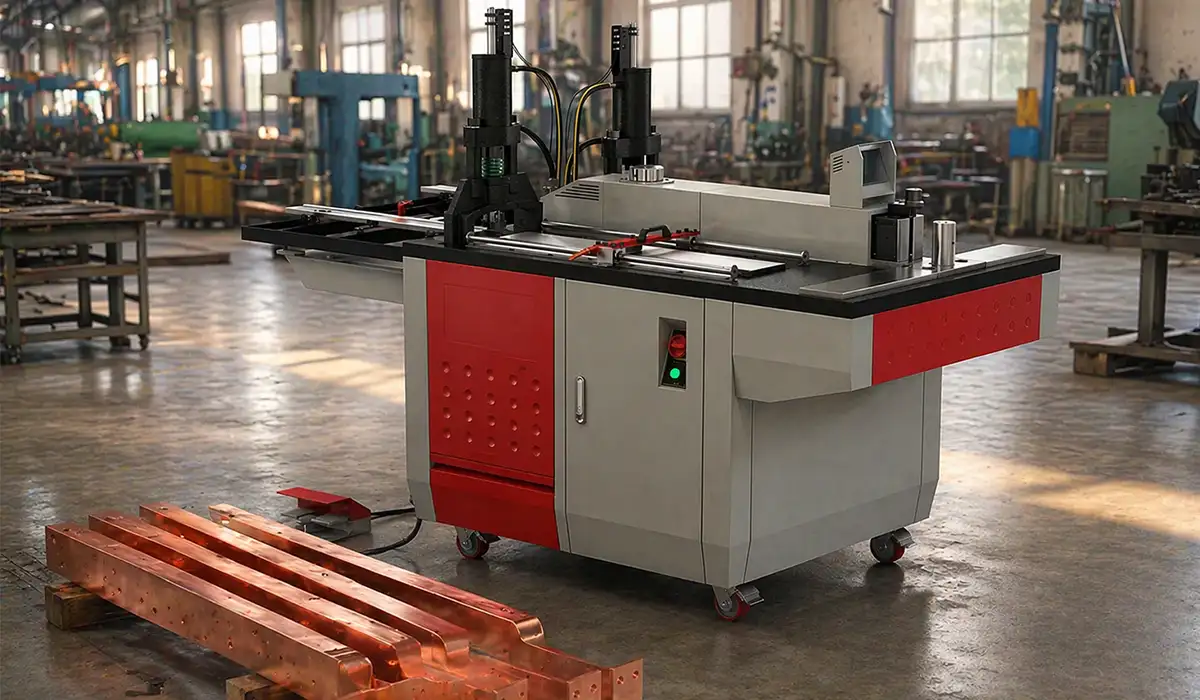
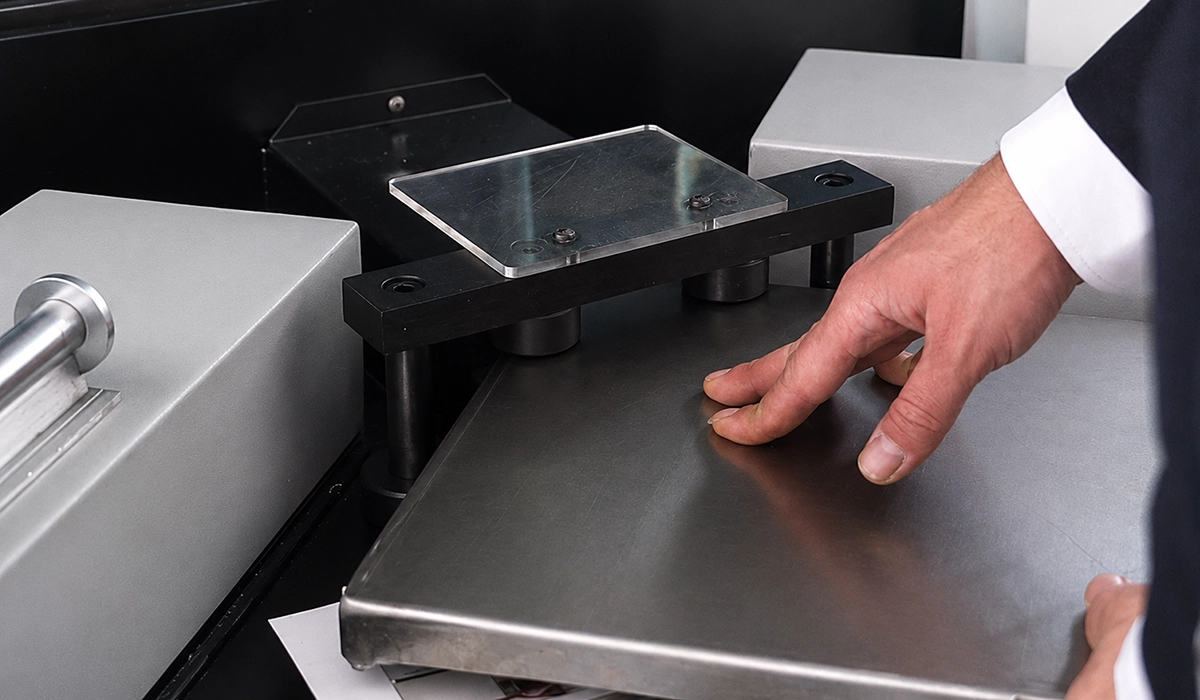
All corner forming machine applications rest on the same short sequence. The flat blank is pre-bent on a brake, the corner is pressed against a mold at room temperature, and the flange closes into a sealed corner. No heat, no filler, no seam. A sheet metal corner without welding therefore carries no heat-affected zone, so stainless keeps its color, thin gauge cannot burn through, and nothing needs grinding or polishing afterwards. Cold formed corners sheet metal shops once welded now leave the press already finished.
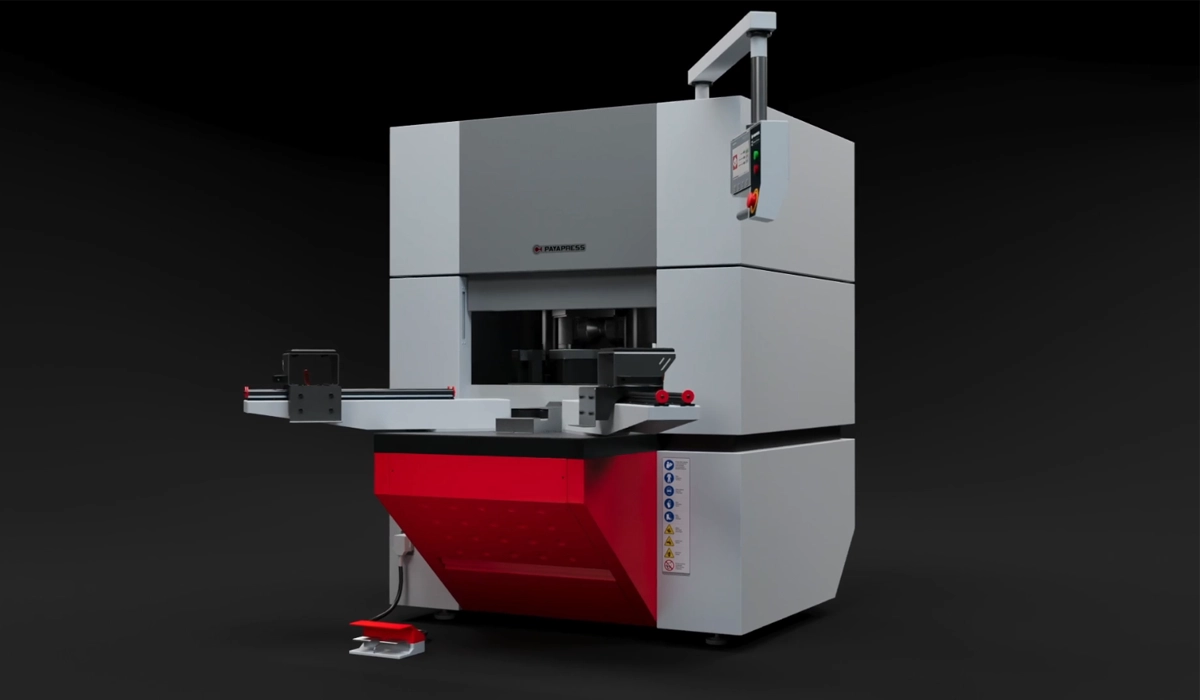
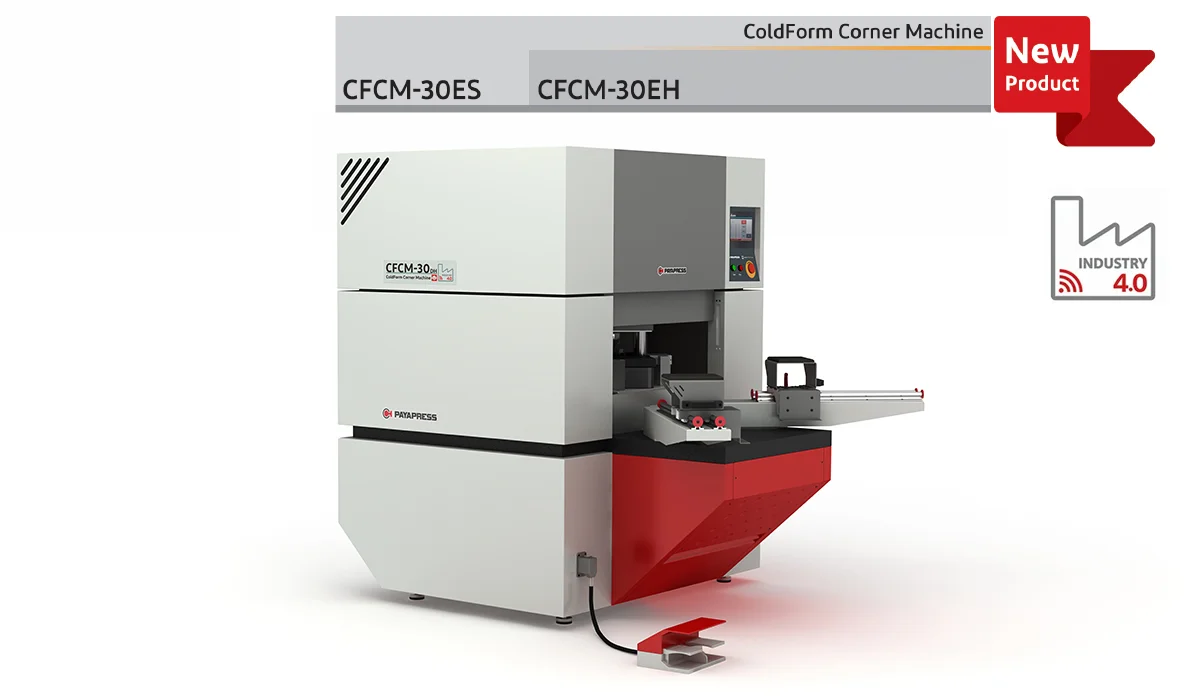
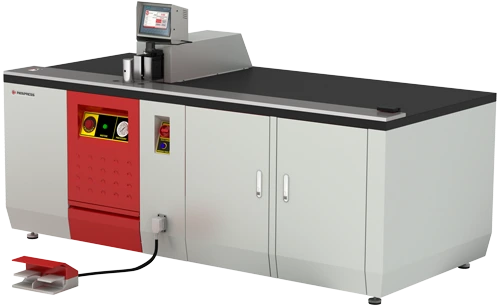
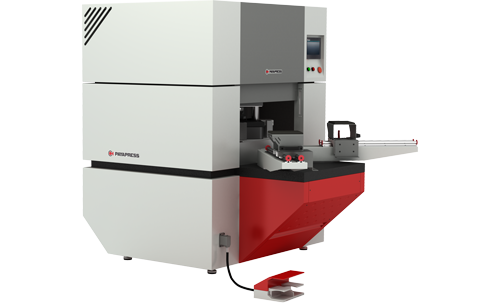
The CFCM-30 forms a 2–3 mm corner bend and ships in two models. The CFCM-30EH adjusts thickness manually and costs less; the CFCM-30ES adjusts automatically and changes over faster. Both run a Delta PLC, a 7-inch HMI, and the same 1,200 kg frame. The machine processes steel up to a maximum thickness of 2 mm — anything thicker is outside its capability.
Will Your Part Fit? The Spec Gate
Twenty seconds of checking saves a wasted call. The corner forming machine thickness window is 0.5–2 mm overall, and it narrows by material:
- Oiled ST12 cold-rolled steel: 0.8–2 mm
- Black ST37 hot-rolled steel: 1.5–2 mm
- Stainless steel: 0.8–2 mm
- Forming radius: 6–30 mm, set by interchangeable molds
Electrical Panel Door Manufacturers: The Largest Segment need to corner forming machine
A corner forming machine for electrical enclosures earns its floor space here first, because LV switchgear and distribution panel doors run at 1–2 mm steel — squarely inside the window. The old route takes five operations per corner: notch, bend the flanges, weld the corner closed, grind, then polish and re-coat the damaged area. That is twenty operations for a single door.
One press cycle per corner removes all of them. There is no seam, no heat distortion across a large flat panel, and no coating rework — zinc-coated sheet needs no re-galvanizing after forming. Weld free sheet metal corners also fix the failure that panel builders actually get called back on: door corners are where IP sealing goes. A formed corner gives a continuous, repeatable gasket seating surface, which is what an IP-rated door needs under IEC 60529. Enclosures for LV assemblies are qualified against IEC 62208 and IEC 61439-1/-2.
The most up-to-date information is always published on the official website, so it is worth checking there as well.
Electrical cabinet door manufacturing lives or dies on consistency. Welded corners vary by welder and by shift; formed corners are identical from part one to part ten thousand. That matters when doors ship in matched sets. For the bend geometry feeding the corner, see our enclosure corner design rules.
Corner former machine for control and Protection Panel Builders
Control panel door corner forming looks nothing like volume door work. Batches are smaller, the mix wider, and changeovers happen several times a shift. This is the strongest argument for the CFCM-30ES. Automatic thickness adjustment means nobody re-sets the machine when the job jumps from a 1 mm control panel door to a 2 mm protection panel door.
Protection and relay panels are often stainless, or painted to a visible finish standard. A formed corner arrives finished, so no polishing step and no grinder mark reach a customer-facing surface. The labor angle lands harder. The machine needs no certified welder, which removes a hiring bottleneck most small shops recognize immediately.
You can also save a copy for later, which is helpful if you plan to return to this more than once.
Corner former for Retail Display Stand Manufacturers
Retail display stand sheet metal fabrication runs on thin coated gauge that welding punishes. The parts are shelf edges, header panels, plinths and checkout units, usually 0.5–1 mm painted or powder-coated sheet. Weld that and you get burn-through, distortion, and a heat mark telegraphing through paint at eye level.
Cold forming touches thin gauge without heat, so the panel stays flat and the coating stays intact. Pre-painted and coated stock can be formed directly. The commercial angle is worth naming. Display programs are rollouts, and two hundred units for two hundred stores only look right if corner geometry is identical. That is a repeatability problem, not a welding one.
If you would like to keep everything in one place, you can download the complete version and read it whenever it suits you.
Cold former machine for Shelving Manufacturers
Shelving is a volume product on a thin margin, so every second of grinding multiplies by thousands of corners a week. The parts are shelf pans, side panels, end caps and trays flanged on all four sides.
Shelving sheet metal corner forming turns that into one cycle per corner with no consumables: no weld wire, no shielding gas, no grinding discs. Variable cost falls to electricity and mold wear. The handling angle matters just as much. A formed corner carries no weld spatter and no grinding burr, which counts on a product warehouse staff grab a hundred times a day.
Corner Forming Machine Rack Manufacturers for Data Centers
Data center rack sheet metal corners are a tolerance problem before they are a finish problem. Side panels, doors, roof and base plates all sit against the 482.6 mm (19-inch) dimensional standard set by EIA-310 and IEC 60297-3-100.
A welded corner pulls the panel. On a 42U side panel, a few tenths of distortion becomes a door that will not align and an airflow gap nobody designed. Cold forming applies no heat, so the panel keeps the flatness it had coming off the brake, and corner geometry comes from the mold rather than from the operator. Airflow is the second-order effect. Hot-aisle containment only works if the enclosure seals, and consistent corners give consistent gasket compression around the full perimeter.
All the points described above are collected in this document, so you do not have to search through the page again.
Now Cabinet Manufacturers can use corner machine
Sheet metal cabinet corner forming is a job-shop problem: small runs, many sizes, constant setup changes, and a finish standard set by whoever placed the order. Parts range from general-purpose steel and stainless cabinets to tool cabinets, storage units and workshop furniture.
Interchangeable molds cover 6–30 mm radii, so one machine serves several cabinet families and corner styles without new tooling for every product line. That is the real decision point here. Where thickness stays in a stable range, the CFCM-30EH is the better buy, because manual adjustment keeps capital cost down and gives up nothing in forming quality.
Elevator Cabin Manufacturers
Elevator cabin panel corners are the hardest finish problem here. Cabin wall panels, ceiling panels, door panels and kick plates are usually stainless with a brushed or mirror finish.
Welding stainless discolors the heat-affected zone, and polishing a mirror panel back to standard is slow, skilled work that often fails outright. A rejected cabin panel becomes scrap, not rework, and the material is expensive. Cold forming leaves no heat tint and no color change, so the panel coming off the machine is the panel that goes into the cabin. Compliance follows the same logic. Lift car construction falls under EN 81-20, now carried forward as EN ISO 8100-1. A formed corner presents no weld bead and no sharp edge to dress.
Explosion-Proof Panel Manufacturers (Petrochemical, Oil and Gas)
An explosion proof enclosure corner is a sealing feature first. The parts are increased-safety (Ex e) enclosures and covers under the IEC 60079 series.
Everything mentioned here, including the additional notes, is included in this file.
In a classified area the corner is the weak point, because a gasket only works if it compresses evenly along its whole path. A formed corner gives a continuous seating surface, with no weld crown proud of the flange and no grinding hollow leaving a gap. The boundary deserves an honest note. Flameproof Ex d housings, and the NEMA Type 7 enclosures serving the same duty in North America, are heavy-wall castings or thick fabrications. Both sit well outside 0.5–2 mm. This machine serves the sheet-metal side, and our explosion-proof corner sealing article carries the depth.
HVAC Duct Manufacturers
HVAC duct corner forming attacks leakage at its source. Duct performance is judged as air-tightness. The classes in EN 1507 for rectangular ducts, EN 12237 for circular, and SMACNA in North American practice are all lost at joints and corners. They are never lost mid-run.
The parts are rectangular duct sections, plenum panels, air-handling unit casings, drip trays and access doors. A formed corner is closed metal rather than a sealed joint, so each corner removes one leak path and one dependence on hand-applied sealant. Drip trays deserve their own line. A tray holding condensate cannot carry a porous weld anywhere, and a cold-formed corner has no weld at all.
cold former machine for Medical Equipment and Instrumentation Manufacturers
Stainless steel medical enclosure corners are a cleanability requirement in fabrication disguise. Instrument housings, trolley and cart panels, sterilization furniture and equipment enclosures are almost always stainless.
A welded corner that has been ground leaves micro-porosity and crevices, and those are exactly the geometries infection-control procedures are written against. A smooth, radiused formed corner traps nothing and wipes down in one pass, with no bead to catch a cloth and no pitting to hold residue. The quality-system angle carries equal weight. Suppliers here work under ISO 13485, where repeatability must be demonstrable; a mold-defined corner is a documented process, while a hand-welded one is operator-dependent. Electrical medical enclosures also sit under IEC 60601-1, which sets edge requirements for accessible surfaces.
Quick Reference: Industry, Part, Reason
Nine corner forming machine uses, one table, in the order used above.
| Industry | Typical part | Main gain |
|---|---|---|
| Panel doors | LV switchgear doors | Repeatable gasket seating |
| Retail displays | Header panels | Coating survives forming |
| Shelving | Shelf pans, end caps | No consumables or burrs |
| Data center racks | 42U side panels | Flatness held |
| Cabinets | Tool and storage units | Many radii, one machine |
| Elevator cabins | Wall, ceiling panels | No heat tint |
| Explosion-proof | Ex e covers | Continuous gasket path |
| HVAC ducts | Sections, drip trays | One less leak path |
| Medical equipment | Instrument housings | No crevice, wipes clean |
Readers who want to understand the reasoning behind this will find this detailed article very useful.
Conclusion: Two Numbers Decide It
Across all sectors, corner forming machine applications come down to two checks. Is the sheet between 0.5 and 2 mm? Is the corner radius between 6 and 30 mm? Two yeses and cold forming replaces four operations with one press cycle. Anything outside those limits belongs to another process, and knowing that early saves a procurement cycle.



Rate this article
Choose a rating from 1 to 5 stars.
No ratings yet