This articlecr explains the most important points of IEC 62271-200 for medium voltage (MV) metal‑enclosed switchgear (1–52 kV, up to 60 Hz). It helps you write specifications, compare products, and pass FAT/SAT.
What’s IEC 62271-200 Covers
- Field Of Application: AC Metal clad switchgear and control gear, indoor or outdoor. replaces current IEC 60298 and aligns with IEC 62271‑1.
- Typical Format: Ratings; Design & Construction; Type Tests; Routine tests.
- Key concept: Put people’s safety and service continuity first, rather than cabinet makeup.
Metal‑enclosed vs Metal‑clad
• Metal‑enclosed is the general family: live parts are behind an earthed metal enclosure.
• Old style terms like “metal‑clad/compartmented” are now less important. IEC uses LSC (Loss of Service Continuity) and Partition Class (PM/PI) to describe safety and access.
Internal Arc Classification (IAC) Explained
• Goal: protect PEOPLE during an internal arc fault (very hot gas, high pressure, particles).
• Test: create a 3‑phase arc with an ignition wire. Vents and ducts must control pressure and gas.
• Pass criteria (all five must be OK): 1) doors/covers stay closed; 2) no dangerous fragments; 3) no holes on accessible sides up to 2 m; 4) indicators do not ignite (note: 1‑second rule in 2021 edition); 5) earthing stays effective.
• Marking example: IAC A FLR 31.5 kA 1 s (accessibility type A; protected at Front, Lateral, Rear; arc current and duration).
IAC AFLR Notation and Sides
• IAC = Internal Arc Classification.
• A or B = accessibility (A for authorized locations; B for public).
• Sides: F = front, L = lateral, R = rear. Show all sides that passed the test.
• Current I and time t must appear on the nameplate.

Accessibility Types A vs B
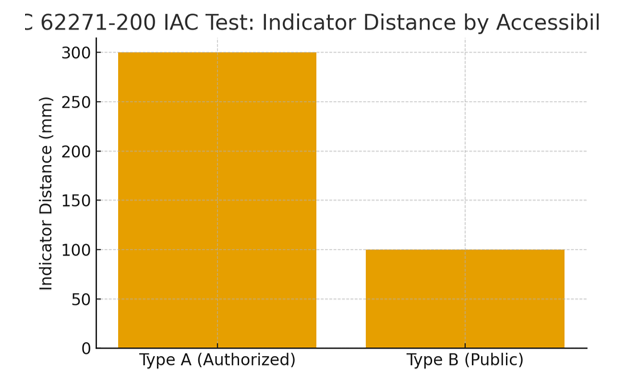
• Type A (authorized personnel): test indicators at 300 mm distance.
• Type B (public access): indicators at 100 mm.
• Type C (out of reach) is handled in other IEC parts and not used for typical metal‑enclosed MV switchgear.
LSC Categories and Service Continuity
• LSC shows how much of the system can stay in service when you open a compartment for work.
• LSC1: lowest continuity; opening one accessible part requires isolating the whole panel/section.
• LSC2A: you can open a compartment while busbar and adjacent panels stay energized; incoming cable is isolated.
• LSC2B: highest continuity; when you open a compartment, the incoming cable, busbar, and adjacent panels can stay energized. Needs partitions and proper isolating distances.
Partition Class PM vs PI
• PM (Partitions of Metal): metal shutters/partitions between live parts and the open compartment. Best for personnel safety and earthing continuity; also reduces electric‑field exposure.
• PI (Partitions of Insulating material): discontinuity of metal is covered by insulating material. Acceptable in some cases, but safety philosophy is different from PM.
• LSC choice and PM/PI are linked: many utilities and data centers prefer LSC2B, PM.
Ratings You Must Specify
• Rated voltage Ur and insulation levels: select Up (lightning impulse) and Ud (power‑frequency withstand) using IEC 62271‑1 tables, per your system overvoltage level.
• Short‑time withstand current (Ik, e.g., 25 kA 3 s): thermal and dynamic endurance of main/earth circuits.
• IAC current and duration: e.g., 31.5 kA 1 s, sides AFLR, type A or B.
• Nameplate fields: IAC code, Ur, Ik (time), frequency, IP/IK, mass, serial, manual references.
Type Tests vs Routine Verification
• Type Tests (on a prototype): internal arc test, dielectric withstand, switching capabilities (breaker and earthing switch tested inside the panel), temperature rise (where applicable), mechanical operations, interlocks, degrees of protection.
• Routine Tests (on every delivered unit): high‑potential/insulation checks per rating, control circuits, interlocks, mechanical function, wiring/marking, routine verification records. Keep reports for handover.
Marking, Labeling, and Documents (EU/UK focus)
• Show IAC label with accessibility, sides, current, time.
• Provide operation/maintenance manual, routine test records, wiring diagrams, nameplate data, IP/IK references.
• Many owners request a compliance checklist attached to the FAT dossier.
Arc Detection and Mitigation Options
• Faster clearing reduces damage but does not replace IAC testing.
• Options: optical arc relays, high‑speed shorting devices, pressure relief ducts/exhaust routing, fast earthing switches, zone‑selective interlocking.
• Plan duct orientation to move hot gas away from the operator corridor.
IEC vs IEEE C37.20.7 (Quick Note)
• Both address arc‑resistant behavior, but test setups, accessibility zones, and labeling conventions differ. Do NOT assume ratings are “1:1 equivalent.” For global projects, specify per market and show both wordings if needed.
Specification Template (copy/paste)
• Standard: IEC 62271‑200, metal‑enclosed, LSC2B, Partition Class PM.
• Ratings: Ur … kV; Up … kV; Ud … kV; Short‑time withstand Ik … kA … s; Frequency … Hz.
• IAC: Accessibility Type A, sides AFLR, I = … kA, t = … s; pressure relief duct to safe zone.
• Degree of protection: IP … / IK ….
• Devices: VCB per IEC 62271‑100; earthing switch per IEC 62271‑102; interlocks as per standard.
• Tests: complete type‑test evidence; routine verification records for each unit; nameplate and documents per IEC.
Summary
Choose LSC and partition class first (many projects: LSC2B, PM). Then set insulation levels, short‑time withstand, and IAC (kA, time, sides, accessibility). Request full type‑test evidence and keep routine verification records. With a clear specification, you will buy safer, more reliable MV switchgear and speed up approvals.
FAQ
What does IAC AFLR mean?
Protected on Front, Lateral, Rear sides for a declared kA and time.
Is LSC2B always PM?
Often paired, but not a strict rule. Check design.
Does PM guarantee arc resistance?
No. IAC is proven by test; PM supports safety philosophy.
What does “31.5 kA 1 s” mean?
Internal arc current and duration during the type test.
Are IP/IK related to IAC?
Different topics: ingress/impact vs internal arc; specify all.