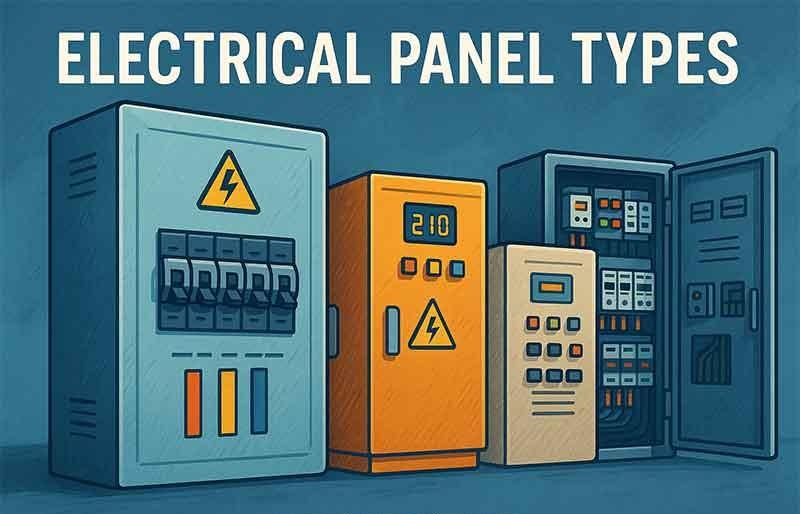
This short guide explains common electrical panels in United States. Its includes clear and simple words and short sentences to help engineers who do not use English every day.
Electrical Panel Terms—Quick Guide
– Electrical panel / Load center: The box that can distributes power and holds circuit breakers.
– Panel board: The internal assembly (busbars, breakers, terminals) inside the enclosure.
– Main breaker: A big switch that can turn off power to most circuits in the panel.
– Main lugs: Terminals where incoming wires land (no main breaker inside the panel).
– Sub panel: A smaller panel fed from the main panel to add more circuits.
– NEMA: Enclosure rating for environment (indoor, outdoor, wash down, etc.).
– NEC (NFPA 70): U.S. electrical code for safe design and installations.
Main Panel Types and What They Do?
– Main breaker panel: Common in homes. Has an internal main breaker for easy shutdown.
– Main lug panel: No main breaker inside. Needs an upstream disconnect. Good for downstream distribution.
– Sub panel: Adds more circuits for a garage, workshop, or new rooms. Keep neutral and ground separated per code.
– Meter‑main combo: Outdoor meter + main disconnect in one NEMA 3R cabinet.
– Transfer switch + subpanel: Safe way to connect a generator. It prevents back‑feeding to the utility.
Choose the Best Panel for Your House
- Plan spaces: Choose enough breaker spaces for today and future (EV charger, heat pump, ADU).
- Location: NEMA 1 for dry indoor; NEMA 3R for outdoor. Follow utility and inspector rules.
- Labeling: Write clear names for each circuit. This helps maintenance and safety.
For Commercial and Industrial Sites
– Panelboards (3‑phase options): For offices, retail, and light industry.
– Switchboards: Floor‑mounted, high ampacity, multiple sections, metering—good for main distribution.
Illustrative chart: common use of panel types by context (Home / Commercial / Industrial).
– Switchgear: High protection and operation features (draw‑out breakers, compartments).
– MCC (Motor Control Center): Modular units with starters, VFDs, and protection for many motors.
Sizing & Power System Basics
– What size panel? Do a load calculation (per NEC). You can Choose 100A, 150A, 200A, etc. based on the result and future growth.
– Single vs three phase: Homes are usually single phase 120/240 V. Many commercial systems use three phase (e.g., 208Y/120 V or 480Y/277 V) for motors and efficiency.
– Circuit spaces: A 200‑A panel doesn’t mean unlimited circuits. Follow the listed number of breaker spaces and the makers rules for tandem breakers.
U.S. Electrical Compliance at a Glance
- Codes and listing: Follow NEC (NFPA 70). Look for UL listings (e.g., UL 67 for panelboards) and correct NEMA enclosure ratings.
- Protections: Use AFCI where arc fault protection is required and GFCI where shock risk exists (bathrooms, outdoors, etc.).
- SCCR: Make sure the panel’s short‑circuit current rating matches the available fault current at the site.
Installation Basics (Always Verify Locally)
- Neutral vs ground: In the main service equipment, neutral is bonded; in subpanels, keep neutral isolated and bond only the ground bar to the enclosure.
- Torque and terminations: Tighten to the manufacturer’s values. Do not double‑lug neutrals. Use proper connectors/bushings at knockouts.
- Wire protection and routing: Protect conductors from sharp edges. Keep the inside neat for inspection and future work.
For deeper guidance, see the official NEC (NFPA 70) and the enclosure selection resource from NEMA. These references help you choose the right ratings, listings, and safe installation methods.
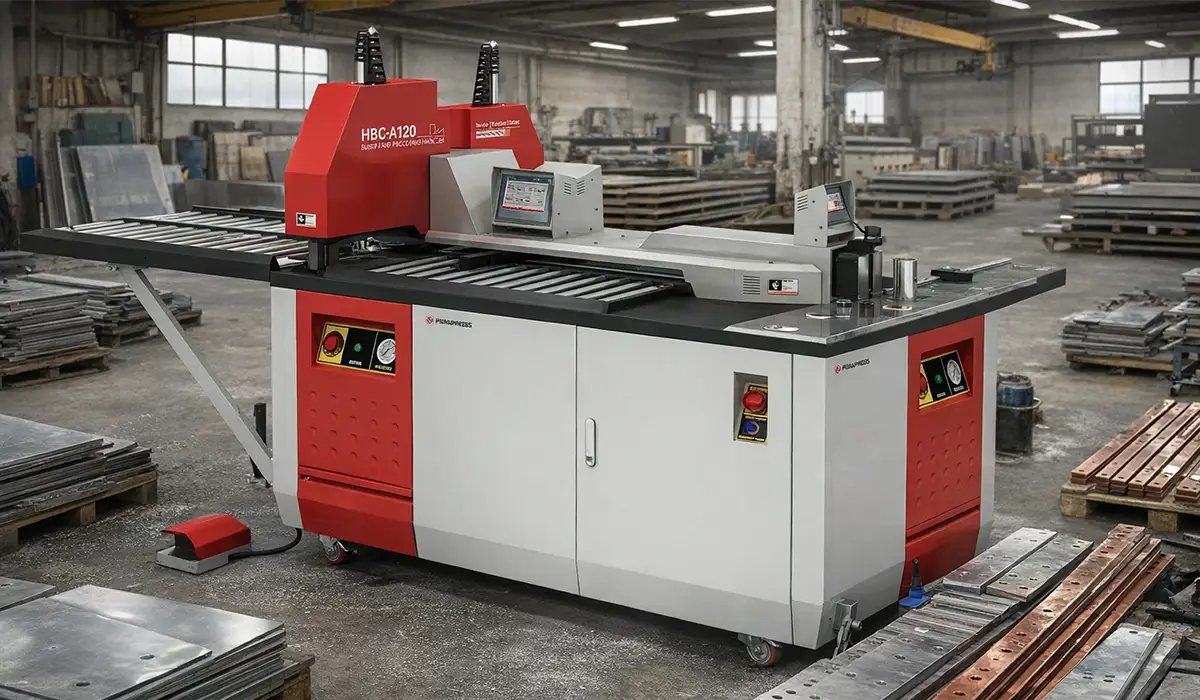
Working with busbars? Explore our compact, high-precision busbar bending machine line for clean, code-friendly fabrication.