





If you’d rather listen than read, feel free to play the audio file below for the rest of this article.
Why 1,000 m Is the Line
What is the normal altitude limit for switchgear? IEC 62271-1 defines normal service conditions for indoor and outdoor switchgear. They include an altitude not exceeding 1,000 m, a maximum ambient temperature of 40 °C and a 24-hour average of no more than 35 °C.
Every rating on the nameplate assumes those conditions. Above 1,000 m, therefore, the insulation ratings no longer hold automatically, and the IEC 62271-1 altitude rules call for an altitude correction factor.
Be careful with other standards. Some low-voltage standards, for example, use 2,000 m as their normal limit, while some US standards have used other thresholds. Never mix them in one specification.
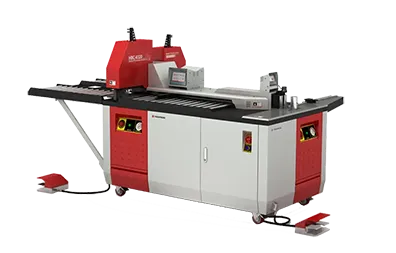
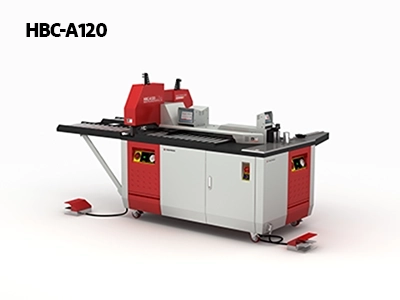
The PAYAPRESS HPM-63S sheet metal punching machine provides precise punching, notching, and cutting capabilities for industrial sheet metal fabrication. Its interchangeable dies make it suitable for manufacturing electrical enclosures, control panels, and other sheet metal components.
Service conditions like altitude are only one part of a much larger rulebook. To see how all the requirements fit together, read our guide to switchgear standards.
What Thin Air Does to Insulation
Why does altitude affect switchgear insulation? The answer starts with the air itself. Air pressure and air density fall as you climb. Near sea level, pressure drops by roughly 11% over the first 1,000 m, and at 3,000 m it is about 30% lower than at sea level (computed from a standard atmosphere model).
The dielectric strength of air falls with its density. As a result, a given clearance in air flashes over at a lower voltage up the mountain than it does at sea level. Paschen’s law describes this link between gas pressure, gap length and breakdown voltage.
What is an air density correction factor? It adjusts test voltages to the actual air density in the test lab. The altitude correction factor is the simplified design version, because it assumes a standard atmosphere and depends only on height.
Standard atmosphere models give the pressure at any height with two short equations. NASA publishes the metric version of these troposphere equations in its atmosphere model.
Air density is not the only factor that sets the clearances you need. Dirt, moisture and surge levels matter too, as explained in our guide to pollution degree and overvoltage category.
The Altitude Correction Factor (Ka)
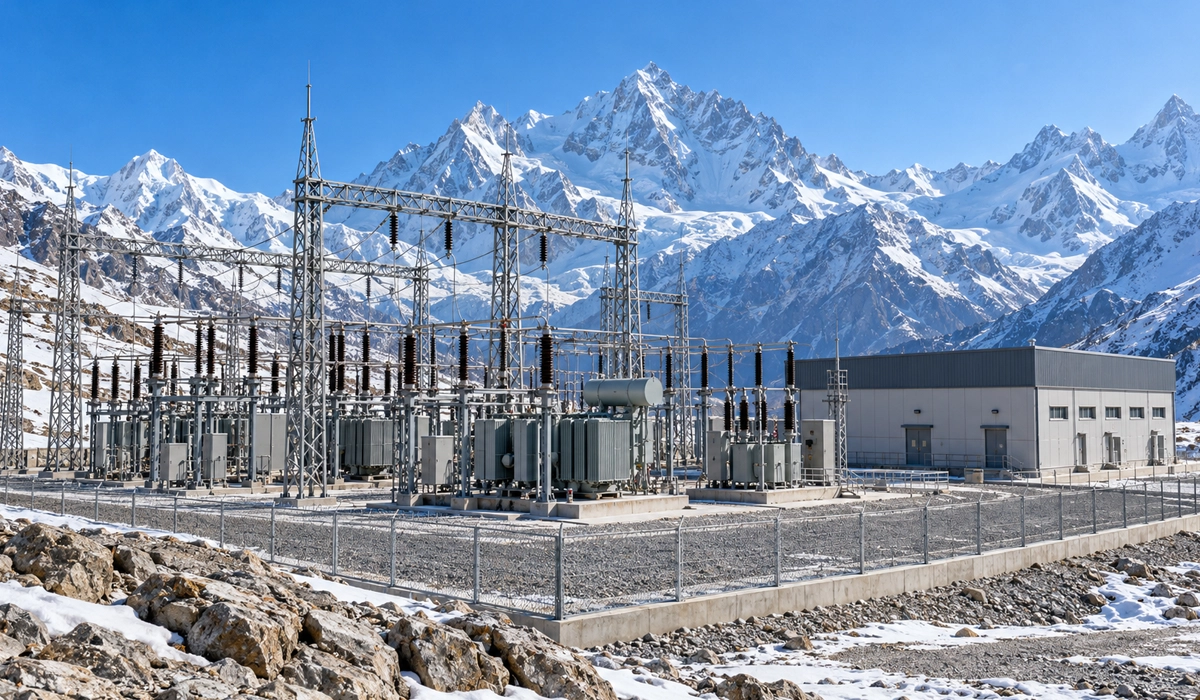
The factor, written Ka, multiplies the withstand voltage your system needs at site. The result is the withstand level the equipment must prove at standard, sea-level conditions.
This step is part of insulation coordination, which matches insulation strength to the stresses a system will see.
The same formula appears in training slides for breaker engineers. An IEEE Power & Energy Society tutorial sets out the factor, its m values and a correction curve in its insulation coordination tutorial.

The Formula and the m Exponent
Here is how to calculate altitude correction factor values for any site: Ka = e^(m × (H − 1000) / 8150), where H is the site altitude in metres and m is an exponent that depends on the voltage stress.
| Voltage stress | Exponent m |
|---|---|
| Power-frequency withstand voltage | 1.0 |
| Lightning impulse | 1.0 |
| Phase-to-phase switching impulse | 1.0 |
| Longitudinal switching impulse (across the open gap) | 0.9 |
| Phase-to-earth switching impulse | 0.75 |
For m = 1, the factor grows like this (computed):
| Altitude | Ka |
|---|---|
| 1,500 m | 1.06 |
| 2,000 m | 1.13 |
| 2,500 m | 1.20 |
| 3,000 m | 1.28 |
| 4,000 m | 1.44 |
The constant 8,150 m reflects how quickly air density falls with height, so Ka equals exactly 1.0 at 1,000 m. In other words, each further 1,000 m adds roughly 13% to the withstand you need when m = 1.
Switching impulse ratings apply mainly at 300 kV and above. In practice, MV designers therefore work with m = 1.
Worked Example: 12 kV Switchgear at 3,000 m
Worked example (hypothetical example): a 12 kV system installed at 3,000 m.
- Need at sea level: a 12 kV system normally needs a 75 kV lightning impulse withstand voltage (its BIL).
- Factor: Ka = e^((3,000 − 1,000) / 8,150) = e^0.245 ≈ 1.28.
- Corrected need: 75 × 1.28 ≈ 96 kV.
- Power frequency: 28 × 1.28 ≈ 36 kV.
That 75 kV value is the system’s basic insulation level: the number the factor scales.
Now compare with the standard rating classes. The 17.5 kV class gives 95 kV lightning impulse and 38 kV power frequency, so 96 kV is just above it. Therefore, the usual answer is 24 kV class switchgear (125 kV and 50 kV), or a 17.5 kV design the maker confirms for that altitude. The 17.5 kV vs 24 kV choice is where the altitude derating factor shows up in cost.
Finally, the altitude correction factor applies to insulation, not to the system voltage. The system still runs at 12 kV.
Low-voltage assemblies follow a different altitude rule and different standards. See how the two worlds compare in our guide to low-voltage assemblies.
Which Parts Are Affected and Which Are Not
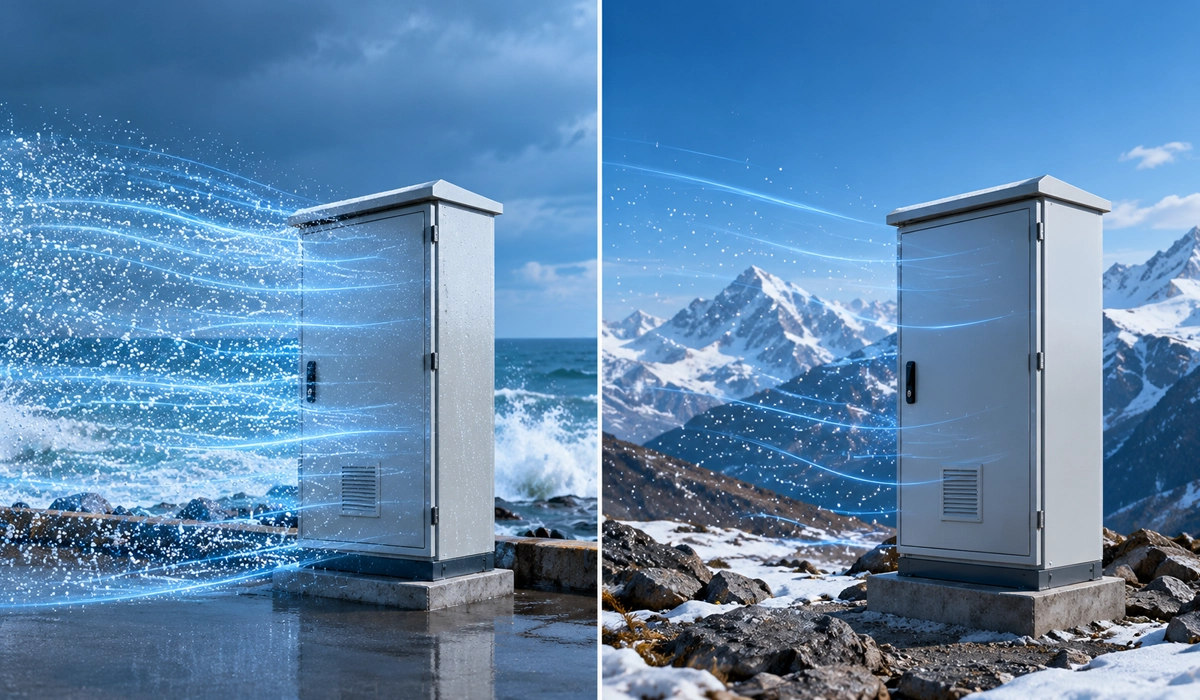
Altitude only weakens insulation in outside air. So internal vs external insulation is the key split, and altitude derating switchgear checks focus on the external side:
| Part | Affected? | Why |
|---|---|---|
| Air clearances between busbars and to earth | Yes | Insulated by room air |
| Bushings, cable terminations, post insulators | Yes | External surfaces in air |
| Vacuum interrupter, internal gap | No | Sealed in vacuum |
| Vacuum interrupter, outer insulation | Yes | Surrounded by air |
| Gas-insulated tank, inside | No | Sealed gas at fixed pressure |
| Gas-insulated tank, external connections | Yes | In air |
| Instrument transformers | Per maker | Depends on design |
Does altitude affect vacuum circuit breakers? Not inside, since the contact gap is sealed; air vs vacuum is the difference. However, the interrupter’s outer insulation sees the same thin air, so switchgear altitude derating still applies there.
Makers confirm this for gas tanks. One maker’s FAQ explains that Ka applies only to external insulation, while internal SF6 insulation keeps its dielectric strength at any altitude, in its altitude insulation FAQ.
Air clearances depend on the panel layout as much as on the altitude. Browse our simple overview of electrical panel types to see how designs differ.
Does Current Need Derating Too?
Do I need to derate current at high altitude? Sometimes, and the reason is cooling. Thinner air carries heat away less well, so the temperature rise at the same current is higher.
However, ambient temperature usually falls with altitude, which offsets part of that effect. Many makers therefore keep the rated current up to a certain altitude and give altitude derating figures above it.
Always treat this as a separate check from insulation correction. Insulation vs current problems have different causes, different tests and different fixes. For how current ratings move with temperature, see our temperature derating guide.
US metal-clad practice shows how small the current effect usually is next to the voltage effect. One maker’s FAQ lists a continuous-current factor of 0.96 at 3,000 m, against 0.80 for dielectric withstand, in its metal-clad correction table.
Temperature rise limits are proved by testing, not just by calculation. Learn how manufacturers prove this in our guide to design verification.
Conclusion: Altitude Above 1000 m
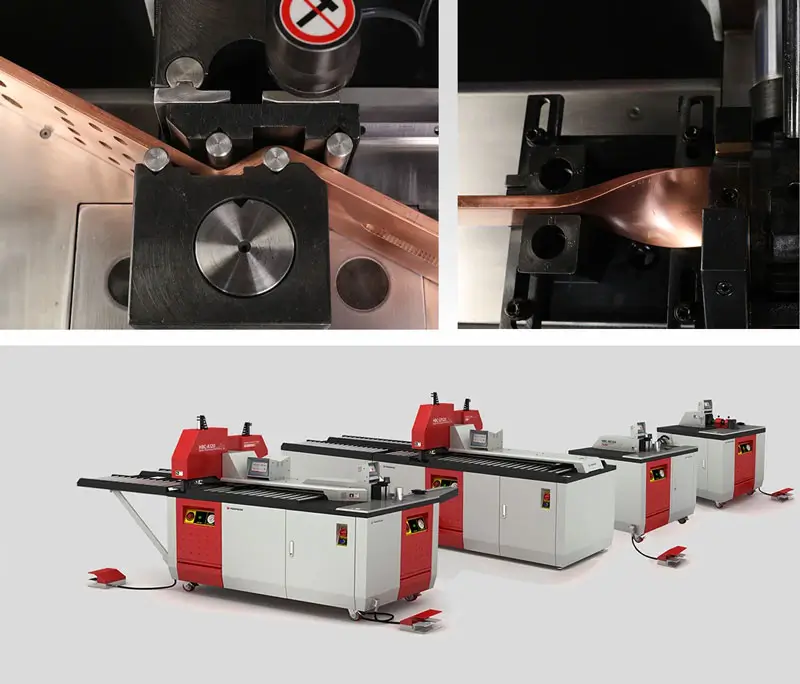
Above 1,000 m, multiply the withstand voltage you need by the altitude correction factor, then choose the insulation class that covers it. Next, check which parts sit in air, and confirm current with the maker. Larger air clearances also mean different busbar bends and hole positions, which PAYAPRESS machines produce exactly to the drawing.


Rate this article
Choose a rating from 1 to 5 stars.
No ratings yet
0 Comments
No comments yet. Be the first to comment.