ATEX vs IECEx — what is different?
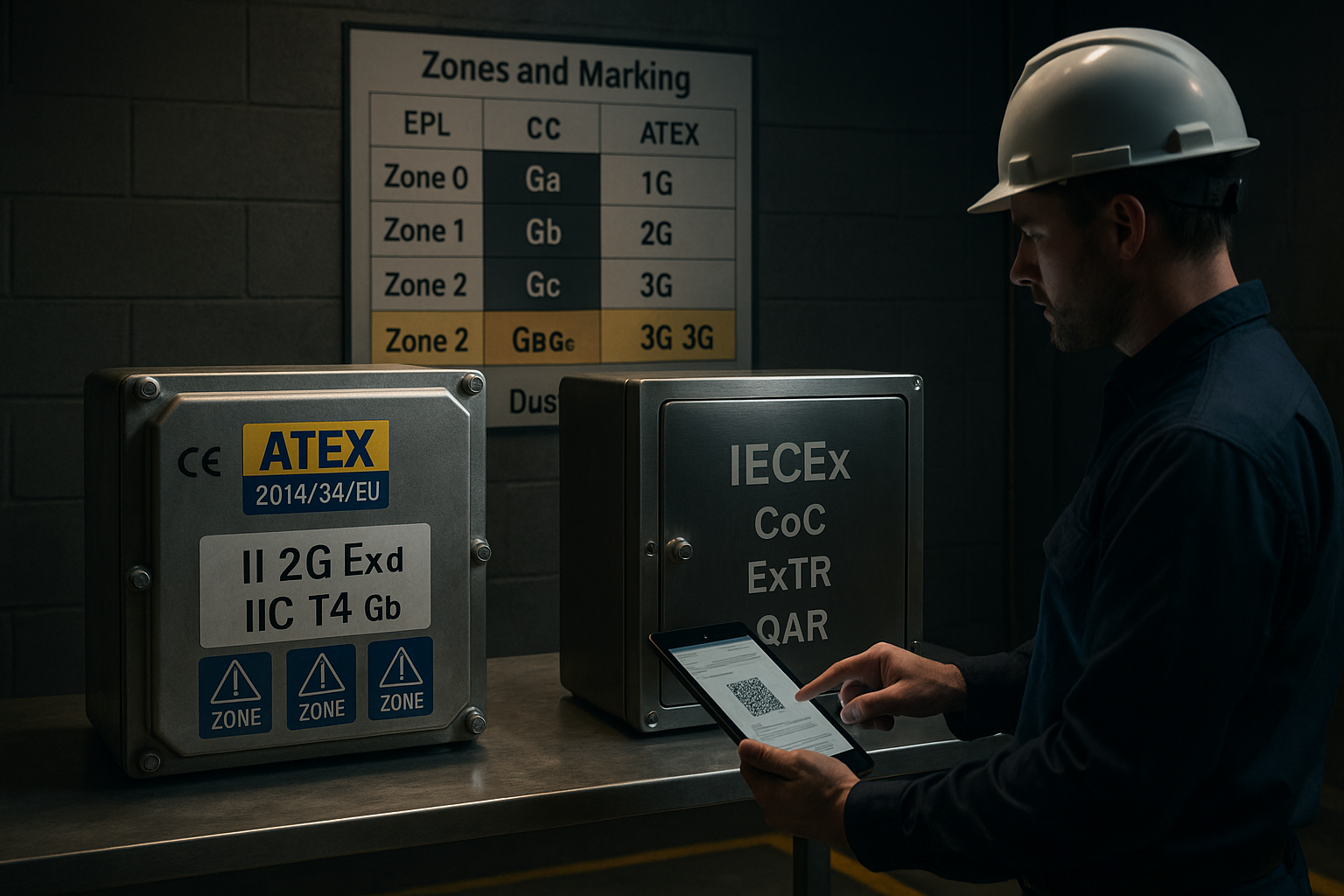
– ATEX is EU law (Directives 2014/34/EU for equipment and 1999/92/EC for safety of the personnel). It is mandatory in EEA.
– IECEx is an international certification scheme of IEC 60079 standards. It is voluntary internationally, but accepted by most nations and utilized to supplement local approvals in many cases.Certificates & quality:
- ATEX: EU Type Examination + manufacturer’s Declaration of Conformity; factory quality under QAN.
- IECEx: Certificate of Conformity (CoC) plus ExTR (test report) and QAR (quality). CoCs can be found online (useful for clients and AHJs).
Tip: Many companies hold both (ATEX for EU sales; IECEx for global sales).
Zones (EU/IEC) vs U.S. Class/Division (NEC)
Gas/Vapor (G):
- Zone 0 → roughly Class I, Division 1 (continuous presence)
- Zone 1 → Class I, Division 1 (likely in normal operation)
- Zone 2 → Class I, Division 2 (abnormal/short time)
Dust (D):
- Zone 20 → Class II, Division 1 (continuous)
- Zone 21 → Class II, Division 1 (likely)
- Zone 22 → Class II, Division 2 (abnormal)
Zones ↔ Classes/Divisions ↔ EPL/Category (Quick Map)
| Hazard | Zone | Approx. NEC Class/Division | IECEx / ATEX (EPL / Category) |
| Gas/Vapor | Zone 0 | Class I, Div 1 | Ga / 1G |
| Gas/Vapor | Zone 1 | Class I, Div 1 | Gb / 2G |
| Gas/Vapor | Zone 2 | Class I, Div 2 | Gc / 3G |
| Dust | Zone 20 | Class II, Div 1 | Da / 1D |
| Dust | Zone 21 | Class II, Div 1 | Db / 2D |
| Dust | Zone 22 | Class II, Div 2 | Dc / 3D |
Equipment Categories (ATEX) and EPL (IECEx)
– ATEX stands for the EU directive (Directives 2014/34/EU for equipment and 1999/92/EC for worker safety). EEA compulsory.
ATEX groups (gas): 1G(zone 0), 2G(zone 1), 3G(zone Relationship(simple view): 1G ≈ Ga, 2G ≈ Gb, 3G ≈ Gc. Use dust forms similarly: 1D/2D/3D ↔ Da/Db/Dc.
Gas groups and sub-groups of dust
Gas groups: IIA (Propane), IIB (Ethylene), IIC (Hydrogen/Acetylene; Most demanding). – Dust: IIIA (fibers), IIIB(Non-conductive dust), IIIC(Conductive dust such as metal or carbon; most demanding)Select equipment that is rated for the worst-case group present.5) Temperature classes (T1–T6)
This shows max surface temperature of equipment. Choose T class below the auto ignition temperature of your gas / dust.
- T1 450°C, T2 300°C, T3 200°C, T4 135°C, T5 100°C, T6 85°C
Remember: ambient temperature limits can change the allowed T class. Check the nameplate and manual.
Common protection methods (selection quick view)
- Ex i (Intrinsic Safety) — limit energy (signal/control circuits; Zone 0 possible with “ia”).
- Ex d (Flameproof) — strong enclosure contains internal explosion (popular for motors, junction boxes).
- Ex e (Increased Safety) — avoid arcs/sparks and improve creepage/clearance.
- Ex p (Pressurization/Purge) — positive pressure keeps explosive atmosphere out (common for control panels).
- Ex n/Ex ec (Non-sparking/Restricted for Zone 2) — for less hazardous areas.
Pick method by zone, device type, maintenance practice, and local code.
How to read a marking (example)
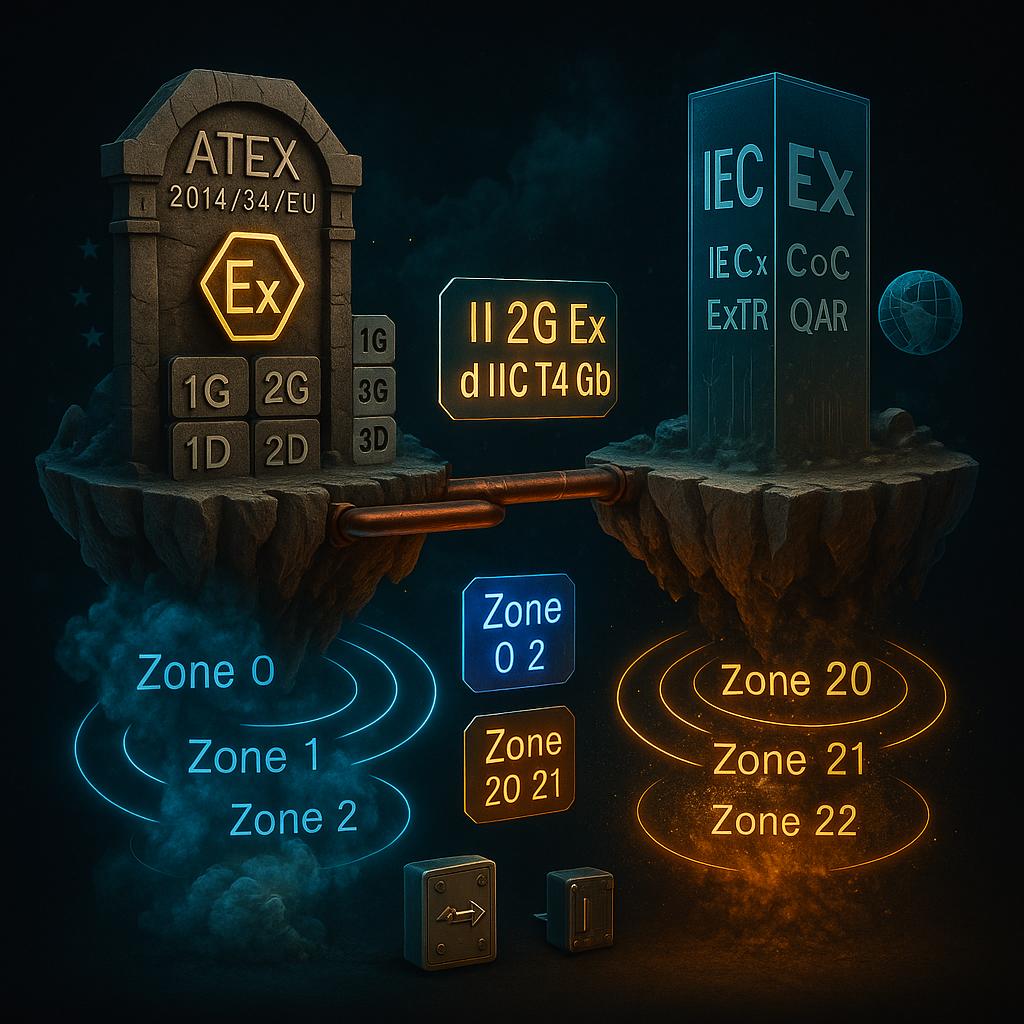
Example label (gas): II 2G Ex d IIC T4 Gb
– II = non-mining; 2G = ATEX Category 2 (gas → Zone 1)
– Ex d = flameproof method
– IIC = gas group (most demanding)
– T4 = max surface 135 °C
– Gb = EPL for gas (Zone 1)
For IECEx, you will see the IECEx CoC number instead of CE/ATEX category. Keep the certificate and IOM manuals in your project file.
NEC 500 vs 505 (U.S.)
– NEC 500 uses Class/Division.
– NEC 505 allows Zones (closer to ATEX/IECEx).
Your AHJ may accept Zone labeling, but confirm early. If converting from ATEX/IECEx to U.S. labeling, add the required NEC elements.

Fast compliance checklist
- Confirm area classification (Zones or Class/Division; include gas group/dust group and T requirement).
- Choose protection level (Category/EPL) that matches the zone.
- Pick protection method (Ex i, Ex d, Ex e, Ex p, etc.) suitable for device/panel.
- Verify certificates (ATEX DoC/EU Type Cert or IECEx CoC; check QAN/QAR status).
- Check nameplate: group, T-class, ambient (Ta), EPL/Category, enclosure rating.
- Prepare docs: certificates, manuals, wiring diagrams, purge calculations (for Ex p), inspection plan.
- For panels: confirm internal components and labeling rules (e.g., Ex p with proper purge/pressurization control).
For authoritative guidance and certificate verification, consult the official IECEx website. It provides the IECEx Scheme overview, searchable Certificate of Conformity (CoC) database, ExTR reports, QAR quality requirements, and resources aligned to IEC 60079—so you can validate Ex markings (e.g., Ex d IIC T4 Gb), understand Equipment Protection Levels (Ga/Gb/Gc, Da/Db/Dc), and align your ATEX/IECEx compliance steps with trusted documentation.
you can also check our first page to find out more just click.