



Prefer listening? You can play the audio version of the rest of this article below.
Why Copper Busbar Calculation Accuracy Decides Panel Fit
A copper busbar calculation that is 3 mm out will not show up on the drawing. It shows up on the shop floor, when the bar sits 3 mm proud of the terminal and the fitter reaches for a hammer.
That is the real cost of a wrong blank length. Copper bars are rigid conductors. Unlike a cable, they cannot be rerouted to absorb small errors. A bar that misses its tangent point becomes rework, scrap, or a joint carrying permanent mechanical stress — and a stressed joint runs hotter than a relaxed one for the life of the panel.
Dimensional discipline also has a compliance side. Creepage and clearance distances, joint torque, and assembly verification under IEC 61439-1 all assume the bar sits where the drawing says it sits. A bar that is “close enough” on the bench can still fail verification in the finished assembly.
There is a production argument too. Once tangent points, bend radii, and cut lengths are controlled, both manual and CNC shops cut fitting time, protect contact integrity, and waste less stock copper. Accuracy is not perfectionism here — it is throughput.
If the details you gathered about Accurate Busbar Bending Calculation were interesting and insightful, you may find diving deeper into Busbars for Power Distribution Systems equally captivating.
Busbar Calculation Formula: Sizing or Bending — Which One Do You Need?
Search for “busbar calculation formula” and you get two completely different answers, because engineers use the phrase for two different jobs. Sort out which one you need before you use any equation below.
Sizing answers how big must the bar be? It is an electrical and thermal question, driven by load current, short-circuit withstand, ambient temperature, and enclosure ventilation.
Bending and cut length answers how long must the flat blank be? It is a geometry question, driven by bend angle, inside radius, thickness, and K-factor. This article covers the second one.
| Busbar Sizing Calculation | Busbar Bending Calculation | |
|---|---|---|
| Question Answered | What Cross-Section Do I Need? | How Long Do I Cut the Flat Bar? |
| Core Formula | A = I ÷ J (Current Density), Checked Against Short-Circuit Withstand | BA = (π/180) × Angle × (r + K × t) |
| Key Inputs | Load Current, Ambient Temp, Mounting, Fault Level, Clearing Time | Bend Angle, Inside Radius, Thickness, K-Factor |
| Governing Reference | IEC 61439-1 Temperature Rise, IEC 60865-1 Short Circuit | EN 13601 Material, ISO 2768-1 Tolerances |
| Gets It Wrong → | Overheating, Nuisance Tripping, Derated Panel | Bars That Miss Terminals, Scrap, Stressed Joints |
| Do It When | During Design, Before Ordering Copper | During Fabrication, Before Cutting Stock |
A quick worked example of the difference. A 630 A feeder at 1.2 A/mm² needs roughly 525 mm², so a 60 × 10 mm bar (600 mm²) works — that is sizing. Cutting that same 60 × 10 mm bar to 222 mm so it lands on both terminals after one 90° bend — that is bending calculation. Two formulas, two failure modes, one bar.
If you came here for sizing, read our copper busbar sizing and ampacity guide instead. If you came here for cut length, keep reading.
Key Terms Behind Every Copper Busbar Bending Calculation
Most copper busbar bending calculation errors are not arithmetic errors. They are vocabulary errors — two people measuring from two different features and both believing they are right.
Developed length, flat length, blank length, unfolded length, and pre-bend length all mean the same thing: the straight piece of copper you cut before forming. They only stay consistent when everyone measures from the same reference features.
Three ideas control the result: the neutral axis, the inside bend radius, and the habit of measuring straight legs to the tangent points rather than to the bend centerline. Get the third one wrong and every other number in the calculation is correct but useless.
You also need to keep bend allowance and bend deduction apart. They describe the same bend from two layout methods, and both reach the same cut length when applied correctly.
Finally, copper temper matters. Soft-annealed and hard-drawn bars do not behave the same way, and tight bends do not behave like large-radius bends. K-factor, minimum radius, and springback all move together — change the temper and you change all three at once.
If you are looking for more information about busbar fundamentals, it is recommended not to miss reading this article. See the fundamentals of metalworking bending
Copper K-Factor and the Neutral Axis Explained
When a flat copper bar bends, the inside face compresses and the outside face stretches. Between them sits the neutral axis — the layer that changes direction without changing length. The copper K-factor is simply where that layer sits, expressed as a fraction of thickness measured from the inside face.
The effect on your calculation is direct: a lower K-factor shortens the bend allowance, a higher one lengthens it. K never exceeds 0.5, because the neutral axis always shifts toward the inside of the bend and can at best stay at mid-thickness.
Two things move it. Temper is the first — annealed copper flows more easily, so its neutral axis shifts further in. The r/t ratio is the second — the tighter the bend relative to thickness, the more the axis migrates inward.
Use the table below by temper when you only know the grade, and the r/t table when you know your actual die radius. Both are practical starting points, not standards. Confirm on a trial bend with your own tooling.
Explore copper conductor properties
TABLE A — K-factor by copper temper
| Copper Condition | Typical K-Factor | Common Shop Use |
|---|---|---|
| Soft / Annealed Copper (ETP R220) | 0.35 | Tight Radii, Hand-Formed Links |
| Semi-Hard Copper and Brass (R290) | 0.41 | General Panel Busbar Work |
| Hard-Drawn Copper (R320) | 0.45 | Large Radii, Rigid Main Bars |
TABLE B — K-factor by r/t ratio
| Copper Grade | Condition | r/t Ratio | Typical K-Factor |
|---|---|---|---|
| ETP Cu R220 | Soft / Annealed | r/t < 1 | 0.33 |
| ETP Cu R220 | Soft / Annealed | r/t 1–3 | 0.40 |
| ETP Cu R220 | Soft / Annealed | r/t > 3 | 0.50 |
| ETP Cu R290 | Half Hard | r/t < 1 | 0.33 |
| ETP Cu R290 | Half Hard | r/t 1–3 | 0.38 |
| ETP Cu R290 | Half Hard | r/t > 3 | 0.45 |
| ETP Cu R320 | Hard Drawn | r/t > 1.5 | 0.45 |
Minimum Inside Bend Radius for Copper Busbars
The inside bend radius is measured on the compressed face of the bend, and it is one of the most important inputs in any busbar bend allowance calculation. If the radius is too tight, the outside fibers can crack; if it is too large, the finished route may miss the intended geometry.
Use the table below as a practical starting guide for minimum bending radius for copper busbar in switchgear panels. Then confirm it against your copper temper, die set, and a sample bend.
Get the radius wrong in either direction and you pay. Too tight, and the outer fibers craze or crack — sometimes invisibly, leaving a bar that passes inspection and fails under thermal cycling two years later. Too large, and the finished route misses the intended geometry, so the bar reaches the terminal at an angle and the joint never sits flat.
One field rule saves more copper than any formula: design to the die you own. Specifying a 7 mm radius when your machine carries 5 mm and 10 mm tooling guarantees either a rework loop or a quiet, undocumented substitution on the shop floor. Check the die set before the drawing is released, not after.
| Copper Condition | Minimum Inside Radius |
|---|---|
| Soft annealed (R220) | 0.5 × t |
| Half hard (R290) | 1.0 × t |
| Hard drawn (R320) | 1.5 × t |
Bend Allowance vs Bend Deduction: Two Methods, One Cut Length
Bend allowance (BA) is the arc length of the neutral axis through the bend. You measure legs to the tangent points and add the allowance. Bend deduction (BD) is the amount you subtract from two outside dimensions to reach the same flat pattern. One method adds, the other subtracts — and they must agree.
Which one you use depends on how your drawing is dimensioned, not on which is “better”. If the drawing gives outside dimensions, use deduction. If it gives tangent-to-tangent legs, use allowance. Converting between them by eye is where errors enter.
The deduction formula needs one extra term, the outside setback (OSSB):
OSSB = (r + t) × tan(Angle ÷ 2)
BD = (2 × OSSB) − BA
Take the same bar used later in this guide — 60 × 10 mm soft copper, r = 10 mm, t = 10 mm, one 90° bend:
OSSB = (10 + 10) × tan 45° = 20 mm
BD = (2 × 20) − 21.99 = 18.01 mm
Now check both routes give the same blank. Measured to tangent points, the legs are 120 mm and 80 mm. Measured to outside corners, they become 140 mm and 100 mm.
| Method | Working | Result |
|---|---|---|
| Bend Allowance | 120 + 80 + 21.99 | 221.99 mm |
| Bend Deduction | (140 + 100) − 18.01 | 221.99 mm |
Identical, as they must be. If your two methods disagree, you have mixed tangent-point and outside dimensions somewhere — that is the error, every time.
For a comprehensive understanding of busbar sizing, we highly recommend reviewing this article.
Copper Busbar Bending Formula: The Only Equation You Need
How to calculate copper busbar bending and cutting length becomes predictable once the bend is treated as neutral-axis arc length rather than guessed from outside dimensions. For most workshop layouts, the core relation is the standard bend allowance formula below.
BA = (π / 180) × Angle × (r + K × t)
Here, Angle is the bend angle in degrees, r is the inside bend radius, K is the K-factor, and t is material thickness. Physically, the formula estimates the length consumed as the copper bar wraps around the bend zone.
The busbar developed length or total cutting length is then assembled as: sum of straight legs + sum of all bend allowances. This is the most reliable way to answer how to calculate busbar cutting length before bending.
Further exploration of busbar design software can be found in the following recommended reading.
Always measure straight legs to the tangent points, not to the bend center. That single distinction prevents many layout errors in busbar fabrication drawing work, especially on 90° and offset bends.
| Variable | Meaning | Unit |
|---|---|---|
| BA | Bend allowance | mm |
| Angle | Bend angle | Degrees |
| r | Inside bend radius | mm |
| K | K-factor | — |
| t | Thickness | mm |
Before you copy a busbar bending formula from elsewhere, test it. A version circulating widely online reads:
Unfolded length = Σ(straight segments) + n × π × (R_inside + R_outside) ÷ 2
It looks reasonable, and it hides a factor-of-two error. The term (R_inside + R_outside) ÷ 2 is just the mid-thickness radius — that is our (r + K × t) with K fixed at 0.5. But the published version drops the angle term, so it only holds for a 180° bend.
Run our example through it: r = 10, t = 10, so the mean radius is 15 mm. The shortcut gives π × 15 = 47.1 mm for one 90° bend. The correct value at K = 0.5 is (π/180) × 90 × 15 = 23.6 mm. Exactly double the true figure — on a five-bend assembly that is over 100 mm of wasted copper per bar.
The test is simple: any bending formula that does not contain the bend angle is wrong for anything except a 180° bend.
Worked Example: Copper Busbar Calculation Formula in Practice
This is the clearest place to apply the copper busbar 90-degree bend allowance formula step by step. Take a 60 × 10 mm ETP copper bar, soft condition, with a 10 mm inside radius, one 90° bend, and leg lengths of 120 mm and 80 mm.
Because r/t = 1.0, a practical starting K-factor is 0.40. Substituting the values gives: BA = (π / 180) × 90 × (10 + 0.40 × 10) = 1.5708 × 14 = 21.99 mm, which is rounded to 22 mm for shop use.
The busbar cutting length formula is then straightforward: 120 + 22 + 80 = 222 mm. That 222 mm is the blank length, raw material length, or unfolded length you cut before bending.
Round only at the final step, and keep the same measurement convention across all legs. Mixing tangent-point dimensions with centerline dimensions is a common cause of bad switchgear fits.
Every figure below is reproducible. Change any input and the method holds.
| Item | Value |
|---|---|
| Busbar size | 60 × 10 mm |
| Copper grade | ETP R220 |
| Inside radius, r | 10 mm |
| K-factor | 0.40 |
| Angle | 90° |
| Leg A | 120 mm |
| Leg B | 80 mm |
| Bend allowance | 21.99 mm ≈ 22 mm |
| Total cutting length | 222 mm |
| Bend deduction (cross-check) | 18.01 mm ≈ 18 mm |
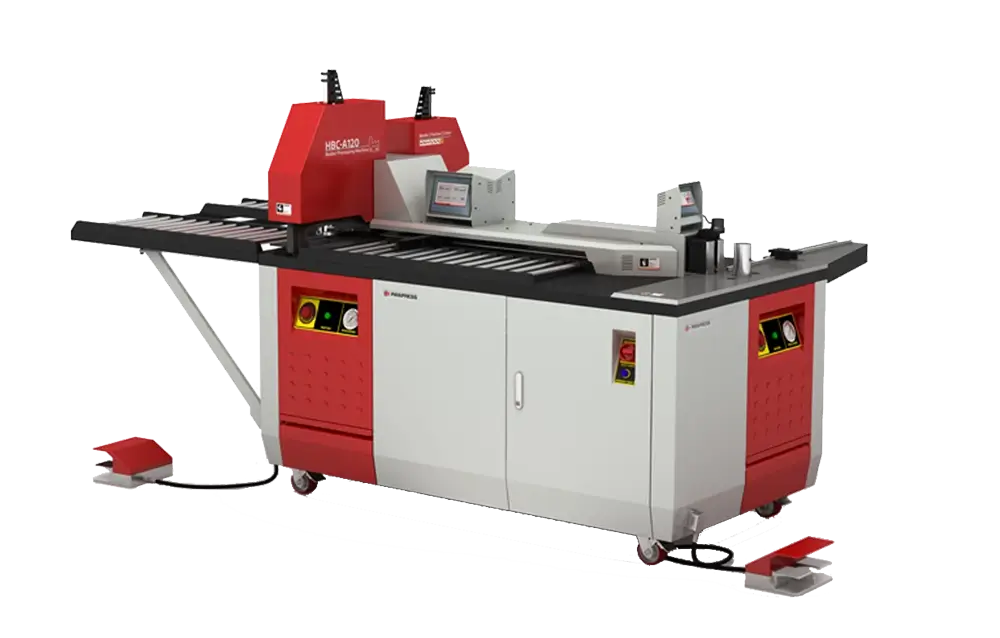
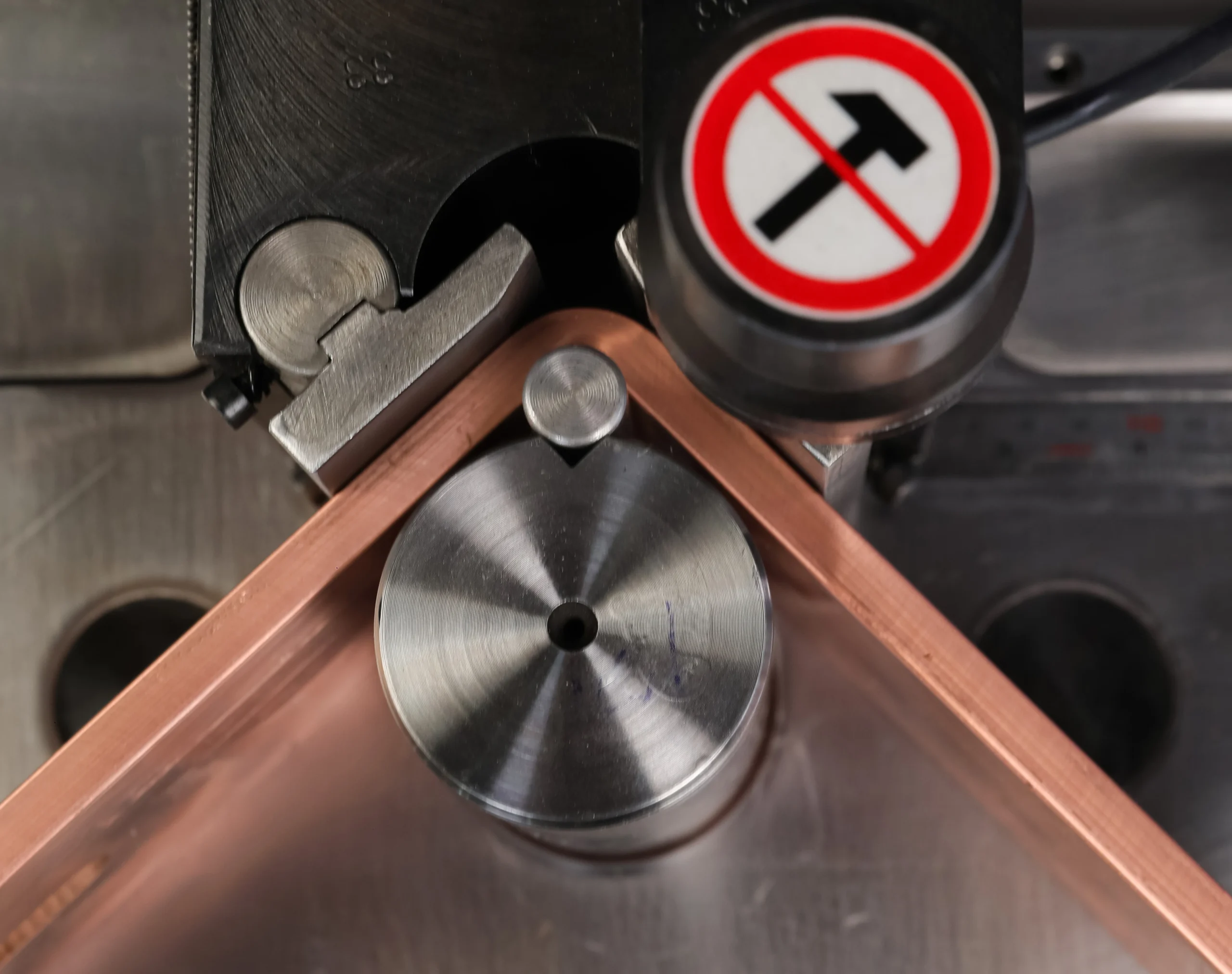
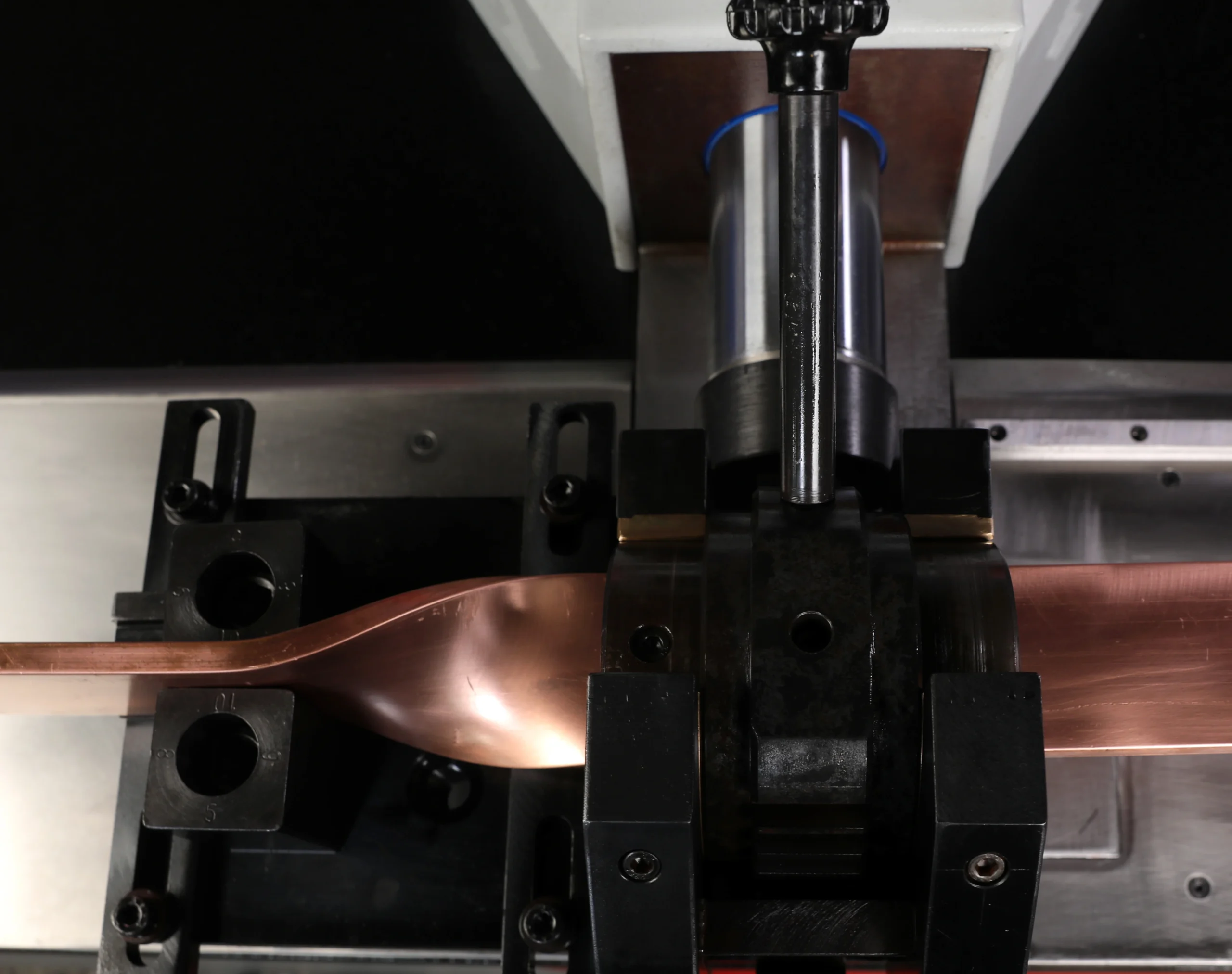
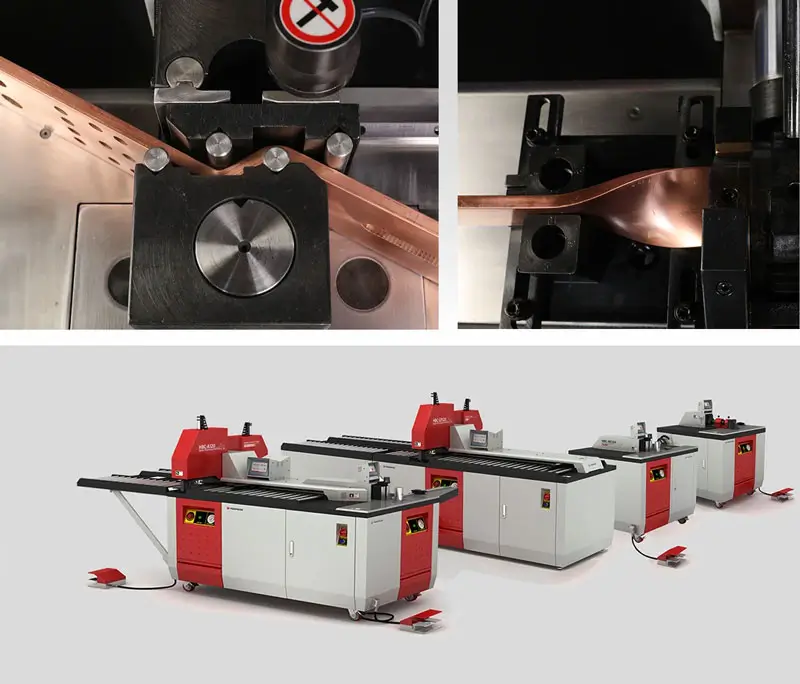
A PAYAPRESS copper busbar machine helps panel builders convert accurate bending calculations into precise finished copper busbars for switchgear and electrical panel assemblies. Since correct cutting length depends on bend allowance, inside radius, K-factor, tangent-point measurement, and springback control, using a reliable copper busbar machine can improve dimensional repeatability and reduce costly rework. This allows manufacturers to produce busbars that land cleanly on terminals, fit properly inside enclosures, and maintain the mechanical accuracy required for professional panel fabrication.
Copper Busbar Calculation for Parts with Multiple Bends
For multi-bend parts, the logic does not change. You still build the cut length from straight segments plus the bend allowance for each bend zone, whether the bar is forming an offset, a saddle, or a routed diagonal.
That makes how to calculate the developed length of a copper busbar with multiple bends a bookkeeping problem as much as a geometry problem. Each bend gets its own angle, radius, and K-factor if the conditions differ.
Sequence also matters. A U-bend, Z-bend, and compound 45° layout may share the same flat bar thickness, but they do not share the same straight-leg measurements or setup order on the machine.
For parts with several bends, a template or layout drawing is worth the time. It exposes mistakes early, especially where manual versus CNC setups produce slightly different tangent-line marking habits.
This article serves as a valuable resource for those seeking detailed information on flexible busbar types.
Every worked example below uses the same bar as above: 60 × 10 mm soft ETP copper, 10 mm inside radius, K = 0.40, so each 90° bend allowance is 22 mm. Change any of those and every bend allowance changes with it.
Z-Bend (Two-Bend Offset) Busbar Cutting Length Calculation
A Z-bend uses two equal bends in opposite directions to shift the bar sideways or vertically. For busbar offset bend calculation for LV panel installation, use: Total = Leg A + BA1 + Offset Straight + BA2 + Leg B. With 60 + 22 + 30 + 22 + 40, the cut length is 174 mm.
Note the assumption: this works only when both bends share the same angle, radius, and K-factor. Panel offsets are often formed at 30° or 45° rather than 90°, and mixed-angle offsets need a separate bend allowance for each bend.
45° and 90° Compound Busbar Bending Calculation
A U-bend adds two 90° bend allowances between three straight legs. If Leg A = 50 mm, bridge = 40 mm, Leg B = 50 mm, and each bend allowance = 22 mm, the developed length is 50 + 22 + 40 + 22 + 50 = 184 mm.
Bend allowance scales linearly with angle. Once you know the 90° value for a given bar and die, every other angle is a multiplication.
Compound Busbar Bending Calculation for 45-Degree and 90-Degree Angles
For copper busbar bending calculation for 45 degree and 90-degree angles, keep the same formula and replace Angle = 45. Using the earlier 10 mm radius, 10 mm thickness, and K = 0.40 gives BA ≈ 11.0 mm for a 45° bend—about half the 90° value—while the diagonal straight leg must still come from panel geometry.
A reusable reference table:
| Bend Angle | BA Formula Share | BA When r = t = 10 mm, K = 0.40 |
|---|---|---|
| 30° | 0.33 × 90° Value | 7.3 mm |
| 45° | 0.50 × 90° Value | 11.0 mm |
| 60° | 0.67 × 90° Value | 14.7 mm |
| 90° | Reference | 22.0 mm |
| 120° | 1.33 × 90° Value | 29.3 mm |
Minimum Bend Radius Limits for Copper Busbars in Switchgear
Bend calculation is only useful inside the material limits of the copper bar. If the inside radius is too small, the outer face can craze or crack, reducing both mechanical quality and long-term current-carrying reliability.
The allowable radius depends on temper, thickness, and bending orientation. Soft annealed versus half-hard copper is one decision boundary; flat-wise versus edge-wise bending is another, because edge-wise bends need a much larger effective radius.
Selecting the right busbar fabrication machine can significantly reduce these production issues and improve repeatability across multiple projects.
In practice, designers should match the required radius to an available die set. Designing a theoretical 7 mm radius when the machine only has 5 mm or 10 mm tooling creates avoidable rework.
If you are looking for more information about ground bus bar, it is recommended not to miss reading this article.
The table below is a practical panel-shop guide for straight flat bars. Use it as a starting point, then validate on the actual copper temper and machine you will run.
| Bar Thickness, t (mm) | Soft Cu R220 Min. r (mm) | Half Hard Cu R290 Min. r (mm) |
|---|---|---|
| 5 | 2.5 | 5.0 |
| 6 | 3.0 | 6.0 |
| 8 | 4.0 | 8.0 |
| 10 | 5.0 | 10.0 |
| 12 | 6.0 | 12.0 |
| 15 | 7.5 | 15.0 |
Springback Compensation in Copper Busbar Bending
Springback is the elastic recovery that opens the bend slightly after load is released. In shop terms, a bar formed to a nominal 90° may relax to a slightly larger included angle unless the operator compensates.
The effect grows as material gets harder and as the radius-to-thickness ratio increases. That is why hard-drawn copper and large-radius bends usually need more overbend than soft copper and tighter bends.
There is no single universal formula that replaces trial work. Experienced fabricators use empirical tables by machine, die, and copper temper, then fine-tune with a sample bend before running production material.
A safe rule is to treat the table below as a starting overbend guide, not a standard. If dimensional accuracy is critical, test on scrap from the same batch first.
| Copper Condition | Practical Starting Overbend |
|---|---|
| Soft / annealed | 0.5°–1.5° |
| Half hard | 1°–3° |
| Hard drawn | 2°–4° |
Record the correction. The most common springback failure is not getting the overbend wrong on the first bar — it is getting it right, then losing it because nobody wrote it on the setup sheet. Log the compensation against die, machine, and copper batch.
Five Copper Busbar Calculation Mistakes That Scrap Finished Bars
Every mistake below produces a bar that measures correctly against the wrong reference. That is what makes them expensive — they survive to the final assembly before anyone notices.
1. Measuring legs to the bend center instead of the tangent point. Adds roughly (r + t) per bend to the true leg. On our example bar that is 20 mm of error on a single 90° bend. Fix: mark tangent lines on the drawing, not bend centers.
2. Using one K-factor for the whole part. A part with a tight 5 mm radius bend and a loose 20 mm radius bend has two different neutral axis positions. Using a single K value pushes one of them out. Fix: assign K per bend from the r/t ratio.
3. Rounding at every step. Round 21.99 to 22 five times across a five-bend part and you have accumulated real drift. Fix: carry full decimals through, round once at the end.
4. Designing to a radius the machine does not have. The operator substitutes the nearest die, the blank length is now wrong by several millimeters per bend, and nothing is documented. Fix: publish the available die list to whoever draws the bars.
5. Ignoring springback on hard-drawn stock. The blank length is perfect, the angle is 92°, and the bar still misses the terminal. Cut length and formed angle are separate problems. Fix: prove the overbend on scrap from the same batch.
There is a pattern here. Four of the five are communication failures between drawing office and shop floor, not mathematics failures. Fix the handover and most of them disappear.
Practical Copper Busbar Fabrication Tips for Accurate Cutting and Bending
Theory saves copper only when shop practice is disciplined. For everyday busbar fabrication calculation work, use this checklist before you cut stock.
- Mark bend tangent lines, not just bend centers.
- Verify the actual die radius before releasing drawings.
- Check machine force against bar width and thickness.
- Deburr cut ends before bending to reduce crack starters.
- Label orientation and circuit reference on every finished bar.
- Build a paper or cardboard template for parts with more than three bends.
Those six habits matter because they connect formula accuracy to real fabrication repeatability. They also reduce the usual mismatch between drawing intent, operator setup, and final fit inside the panel.
For a comprehensive understanding of distribution board types, we highly recommend reviewing this article.
Standards and References Governing Copper Busbar Fabrication
No single standard covers every part of busbar fabrication. In practice, fabricators combine material standards, dimensional standards, general tolerances, and assembly standards to control the finished result.
For copper bar material itself, EN 13601 is the most directly relevant modern reference because it specifies composition, electrical properties, and tolerances on dimensions and form for copper rod, bar, and wire for electrical purposes.
For switchgear sizes and long-used shop conventions, DIN 46433 remains a familiar reference. For fabricated dimensional tolerances, ISO 2768-1 is the common fallback. For the completed assembly, IEC 61439-1 governs construction and verification.
One correction matters: IEC 60228 is primarily a conductor standard for insulated cables, not a busbar-dimension standard. It is still useful when discussing copper conductivity and conductor-resistance terminology, but it does not replace EN 13601 or DIN 46433 for flat bars.
Further exploration of busbar system trends can be found in the following recommended reading.
Getting Copper Busbar Calculation Right, First Time
Accurate copper busbar calculation comes down to one equation and one discipline. The equation is BA = (π/180) × Angle × (r + K × t). The discipline is measuring every straight leg to the tangent point and using a K-factor that matches the actual r/t ratio and temper of the bar in your hand.
Do those two things and you can cut with confidence, cross-check by bend deduction, and stop discovering problems at final assembly. You now have what you need to decide two things: which K-factor your copper grade justifies, and whether your drawing convention is allowance-based or deduction-based. Settle both before the first bar is cut.


Rate this article
Choose a rating from 1 to 5 stars.
No ratings yet