Why CE Marking Matters
CE marking is your product’s EU passport. It says: “We follow the safety, health, and environmental rules.” You place the CE mark only when you are confident and can prove compliance. It is a legal promise by the manufacturer.
Do Control Panels Need CE? (Quick Answer: Yes)
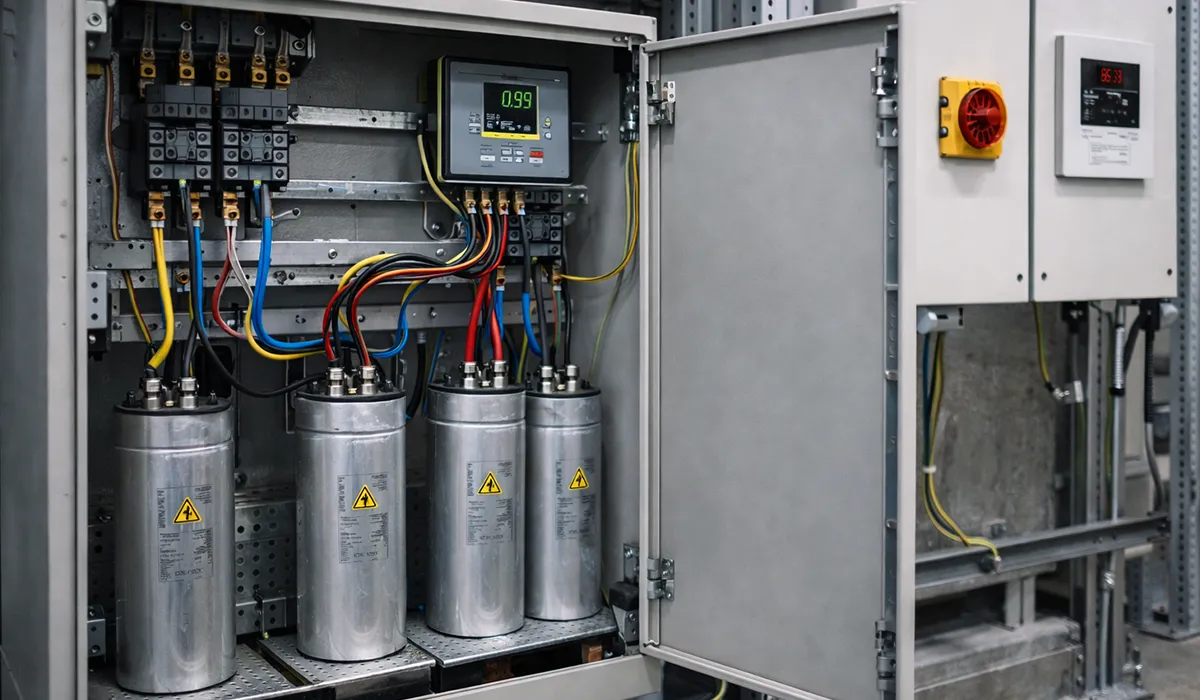
Almost all industrial control panels need CE when placed on the EU/EEA market. One-off panels need it too. Panels are electrical equipment above 50 Vac, so the Low Voltage Directive (LVD) applies, and usually the EMC Directive as well.
Standalone vs. Part of a Machine
- Stand-alone panel → you CE-mark the panel itself.
- Panel inside a machine → the machine builder CE-marks the whole machine. Although having a CE-marked panel is advantageous, it cannot by itself ensure compliance of the complete machine.
EU Laws You Might Need
• LVD 2014/35/EU — “electrical safety for 50–1000 Vac or 75–1500 Vdc. “
• EMC 2014/30/EU — “emission limits and immunity requirements. “
• Machinery 2006/42/EC → “Regulation (EU) 2023/1230 after transition. “
• RED 2014/53/EU — “for Wi Fi/Bluetooth, etc. “
• RoHS 2011/65/EU — “controls of hazardous substances. “
• WEEE — “end of life collection / recycling (wheelie bin symbol). “
• REACH — chemicals/substances management.
Standards That Make Life Easier (EN)
- Using harmonized EN standards gives you “presumption of conformity.” If you follow the right EN standards, regulators generally assume you meet the law.
- EN 60204‑1 — Electrical equipment of machines (like NFPA 79). Use green/yellow for PE. Avoid red/yellow on normal isolator next to an E‑stop.
- EN 61439‑1/‑2 — “LV switchgear/controlgear assemblies. “
- EN 61000‑6‑2 / ‑6‑4 (+ other EN 61000 parts) — “ EMC immunity & emissions.“
- IEC 60529 — “ IP ratings (e.g., IP65 for dust tight, water jet).“
- ISO 12100 — “Risk assessment. “
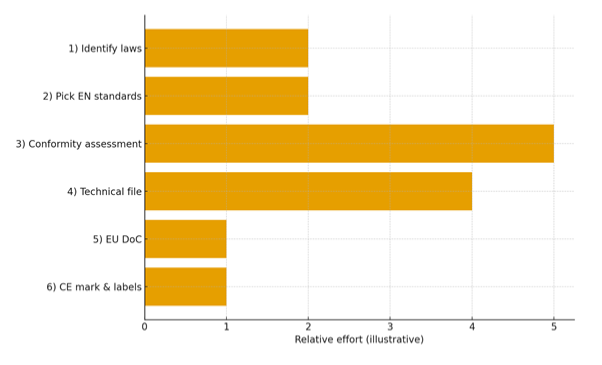
How to Get CE in 6 Steps
1) Identify applicable laws (directives/regulations).
2) Pick harmonized EN standards.
3) Do conformity assessment: calculations, inspections, tests (Notified Body rarely needed for LVD/EMC panels).
4) Build the technical file.
5) Prepare and sign the EU Declaration of Conformity (DoC).
6) Put CE mark and required labels on the panel.

Risk Assessment, in Plain Words (ISO 12100)
Start early. Update at the end. Look at normal use and foreseeable misuse.
Use the safety hierarchy: eliminate → substitute → engineering controls (guards/interlocks) → admin controls (warnings/training) → PPE.
EMC in Real Projects — What Works
Many first-time designs fail EMC. Plan early.
- Keep noisy and sensitive parts apart; avoid big loops; route cables cleanly.
- Use filters and shielded cables with 360° terminations when needed.
- Make bonds short and wide. Use zinc-plated backplates; remove paint around bonding; use serrated washers.
- Bond the cabinet door. Use EMC cable glands where helpful.
Safety Basics from the LVD
Protect users from electric shock, overheating, fire, mechanical and chemical risks. Often you need two independent protections. For safety-related control functions validate performance to ISO 13849‑1 or EN 62061
Labels & Documents You Must Keep
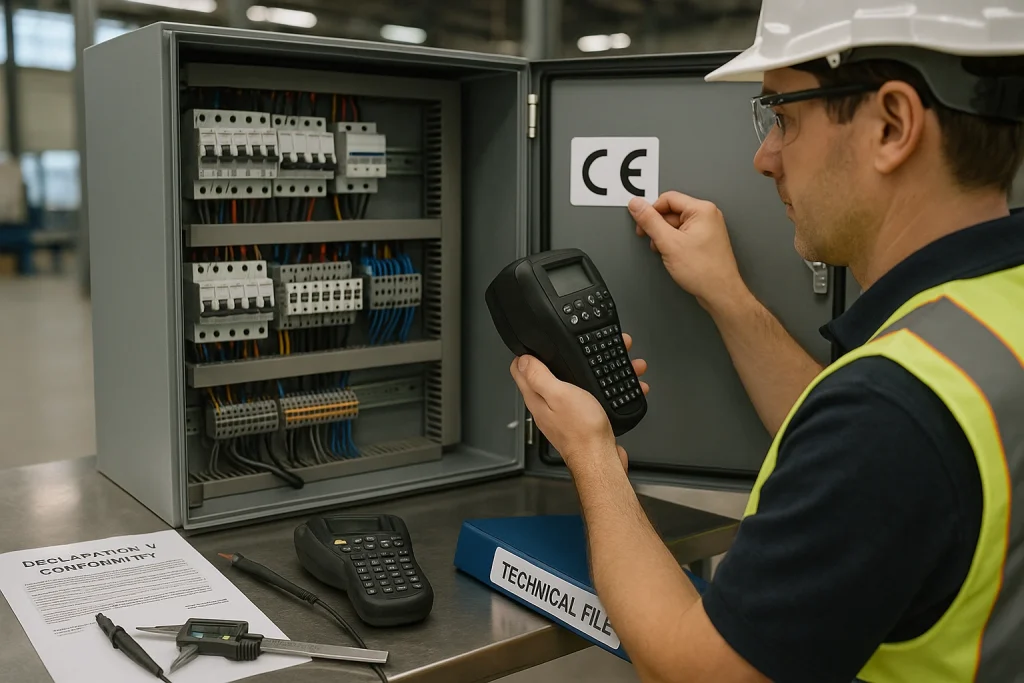
Label must show CE, manufacturer, model/serial, year, ratings, and required symbols (e.g., WEEE). The technical file keeps: risk assessment, drawings/wiring/BOM, list of standards, calculations, test reports, user manual, and your EU DoC. Keep it for 10 years.
Who Does What in the EU
- Manufacturer — designs/makes; signs the DoC.
- Authorized Representative (AR) — EU contact if you are outside EU.
- Importer — brings product into EU, must check compliance.
UKCA vs CE (Good News)
Great Britain accepts CE‑marked goods indefinitely (current policy). Northern Ireland uses CE. So CE compliance usually covers the UK too.
Common Mistakes :
- “CE part + CE part = CE system.” Wrong. Always assess the whole panel.
- Weak EMC evidence; no test plan.
- No or poor risk assessment.
- Listing standards without really applying them.
- Bad instructions or poor traceability.
- Not updating documents when design changes.
For more detailed information on CE marking and the regulatory requirements for industrial control panels, you can refer to the official and scientific article published on the European Commission’s CE Marking page. This article provides comprehensive insights into the laws, standards, and directives related to CE marking, including EMC and LVD regulations.
Mini FAQ
Do all panels need CE?
→ Usually yes, if placed on EU/EEA market.
Do I need EMC tests?
→ The directive doesn’t force testing, but test reports are the strongest proof.
EN 60204‑1 vs EN 61439‑1?
→ 60204‑1 is for electrical equipment of machines; 61439‑1/‑2 is for LV assemblies.
How long to keep the technical file?
→ 10 years after the last unit is placed on the market.