




If you’d rather listen than read, feel free to play the audio file below for the rest of this article.
Why CNC Changes the Hazard Picture
On a manual or stopper-based machine, the press releases energy when the operator acts. Hazard and action are linked, and every operator understands that link by instinct.
On a CNC machine, by contrast, the program decides when things move. A machine mid-cycle can sit still for several seconds and then traverse without warning. Therefore an operator who reads stillness as safety has misread the machine.
A second factor is distance. Automated running invites you to step away and come back, so people approach a machine in an unknown state far more often than at a manual station.
Third, guards and interlocks stop being an inconvenience. They are the only parts of the system that know where you are; the control does not. In short, good CNC busbar machine safety rests on one rule: the program state decides whether you can approach, and only the control display shows that state.
Safety starts with knowing what the machine does. For a quick overview of the main machine types, read our guide to busbar fabrication machines.
The Hazards, Listed Honestly
Busbar machine hazards fall into four groups: point of operation, machine motion, material handling and stored energy. The first two are severe; the third is frequent.
For definitions of these danger areas, OSHA explains each one in plain terms. Its eTool introduces point of operation and power transmission hazards in its machine guarding basics.
The point of operation
This is a hydraulic press that develops high force through matched tooling. Anything between punch and die when the stroke starts will be crushed or severed. For example, machines in this class run at around 200 bar and can develop forces in the region of 400 kN.
The busbar-shop temptation is reaching in to reposition a bar or clear a jammed offcut without stopping the cycle. Speed makes this worse, not better. A hydraulic stroke is fast enough that human reaction time is irrelevant, so there is no recovering from a hand in the wrong place.
Die changes add one more risk: you handle heavy tooling at close quarters, and the machine is only safe when it is properly isolated.
The UK regulator warns that machinery can start or move unexpectedly. Its brief leaflet covers guards, isolation and training in its safe machinery guide.
Machine motion and the clamp zone
On CNC machines, the tooling carrier traverses along the bar while the length-measuring drive positions the material. Both move under program control, not operator control, so axis motion can start while you are still close.
The clamp, meanwhile, grips the bar with substantial force to hold position, and it closes when the program says so. Fingers positioning a bar as the clamp closes are a foreseeable, serious injury, and loose sleeves add an entanglement risk.
Next, consider the feed path. Bars up to 4 m long move in and out of the machine, and the outfeed side is a struck-by hazard for anyone standing in line with it. The rule follows directly: the space in front of and behind the machine along the feed line is part of the hazard zone, even though nothing is bolted there.
Handling the material
Manual handling produces the most incidents and gets the least attention. Copper bars up to 4 m are heavy, awkward and flexible enough to swing. At these sizes, therefore, two-person lifts, mechanical assistance and proper racking are not optional extras.
Next, freshly sheared and punched copper carries burrs that cut easily, so hole edges and sheared ends stay hazardous until deburred. That is one more argument for deburring during the process rather than as an afterthought.
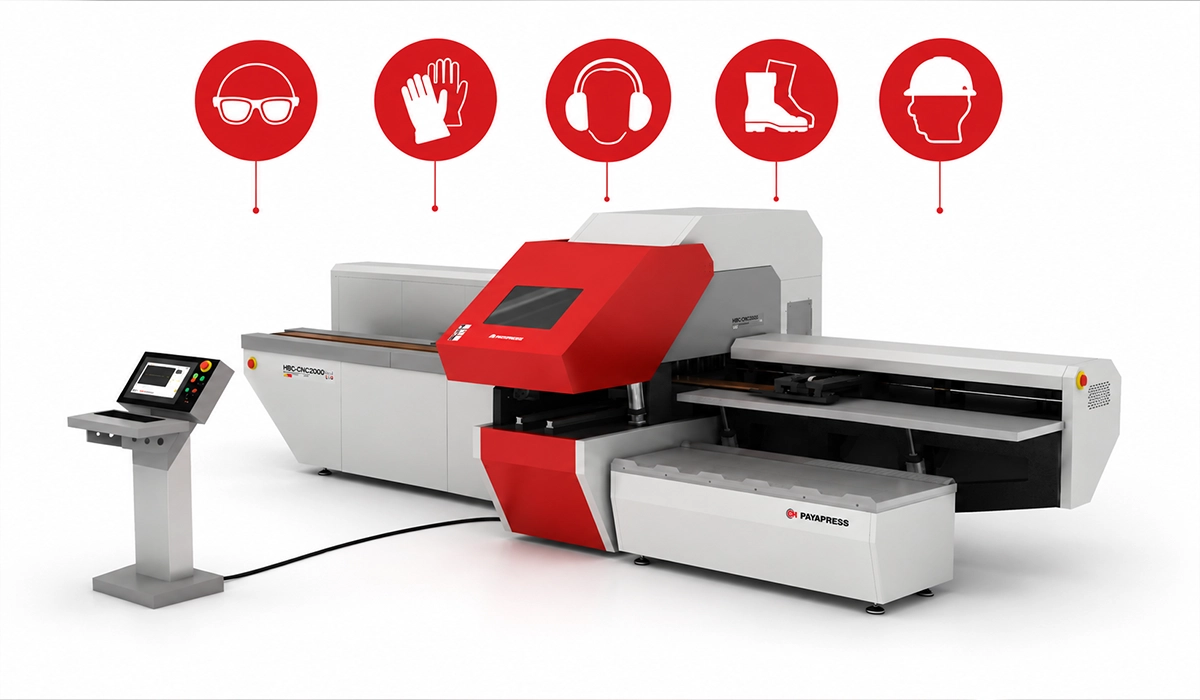
For handling, use cut-resistant gloves and eye protection; however, glove policy near moving machinery must come from the site’s own risk assessment. Finally, swarf needs care. Copper and aluminium chips are sharp and electrically conductive. Never clear them by hand, never blow them toward the machine with compressed air and never touch them while the machine can cycle.
Stored energy
Servicing safety is covered elsewhere, but the operational point stands: a machine that is switched off is not automatically a machine at zero energy.
Hydraulic circuits hold residual pressure, and accumulators, where fitted, store hydraulic energy on purpose. In other words, someone has to release that pressure, because nobody can safely assume it away. Likewise, electrical energy in the control cabinet stays present until you isolate the machine at the main disconnect.
For production staff, the rule is simple. Any task that needs access past a guard is not a production task. Instead, it stops being operating and becomes servicing, and the isolation procedure that goes with servicing applies in full before anyone reaches in.
Bending is one of the tasks where the hazards above appear most often. To see how the process works, read our deep dive into busbar bending techniques.
Protective Measures and How to Verify Them
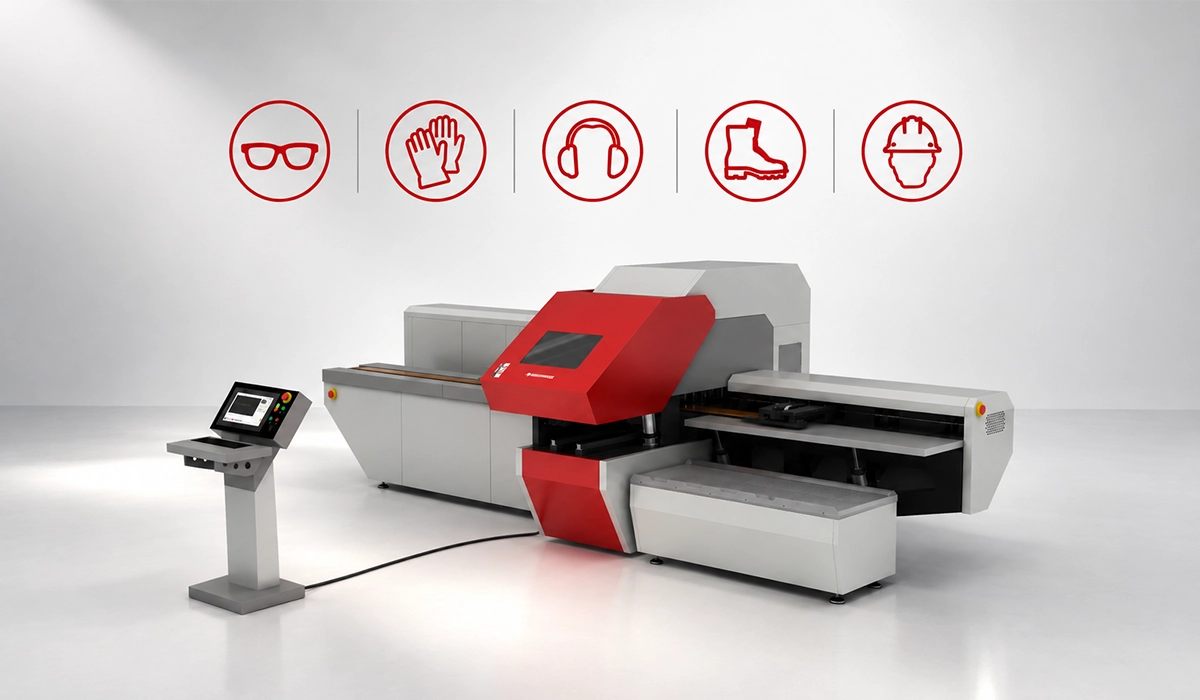
Each device has a purpose and a check that proves it still works. That third column is the heart of CNC busbar machine safety on a working floor.
| Device | Purpose | How you know it still works |
|---|---|---|
| Fixed and interlocked guards | Machine guarding that prevents access to moving parts | Opening an interlocked guard stops the machine, and nobody has defeated it |
| Light curtain | Detects approach into the hazard zone and stops the cycle | It trips far enough out for the machine to stop before a hand arrives |
| Emergency stop | Reaction device at the operating position | Functional test on a schedule |
| Main isolator | Cuts power; starting point for non-production work | Isolation is confirmed before any servicing |
| Foot pedal | Keeps hands away from tooling in automatic mode | Only the person whose hands are clear uses it |
Defeated interlocks are common and always deliberate. For a light curtain, a correctly working unit mounted too close protects nobody, so a standard governs its position, not convenience.
An emergency stop cannot prevent an injury already in progress. So test every device on schedule and record it, since an untested device is an assumption.
OSHA shows how stopping time and hand speed set the minimum gap between a light curtain and the hazard. Its press page works through the calculation in its safety distance guide.
These devices work together with the machine’s control system. To see how it runs the cycle, read about CNC busbar processing in more detail.
Compliance: What to Check, and What Changes in 2027
Regulation (EU) 2023/1230 replaces Machinery Directive 2006/42/EC and becomes mandatory on 20 January 2027, with no grace period for machinery placed on the market from that date. However, machines placed before it stay under the Directive without re-certification.
For machinery regulation compliance, CNC busbar machine safety paperwork changes too. A machine bought in 2027 should carry a declaration of conformity referencing the Regulation. Therefore, ask your supplier which framework their CE marking machinery documents cite, and when they will switch.
Around 90% of requirements are unchanged, and much of the rest is described in more detail rather than being new. The new emphasis falls on protecting safety functions against corruption, digital documentation formats and ten-year document retention. You will also see these standards referenced:
- ISO 12100: general principles for design, risk assessment and risk reduction.
- ISO 13849-1: safety-related parts of control systems, performance levels.
- IEC 60204-1: electrical equipment of machines.
- ISO 13850: emergency stop function design principles.
- ISO 13855: positioning safeguards for approach speeds of the human body.
- ISO 14120: general requirements for guard design and construction.
In the UK, PUWER 1998 covers work equipment in use. In the US, OSHA 29 CFR 1910.212 covers general machine guarding, 1910.147 hazardous energy control and ANSI B11.2 hydraulic power presses. Ultimately, your compliance function decides what applies.
The EU’s safety agency keeps a short summary of the new law and its dates. It confirms the replacement of Directive 2006/42/EC in its Machinery Regulation summary.
Compliance is easier when the supplier already works to these rules. To compare the main options, see our list of CNC machine manufacturers.
The Practices That Actually Prevent Injuries
Most incidents on machines like this come from habits, not missing hardware; every shop that had an accident had guards. Operator safety depends on safe operating practice, applied every shift:
- Know the machine state before you approach. The control display is the only reliable indicator, not stillness or silence.
- Keep one person in control. Where several stations run at once, only one assigned person starts a cycle.
- Never clear a jam, an offcut or swarf while the machine can cycle. Stopping the cycle costs seconds.
- Do not defeat interlocks. Treat any defeated interlock as an incident to investigate, not a shortcut to tolerate.
- Dry run new programs first, with nobody close to the machine, because a program error is a motion hazard, not just a scrap risk.
- Train for this machine, not machines in general, and re-train when tooling or the process changes.
- Deburr during the process, so sharp bars do not travel through the whole shop.
- Keep the feed line clear, since it is the hazard zone nobody sweeps.
Scrap and offcuts are part of everyday work at the machine. Learn why they appear in our guide to busbar cutting scrap.
Safety During Setup and Servicing
The core safe working practice is a boundary: production tasks happen with the guards in place, and anything that needs access past them is servicing, with a different procedure.
The essentials follow a fixed order:
- Isolate the machine electrically.
- Release hydraulic pressure, including any accumulator.
- Confirm zero energy, then start work.
- Refit the guards and verify them before restart.
Die changes are the most common reason production staff cross that line. They are also where people most often skip the procedure, because the job feels small. Servicing safety is covered in full in a separate maintenance guide.
For the US approach to isolation during servicing, OSHA’s hazardous energy page is the clearest starting point. It explains lockout and tagout under 29 CFR 1910.147 in its lockout/tagout overview.
A regular service plan keeps the machine safe and reliable. For the full routine, read our machine maintenance guide.
Conclusion: CNC Busbar Machine Safety
The hardware on a modern machine is good. The gap is almost always between what the machine is doing and what the person in front of it believes it is doing, and that is where CNC busbar machine safety is won.
Fewer machines in the workshop also means fewer hazard zones to manage. Learn more about the 3-in-1 busbar machines and how they combine several operations.



Rate this article
Choose a rating from 1 to 5 stars.
No ratings yet
0 Comments
No comments yet. Be the first to comment.