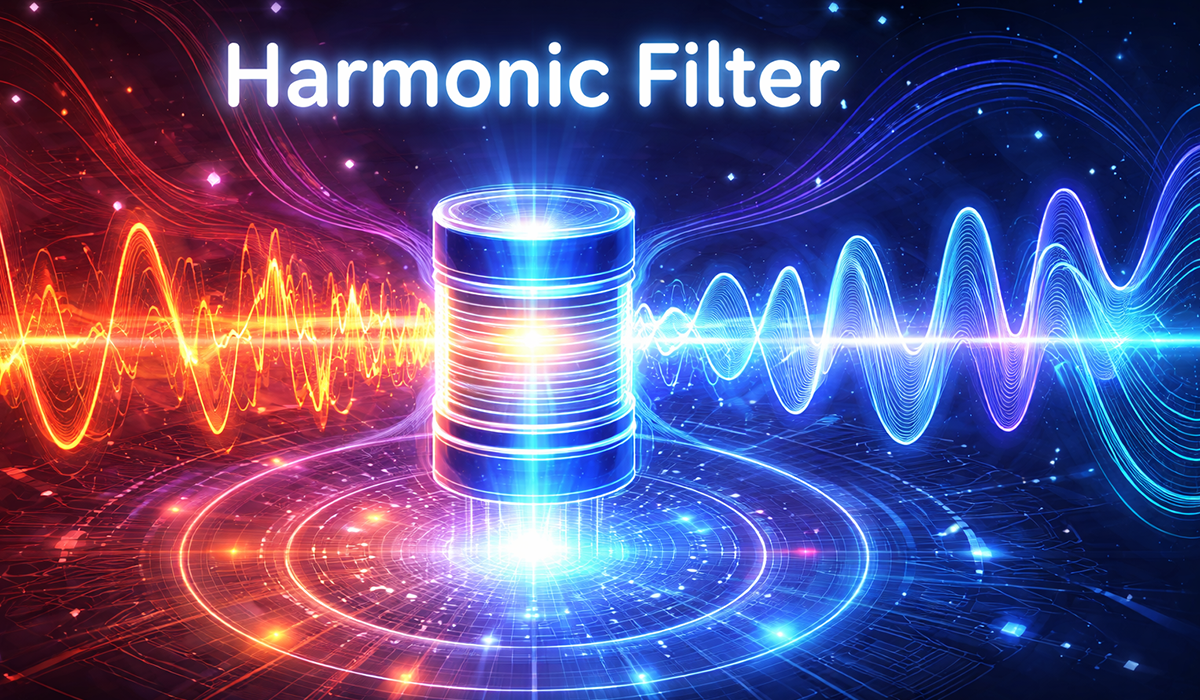
What Is a Harmonic Filter, and What Is It Used For?
In power networks, harmonics are current or voltage components whose frequency is an integer multiple of the network’s
fundamental frequency. In low-voltage (LV) networks with a 50 Hz fundamental frequency, harmonics at 150, 250, 350,
and 550 Hz contribute the most to waveform distortion. These components are typically created by non-linear loads and
cause the waveform to deviate from an ideal sine wave.
Harmonic sources are not limited to heavy industries. In industrial networks, equipment such as inverters, motor speed
control drives, 6-pulse rectifiers, and UPS systems are among the most important harmonic generators. In residential
and commercial buildings, switch-mode power supplies, TVs, computers, and LED lighting systems significantly increase
3rd, 5th, and 7th harmonics.
Harmonics become a serious challenge when a capacitor bank is added to the circuit for power factor correction. The
combination of the capacitor with the network’s inherent inductance can form a resonant circuit. If the resonance
frequency gets close to one of the dominant harmonic frequencies, the capacitor bank can experience a sharp rise in
current and voltage. This condition is typically associated with capacitor overheating, reduced equipment lifespan,
and higher failure risk.
If this article has been helpful, we encourage you to read the article on topic CE Marking for Industrial Control Panels for a deeper understanding of the subject.
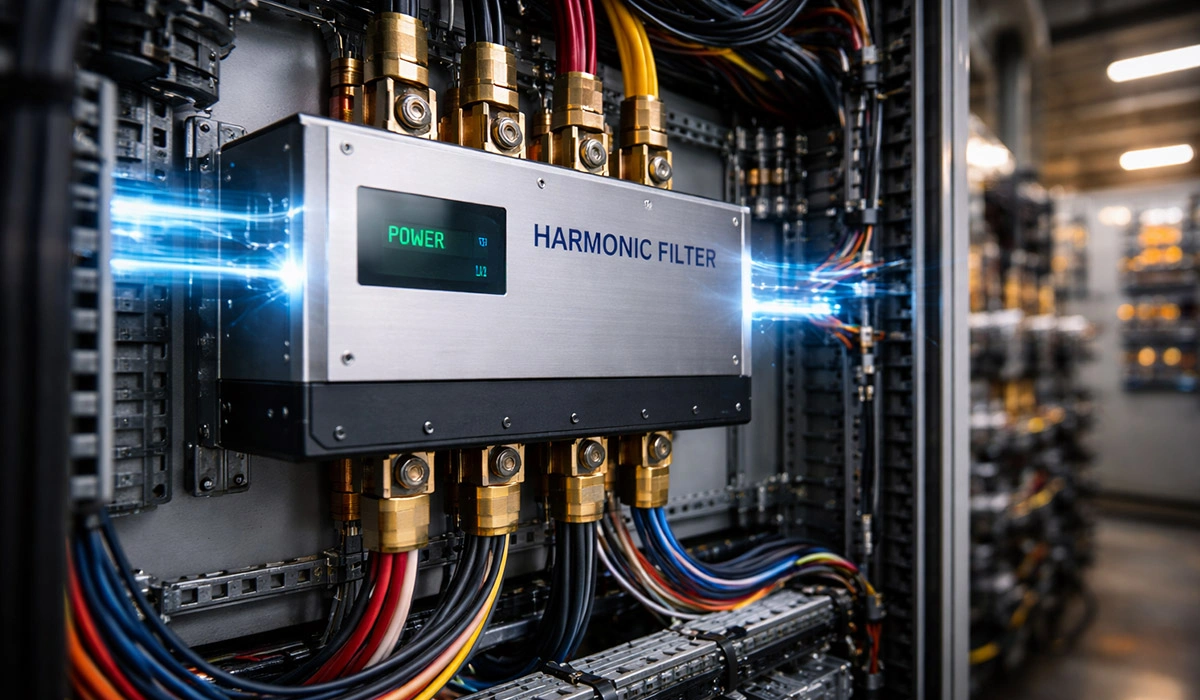
In such networks, a harmonic filter is used as an engineering solution to control this phenomenon. By shifting the
resonance frequency and limiting the flow of harmonic currents, a harmonic filter helps ensure safe capacitor bank
operation and maintains network stability in the presence of non-linear loads. That is why, in proper capacitor bank
design, using a harmonic filter is considered a technical requirement, not an optional feature.
Where Do Harmonics Occur, and Why Do They Matter?
Harmonics are extra currents or voltages in the power network that can reduce power quality and affect sensitive
equipment.
In industrial low-voltage networks, especially when speed changers for induction motors are installed, harmonics are
generated significantly and, if left uncontrolled, can cause equipment heating, shorter capacitor life, and disruption
in capacitor bank operation.
But harmonics are not limited to industrial environments. In residential and commercial buildings, many devices such
as TVs, computers, and energy-saving lamps also generate harmonics. If these abnormal currents are not controlled,
they may cause voltage fluctuations, malfunctions in electronic equipment, and reduced network efficiency.
To manage this issue, using a capacitor harmonic filter or a capacitor bank harmonic filter is a practical approach.
These filters reduce and control harmonic currents, prevent capacitor overheating, and improve network power quality.
So even in small residential and commercial buildings, correct harmonic filter installation can noticeably improve electronic equipment performance and extend the electrical system’s service life.
If this article has been useful, it is suggested that you read the article on topic How to find harmonics for more in-depth and accurate details.
What Is a Harmonic Filter?
- Controls harmonic currents and reduces waveform distortion caused by non-linear loads.
- Helps avoid resonance problems, especially when capacitor banks are used for power factor correction.
- Protects capacitors against overheating, overcurrent, and premature failure.
- Improves overall network stability and power quality.
If this article has assisted you, reading an article focused on topic Harmonic Filter will offer more extensive information
Common Harmonics in Power Networks
In theory, many harmonics can exist in a network, but in low-voltage networks, the 3rd and 5th harmonics have the
greatest practical importance. The 3rd harmonic is more common in office and commercial buildings and tends to
accumulate in the neutral conductor, while the 5th harmonic is the most common harmonic in industrial environments
and plays the biggest role in creating resonance with capacitor banks.
If you found this article beneficial, we suggest reading an article on topic Power Networks for more up-to-date and detailed information.
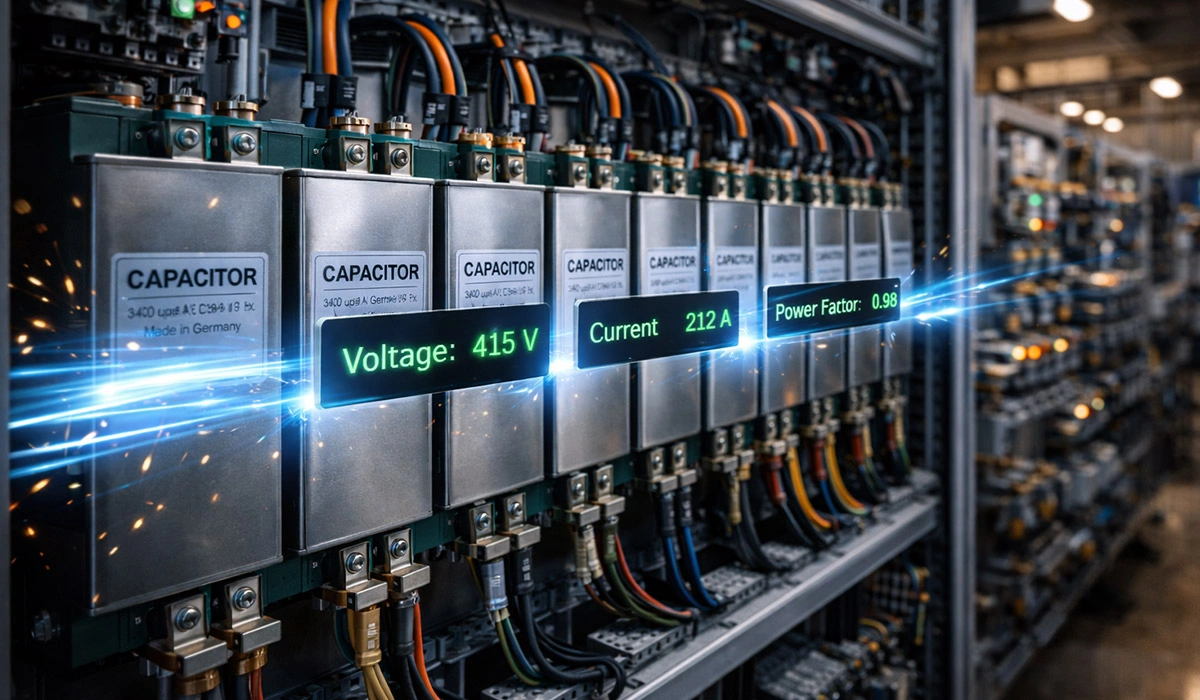
The Role of a Capacitor Harmonic Filter
- When tuned to a specific frequency (such as 7% or 14%), it prevents harmonic resonance.
- Protects capacitors and increases equipment stability and service life.
- Correct kVAR selection and filter tuning percentage are critical for safe operation.
- This point receives special attention in the design of Lifasa capacitor harmonic filters.
Types of Harmonic Filters and Their Applications
To control harmonics in low-voltage and industrial networks, two main categories of harmonic filters are used: passive
filters and active filters. The filter type selection depends directly on harmonic levels, load type, and the capacitor
bank structure.
Passive Harmonic Filter
Passive filters are the most common and cost-effective method for harmonic control in industrial networks. These filters
are made from a combination of a capacitor and a reactor, and they are tuned to a specific frequency.
Types of Passive Filters
- Detuned Filter (Detuned Filter)
In this type, the resonance frequency of the capacitor–reactor set is intentionally adjusted below the dominant
harmonic (usually the 5th harmonic), such as 7% tuning (189 Hz) or 14% tuning (134 Hz).
Its main application is preventing resonance and protecting the capacitor bank in networks with moderate THD. - Tuned Filter (Tuned Filter)
This filter is tuned exactly to the frequency of a specific harmonic (for example, the 5th or 7th harmonic) and
directly absorbs that harmonic.
It is mostly used in industrial networks with heavy loads and high harmonics.
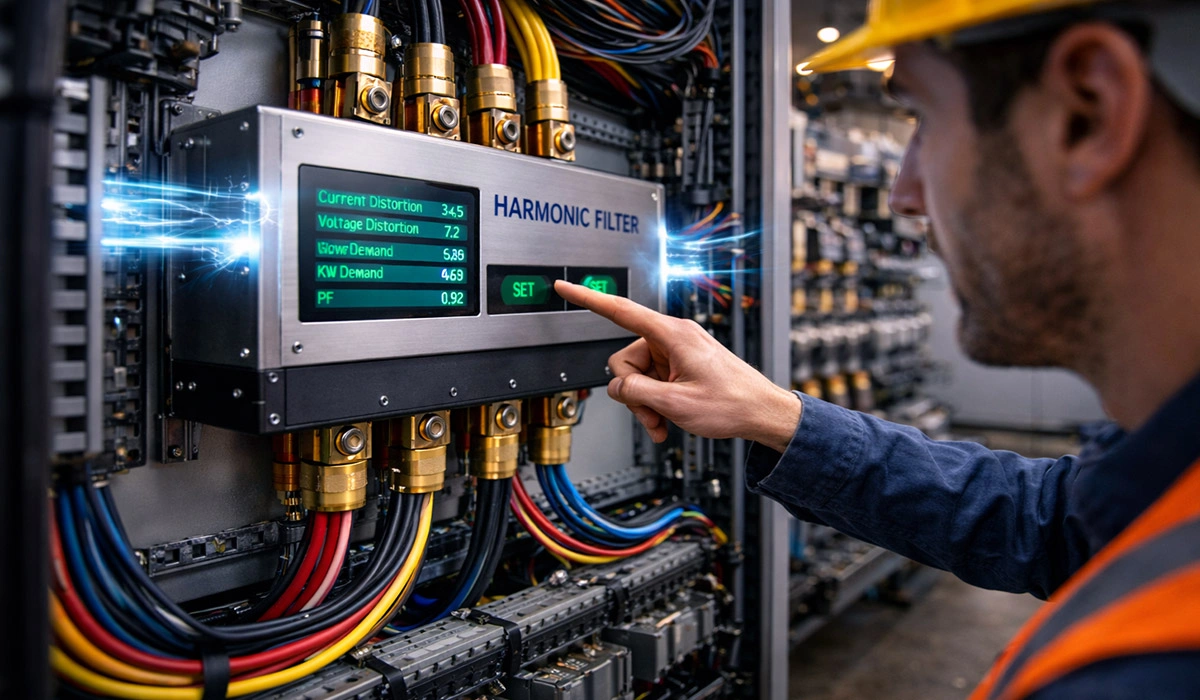
Active Harmonic Filter
An active filter is an electronic device that measures harmonics in real time, injects an inverse current, and eliminates
distortion.
These filters are used for:
- Variable and unpredictable loads
- Networks with multiple harmonic orders simultaneously
- Sensitive projects (data centers, hospitals, precision production lines)
However, high cost and maintenance complexity usually make them a complement to passive filters, not a complete replacement.
If you found this article useful, reading an article on topic Active Harmonic Filter is recommended for more specialized information.
Key Points in Capacitor Bank Design to Reduce Resonance
Resonance is one of the most dangerous phenomena in networks with capacitor banks. It occurs when a harmonic frequency matches
the network’s resonance frequency. To prevent it, the following points are essential:
- Checking THD percentage of current and voltage before designing the capacitor bank
- Correct selection of capacitor reactive power (kVAR) according to the network’s real load
- Using a detuned harmonic filter in the presence of dominant 5th or 3rd harmonics
- Coordinating the filter tuning frequency with the network structure (for example, 7% or 14%)
- Reactor and capacitor quality in terms of harmonic current capability and operating temperature
In proper design, the goal is not only power factor correction, but also network stability, longer equipment life, and preventing
hidden harmonic damage.
If this article has been helpful to you, we recommend reading the article on topic Understanding Capacitor Banks for more detailed and accurate information.
What Is THD, and Why Must It Be Checked Before Buying a Capacitor Harmonic Filter?
THD (Total Harmonic Distortion) is an index that measures the harmonic “pollution” of a power network and shows what percentage of
the network’s current or voltage deviates from the standard sinusoidal waveform. The higher the THD, the more non-linear loads such
as inverters, motor speed drives, UPS, and power electronics equipment are present in the network.
In practice, current THD (THDi) is the most important parameter for selecting a capacitor harmonic filter and designing a capacitor bank,
because it directly affects capacitor current and resonance probability.
Interpreting THD Percentage for Harmonic Filter Selection
- THD below 10%
The network is relatively healthy, and usually a simple capacitor bank without a special filter can be used, although using a detuned
filter is safer. - THD between 10% and 20%
This is the most common range in factories and buildings with drives and electronic equipment. In this condition, using a 7% detuned
capacitor harmonic filter (189 Hz) is recommended to prevent resonance and capacitor overcurrent. - THD above 20%
The network is heavily polluted with harmonics. In this situation, 14% filters (134 Hz) or a combination of passive and active filters
usually becomes necessary to protect the capacitor bank and equipment.
The Relationship Between THD and Choosing a Capacitor Bank Harmonic Filter
Ignoring THD is one of the most common reasons for early capacitor bank failure. If THD is not checked, the filter may be selected correctly
in terms of nominal rating, but in real operation it can be exposed to harmonic currents, leading to higher temperature, overcurrent, and
frequency resonance.
Correct Selection of Capacitor Reactive Power (kVAR) for the Network
To choose the correct capacitor rating, three main factors must be considered:
1) Real network load (required reactive power)
- Before purchase, determine the required reactive power by measurement or technical consultation.
- Choosing a capacitor below the requirement causes incomplete compensation; choosing a capacitor too large causes overcurrent and equipment damage.
2) Harmonic filter percentage (7% or 14%)
- 7% is suitable for networks with THDi between 10% and 20% and a dominant 5th harmonic.
- 14% is recommended for more polluted networks and where the 3rd harmonic is dominant.
3) Power distribution in the network
- It is better to split the required power into multiple lower-capacity capacitors to achieve better flexibility and control and reduce resonance risk.
Lifasa Harmonic Filter Product Selection Guide
| Capacitor Power (kVAR) | Harmonic Percentage | Application |
|---|---|---|
| 12.5 | 7% | Small network with medium load and THD 10–15% |
| 20 | 7% | Network with medium load and THD about 15% |
| 25 | 7% | Small industrial network and moderate non-linear load |
| 30 | 7% | Industrial network with several inverters and THD 15–20% |
| 40 | 7% | Large industrial network with high non-linear load |
| 50 | 7% | Large industrial network and multi-phase with high-power equipment |
| 12.5 | 14% | Polluted network with dominant 3rd harmonic |
| 25 | 14% | Industrial network with THD higher than 20% |
| 50 | 14% | Very polluted industrial network and heavy load |
Note: For large networks or variable loads, splitting the power into multiple lower-capacity capacitors is recommended for better control and to avoid overcurrent and resonance.
Final Summary
Harmonics can disrupt capacitor bank operation and overall network equipment, and higher THD increases resonance risk and reduces system lifespan.
Using a capacitor harmonic filter, choosing the correct capacitor kVAR, and selecting the proper tuning percentage (7% or 14%) help control harmonic currents,
protect capacitors, and stabilize the network.
Correct filter and capacitor selection must be based on the network’s real load, the dominant harmonic, and THD percentage. By following these principles,
the network becomes safer, and optimal performance and equipment lifespan are ensured.
FAQ
When is a harmonic filter required in a capacitor bank?
A harmonic filter becomes necessary when non-linear loads are present and harmonics increase resonance risk, especially near dominant harmonics such as the 3rd or 5th.
Which harmonics are most critical in low-voltage networks?
In practice, the 3rd and 5th harmonics are the most important in LV networks due to their common presence and their impact on neutral loading and resonance behavior.
How does THD affect harmonic filter selection?
THD indicates how distorted the network waveform is. Higher THD increases resonance probability and capacitor stress, so it strongly influences whether 7% or 14% tuning is more appropriate.
What’s the difference between passive and active harmonic filters?
Passive filters use capacitors and reactors tuned to specific frequencies, while active filters measure harmonics in real time and inject inverse current to cancel distortion.