If you’re building a DC power system for solar, marine, RV, or industrial use, understanding Victron busbar solutions can save you headaches, wasted money, and questionable wiring practices. At the simplest level, a busbar is a copper conductor that collects and distributes current at a common point. Unlike running dozens of separate cables that all struggle for space and heat dissipation, the busbar lets you bring multiple connections together with lower resistance and better mechanical stability.
Where most guides stop at part numbers, this one walks through what a DC busbar system actually does in a real installation, how to pick between Victron busbar 150A, 250A, and 600A options, and how it all plays with the broader Victron Lynx Distributor and Lynx Smart BMS ecosystem. Getting the right busbar sizing and layout affects performance, longevity, and safety in your battery bank and inverter system.
For a comprehensive understanding of how busbars function across different power distribution contexts, we highly recommend reviewing Electrical Busbars for Power Distribution Systems.
If you’d rather listen than read, feel free to play the audio file below for the rest of this article.
What Is a Busbar and Why Use One in DC Systems?
When you hear “busbar,” think of a metal strip inside your electrical panel that distributes power to various circuits. In electrical engineering, a busbar is a metallic conductor that handles high current, provides tap-off points, and lets connectors bolt directly onto it.
Why Busbars in DC Installations
In a DC distribution block for batteries and inverters, you want power flowing with as little resistance and thermal rise as possible. A busbar’s flat, broad copper shape provides excellent conductivity and cooling compared with bunches of cables. The surface area helps dissipate heat and keeps voltage drop low in high-current circuits.
Compared to conventional cable runs, busbars provide a neat, centralized battery bank connection point where everything ties together, allow easy branch connections without spaghetti-junction wiring, and improve reliability by reducing joins and crimps that create resistance and failure points. If you want a deeper primer on how busbars compare to cable systems, see this overview of electrical busbar systems and their advantages.
Where Victron Busbars Fit in Modern Installations
Victron’s busbars are designed as part of low-voltage DC distribution in 12 V, 24 V, and 48 V systems where inverters, chargers, solar controllers (MPPTs), and battery banks all need solid power feeds. A busbar is typically used upstream of your inverter or battery charger and downstream of the battery, serving as the common node for positive and negative DC feeds.
In many setups you’ll see battery negative and positive feeds bonded into a centralized busbar, DC loads and inverter inputs tied to busbar posts, and shunts, fuses, and monitoring tied in at the busbar spine. Instead of running dozens of separate wires between devices, busbars shorten run lengths, cut voltage drop, and keep your DC power distribution tidy and safe.
Victron Busbar Options at a Glance: 150A, 250A, 600A
Victron offers a range of standalone busbars rated for different current levels (typically 70 V DC rating). Each class comes with a set of high-current posts for main feeds and auxiliary low-current points for small circuits or monitoring. The choice comes down to expected load and future growth.
| Description | MODEL |
|---|---|
| Suitable for smaller systems with lower loads and fewer connections; compact footprint | 150A Busbar |
| Middle ground for most small to medium installs; good balance of posts and current headroom | 250A Busbar |
| High current with many posts; ideal for larger battery banks and multiple inverter systems | 600A Busbar |
| Modular DC busbar with integrated fuse slots and LED indicators; M8/M10 variants available | Lynx Distributor |
| BMS with main contactor and shunt built on a busbar platform; 500A and 1000A versions with M10 connections | Lynx Smart BMS |
Victron Busbar 150A vs 250A vs 600A
Think of these like plumbing pipe sizes. A 150A unit may be plenty if you’re running a modest inverter and a handful of loads. But if you’re planning room for expansion — bigger inverters, more DC circuits — a 250A or 600A unit gives headroom, and you’ll thank yourself when you don’t need to rewire mid-project.
For a comprehensive understanding of Victron Busbar, we highly recommend reviewing this article.
Choosing by Load & Growth
The short answer to what size Victron busbar you need: pick a busbar rated above your expected continuous current plus a margin. Your loads, inverter draw, and charging currents all count. Always plan for a safety margin — a busbar operating near its limit will run hotter and see more wear.
For example, a 12 V system with a 3 kW inverter may draw 250 A peak, so a 250A busbar gives that buffer. If you’re pairing multiple inverters or large DC loads, a 600A busbar is often wiser. A system that’s comfortable today can become cramped if you add gear — a bigger busbar now saves costly rewiring later.
Terminations & Accessories
On larger busbars like the 600A unit, you’ll find a mix of stud sizes: heavy posts for mains and smaller screws for auxiliary circuits, often in M8/M10 terminals that match lug sizes on cables and accessories. Always use the right terminal size for your cable lugs to avoid loose connections or uneven torque. Protective covers and insulating barriers reduce the risk of accidental shorts during maintenance.
Further exploration of Terminations can be found in the following recommended reading.
Inside the Lynx Modular DC Distribution System
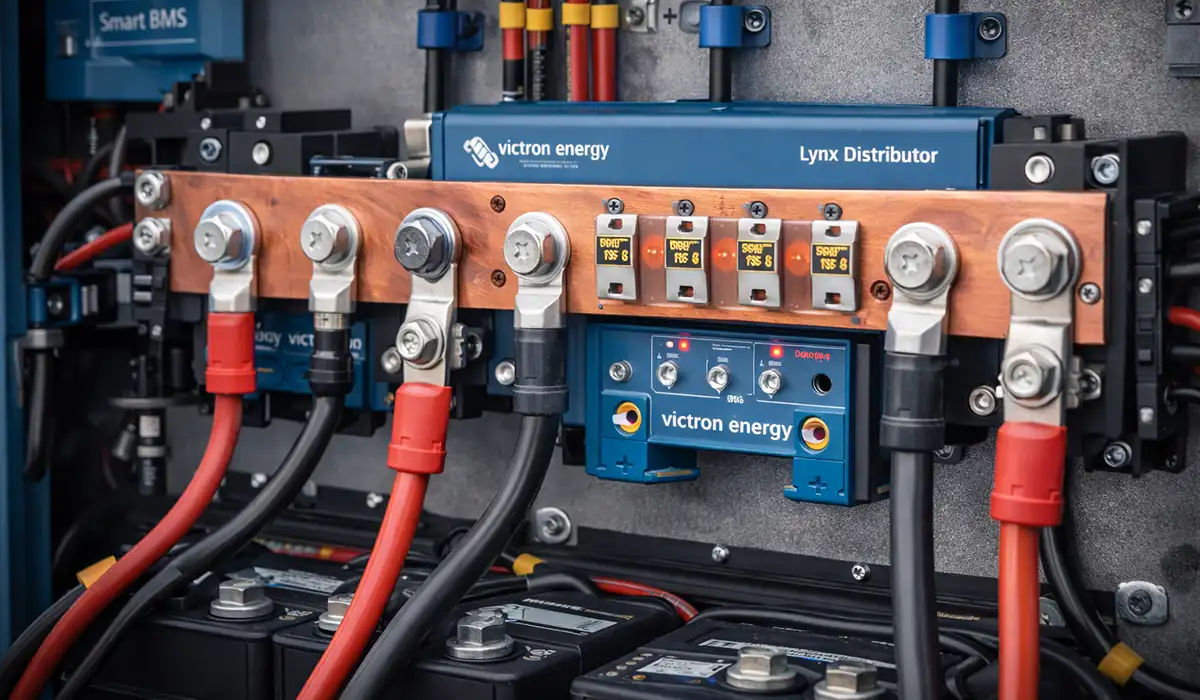
Victron’s Lynx Distributor takes the busbar concept further. It’s a modular DC busbar with built-in fuse slots and LED indicators that show the status of each fuse, adding a layer of protection and real-time visibility that a bare busbar doesn’t provide. The Lynx Distributor is available in both M8 and M10 variants, and its modular pieces let you build a backbone of DC distribution that’s much easier to service and expand than a one-piece busbar.
How the Lynx Distributor Works
At its core, the Lynx Distributor still gives you a positive and negative bus. What’s useful about it is the integrated fuse holders and LED state lamps that show when something has blown — this is significant in systems where you don’t want to guess which branch fuse has failed.
Lynx Smart BMS & Busbar Integration
A Lynx Smart BMS isn’t just a busbar — it’s a battery management system with a main contactor and shunt, built on a busbar platform. It comes in 500A and 1000A versions, both with M10 busbar connections, and integrates directly with Victron’s modular Lynx system. The batteries connect through it, and downstream modules like Lynx Distributors and shunts carry on the distribution. The BMS monitors state of charge, can warn via Bluetooth or GX device, and provides a safe disconnect if something goes wrong.
Example Stack: Batteries → Lynx Smart BMS → Lynx Distributor → Inverter/Loads
Here’s a high-level wiring flow you’ll see in robust systems. The battery bank ties into the Smart BMS or primary busbar. The Smart BMS feeds into one or more Lynx Distributors. Each Lynx Distributor routes power to inverters, chargers, and DC loads via fuses. Monitoring devices like a shunt or GX hub give feedback on current and state of health. This approach keeps batteries isolated, protected, and easy to service without a tangle of individual cables.
If you’re curious about how the Smart BMS interfaces with larger systems, check this technical overview of BMS and distribution integration pdf.
Standards & Best Practices for Sizing and Safety
Just because a busbar is rated at 600A doesn’t mean you can ignore standards. Assemblies like these are part of the overall enclosure and should respect low-voltage assembly norms like IEC 61439 and, where applicable, UL 508A for industrial control panels. IEC 61439 covers design verification and requirements for switchgear and controlgear assemblies up to 1500 V DC, calling out tests for temperature rise, short-circuit withstand, and mechanical integrity. UL 508A, common in North America, emphasizes construction rules and component choice for industrial panels.
Understanding how these standards apply to distribution boards more broadly is equally useful. This article serves as a valuable resource for those seeking detailed information on Types of Electrical Power Distribution Boards.
Calculating Current & Temperature Rise Considerations
When sizing your busbar and wiring plan, consider continuous vs intermittent loads, ambient temperature, and enclosure ventilation. A busbar running near its rated limit in a cramped, hot enclosure will see more temperature rise than the same part in a ventilated cabinet. Derating for temperature and knowing how much continuous current your layout will carry helps you pick the right busbar class and mounting position. Follow manufacturer torque specs on terminals to keep resistance low and heating in check.
Overcurrent Protection & Fuse Coordination
Selecting the right fuse for Victron busbar setups is more than eyeballing amps. You want fuses whose interrupt ratings handle potential fault current and whose characteristics match system behavior. In a modular Lynx setup, the integrated fuse slots take standard Mega-style fuses that help protect branches off the main bus. Correct coordination between main, branch, and device protection stops a single fault from taking down your whole DC network.
Installation: Wiring, Torque, and Layout Tips
Practical wiring tips make your installation safer and easier to maintain. Mount busbars close to batteries and inverters to minimize voltage drop. Use cables with the correct lug size and rated insulation, and label everything clearly — DC busbar layout clarity saves troubleshooting time. Respect torque specs on M8 vs M10 terminals to avoid loose connections. Common mistakes include stacking too many lugs on one post, mixing terminal sizes without adapters, and ignoring protective covers, all of which compromise safety and performance.
Power factor also plays a role in sizing decisions for AC-coupled systems tied to these DC distributions. If you are looking for more information about how power factor affects electrical system design, it is recommended not to miss reading Power Factor in Electrical Systems.
Common Mistakes to Avoid
Even seasoned installers sometimes slip up. Typical pitfalls include ignoring the difference between M8 and M10 terminals and forcing mismatched hardware, stacking too many cables under one lug leading to uneven torque, skipping protective barriers which invites accidental shorts, and undersizing fuses or placing them incorrectly relative to the busbar feed. Avoiding these saves time and prevents shock hazards or system downtime.
Conclusion
Sizing, wiring, and integrating a Victron busbar into your power system is more than a parts list. It’s about creating a DC distribution backbone that’s safe, scalable, and compatible with the rest of your system — whether that’s a simple inverter in an RV, a home solar setup, or an industrial energy storage system. Choosing between Victron busbar 150A, 250A, and 600A isn’t guesswork: it’s about matching your expected currents, leaving room for growth, and respecting practical layout principles that reduce voltage drop and heat.
By incorporating modular components like the Lynx Distributor and Lynx Smart BMS, you build in visibility and protection that go beyond bare copper bars. Following standards like IEC 61439 and wiring best practices ensures your assembly isn’t just functional but resilient. With thoughtful planning and attention to connection details, you end up with a distribution network that’s clean, safe, and ready for upgrades.
FAQs
Can I Connect Multiple Batteries and Loads to One Victron Busbar?
Yes. Choose a busbar with enough posts and current rating for all connections and add branch fuses for each outgoing circuit. The key is ensuring the total continuous current from all connections stays within the busbar’s rating with a reasonable safety margin.
What’s the Difference Between the Lynx Distributor and a Plain Busbar?
The Lynx Distributor adds integrated fuse positions and LED status indicators, making it more than a simple copper bar. It gives you per-branch protection and real-time fault visibility, which is valuable in any installation where you can’t afford to hunt for a blown fuse under load.
Do I Need M8 or M10 Terminals?
Match the terminal size to the connected gear — many smaller modules use M8, while larger systems like the Lynx Smart BMS 1000 use M10. Forcing mismatched hardware is a common mistake that leads to uneven torque and loose connections over time.
What Voltage Are Victron Busbars Rated For?
Victron DC busbars are typically rated at 70 V DC. Ensure your system voltage and short-circuit capability align with this rating before sizing your installation.
Are Busbars Compliant with IEC 61439 / UL 508A?
The components themselves are product-rated; full compliance depends on the overall assembly meeting the relevant standard. If you’re building a panel that must carry a certification, the entire assembly — not just individual parts — needs to be verified against IEC 61439 or UL 508A requirements.