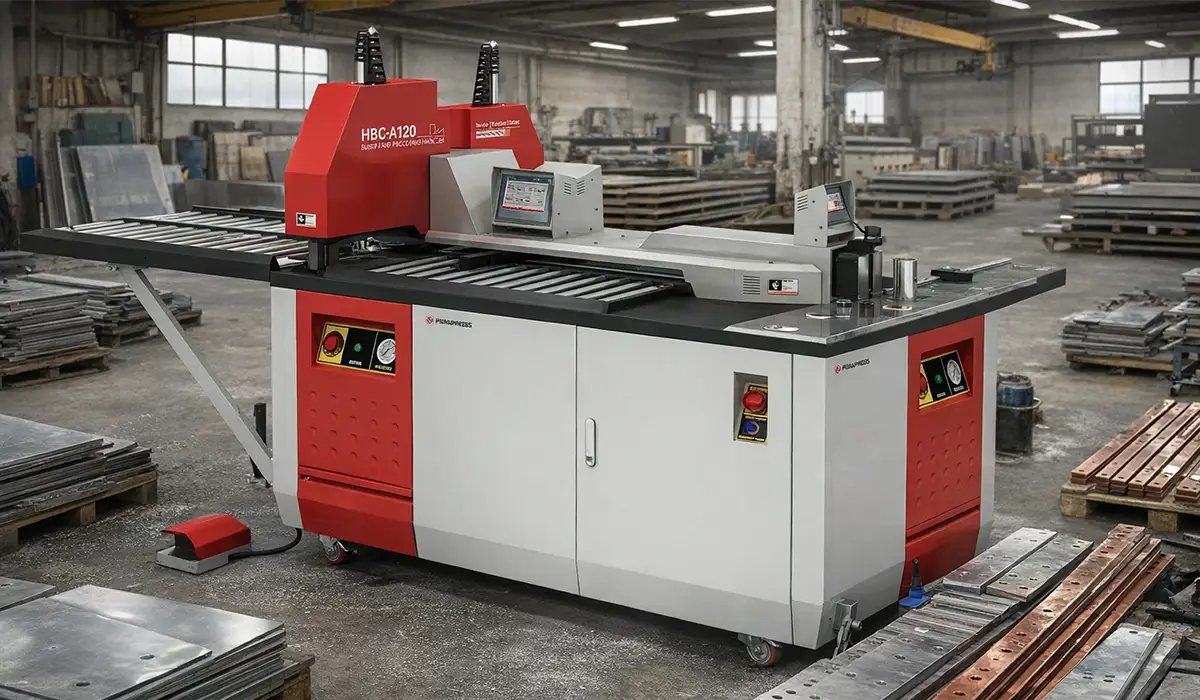
In the fast-paced world of electrical manufacturing, efficiency and versatility are key to staying competitive. The traditional approach involved using separate machines for cutting, punching, and BENDING BUSBAR, which often led to increased space requirements, higher costs, and longer production times. Today, innovative solutions like PAYAPRESS’s multi-functional BUSBAR MACHINE are transforming the industry by offering integrated capabilities that bring numerous advantages.
Prefer listening? You can play the audio version of the rest of this article below.
The Concept of a 3-in-1 Busbar Machine
A 3-in-1 BUSBAR MACHINE combines three essential processes—cutting, punching, and bending—into one compact, efficient unit. This integration allows manufacturers to perform multiple operations without transferring workpieces between different machines, streamlining the entire fabrication process. Unlike conventional setups, a 3-in-1 machine is designed to handle copper, aluminum, and other conductive materials with precision, making it a cornerstone of modern electrical panel assembly and switchgear production.
The three core functions integrated into this machine include:
- Cutting: Clean, burr-free shearing of busbars to exact lengths using hydraulic or mechanical blades.
- Punching: High-precision hole punching for mounting and connection points, with interchangeable die sets.
- Bending: Accurate angle bending up to 90° and beyond, guided by digital indicators to ensure repeatability.
If you are looking for more information about Busbar Fabrication Machines, it is recommended not to miss reading this article.
Key Benefits of Multi-Function Busbar Machines
1. Space Savings
Traditional setups require multiple dedicated machines, consuming valuable workshop space. A single multi-functional machine consolidates these operations, freeing up space for other equipment or workspace environment improvements. On average, manufacturers report a floor space reduction of up to 60% when switching from individual machines to an integrated busbar processing unit.
2. Cost Efficiency
Investing in one versatile machine reduces capital expenditure compared to purchasing separate units. Additionally, it lowers overhead costs related to maintenance, energy consumption, and machine operation. The total cost of ownership (TCO) of a 3-in-1 solution is significantly lower when factoring in spare parts, operator training, and energy bills over a 5-year lifecycle.
3. Enhanced Productivity
With multiple processes occurring within one machine, production cycles are shortened. Operators can switch between functions seamlessly, significantly increasing throughput and minimizing downtime. Studies show that integrated machines can reduce cycle time per busbar by up to 40% compared to multi-machine workflows.
For a comprehensive understanding of Busbar Fabrication Machinery, we highly recommend reviewing this article.
4. Improved Accuracy and Consistency
Performing all operations on one machine reduces errors caused by moving workpieces between different tools. The likelihood of misalignment during transfer is eliminated, leading to higher precision in dimensions and better overall quality. This is particularly critical in high-voltage switchgear applications where dimensional tolerances are tight.
Further exploration of Busbar can be found in the following recommended reading.
5. Simplified Workflow and Reduced Handling
Having an integrated machine simplifies workflow, making it easier for operators to manage tasks, optimize sequences, and maintain quality control. Reduced handling also decreases the risk of damage or contamination to sensitive busbar surfaces, especially in copper busbar fabrication where surface quality directly impacts conductivity.
6. Flexibility in Manufacturing
Multi-functional busbar machines accommodate various sizes and types of busbars, providing manufacturers with the flexibility to adapt to different job requirements quickly and efficiently. Most PAYAPRESS models support busbar widths from 20mm to 200mm and thicknesses up to 15mm, covering the vast majority of industrial applications.
Further exploration of Flexibility in Manufacturing can be found in the following recommended reading.
7. User-Friendliness
Modern integrated machines, like those from PAYAPRESS, feature intuitive interfaces, programmable settings, and digital controls, making them accessible even for operators with limited experience. Training time is reduced considerably thanks to centralized controls and clear visual feedback systems.
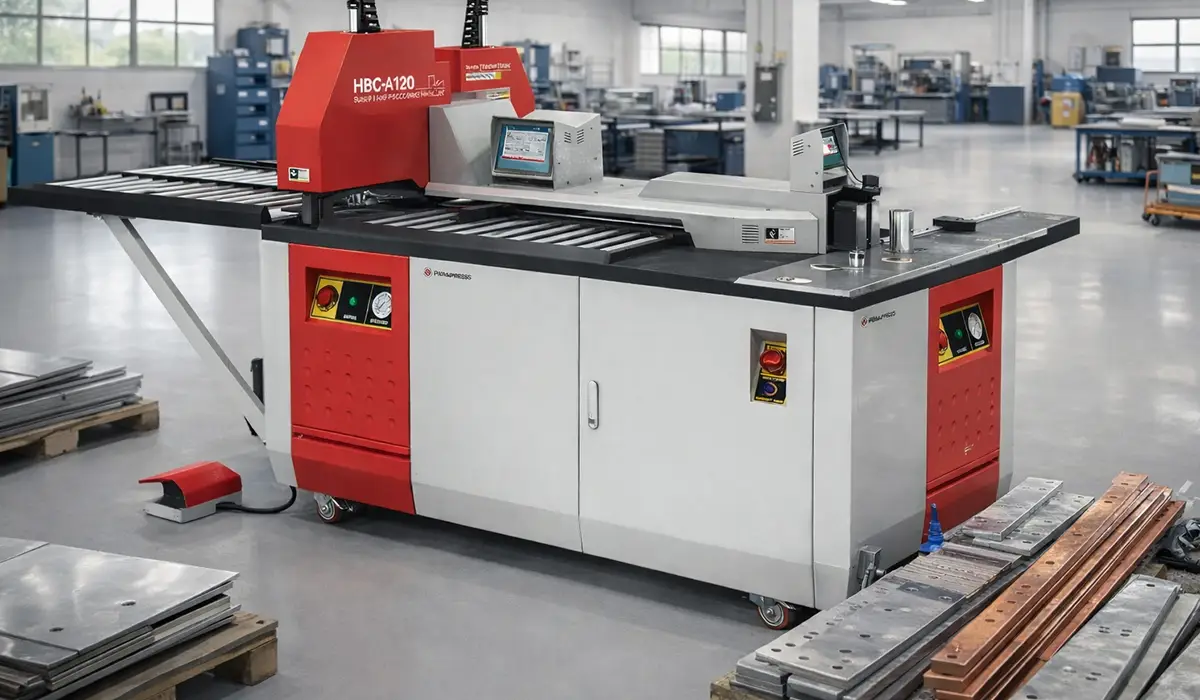
Traditional vs. 3-in-1 Busbar Machine: A Comparison
Below is a side-by-side comparison between using separate individual machines and a PAYAPRESS 3-in-1 integrated busbar processing machine:
| 3-in-1 Integrated Busbar Machine (PAYAPRESS) | FEATURE |
|---|---|
| Single compact unit replaces 3 separate machines — saves up to 60% floor space | Floor Space Required |
| One-time investment with significantly lower total cost of ownership | Initial Investment |
| One machine to maintain — lower spare parts inventory and service costs | Maintenance Cost |
| Up to 40% faster cycle times — no workpiece transfer between stations | Production Speed |
| High precision — digital indicators and programmable stops eliminate human error | Dimensional Accuracy |
| Minimal handling — reduces risk of surface damage and contamination | Workpiece Handling |
| One operator can manage all three functions from a centralized control panel | Operator Requirement |
| Supports copper, aluminum busbars from 20mm to 200mm wide, up to 15mm thick | Material Compatibility |
| Industry 4.0 ready — real-time monitoring, remote diagnostics, and data logging | Smart Connectivity |
| Rapid tooling changeover with interchangeable die sets for various hole patterns | Setup Flexibility |
| Lower energy draw per part produced due to optimized hydraulic system | Energy Consumption |
| Reduced training time — intuitive HMI interface with guided operation modes | Ease of Training |
Why Choose PAYAPRESS Multi-Functional Busbar Machines?
PAYAPRESS has established itself as a leading manufacturer of busbar processing equipment, trusted by electrical panel builders, switchgear manufacturers, and power distribution companies worldwide. PAYAPRESS’s 3-in-1 busbar machines are engineered with advanced features that set them apart from the competition:
- Programmable length stop for precise PUNCHING and repeatable cutting operations
- Digital bending indicators for accurate, consistent bends across large production runs
- Industry 4.0 connectivity for real-time feedback, remote diagnostics, and production monitoring
- Hydraulic power unit optimized for quiet operation and energy efficiency
- Interchangeable tooling to handle a wide variety of busbar profiles and hole patterns
- Robust steel frame construction ensuring long-term durability in demanding industrial environments
Industries That Benefit Most from 3-in-1 Busbar Machines
The PAYAPRESS 3-in-1 machine is the ideal solution across a broad range of sectors, including:
- Electrical panel and switchboard manufacturing
- Power distribution equipment production
- Railway and transportation electrification
- Renewable energy (solar inverters, wind power substations)
- Industrial automation and motor control centers (MCCs)
- Data center power infrastructure
If the information related to Busbar Machines was interesting and informative to you, researching 3D Busbar Processing Machine can be very engaging.
Conclusion
Integrating multiple BUSBAR PROCESSING functions into a single machine offers substantial advantages—saving space, reducing costs, increasing productivity, and ensuring consistent quality. As the electrical manufacturing industry continues to evolve, the demand for smarter, faster, and more flexible production tools will only grow. For manufacturers looking to optimize their operations, investing in PAYAPRESS’s multi-functional busbar machines is a strategic decision that delivers measurable returns from day one. Embracing this technology will not only streamline your workflow but also elevate the quality, consistency, and competitiveness of your products for years to come.