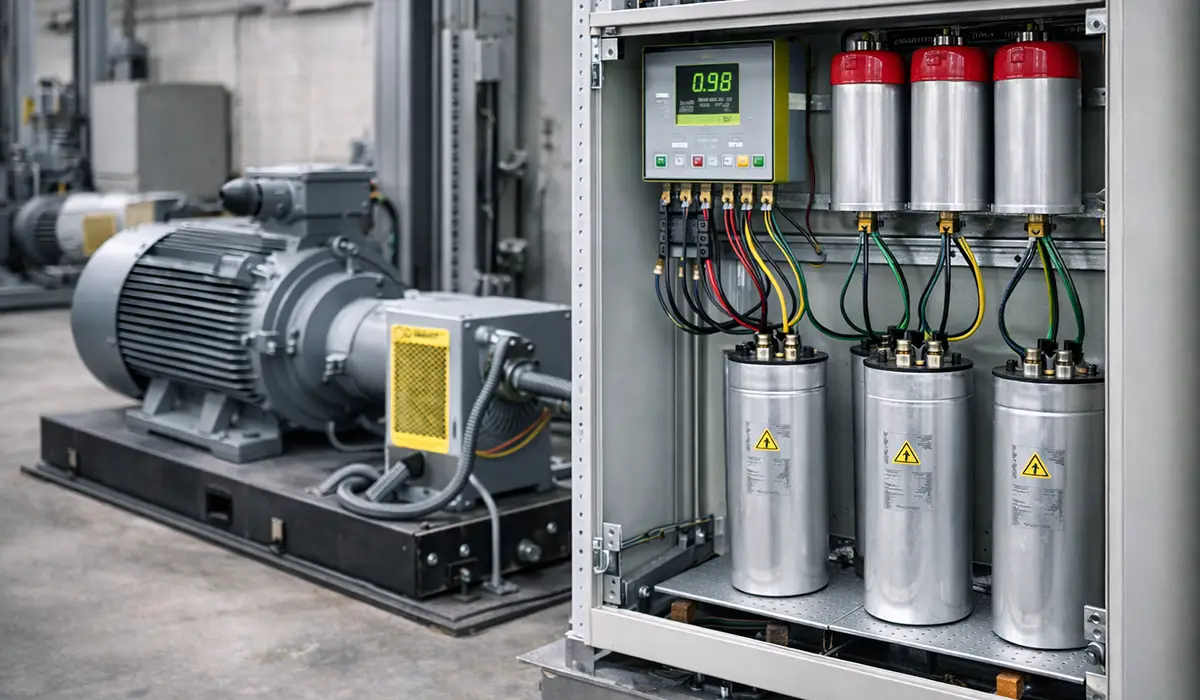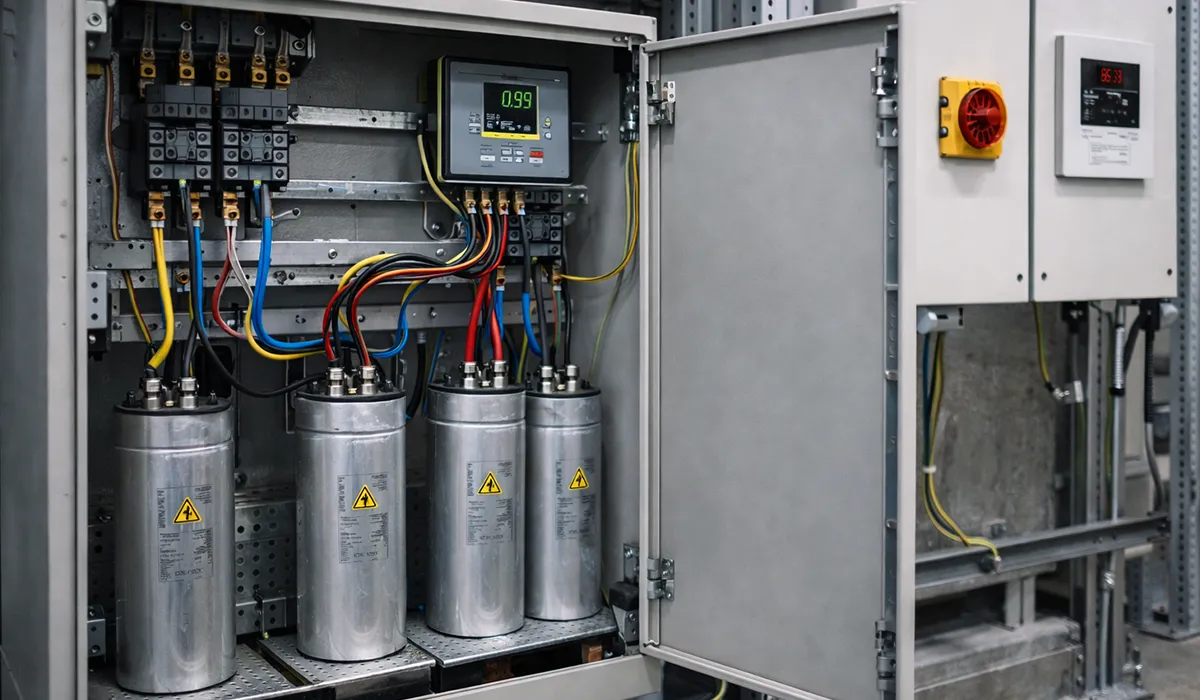
Power factor (cos φ) is one of the most important concepts in AC electrical systems because it directly affects efficiency, energy losses, voltage drop, and electricity costs. In this article, we explain active, reactive, and apparent power in simple terms, then review power factor correction methods, required equipment, and key capacitor bank design considerations.
If you’d rather listen than read, feel free to play the audio file below for the rest of this article.
What is Power Factor?
Power factor, power coefficient, or cos φ, is the ratio of active power (real power) to apparent power.
In loads (consumers), three types of power are defined: apparent power (S), active power (P), and reactive power (Q). Active power is the real power and the power of resistive loads, shown in watts (W). Reactive power is an imaginary power defined to compare the power of inductors and capacitors, and apparent power is the vector sum of active and reactive power. If the reactive power of a capacitor increases, the energy required to charge and discharge it increases, but ultimately it does not consume it. This power is expressed in kVAR.
Let’s explain this concept with a cup of cappuccino. You have a cup of cappuccino. The part of the cup filled with coffee is the real power or active power. The part filled with cream or foam is reactive power, which is usually not fully consumed, and the entire cup is apparent power. You pay for the whole cup, but in practice you do not consume the cappuccino foam.
Table 1 — Types of Power in AC Electrical Systems
| Definition | Actually Consumed? | Unit | Symbol | Type of Power |
|---|---|---|---|---|
| Real power consumed by resistive loads; performs useful work | Yes | W / kW | P | Active (Real) Power |
| Imaginary power of inductors and capacitors; not consumed but occupies network capacity | No | VAR / kVAR | Q | Reactive Power |
| Vector sum of active and reactive power: S = √(P² + Q²) | Partial | VA / kVA | S | Apparent Power |
The Vector Concept of Apparent and Reactive Power, and the Definition of Leading and Lagging
As we said, apparent power is the vector sum of active and reactive power. Let’s examine the vector concept of power.
A circuit with a resistive load has current and voltage waveforms in phase, but in a circuit with a reactive load (capacitive or inductive), the inductor and capacitor do not consume power but occupy network capacity because they draw current. A capacitor draws leading current, meaning it produces lagging current (for the inductor). The inductor consumes lagging current. In the waveform of a capacitive load, the current leads the voltage. In electrical systems that are a combination of resistive and reactive loads, the combination of active and reactive power components is introduced as total power or apparent power and is shown in kilovolt-ampere (kVA).
So a phase difference is created between voltage and current, and in fact both parameters are vector quantities. Since power is the product of voltage and current, power is also a vector quantity. If the angle between the voltage and current of the load decreases (power factor increases), the amount of active power consumed becomes closer to apparent power, and therefore the reactive power consumed decreases. One method to correct this angle is using a capacitor bank, which we will discuss further below.
The Importance of Power Factor Correction and cos φ Compensation
One of the policies of the Ministry of Energy, to apply electrical energy consumption management, is in the form of setting laws and regulations related to power factor correction and also tariffs related to consumed energy.
To the extent that the power factor of consumers increases, the current passing through the network (for a constant consumed power) will decrease, which causes reduced losses, reduced voltage drop, and increased capacity of lines, transformers, and so on. On the other hand, by managing electricity tariffs, consumers can be guided toward consumption during hours when the cost of consumed energy is lower (light load).
Here, we examine the necessity and methods of power factor correction, as well as electricity tariffs, in order to free capacity in distribution and transmission networks and also reduce the cost of energy consumed by subscribers.
Most electrical devices and consumers require some reactive power to provide the necessary conditions to perform useful work. For example, an electric motor, to convert electrical energy into mechanical energy, needs to generate magnetic flux in the motor air gap and cannot create electromotive force without reactive power.
Also, power electronics systems, voltage stabilizers, induction and electric arc furnaces, AC and DC welding systems, unbalanced load balancers, equipment with nonlinear characteristics, and so on require reactive power. But this power adds network current and, as a result, causes voltage drop and increases power losses along the path as heat. Among the losses imposed on the network in this state are:
- Adding generator current and the need for generators with higher power
- Increasing network current (need for cables with larger cross-sectional area)
- Power loss in distribution networks (heat generation and voltage drop)
So we must know what power factor means exactly and what effect it has in the system. Then we must understand power factor correction methods and the equipment required for compensation.
Energy Price Tariffs
In calculating the energy price, maximum demand and active and reactive energy are considered separately. In most contracts, the maximum reactive consumption is considered equal to 50% of active consumption.
Reactive consumption is subject to cost if it is more than 50% of active consumption, which corresponds to a power factor of 0.9. It is recommended that a higher number such as 0.92 be considered for calculation so that we have reserved capacitive capacity. For a broader understanding of how electricity tariffs are structured, consulting national regulatory guidelines is advised.
Demand Tariffs
In this case, the basis of consumption is the customer’s maximum power consumption during a specific month. If apparent power, not active power, is the basis, it is noted that you should select the capacitor amount so that cos φ = 1 becomes the target.
Parts Used in Power Factor Compensation Along with the Capacitor
Industrial capacitors are in two categories: low-voltage capacitors and medium-voltage capacitors.
Table 2 — Comparison of Low-Voltage and Medium-Voltage Capacitors
| Low-Voltage Capacitor | Medium-Voltage Capacitor | Feature |
|---|---|---|
| Below 1,000 V | Above 1,000 V | Voltage Range |
| Dry | Oil-filled | Insulation Type |
| Single-phase or three-phase — delta | Single-phase or three-phase — delta | Connection Type |
| IEC70, VDE0560, DIN4800, ISIR2781 | IEC 60143 / IEC 60871 | Standards |
| Industrial LV panels, local motor correction | MV transmission and distribution substations | Typical Application |
Low-voltage industrial capacitors fall into the following categories:
- Capacitors with voltage less than 1000 V
- Dry capacitor
- Single-phase or three-phase connection in delta connection
Medium-voltage capacitors fall into the following categories:
- Capacitors with voltage above 1000 V
- Oil-filled capacitors
- Single-phase or three-phase capacitor with delta connection
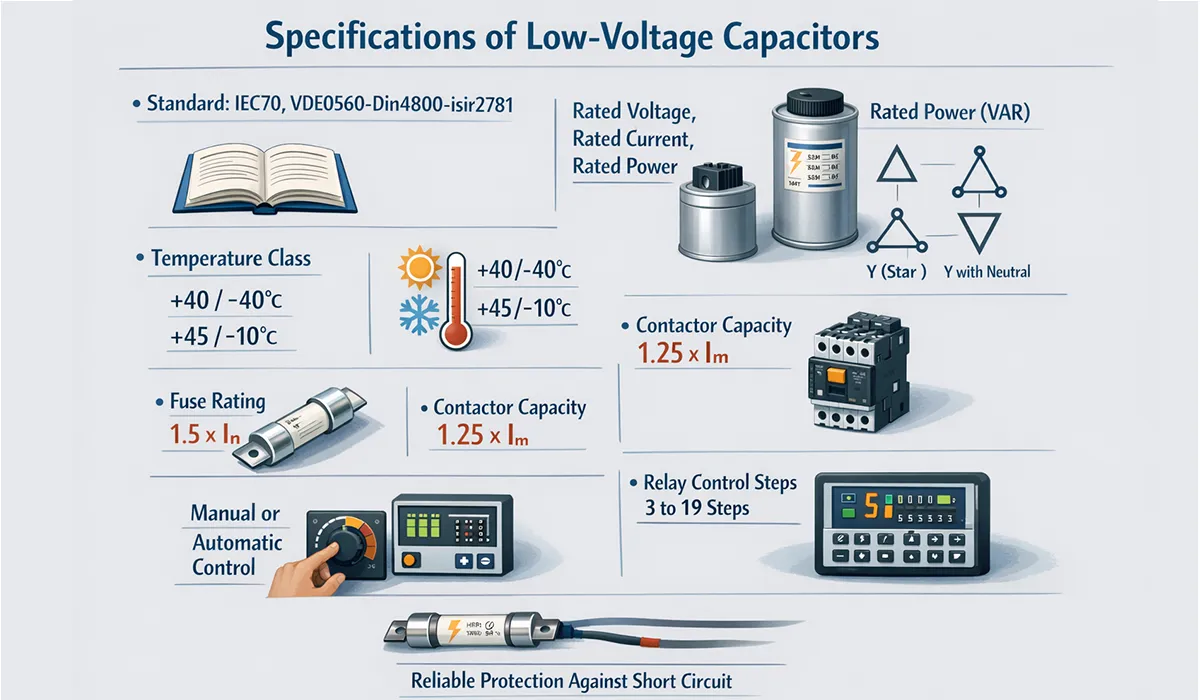
Specifications of Low-Voltage Capacitors
- Standard: IEC70, VDE0560-Din4800-isir2781
- Rated voltage, rated current, rated power (VAR capacity), active losses, ambient temperature, cooling temperature, maximum and minimum capacitor operating temperature, type of connection to the network
- The temperature class for maximum and minimum operating temperature of the capacitor is +40/−40, +40/−20, +40/−10, +45/−10.
- A three-phase capacitor can be connected as Y (star), Δ (delta), Y (star with neutral point), lll (three sections without internal connections).
- The power of a three-phase capacitor unit must be stated as the sum of the three-phase power.
- The capacity of the fuse switch installed in the capacitor feeder path must be 1.5 times the capacitor current.
- If a contactor is used, its capacity (after applying thermal coefficients) is 1.25 times the maximum resulting current.
- For more reliable protection of the capacitor against short circuit, HRC fuses or a factor of 1.5 times the rated capacitor current is used.
- At low voltage and very small loads, power adjustment by manual control is possible.
- For automatic control and adjustment of active power, active power measuring relays, current-sensitive relays, or timers can be used.
- In small industrial consumers and also group compensators, using a current relay is better.
- In a uniform and predictable load, a time relay can be used. The best control method is a relay sensitive to reactive power. The capacitor steps can be programmed from 3 to 19 steps. The value of each step and the number of steps depend on load conditions.
Table 3 — Standard Industrial Capacitor Ratings (kVAR)
| # | Rating (kVAR) | Common Application | Voltage Class |
|---|---|---|---|
| 1 | 5 | Small motors, local compensation | LV |
| 2 | 10 | Small to medium loads | LV |
| 3 | 12.5 | Small industrial loads | LV |
| 4 | 15 | Medium-duty motors and equipment | LV |
| 5 | 20 | Small to medium industries | LV |
| 6 | 25 | Central LV panels | LV |
| 7 | 30 | Heavy industrial loads | LV |
| 8 | 40 | Large industrial loads | LV |
| 9 | 50 | Industrial plants | LV |
| 10 | 60 | Distribution substations | LV |
| 11 | 100 | Large central compensation banks | LV |
The Role of Fuses in Reactive Power Compensation
According to the short-circuit level in capacitor banks, HRC (High Rupture Current) fuses must be used to protect against overcurrent. The fuse current rating, according to the standard, is selected from 4.1 to 5.1 times the rated current of the capacitors. These fuses have high breaking capacity. To protect capacitor banks, fuses are used that react quickly to short circuit and overload and disconnect. For this reason, knife fuses or disconnectors are used.
Operation of Discharge Resistors in Power Factor Correction
To reduce the voltage across power factor correction capacitors after they are taken out of the circuit, resistors connected to the capacitor terminals are used. The value of these resistors varies depending on the capacitor power.
This resistor must be able to reduce the voltage within 3 minutes after disconnecting the capacitors to a low-risk level (below 75 V). In special cases where the capacitor is directly connected to the motor windings, there is no need for a discharge resistor, and contact with the live parts of the capacitor must be avoided until the motor comes to a complete stop. According to the standard, capacitors must be charged to a maximum of 10% of the rated voltage for reconnection to the circuit.
The discharge resistor is calculated by the manufacturer based on the capacitor power and is connected to the capacitor during unit construction. Also, the discharge time is specified on the capacitor nameplate. In cases where fast discharge of the capacitor is needed for switching into the circuit, a fast discharge circuit is used instead of a resistor.
Using a Thyristor Switch in a Power Factor Correction Circuit
In cases where power factor changes are rapid, a thyristor switch should be used instead of a capacitor contactor. These parts, together with a fast discharge circuit, are connected to the capacitor and can insert the capacitor into the circuit 5 milliseconds after it is taken out of the circuit.
Using an Intelligent Regulator in a Capacitor Bank
In addition, by using an intelligent regulator, a lot of information can be obtained from the circuit much more easily. The intelligent regulator for managing capacitor banks is designed and manufactured in two models, 6-step and 12-step. Advantages of the intelligent regulator include control and measurement of voltage, power, load current, reactive current, voltage harmonic distortion, cos φ, capacitor connection steps, the number of capacitor switching operations, recording the date of alarms, and measuring the ambient temperature inside the electrical panel.
This device measures the load power factor and inserts the required capacitor amount (step-by-step) into the circuit. In other words, by measuring the consumer voltage and current, the power factor is calculated, and considering the desired power factor (usually 0.9), the required reactive power is calculated. The regulator output, in proportion to this reactive power, inserts suitable steps (or removes them from the circuit).
If the total capacitive reactive load is Q, it can be divided into small steps q. Increasing the number of steps helps the accuracy of the result, but the number of contactors and other equipment increases and causes higher cost.
Capacitor Contactor in a Capacitor Panel
Another important piece of equipment in this method of power factor correction is the capacitor contactor. Due to the very high current of capacitors (at switching-on), using ordinary contactors causes the contacts to be destroyed in less than their useful lifetime.
To insert each capacitor of the capacitor bank into the circuit, a capacitor contactor is used. The capacitor contactor can be controlled by the intelligent regulator. For example, if we have 9 capacitors of 25 kVAR, 9 capacitor contactors and one 8-step regulator are used. For each capacitor, a separate fuse must be used, and only one control circuit can be used for the capacitor bank.
First, two capacitors enter the circuit, and the next capacitors are added in pairs, and after capacitors 1 and 2 enter the circuit, capacitors 3 through 8 enter the circuit one by one in order.
The Concept of Power Factor Correction in Plain Language
Power factor correction is a technique to reduce the negative effects of reactive loads in an AC power network. But as stated, the load needs reactive power. Therefore, the reactive power required by the consumer must be supplied by a way other than the network, because increasing reactive power generation in power plants increases generator excitation current, which faces dynamic limitations.
Power factor is usually a number between zero and one, where one and values close to it are considered desirable. Correction or reduction of the power factor leads to increased losses. The lost power at a power factor less than one indicates reactive power. Reactive power leads to increased overload and increased electricity costs. Inductive loads and harmonics are among the reasons for a reduced power factor.
During power factor correction, instead of the network supplying inductive current (lagging current), by using a capacitor in parallel, the required current is supplied by the capacitor. As stated, the capacitor draws leading current, meaning it produces lagging current, and the inductor consumes lagging current. This action is called power factor correction.
When the capacitor is charged, the inductor is discharged, and vice versa. The inductor and capacitor supply each other’s current. The power factor correction triangle shows the required capacitive capacity to change the correction angle, or in other words the PF angle from Φ1 to Φ2.
The current in a capacitor connected to AC, unlike an inductor, has a 90-degree phase lead and therefore, while neutralizing the inductive effect of the consumer, does not draw any real power from the network. To insert capacitors into the circuit in the required amount, the capacitor regulator and capacitor contactor help.

Power Factor Calculation in an Electrical Panel
As stated, from the cosine of the phase angle difference between current and voltage, the apparent and effective components of powers, voltages, and currents can be calculated. In electrical devices, power factor is often written for full load. Since the network is designed for a specific apparent power, the attempt is to keep the apparent power as low as possible. If suitable capacitors are installed in parallel and next to the consumer, part of the reactive power oscillates between the capacitor and the consumer, and the remainder is drawn from the network, which reduces the reactive loading of the network. If by compensation the power factor reaches one, only effective current will exist in the network.
The ammeter and power measuring device are often installed in the main panel. Clamp meters can also be used. The required measurements are performed in the incoming feeder or outgoing feeders of the main substation.
Simultaneous measurement of network voltage improves calculation accuracy. However, the rated voltage can be considered 380 or 400 volts. From voltage (U), apparent current (Is), and power factor, active power can be calculated.
To obtain Qc, the reactive power taken from the capacitor is obtained from the difference between reactive power Q1 before compensation and Q2 after compensation. Therefore:
Qc = Q1 − Q2
Capacitor Bank Design for Compensation
When designing power factor correction capacitors, a list of loads must be prepared, and the power factor of each load must be read along with the active power consumption, which is usually written on all devices. Then the consumed kVA is calculated, and by dividing the total active power by the apparent power, the overall power factor is obtained. Then the capacitor value is calculated according to the tables available in the catalog. Typically, the capacitor bank is designed 20% higher than the obtained number.
Calculating Capacitor Power at Different Power Factors
A) With available and desired power factors and reactive power, we have:
- Qc: capacitor power in kVAR
- P: active power of equipment in kW
- tanφ1: existing power angle coefficient
- tanφ2: desired power angle coefficient
Formula: Qc = P × (tanφ1 − tanφ2)
B) Through the electricity bill of the unit:
The information on the bill includes: consumed active power and consumed reactive power.
Table 4 — Capacitor Correction Factor (kVAR per kW) to Reach Target Power Factor
| Existing PF \ Target PF | 0.85 | 0.90 | 0.92 | 0.95 | 1.00 |
|---|---|---|---|---|---|
| 0.60 | 0.714 | 0.849 | 0.905 | 1.005 | 1.333 |
| 0.65 | 0.539 | 0.674 | 0.730 | 0.830 | 1.158 |
| 0.70 | 0.388 | 0.523 | 0.579 | 0.679 | 1.007 |
| 0.75 | 0.252 | 0.387 | 0.443 | 0.543 | 0.882 |
| 0.80 | 0.130 | 0.265 | 0.321 | 0.421 | 0.750 |
| 0.85 | — | 0.135 | 0.191 | 0.291 | 0.620 |
| 0.90 | — | — | 0.056 | 0.156 | 0.484 |
Capacitor operating logic: The sequence of inserting capacitors into the circuit or removing them from the circuit by the regulator is called operating logic.
Example: logic 122 for a 5-step capacitor
Example: logic 111 for a 3-step capacitor
What is the C/K Coefficient in a Regulator?
This coefficient is given to the regulator to set the interval between inserting the capacitor and removing it from the circuit. In fact, this ratio indicates the ratio of the conversion of the first capacitor step power (C) to the conversion ratio of the current transformer connected to the regulator (K).
For example, if the power factor drops below 89%, it inserts a capacitor step into the circuit, and if cos φ becomes greater than 0.935, it removes one step from the circuit. C is the capacity of the first capacitor step installed in the circuit, and K is the CT ratio.
- If capacitor power is less than 500 VAR, its value is expressed as capacitor capacitance (C).
- If capacitor power is more than 500 VAR, its value is expressed in kVAR.
- Care must be taken that QC < QL to prevent an increase in network voltage. (QC is the required capacitor power, QL is the measured reactive power.)
Harmonic Effects in Power Factor Correction Capacitors
When the system is started and operating, a power analyzer can determine the required capacitor value and measure harmonics present in the system. By calculation through the electricity bill and reading the loss coefficient, which leads to calculation of the power factor, and considering the contractual demand, the required capacitor bank is designed.
1 − (power factor / 90%) = loss coefficient
Power factor correction capacitors are sensitive to harmonics. These harmonics include the 5th, 7th, 11th, 13th, and so on. Depending on the basic structure design of capacitor banks, stability limits against overvoltage, overcurrent, and harmonics are very important to keep the capacitor away from failure. In addition to this problem, the following issues also cause capacitor bank failure:
- Resonance
- Overvoltage
- Switching transients
- Inrush current
- Instantaneous spark loading voltage
- Discharge/reclosing voltage
Table 5 — Main Causes of Capacitor Bank Failure and Preventive Measures
| Failure Cause | Description | Solution / Preventive Measure |
|---|---|---|
| Resonance | Resonance between capacitors and network impedance at harmonic frequencies | Install series reactor (passive harmonic filter) |
| Overvoltage | Voltage exceeding the capacitor’s rated voltage | Select capacitor with appropriate rated voltage + overvoltage protection |
| Switching Transients | Overvoltage and inrush current spikes when capacitor is connected to circuit | Use capacitor contactor or thyristor switch |
| Inrush Current | Current of 50–300× rated current at the moment of connection | Thyristor switch with fast discharge circuit |
| Discharge / Reclosing Voltage | Reconnection before full discharge causes increased inrush current and possible arcing | Discharge resistor or fast discharge circuit; observe 3-minute discharge time |
| Network Harmonics | 5th, 7th, 11th, 13th harmonics cause capacitor overload and overheating | Network analysis with power analyzer; install anti-harmonic detuned reactor |
Switching Transients in a Capacitor Bank
Essentially, capacitors generate switching transients, which are generally categorized as inrush current and instantaneous overvoltage.
Inrush current is a phenomenon that occurs when connecting capacitors to the circuit. The impedance presented by a capacitor is naturally very low and resistive. This results in an inrush current of 50 to 10 times the rated current passing through the capacitor. The reason is that the transformer impedance, when switching on the capacitors, only resists the flux of current.
This becomes more complex because in a parallel combination of a capacitor bank, the switching inrush current may reach a level higher than 200 to 300 times the rated current. This inrush current is the result of the discharge of previously charged capacitors in parallel with it.
When turning off (disconnecting) capacitors, depending on the stored charge in them, a higher sudden overvoltage will occur at that time, which may cause arcing at the terminals. When the capacitor is turned off, it retains electrical charge and is discharged via discharge resistors. The discharge time is generally between 60 and 180 seconds.
Until the discharge is effectively completed, the capacitors cannot be returned to the circuit. Any reconnection of the capacitors before full discharge again causes increased inrush current.
Methods of Power Factor Correction
Power factor correction is done in two ways: active and passive. Passive correction is a simple method for correcting power factor in linear loads and is usually performed using capacitor banks.
But this method is not as effective as active power factor correction. Although this method is widely used due to simplicity and low cost, in this method inserting and removing capacitors from the circuit causes harmonic currents. This drawback is one of the reasons why there is still interest in using power electronics equipment or synchronous condensers (active power factor correction).
Active power factor correction is a power electronics system that controls the amount of current drawn by each load to bring the power factor as close as possible to one. Among the most important reactive power compensation methods, four methods can be mentioned: individual, central, group, and mixed power factor correction.
Table 6 — Comparison of Power Factor Correction Methods
| Criterion | Individual | Central | Group | Mixed |
|---|---|---|---|---|
| Capacitor Location | Next to each load | Main LV busbar | Near substation or main panel | Combination of all three |
| Internal Network Current Reduction | Full | None | Partial | Optimized |
| Ease of Installation | Complex | Simple | Moderate | Moderate |
| Capacitor Quantity Required | High (no diversity factor) | Lower (diversity factor applied) | Less than individual | Most optimal |
| Initial Cost | High | Low | Medium | Medium |
| Harmonic Filtering Capability | Limited | Easy (reactor can be added) | Moderate | High |
| Typical Use Case | Large motors, welding equipment | Most industrial facilities | Plants with central motor rooms | Large facilities with diverse loads |
Individual Power Factor Compensation
Individual reactive power compensation for transformers, welding equipment, lightly loaded motors or motors with long cables, and large motors that operate continuously is more economical. In this case, the capacitors are connected directly or via switchgear to the load. Eliminating reactive power from the internal network is an advantage of this method. But the need for more capacitors for a set due to the lack of simultaneity factor, and therefore higher cost, is a disadvantage.
In the simplest model, a suitable capacitor is installed in parallel with each inductive consumer. This significantly reduces the load on wires and cables. Care must be taken that the capacitor is used only during the operating time of the devices. Also, installing capacitors for individual compensation of devices is not simple. Applications include continuous-duty motors, lightly loaded motors or motors with long cables, and compensation of transformer no-load reactive power.
Advantages of Individual Power Factor Compensation
- Lower costs per kVAr
- The internal network is completely free of reactive current.
Disadvantages of Individual Power Factor Compensation
- Compensation is distributed throughout the entire plant.
- Complex installation
- In general, more capacitors are needed because the simultaneity factor is not considered.
Central (Concentrated) Power Factor Compensation
When many small and medium loads that are not always in the circuit need correction, capacitors are connected centrally on the main busbar, controlled manually or automatically. This method is similar to individual compensation but more economical than it. It is also usable for all voltages. However, in distribution lines between the busbar and load points, there is a protection system against short-circuit current, and each capacitor requires an HRC fuse. Also, in voltage transformers with open delta connection, discharging the capacitors after each disconnection is necessary.
The entire compensation is installed centrally at the low-voltage incoming. In this way, all required reactive power is covered. The total capacitor power is divided into multiple steps and, by means of a reactive power regulator through contactors, is inserted into or removed from the circuit depending on the load condition.
This method is currently preferred in most cases, because central compensation can be easily controlled in this way. Modern reactive regulators can continuously monitor the status of switches, power factor, reactive current, and harmonics in the network. In general, with this method, due to considering simultaneity throughout the plant, less capacitive power is needed compared to individual or group compensation.
In this method, the reactive current of wires and cables used in the internal network is not reduced through compensation. That is, if the cross-sections of load cables and wires are sufficiently large, it is no longer an advantage. If the cross-sections of internal plant wires and cables do not create a problem, central power factor correction is always applicable.
Advantages of Central Power Factor Compensation
- Simple installation in most cases
- Useful utilization of installed capacitor power
- The whole system is visible and easily controlled.
- Less capacitor consumption because the simultaneity factor is considered.
- If harmonics exist in the network, it has more suitable costs because capacitors can be more easily equipped with reactors.
Disadvantages of Central Power Factor Compensation
- The internal network load is not reduced.
- Additional costs are needed for automatic system regulation.
Group Power Factor Compensation
In large facilities such as industrial factories with a central motor room, capacitors are installed in groups near the substation or main panel, and their control is performed by power factor correction regulators. Advantages include a simple control system, useful utilization of installed capacitors, and consideration of simultaneity factor.
Bearing additional costs such as installing a regulator is among the disadvantages of this group system. In some cases, for economic reasons, all three methods above may be used, which is called mixed power factor correction. Devices installed in groups are compensated collectively. Instead of different small capacitors, one suitable large capacitor is installed. This method is used for heavy inductive loads when they are operated together.
Advantages of Group Power Factor Compensation
- Group power factor compensation is similar to individual compensation but more economical.
Disadvantages of Group Power Factor Compensation
- Group power factor compensation is only applicable to grouped consumers that work together.
Mixed Power Factor Compensation
For economic reasons, it is often cost-effective to use all three of the above methods together, which is called mixed power factor compensation.
Capacitor Panel Design
The body of the capacitor panel is made of sheet metal with a thickness of at least 1.5 mm. The panel type (floor-standing or wall-mounted) is determined based on the installed capacitor capacity. Low-capacity capacitor panels are designed as wall-mounted, and high-capacity panels are designed as floor-standing. These panels have a door for easier access to the inside of the panel. The capacitor panel is made of two separate cells that are connected to each other. One cell is for installing the capacitor, power cable or busbar, capacitor switch or contactor, and capacitor discharge resistor, and in the other cell, the main switch, intelligent regulator, fuse, signal lamp, and power meter are installed.
Considering that the average capacitor temperature during one hour should not be 5 degrees more than ambient temperature, capacitors inside the panel must be installed so that the heat generated inside the panel is easily transferred outside, and the panel must have ventilation openings and, if necessary, a suitable ventilation system. If providing such facilities is not possible, a capacitor with a higher operating temperature should be used. The cooling temperature is measured at the hottest point of a capacitor bank.
This point is located between two capacitor units. If it is a single-unit capacitor, this temperature will be at a point about 30 cm from the capacitor enclosure and at a height equal to 2.3 times the capacitor height above its base level. The capacitor bank assembly (cable connection panel, regulator, and capacitor panel) is mounted by the panel manufacturer on a chassis and transported as a single unit to the place of use.
High-capacity panels are prepared for installation on a foundation, but low-capacity panels can also be made as wall-mounted panels. The connection of the panel body and all components of the capacitor panel must be reliable. In high-capacity capacitor panels, as much as possible, a suitable interlock system should be installed between the panel door and the main switch so that without turning off the main switch, access to the inside of the capacitor cell is not possible.
Individual Compensation for Transformers
The values suggested by manufacturers for transformer compensation capacitors are not the same. Therefore, before installing such a compensation system, consultation or recommendations from proposers is advised. Modern transformers have core laminations that require little power to change the magnetic field. If the capacitor power is high, during transformer no-load, large overvoltages may occur.
Capacitors with internal power fuses are suitable for direct connection to the transformer terminals, only when connecting the capacitor it must be considered that the capacitor connection cable must be suitable for a short-circuit power.
Note: Capacitors with internal power fuses must not be pulled out inside the load riser, because due to pure capacitive load consumption, it causes the formation of an electric arc. If it is necessary to disconnect the capacitor from an energized transformer, a circuit breaker should be used instead of a fuse switch.
Individual Compensation for Motors
The capacitor power should supply about 90% of the apparent power of the motor at no-load. In this way, at full load, the power factor will be 0.9, and at no-load, the power factor will be between 0.95 and 0.98.
Machines that have been individually compensated and have a capacitor connected to the motor terminals must never have their capacitor power selected too large, especially in devices that have high torque and still rotate after shutdown.
A capacitor placed in parallel with the device can excite the motor similar to a generator and thus create dangerous high voltages, which most likely damages the capacitor and motor. In the simplest form, the capacitor is connected directly to the motor terminals. In this case, capacitor protection can be omitted because the motor fuse protects the capacitor.
If a motor protection switch is installed, it is recommended that a lower trip threshold current be selected. After disconnecting voltage, the capacitors are discharged directly by the low-resistance windings. Therefore, large discharge resistors are not necessary.
Conclusion
Power factor (cos φ) is the ratio of active power to apparent power, and reactive power can increase current, losses, and costs without performing useful work. Reactive power compensation, commonly via capacitor banks, helps reduce network current, voltage drop, and losses while improving usable capacity. Proper selection of capacitors, protective devices, switching methods, and control logic (including regulators and step control) is essential for reliable operation. If you are planning correction for a facility, compile load data and design the capacitor bank based on measured or billed values to reach the target power factor.