


If you’d rather listen than read, feel free to play the audio file below for the rest of this article.
Two Buyers Hide Behind One Question
The direct buyer is a manufacturer or fabricator who needs bars processed to drawing. Behind that buyer sits an end market whose electrical load creates the need for the bars in the first place. Busbar machine applications sit at the join between those two layers.
A machine gets bought when the second layer grows faster than the first layer’s manual capacity can follow. That mechanism explains why busbar fabrication equipment sells in waves rather than steadily.
The practical consequence for anyone selling into switchgear manufacturing: a prospect’s order book tells you more than their company size does. A 40-person shop running three shifts on data centre work beats a 200-person shop with flat demand.
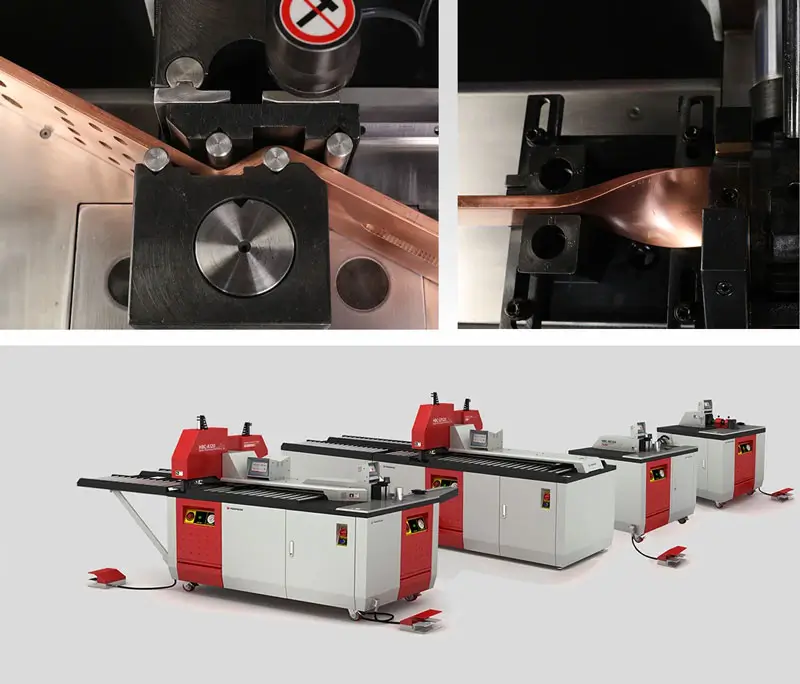
Before looking at who buys, it helps to know what is actually on offer. Our overview of busbar fabrication machines explains the main machine types and what each one does.
The Five Buyers
Five buyer types, and they differ in what each needs from the machine, not just in what they build.
Low-Voltage Panel Builders
The largest single segment. These shops build distribution boards, motor control centres and control panels to IEC 61439-1 and IEC 61439-2, with low-voltage assemblies operating up to 1,000 VAC or 1,500 VDC.
Their work is high-mix and drawing-driven. Every job is a different layout, so they need fast changeover rather than raw throughput, plus copper and aluminium capability without retooling.
Current ratings across this market run from 125 A to above 6,000 A, which spans a wide range of bar cross-sections.
For a clearer and more complete explanation, this page goes into far more depth than we can cover in a short text.
Medium-Voltage Switchgear Manufacturers
Fewer companies, larger bar cross-sections, tighter documentation.
These buyers are driven by traceability and repeatability more than by speed. Their assemblies are type-tested to IEC 62271-200, which means any deviation from the busbar layout drawing is a certification problem rather than a quality one.
Commercially that makes them a different prospect entirely. They buy higher-specification machines, they specify them carefully over long evaluation cycles, and they replace them far less often than the volume segments do.
Readers who want to understand the reasoning behind this will find this detailed article very useful.
Transformer Manufacturers
An overlooked segment that appears in almost every vendor’s customer list without explanation.
Their busbar work concentrates on terminal connections, tap changers and low-voltage bushings. Bar volumes per unit are modest, but bend geometry is demanding and the bar is often thick. Copper bar for electrical purposes is specified to EN 13601 or ASTM B187.
The commercial pattern follows from that. They buy fewer machines, keep them a long time, and care disproportionately about bending accuracy on heavy sections.
For those who prefer to work on paper, the printable form can be completed by hand.
Electrical Contractors and Site Fabricators
Contractors working on substations, industrial retrofits and large building projects often need bar modified on site rather than in a workshop.
Their requirement is different in kind. Portability, single-phase power, and tolerance for conditions that no workshop would accept. A machine that needs a three-phase supply and a level floor is not a candidate.
The commercial pattern is worth stating honestly: this segment buys smaller and cheaper machines, buys them more often, and is considerably more price-sensitive than the manufacturing segments.
If any part of this feels unclear, this simple explanation describes it in everyday language.
Subcontract Busbar Job Shops
The buyer type nobody writes about, and the one the “future customers” framing fits best.
These shops own the machine and sell finished bar to panel builders who do not. Subcontract fabrication economics depend on utilisation rather than panel output, which makes them the most volume-sensitive buyers and the most likely to upgrade.
They compete on lead time, not on price. A panel builder subcontracting bar work is buying a delivery date, and a job shop that can promise three days beats one that quotes cheaper at ten.
| Buyer type | Typical machine class | Bar size focus | Main decision driver |
|---|---|---|---|
| LV panel builders | Three-in-one, mid-tier CNC | Small to medium sections | Changeover speed on high-mix work |
| MV switchgear OEMs | High-specification CNC | Large cross-sections | Repeatability and documentation |
| Transformer manufacturers | Bending-focused, heavy duty | Thick bar, complex geometry | Bend accuracy on heavy sections |
| Contractors and site fabricators | Portable, single-phase | Small to medium | Portability and price |
| Subcontract job shops | Highest available throughput | Full range | Machine utilisation and lead time |
Many of these buyers choose a machine because it combines several operations in one unit. Learn more about multi-function busbar machines and where they save time.
Where the Demand Behind Them Comes From
None of those five buyers creates demand. Five end markets do, and busbar machine applications follow them unevenly.
Data Centres
The fastest-growing segment by a wide margin, and the one worth leading with.
MarketsandMarkets projects the data centre busbar market growing from USD 1.38 billion in 2026 to USD 3.01 billion by 2032, at a CAGR of 14.0%. Within that, the AI segment is forecast at 18.8% and hyperscale at 14.6%. The IEA expects data centre electricity consumption to exceed 945 TWh by 2030.
The driver is one line: rising rack power density makes cable distribution impractical, and every rack fed by bar is bar that somebody had to process.
EV Charging and Electric Vehicles
Two related demand streams that behave very differently.
Charging infrastructure is switchgear-shaped work — cabinets, distribution, bar to drawing. In-vehicle busbars inside packs and inverters are a separate and more specialised business, and they usually require dedicated stamping and lamination equipment rather than general fabrication machines.
Stratview Research puts the EV busbar market at USD 2.9 billion in 2026, up 16.0% year on year, reaching USD 6.2 billion by 2033 at a CAGR of 11.3%. The IEA recorded global EV adoption growing 21.1% year on year in 2025.
Renewables and Grid Modernisation
Solar farms, wind installations and battery storage all need collection and interconnection equipment. Grid modernisation drives replacement demand alongside new build, which makes this segment less cyclical than it looks.
One published market analysis puts busbar penetration at roughly 48% in grid interconnection systems on renewable projects above 500 MW. US renewable capacity now exceeds 400 GW, with substation configurations commonly rated at 13.8 kV and 34.5 kV.
Asia-Pacific is the largest and fastest-growing regional market, driven by transmission expansion in China and India.
Industrial Plants and Automation
The steadiest rather than the fastest segment, and the one that keeps panel shops busy between infrastructure booms.
Factory electrification, automation retrofits and machine building all generate continuous control panel demand. Electrical distribution and industrial automation together account for roughly 70% of copper busbar assembly consumption. Demand there is expanding at around 5–7% annually.
Say plainly what this means for a machine investment: this is the segment that sustains it through a downturn, when data centre and renewables projects pause.
Commercial Buildings and Retrofit
Office towers, logistics centres, hospitals and retail developments use busbar trunking in place of cable risers. Ageing installations then generate replacement work independent of new construction.
Buildings above 100,000 square feet increasingly adopt trunking systems rated between 400 A and 2,000 A, specified to IEC 61439-6 for busbar trunking.
The commercial characteristic matters more than the size here. This segment is project-driven, lumpy, and heavily dependent on regional construction cycles — which makes it a poor sole justification for a machine.
| End market | Market size / indicator | Growth | Character |
|---|---|---|---|
| Data centres | USD 1.38 bn (2026) → USD 3.01 bn (2032) | 14.0% CAGR | Fastest growing; AI segment 18.8% |
| EV and charging | USD 2.9 bn (2026) → USD 6.2 bn (2033) | 11.3% CAGR | Split: infrastructure vs in-vehicle |
| Renewables and grid | 48% penetration above 500 MW [VERIFY] |
Regional, APAC-led | New build plus replacement |
| Industrial and automation | ~70% of copper assembly use [VERIFY] |
5–7% annually | Steadiest; survives downturns |
| Commercial buildings | 400–2,000 A trunking, IEC 61439-6 | Construction-cycle dependent | Project-driven and lumpy |
Growing demand pushes fabricators to process more bar in less time. Read how advanced busbar machinery helps shops keep up with that pace.
Volume Decides the Machine
Market information becomes a purchase decision at one number: how much bar moves through the shop. Busbar machine applications sort into three tiers.
Under roughly 1,000 assemblies a year, basic three-in-one or workshop machines are the fit. Lower throughput, more operator skill, minimum capital exposure.
Between roughly 2,000 and 5,000 panels a year, advanced three-in-one machines with independent power packs balance automation against product variety.
Above roughly 10,000 panels a year, automated CNC processing centres are justified by labour efficiency and by traceability requirements in regulated sectors.
In daily terms: 50 to 300 busbars a day suits a mid-tier machine, while 500 or more a day under continuous running points to full CNC.
Once the volume tier is clear, the next question is budget. Our busbar machine prices guide gives a cost reference for each machine class.
Reading a Prospect Before You Quote
Six signals, each one telling you something specific about busbar machine buyers.
Maximum bar cross-section they handle. This sets the machine class before anything else. Get it wrong and nothing else in the quote matters.
Daily or weekly bar count. This separates workshop from CNC. Ask for the number, not the impression.
Copper versus aluminium mix. Affects tooling and forming force. A shop running both needs a machine that handles both without a tooling change.
Batch variety. High-mix work rewards changeover speed; high-volume work rewards cycle time. These pull in opposite directions.
Whether their assemblies are type-tested. This raises accuracy and documentation requirements substantially. Manufacturer-published figures for CNC systems in this class run to around ±0.3° on bending and ±0.2 mm on punching.
Whether they currently subcontract bar work. The single strongest buying signal available. A shop already paying someone else to process bar has made the business case for you.
Accuracy requirements often decide which prospects are serious about type-tested work. See why fabrication precision matters so much on finished bar.
Who Does Not Buy One
Every vendor page implies the whole electrical industry is a prospect. It is not, and being direct about that makes the rest of this guide more useful.
Shops assembling fewer than a few hundred bars a year will not convert; subcontracting stays cheaper than owning. Installers fitting pre-fabricated trunking are not fabricators — the busbar fabrication happened upstream at the system supplier.
In-vehicle EV busbar producers need stamped and laminated parts and different equipment entirely. And utilities specify busbar systems constantly but almost never fabricate them.
The rule that follows is short. A prospect who does not already handle raw bar is not a prospect yet.
For small shops near the edge of that line, the choice is rarely whether to buy but what to buy. Compare economic vs premium machines to see where each one pays back.
Conclusion of Who Buys Busbar Machines
Busbar machine applications resolve into two layers: five buyer types, and five end markets behind them. Growth is concentrated in data centres and electrification rather than spread evenly across the industry.
The practical conclusion is narrower than the market data suggests. The strongest indicator of a future customer is not their industry label but the volume of raw bar already moving through their shop.
Buyers who are ready to move forward usually want to see who is making the equipment. Browse our list of CNC machine manufacturers to start comparing options.


Rate this article
Choose a rating from 1 to 5 stars.
No ratings yet