




If you’d rather listen than read, feel free to play the audio file below for the rest of this article.
What Are Compact Switchboards?
Compact switchboards for small facilities are a size class, not a separate product category, and the codes treat them exactly as they treat larger boards.
Terminology matters here because two systems collide. The National Electrical Code calls a free-standing assembly with front and usually rear access a switchboard, and a wall-mounted panel accessible only from the front a panelboard. IEC has no direct equivalent term. It calls the same equipment a power switchgear and controlgear assembly, covered by IEC 61439-2.
Compact electrical switchboards therefore sit between those definitions. Physically they are switchboards. Dimensionally they compete with panelboards, and buyers often compare the two directly.
Typical Use Cases and Benefits
You buy floor area back, and that is the measurable benefit: a compact board occupies a fraction of the depth and width of a full-size assembly at the same rating.
The typical sites are predictable. Small offices, retail units, restaurants, clinics, schools, light industrial workshops, pumping stations and telecom huts. Some vendors market mini switchboards for commercial facilities as a separate line, but the governing standards are identical. Switchboard solutions for small buildings usually replace a cluster of separate distribution boards with a single supervised assembly.
Three benefits follow. Fewer enclosures mean fewer earth paths and fewer places for a fault to hide. Metering at one point makes energy accounting straightforward. And one lockable assembly is easier to secure than four cabinets in three rooms.
You can also save a copy for later, which is helpful if you plan to return to this more than once.
Compact or full-size, the assembly obeys the same set of principles. A grounding in switchgear basics makes the sizing and clearance decisions that follow much easier to justify.
How to Size a Switchboard for Small Facilities
Switchboard sizing for small facilities is a thermal problem before it is an electrical one. IEC 61439-1 handles this with the rated diversity factor, which caps continuous simultaneous loading of outgoing circuits.
The reference values are published. An RDF of 0.9 applies to two or three outgoing circuits, 0.8 to four or five, 0.7 to six to nine, and 0.6 to ten or more. Incoming circuits stay at 1.0.
Here is the trap. Statistical diversity lets you shrink the supply cable and transformer. It does not let you exceed the assembly’s thermal limit, because the RDF is a physical constraint on heat, not an estimate of behavior.
Load Calculation and Breaker Coordination
Start from the maximum working temperature, not the connected load, because a busbar’s current rating is set by the temperature it may reach and nothing else.
Work in this order. Total the connected load, apply the demand factors your code allows, then add the heat dissipated by every device inside the enclosure. Manufacturers publish watt losses for breakers, relays, meters and control transformers.
Then plan for growth honestly. Leaving two spare ways in a full board buys nothing if the busbar is already at its thermal ceiling. Specify spare capacity in amps and in kelvins, not in blank spaces.
Coordination comes last and matters more in a compact board. Devices sit close together, so cascading and selectivity must be checked against the manufacturer’s tested combinations rather than assumed from curves alone.
All the points described above are collected in this document, so you do not have to search through the page again.
The same load calculation decides what leaves the board as well as what sits inside it. Choosing the right industrial wiring keeps the outgoing circuits consistent with the rating you just established.
Key Features of Compact Switchboards
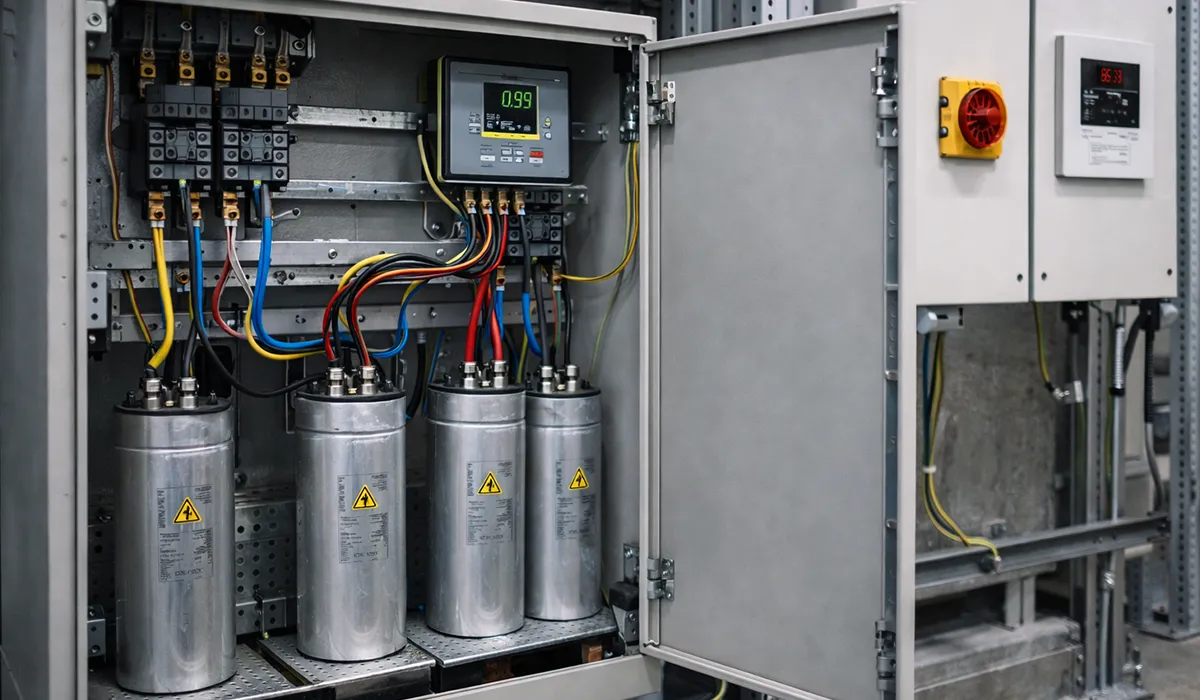
Switchboard features & options divide into four groups: the enclosure, the busbar system, the protective devices and the metering. Compact distribution switchboards package all four into one verified assembly. Every compact switchboard design is a trade between those four and the available volume.
The enclosure sets the ingress rating and the access. Floor mount vs wall mount switchboards is the first decision, and it follows the rating more often than the room. Wall-mounted units suit lighter duties and front access only. Floor-standing units carry heavier busbars and allow cable entry from below.
Modular switchboards for small facilities let you add a section later. Built-in assemblies fit a difficult room better, but replacing one costs far more than extending the other.
We have prepared a downloadable version so that you can share it easily with your team or keep it for your own records.
Enclosures, Busbars, and Protective Devices
Specify the enclosure by environment, not by habit. Indoor plant rooms take IP54 or NEMA Type 12, damp or washdown areas need IP65 upward, and NEMA Type 4X adds the corrosion tests that an IP code never performs.
Busbars in compact power distribution boards are the constrained element. Shorter runs help, but tighter spacing raises mutual heating, so the same copper section carries less current than it would in a wide board.
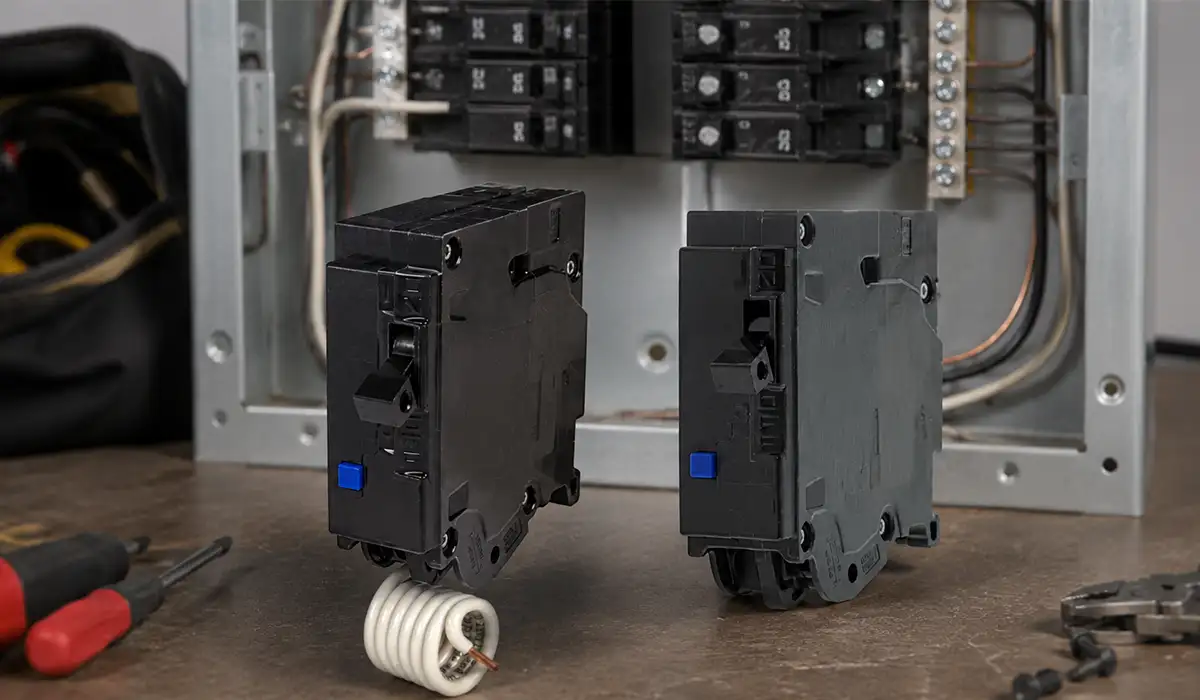
Protective devices then compete for the same volume. Moulded-case breakers save depth over air circuit breakers. The switchgear for compact switchboards must still meet the required short-circuit withstand, and that rating belongs to the tested assembly rather than to the breaker alone.
Metering and monitoring cost almost no space now. A single multifunction meter with communications replaces a row of analogue instruments and gives you load data for the next expansion.
To avoid missing any step, we recommend that you follow the complete guide from beginning to end.

Each of these four groups is a specification in its own right. A breakdown of the individual switchgear components explains what each one contributes before you start trading volume between them.
Installation Best Practices and Safety
Switchboard installation for small facilities fails on the same two details every time: the earthing arrangement and the working space. Both are cheap to get right on the drawing and expensive to correct after energisation.
Earthing and bonding come first. Every metallic part, gland plate and door bond connects to a correctly sized protective conductor, and service equipment bonds to the earth electrode. Painted or corroded bonding faces are the commonest first-inspection finding.
Labelling is the second discipline. A permanent circuit directory, the assembly’s ratings, the available fault current and the arc-flash warning all have to be legible after ten years, not just at handover.
NEC/IEC Code Compliance
Compact does not mean close. NEC switchboard requirements fix the working space regardless of how small the board is, and shrinking the board never shrinks the clearance in front of it.
The numbers are specific. For 151 to 600 volts to ground, depth is 900 mm under Condition 1, 1,070 mm under Condition 2 and 1,220 mm under Condition 3. Width is 762 mm or the width of the equipment, whichever is greater. Height is 2.0 m or the equipment height.
Two further rules bite at scale. Equipment rated 1,200 amps or more and wider than 1.8 m needs two entrances to the working space. Doors within 7.6 m of equipment rated 800 amps and above need listed panic hardware.
The working space also has to stay clear. Storing stock in front of a board is the most commonly cited violation on any inspection.
Cable entry is decided at the same time as the clearance in front of the board. Planning the underground conduit route early avoids the bottom-entry conflicts that compact enclosures create.
Integrating Switchboards With Backup Power Systems
Decide where the transfer point sits before you fix the board’s dimensions, because transfer switching equipment is a type-tested assembly in its own right and it needs room.
Three arrangements are common in electrical distribution panels for small buildings. A single automatic transfer switch upstream feeds the whole board. A transfer switch on one section feeds essential loads only. Or a manual changeover serves a site that tolerates a short outage.
The middle option usually wins in small facilities. You back up the loads that matter and avoid sizing a generator for the entire connected load.
Generators and UPS Interfaces
Match the UPS class to the load, and the classification does the work. VFI is independent of input voltage and frequency, VI regulates voltage only, and VFD follows the input.
VFI is online double conversion and suits servers, medical equipment and controls. VI is line-interactive and suits general office loads. VFD is offline and protects against outage rather than disturbance.
Two integration details cause most of the trouble. First, the generator must be sized for starting currents and non-linear load, not for the nameplate sum. Second, the UPS bypass and its maintenance isolator need to be reachable inside the working space you have already allocated.
Earthing needs a decision too. A generator may be a separately derived source, which changes where the neutral is bonded and where earth fault protection sees the fault.
Backed-up loads are usually the ones that cannot wait for a repair. How emergency panels are arranged determines which circuits belong behind the transfer switch in the first place.
Compact vs Standard Switchboards
The honest threshold is access, not amperage. Once you need rear access, internal separation between functional units, or withdrawable devices, you have left the compact class whatever the rating says.
| Factor | Compact board | Standard switchboard |
|---|---|---|
| Access | Front only, typically | Front and rear |
| Cable entry | Bottom or top, limited | Bottom, top, multiple routes |
| Busbar headroom | Constrained, tighter spacing | Generous, easier derating |
| Two-entrance rule | Rarely triggered | Applies at 1,200 A and 1.8 m wide |
| Live maintenance | Isolate the whole board | Section by section |
| Expansion | Add a module, or replace | Add a vertical section |
Read the last two rows together. A compact board is cheaper until the first outage you cannot schedule, because isolating one circuit often means shutting the whole assembly down.
That is the real dividing line for small sites. If the facility can take a planned shutdown, compact wins on cost and space. If it cannot, buy the access.
Size class is only one axis of the decision. A structured approach to choosing switchgear weighs duty, environment and serviceability alongside it.
Cost, Maintenance, and Lifecycle for Small Facility Switchboards
Serviceability is where compact designs actually cost money, and inspection is a legal duty in the EU rather than an option. Employers must inspect after installation, inspect periodically using competent persons, and keep the records.
Standard catalogue units cost less and ship faster. Build-to-order units fit an awkward room and an unusual load schedule, but they lengthen the programme and the spares lead time.
Then plan for the failures that compact geometry causes:
No room to work. Terminations are stacked and access is front-only, so a ten-minute job becomes an outage. Specify hinged device plates and removable gland plates at order stage.
Thermal drift. Tight busbar spacing plus added circuits pushes temperature up quietly. Run thermographic surveys under load, annually.
Loose terminations. Vibration and thermal cycling relax connections. Torque-check to the manufacturer’s figures and mark the joints.
Obsolete devices. A small board may carry one breaker frame size. Hold a spare, or accept a long outage when it fails.
Most of these failures are preventable rather than inevitable. Practical guidance on optimizing switchgear performance turns an annual inspection into a lifecycle strategy.
Conclusion About compact-switchboards
Size the board on heat and clearance, not on how the equipment fits on a drawing. The rated diversity factor, the busbar temperature limit and the working space rules will settle most of the specification between them.
You can now make two decisions with confidence: whether a compact assembly suits the site’s tolerance for planned shutdowns, and where the transfer point for backup power belongs.
Compact assemblies are one result of a much longer design shift. Tracing the evolution of switchgear shows where the next generation of small-facility boards is heading.


Rate this article
Choose a rating from 1 to 5 stars.
No ratings yet