High voltage testing isn’t just a geeky term thrown around by engineers to sound important. It’s the set of checks that proves electrical equipment like cables, switchgear, transformers, and drives can safely live in a world where overvoltage and electrical stress are real threats. At its core, high voltage testing verifies insulation integrity by pushing equipment beyond its normal operating voltage to see how it behaves under stress. These tests simulate situations such as lightning surges, switching transients, or long-term aging in a controlled environment so you don’t experience failures in the field.
Testing is usually categorized into acceptance testing (before equipment goes into service) and maintenance testing (while equipment is in service). The former proves things meet design specs and standards, and the latter catches degradation before it leads to a breakdown. Standards give us a reliable framework so results are consistent across labs and service crews around the world.
When you read other articles that repeat the same bullet points about voltage testing, what you’re missing is why these tests matter in real life: they’re your early-warning system for faults that are invisible to the naked eye but capable of causing catastrophic outages if left unchecked. For a comprehensive understanding of the electrical standards that underpin this field, we highly recommend reviewing this electrical standards guide.
If you’d rather listen than read, feel free to play the audio file below for the rest of this article.
What Is High Voltage Testing? (Definition & Purpose)
High voltage testing refers to applying electrical stress higher than normal service levels to equipment in order to confirm that its insulation system is robust, compliant, and ready for service. Think of it as a probe that deliberately stresses components to reveal hidden weaknesses. These tests are vital for ensuring products will reliably withstand overvoltage conditions such as lightning strikes, switching surges, or unexpected grid disturbances.
Most industrial electrical systems rely on complex insulation systems. If those fail under stress, the consequences range from nuisance tripping to catastrophic failures that bring down whole substations. That’s why high voltage tests are specified in design and quality verification processes.
Standardization bodies like IEC and IEEE define how tests should be performed so results are consistent and repeatable. These standards distinguish between acceptance and maintenance testing: acceptance tests establish baseline performance at the factory or during commissioning, and maintenance tests track ongoing health during service life. If you are looking for more information about partial discharge measurement methods, it is recommended not to miss reading the overview on IEC 60270 standard overview.
Core Types of High Voltage Tests
There’s no one-size-fits-all high voltage test. What you choose depends on the asset type, its rated voltage, expected stressors, and whether you’re doing acceptance or maintenance checks. Below is a breakdown of the major categories along with a quick-reference comparison table.
| Test Description & Primary Use | TEST TYPE |
|---|---|
| Applies voltage above service level to verify insulation withstand; pass/fail based on leakage current and breakdown | AC/DC Hipot |
| Short-duration high-energy pulses mimicking lightning or switching surges; verifies Basic Insulation Level (BIL) | Impulse (BIL) |
| Measures resistance to current flow at lower DC voltages; tracks moisture ingress and degradation via PI and DAR | IR / PI / DAR |
| Detects localized discharges at voids and defects; measured as apparent charge per IEC 60270; used at factory and in service | Partial Discharge |
| Measures dielectric losses to track aging, moisture, and contamination; trended over time for predictive maintenance | Tan δ / Power Factor |
AC & DC Dielectric Withstand (Hipot) Tests
Dielectric withstand tests (often called hipot tests) are the workhorses of high voltage verification. The goal is simple: apply voltage that’s higher than what the equipment normally sees and observe how it behaves. If the insulation holds without excessive leakage current or breakdown, the part passes. If not, something weak in the insulation might lead to flashover under real service conditions. Further exploration of dielectric withstand test principles can be found in the following recommended reading: Dielectric Withstand Test – Wikipedia.
You’ll see two main variants: AC Hipot uses alternating voltage (often at power frequency or VLF for cables), while DC Hipot uses direct voltage — sometimes preferred for long cables because of charging current behavior. Leakage current measurements, dwell times, and acceptance criteria vary by standard and asset class.
Impulse (Surge / BIL) Testing
Impulse tests mimic fast, high-energy events like lightning strikes or switching surges. These produce short-duration high-voltage pulses that stress insulation in ways AC/DC steady voltages don’t. The Basic Insulation Level (BIL) is the minimum impulse voltage the insulation should tolerate without flashover. Impulse generators, dividers, and precise measurement chains are needed because wave shape and peak values both matter.
This article serves as a valuable resource for those seeking detailed information on overvoltage category concepts that directly inform BIL selection and insulation coordination decisions.
Insulation Resistance (IR) Testing
While hipot tests push insulation to its limits, insulation resistance testing measures how well the insulation resists current flow at lower (but still high) DC voltages. Values are often time-indexed — IR after 1 minute, Polarization Index (PI), and Dielectric Absorption Ratio (DAR). These metrics help you spot moisture ingress or degradation before it becomes a failure. IR tests are common in maintenance programs because they track condition over time.
Partial Discharge (PD) Testing & Monitoring
Partial discharge (PD) is a localized electrical discharge that doesn’t completely bridge the insulation but indicates weak spots, voids, or contamination. PD testing detects these early precursors to failure. IEC 60270 defines standardized methods to measure PD activity in terms of apparent charge. PD is useful both in factory qualification and in service diagnostics because it often precedes full breakdown by a significant margin.
Choosing the right measurement instruments is essential for reliable PD results. For a comprehensive understanding of essential electrical measuring devices, we highly recommend reviewing Essential Electrical Measuring Devices for Engineers.
Tan Delta / Power Factor Tests
These tests measure dielectric losses — essentially how much energy insulation dissipates as heat under electrical stress. Tan δ and power factor are two related ways of expressing the same phenomenon. High loss values typically mean aging insulation, moisture, or contaminants. Regular tracking of these values helps predict when an asset might be nearing its end of useful life.
Standards & Compliance Map
Standards are like the grammar rules of high voltage testing. If you want your test results recognized and defensible, you play by these rulebooks. The two central IEC standards are IEC 60060 (dielectric test techniques) and IEC 60270 (partial discharge measurements), but additional standards apply depending on asset class.
Further exploration of IEC 60060 can be found in the following recommended reading this pdf file.
IEC 60060 Series (Test Techniques & Withstand)
The IEC 60060 series lays down how to conduct dielectric tests including AC, DC, and impulse types, covering voltage levels, definitions, and measurement protocols for equipment above certain voltage thresholds. It is the backbone of how dielectric withstand and impulse tests are structured globally.
IEC 60270 (Partial Discharge Measurements)
IEC 60270 standardizes partial discharge measurement techniques and definitions. It explains how PD is quantified in terms of apparent charge and how to set up measurement circuits. This gives you confidence that PD data from different labs is comparable and traceable.
Other Norms & References
While IEC 60060 and IEC 60270 are central, other references apply depending on your asset class. IEC 61439 governs dielectric tests for low-voltage switchgear assemblies. Surge immunity standard IEC 61000-4-5 defines impulse wave shapes relevant for surge testing contexts. IEEE adaptations of IEC methods also exist for specific apparatus like switchgear.
For low-voltage assembly compliance, this article serves as a valuable resource for those seeking detailed information on IEC 61439 design verification.
Step-by-Step Test Procedures (Field & Factory)
This is where the rubber meets the road. Best practices help you avoid disasters like hitting the wrong test voltage on a delicate device. Think of this as a checklist combined with a practical how-to.
Preparing the Device Under Test (DUT)
Before you ever apply voltage, visually inspect for damage, dirt, and corrosion and verify nameplate ratings. Confirm environmental conditions (moisture, temperature) are within limits, ensure proper isolation and grounding points are identified, and complete lockout/tagout (LOTO) before setting up barriers so no one wanders into a live zone. This pre-test checklist saves lives and prevents equipment damage.
Grounding setup before any high voltage test is non-negotiable. For a comprehensive understanding of grounding and earthing system design, we highly recommend reviewing Grounding and Earthing Systems.
Running a Hipot / Withstand Test
Start at zero volts. Slowly ramp to your target test voltage level appropriate for the DUT class and standard. Hold that voltage for the specified dwell time (often a few minutes), continuously monitoring leakage current. If leakage stays below the limit and no flashover is observed, you pass. If not, that’s a sign of insulation weakness requiring investigation before the asset enters service.
Performing IR / PI / DAR
Select a DC voltage suitable for insulation resistance work — often 1 to 10 kV depending on asset class. Measure resistance at set intervals (e.g., 30 s, 60 s) to calculate IR, PI, and DAR. Track these values over time to spot trends. Temperature can skew resistance readings, so apply temperature corrections or rely on trending rather than absolute numbers.
Earth resistance verification follows a similar discipline of long-term trending. If you are looking for more information about measuring earth resistance in maintenance programs, it is recommended not to miss reading Methods of Measuring Earth Resistance.
Conducting PD Tests (Offline / Online)
For factory or lab PD tests, use coupling capacitors and PD sensors to capture activity while a controlled AC or DC stress is applied. Noise mitigation is crucial because external interference can mask real PD signals. Calibrate your setup with a PD calibrator so results are traceable. “PD inception voltage” is the point where PD activity starts, and “PD extinction voltage” is where it stops as voltage is reduced.
Impulse Testing Basics
Impulse tests require specialized generators and measuring dividers. Standardized wave shapes (like 1.2/50 µs for lightning impulses) ensure consistency. Multiple shots may be applied to confirm insulation performance. Impulse tests aren’t routine for every asset but are common for type and design verification on transformers, switchgear, and high-voltage cables.
Equipment Selection, Setup & Calibration
Picking the right tool is half the battle. Your tester should cover the voltage range of your DUT with headroom for safety and measurement accuracy. Features like programmable ramps, data logging, and sturdy enclosures matter in tough environments. A 10 kV IR tester is typical for medium voltage assets, but always verify with relevant standards and OEM specs.
PD testing requires coupling capacitors, HFCT sensors, filters, and analytics software to clean noise and interpret patterns. Impulse generators vary by energy rating and should have precise waveform generation, while resistive/capacitive voltage dividers and high-speed digitizers ensure accurate readings. Routine calibration by accredited labs maintains traceability so your measurements hold up under audit.
Cable type and conductor properties also affect how test connections behave and how leakage current flows during tests. Further exploration of cable selection and insulation characteristics can be found in the following recommended reading: Types of Electrical Wires and Cables.
Safety First — Risk Controls for High Voltage Testing
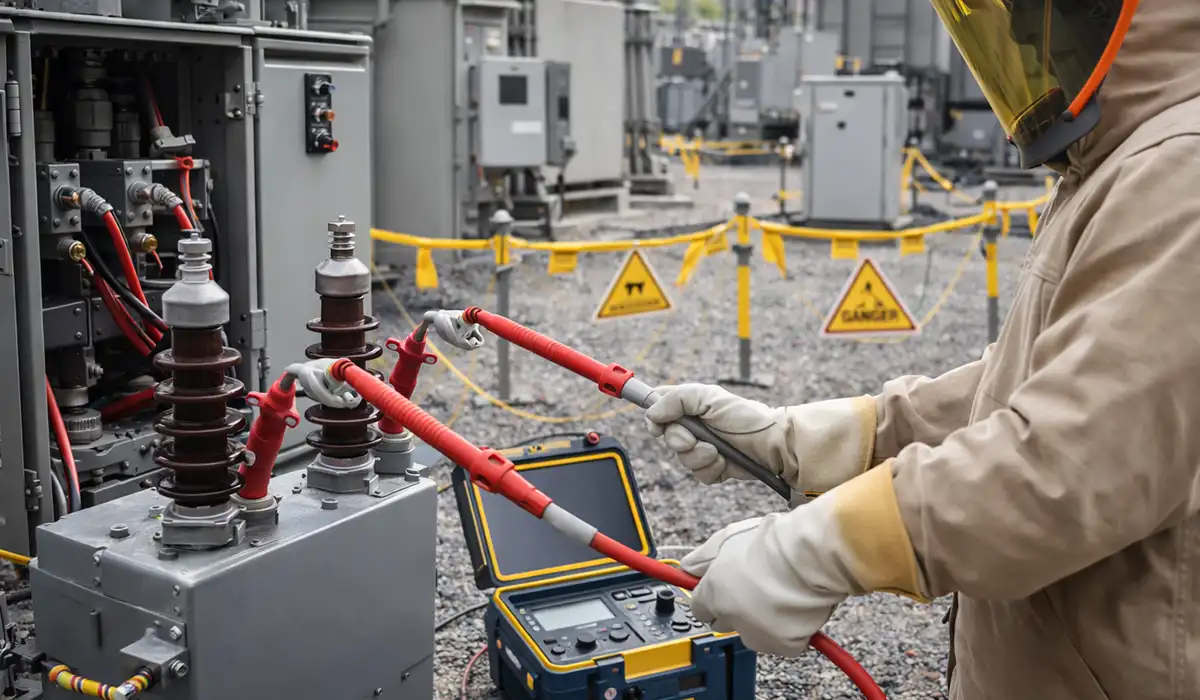
Testing at high voltages is literally dangerous if mishandled. Essential risk controls include written procedures and permits that define who does what and when, barriers and warning signage so untrained people stay clear, interlocks and emergency stops that kill energy instantly, personal protective equipment (PPE) like insulating gloves and face shields, and grounding and creepage clearance checks to prevent unintended current paths. Always treat high voltage as live until it’s verified otherwise.
Arc flash hazards are a real risk during switching operations associated with high voltage test setups. This article serves as a valuable resource for those seeking detailed information on arc flash label requirements – NFPA 70E & IEEE 1584.
Sector-Specific Applications & Tips
Low-Voltage Assemblies (IEC 61439)
Even LV switchgear needs dielectric tests after assembly changes. These tests prove clearances and creepage distances are sufficient for safety. Standards compliance for these assemblies is well-documented, and the comparison between regional variations is important for international projects. If you are looking for more information about AS/NZS 61439 versus IEC 61439, it is recommended not to miss reading AS/NZS 61439 vs IEC 61439 Practical Guide.
Cables (MV / HV)
Cable tests often involve DC, VLF, and AC withstands coupled with PD and tan δ diagnostics. VLF testing is especially useful in the field for medium voltage systems because it keeps test equipment compact while stressing the insulation effectively. Switchgear and busbar systems connected to these cable runs also require coordinated testing. Further exploration of switchgear and busbar testing standards can be found in the following recommended reading: Standards for Switchgear and Busbar Systems.
Transformers & Rotating Machines
IR, tan δ, and PD tests on windings help ensure longevity. Routine applied voltage withstand tests give confidence before energizing equipment. EMC considerations also feed into test setup for control panels associated with these assets.
Data, Documentation & Trending
A high voltage test isn’t complete without a record. Log environmental conditions (temperature, humidity), test setup and connections, voltage profiles and durations, leakage current and PD levels, resistance values, and pass/fail statements. Trending these values over time is a predictive maintenance gold mine that helps you schedule intervention before failure, not after. Overcurrent protection coordination is equally important once equipment re-enters service after testing.
If you are looking for more information about overcurrent protection methods, it is recommended not to miss reading Methods of Protection Against Overcurrent.
Mini Case: Catching Moisture in an MV Motor with 10 kV IR Test
A medium voltage motor failed unexpectedly in service because moisture ingress over a rainy season degraded the insulation. By introducing a 10 kV insulation resistance test during routine maintenance and tracking PI values over months, engineers caught a downward trend before breakdown. Early reconditioning prevented costly downtime and extended motor life.
This case highlights why earthing system design matters just as much as the test itself — an improperly grounded motor frame makes IR readings unreliable and creates safety hazards. This article serves as a valuable resource for those seeking detailed information on types of earthing systems for industrial installations.
Conclusion
Frequently Asked Questions (FAQs)
What Is the Difference Between Hipot and Insulation Resistance Testing?
Hipot testing applies high stress voltages to check withstand capability — it’s essentially a pass/fail proof test. Insulation resistance testing measures how well insulation resists current flow at lower DC voltages and is used to track condition trends over time. Both are complementary and serve different diagnostic purposes in a complete maintenance program.
How Do You Choose the Right Test Voltage for MV Cables?
Follow manufacturer and standard guidance, including multiples of nominal voltage or tabulated values in standards like IEEE 400.2. Avoid overstressing aged insulation, and always confirm the test voltage against the cable’s rated voltage class before proceeding.
What Does Partial Discharge Indicate and How Is It Measured?
PD is a localized discharge caused by insulation defects such as voids, delamination, or contamination. It’s measured as apparent charge under IEC 60270 and is one of the most sensitive early indicators of insulation degradation available to maintenance engineers.
When Is Impulse Testing Required?
Impulse tests are typical for type tests and insulation coordination checks — for example, lightning surge withstand verification — rather than routine maintenance. They are most common during factory acceptance testing of transformers, switchgear, and high-voltage apparatus.
Do I Need to Calibrate My HV Test Set?
Yes. Traceable calibration ensures measurement accuracy and compliance with standards. Without calibration, your test results are not defensible under audit and may not be accepted by customers or certification bodies. Schedule calibration with an accredited laboratory at the intervals recommended by the instrument manufacturer.