






If you’d rather listen than read, feel free to play the audio file below for the rest of this article.
The Short Answer: Lubrication Can Cut Required Torque by 20–40%
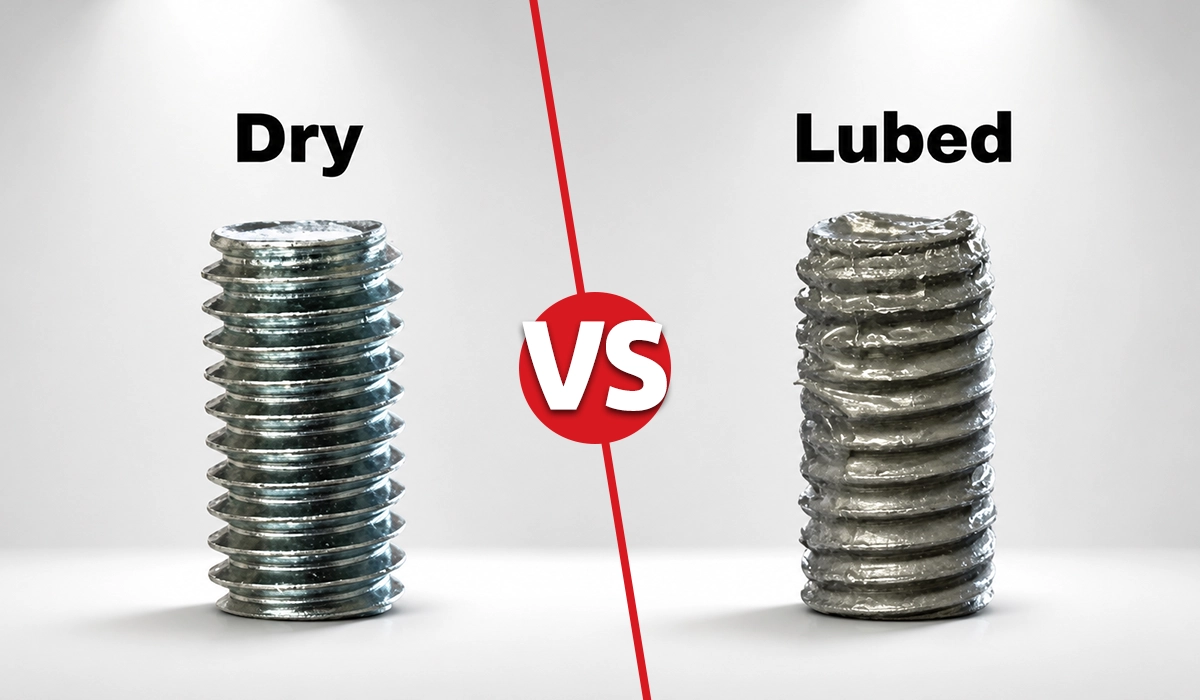
Ask how much does lubrication reduce bolt torque and the answer is 20–40%. A lubricated bolt reaches the same clamping force as a dry one at roughly that much less applied torque. General fastener guidance puts the reduction at 20–30%, while oil on the threads can approach 40%. That is the core of lubricated vs dry bolts: how lubrication changes busbar torque values is a friction question first. This article builds on our broader panel and switchgear basics guide, which covers the wider assembly context these torque figures sit inside.
There is no single fixed figure, because the reduction depends on what the lubricant is. Wax, oil, anti-seize and antioxidant joint compound sit at different points on that scale. Every serious lubricated bolt torque vs dry reference therefore publishes two columns rather than one blanket correction.
The practical consequence is immediate. Apply a dry-bolt torque spec to a lubricated bolt and you over-tension it — potentially past the bolt’s yield point, and often into damage on the soft conductor underneath.
If you would like to explore this subject further, you can read more about it here.
Getting the clamping force right at the joint means nothing if the internal components carrying that current are already a weak link. Our guide to switchgear components covers what sits on either side of these bolted connections.
Why Lubrication Changes the Torque-to-Clamping-Force Relationship
Here is why lubricated bolts need less torque, stated mechanically. Torque does not go into the joint. Most of it goes into overcoming friction on the way there.
When you turn a nut, resistance comes from three places. Friction under the bolt head or nut face, as that surface rotates against the washer or bar. Friction in the threads, as the helix slides against itself. And the useful part: stretching the bolt, which produces clamping force.
Lubrication attacks the first two. Reduce the friction and less of your wrench effort is wasted, so more of the same torque converts into preload. Nothing about the bolt has changed — only how much of your input reaches it. The bolt does not know whether you lubricated it. It responds only to the tension it receives, which is why a wrench reading is such an indirect way to control a joint.
CDA quantifies this for busbar work directly. Dry threads carry a nut factor of 0.20–0.22. Contact aid compound gives 0.19–0.21. A boundary lubricant such as molybdenum disulphide drops it to 0.15–0.16.
Read those three numbers carefully, because they are the most useful thing on this page. The gap between dry and a true boundary lubricant is large, at roughly 25%. The gap between dry and contact aid compound is small, at around 5%. Any bolt lubrication clamping force calculation depends on which of those you actually have on the threads. The two are easy to confuse on a busbar joint, where a compound is present for electrical reasons rather than mechanical ones.
You can also save a copy for later, which is helpful if you plan to return to this more than once.
The K-Factor (Nut Factor) Explained
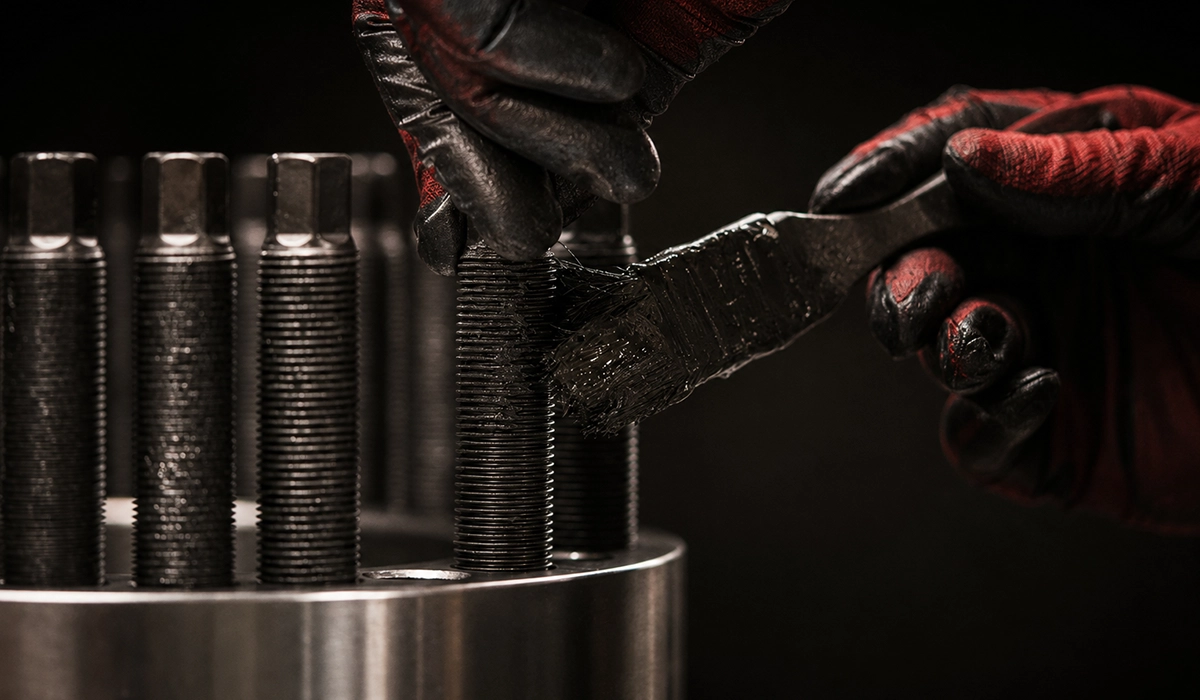
Engineers capture all of that friction in a single number: the K-factor, also called the nut factor. It sits in the torque-tension formula T = K × F × D, where T is torque, F is clamping force and D is the nominal bolt diameter.
A lower K means a given torque produces more tension. Published starting points for K-factor bolt torque work run near 0.20 for dry steel threads, 0.15–0.18 lubricated, and about 0.13 for wax coatings.
Treat those as reference values, not constants. Any nut factor torque calculation is lubricant- and surface-specific, which is standard engineering practice rather than hedging. Surface finish, coating wear and whether the fastener has been used before all move the number.
For a clearer and more complete explanation, this page goes into far more depth than we can cover in a short text.
Where the Torque Actually Goes: Friction vs. Clamping Force
The proportions are more lopsided than most people expect, and seeing them written down changes how the torque figure feels. On a conventional dry bolt, roughly 50% of applied torque overcomes friction under the rotating head or nut face. Another 40% overcomes thread friction. Only about 10% becomes clamping force.
That ratio is sometimes called the 541 rule. Engineering references put the friction share at 85–90% of applied torque under typical dry conditions, so the exact split varies but the shape of it does not.
Now the point. If 90% of your effort is fighting friction, even a modest reduction in friction moves a great deal of energy into the useful column. That is why the required torque number drops so sharply, and why lubrication is never a minor variable.
This same K-factor logic carries straight through to how current itself moves along the busbar once the joint is torqued correctly. Our piece on how busbars conduct current picks up from here.
What “Lubricated” Means on a Busbar Joint
Almost nobody assembling a busbar is dipping bolts in oil. They are applying antioxidant joint compound, and that is where the general fastener literature stops being much help.
Joint compound’s job is preventing oxidation on the contact faces. But it is a grease or petroleum-based product, and if it reaches the threads or the washer bearing surface, it reduces friction there too. The electrical benefit and the torque-changing effect arrive together, whether or not anyone intended the second one. Nobody applies compound in order to change the torque figure, which is precisely why the change goes unnoticed.
The field evidence on this is unambiguous, and it is worth reading in full. In one documented case, fitters applied conducting grease to busbar contact surfaces during assembly. The grease migrated onto steel bolt threads, effective clamping force at the specified torque doubled, and brass threads in electrical bushings stripped during installation.
So the working rule for antioxidant joint compound busbar assembly is simple. Compound confined to the contact faces is close to a dry-thread condition. Compound on the threads or under the nut face is a lubricated condition. Read busbar bolt torque with anti-oxidant compound on the threads from the lubricated column, every time.
The most up-to-date information is always published on the official website, so it is worth checking there as well.
Thread Lubricant vs. Antioxidant Joint Compound
The distinction is blurry because the products do both jobs. Compounds such as Penetrox, NO-OX-ID and Noalox are petroleum- or synthetic-based carriers holding suspended zinc or copper particles. The particles penetrate oxide films and bridge the contact; the carrier is grease.
Manufacturer literature for these compounds describes them as excellent lubricants for threaded applications, reducing galling and seizing. That is the same property that lowers the K-factor.
So does Penetrox count as bolt lubrication? On the threads, yes. How much it lowers the K-factor is disputed: CDA measures only a small shift for contact aid compound, while general thread-compound guidance reports 15–40%. When in doubt on Penetrox busbar torque, assume the larger effect and use the lubricated value.
Plated and Coated Bolts Count as Lubricated Too
Plating changes friction the same way lubrication does, which is why torque references treat it as its own variable.
NETA’s own heat-treated steel table is titled for cadmium- or zinc-plated fasteners specifically, not bare steel. Zinc, cadmium and hot-dip galvanized coatings each shift the friction coefficient, and published K-value tables list plating condition separately from lubrication for exactly that reason.
The practical takeaway: “dry” does not mean “bare.” A dry zinc-plated bolt and a dry bare-steel bolt are two different friction conditions. A table written for one does not transfer to the other, so check what the fastener is coated with before choosing a column.
Readers who want to understand the reasoning behind this will find this detailed article very useful.
Getting torque and plating right on individual fasteners only pays off if the overall assembly is performing as designed. See our guide to optimizing switchgear performance for the wider picture.
Busbar Torque Reference: Lubricated vs. Nonlubricated (NETA)
Any NETA torque table busbar work relies on is the reference the industry uses when the manufacturer’s own value is unavailable. The silicon bronze bus-connection table gives lubricated and nonlubricated columns side by side. It is the clearest published lubricated vs nonlubricated torque table electrical connections work has, and the standard starting point for busbar bolt torque lubricated figures.
| Bolt diameter | Nonlubricated (lb-ft) | Lubricated (lb-ft) | Reduction |
|---|---|---|---|
| 5/16 in | 15 | 10 | 33% |
| 3/8 in | 20 | 15 | 25% |
| 1/2 in | 40 | 25 | 38% |
| 5/8 in | 55 | 40 | 27% |
| 3/4 in | 70 | 60 | 14% |
Figures are from ANSI/NETA ATS Table 100.12.2 for silicon bronze bus connection torque, the fastener class most commonly specified for bolted bus joints. Note that the reduction is not uniform — it runs from 14% to 38% across the range, so no single percentage correction substitutes for reading the table. Editions also drift: earlier published versions list 14 lb-ft at 3/8 in rather than 15.
One detail carries more weight than the numbers, and it settles most of the lubricated vs dry bolts: how lubrication changes busbar torque values question on its own. NETA gives aluminum alloy fastener torque busbar values in a lubricated column only. There is no dry column for that hardware class, because lubrication is the expected assembly condition. Always pull the current NETA ATS table or the equipment manufacturer’s specification for exact figures. Standards are revised, and the values above are reproduced for orientation rather than direct application.
Torque figures like these only matter once the breaker and protection scheme downstream are correctly matched to the joint. Our circuit breaker finder can help confirm that side of the specification.
The Risk of Getting This Wrong
So what happens if you dry-torque a lubricated bolt? Dry spec on a lubricated bolt over-tensions it. Published calculation guidance puts the error at 20–30% more clamping force than intended for a bolt installed with light assembly oil. Use anti-seize (K ≈ 0.12) where dry (K ≈ 0.20) was specified and the figure rises to roughly 67% more, enough to yield or fracture the fastener. On a busbar the conductor suffers too: over-torquing deforms soft copper or aluminium, reduces contact area, and can crack an insulator standoff carrying the reaction load. That over-torquing lubricated bolt risk is the more spectacular failure.
Lubricated spec on a dry bolt is the quieter failure. The joint ends up under-clamped, contact resistance sits higher than designed, and the hot-spot feedback loop starts running from day one. Nothing looks wrong at handover.
The fix is not “always lubricate” or “always assemble dry.” It is matching the torque table to the actual condition of the hardware in front of you. Our guide to busbar joint inspection covers what the under-clamped path looks like in service.
How to Torque a Busbar Joint Correctly When Using Joint Compound
Procedure matters as much as the number, because the same torque figure applied two different ways produces two different joints.
The sequence below assumes you already know which torque table governs — that question is settled first, not during assembly. Four steps, in order.
- Establish the assembly condition first. Decide whether this joint will be lubricated or dry, and keep it that way throughout. Deciding halfway through is how a joint ends up half of each.
- Confirm the governing torque figure. Manufacturer documentation outranks NETA; NETA outranks a generic fastener chart.
- Apply compound deliberately. Contact faces always. Threads only if your governing specification assumes lubricated threads.
- Tighten gradually, in rotation. CDA notes that the rate of torque application matters as much as the final value. Work a cross pattern in stages rather than taking each bolt straight to full torque.
Record what you did. A note that a joint was assembled with compound on the threads, and torqued from the lubricated column, is worth a great deal to whoever inspects it in five years.
Washer choice interacts with all of this, and our washer selection for busbar joints guide covers the spring-washer side.
Confirm Which Torque Table Your Bolt Spec Is Built On
Before the wrench comes out, find out what condition your governing spec already assumes. Switchgear documentation, a NETA table and a project engineering spec can each assume something different.
Do not guess from the number alone. A figure that looks low may be a lubricated value rather than a conservative dry one, and there is no way to tell by inspection. Where the equipment manufacturer publishes its own torque value, that figure takes precedence over any generic table, including NETA’s. NETA itself is the fallback for when the original manufacturer’s figure cannot be found.
Apply Compound Consistently Across Every Bolt
Inconsistency is its own failure mode, separate from getting the number wrong. Torque-based tightening already carries roughly ±25–30% scatter in delivered clamping force before anyone opens a tub of compound. Applying compound generously to some bolts and sparingly to others adds a second layer of variation on top.
The result is bolt scatter: identical wrench readings across a multi-bolt joint, wildly different actual clamp loads. Some fasteners under-clamped, some over-clamped, contact pressure uneven across the overlap. That unevenness is exactly what a bolted joint is meant to avoid. Apply the same amount to every thread and bearing surface, or to none of them.
A joint that is torqued correctly but built from mismatched or undersized hardware still runs hot over time. Our overview of 200 amp panel sizing shows how that hardware selection starts.
How Consistent Busbar Fabrication Reduces Torque Variability
Every torque figure in this article assumes something nobody states out loud: that the bolt is clamping a flat, clean surface through a properly sized hole.
Fabrication decides whether that assumption holds. A hole punched with worn tooling carries a raised burr on the exit face, and that burr holds the two bars apart exactly where they should be in contact. Inconsistent hole diameter changes how the washer seats and how clamping force spreads into the bar. Neither shows up on a torque wrench, because the wrench measures resistance to rotation and knows nothing about what is happening between the bars.
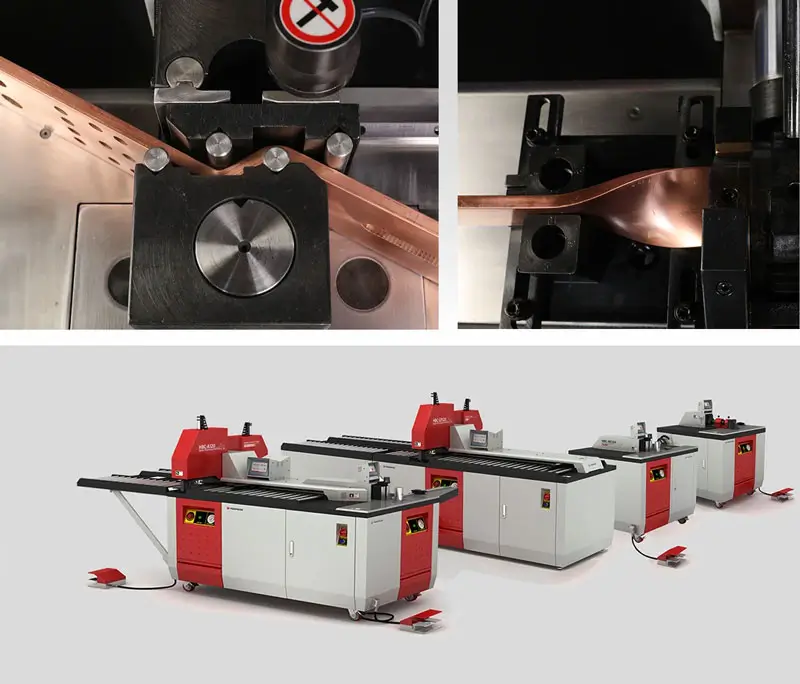
That matters more once lubricated values are in play, because lubricated torque figures are lower and the tolerance band around them is proportionally tighter. Consistent hole tolerance and clean edges from consistent busbar hole punching remove one uncontrolled variable, so the torque table’s assumptions actually hold in the field.
Conclusion about Lubricated vs Dry Bolts
Lubrication — including antioxidant joint compound that reaches the threads — meaningfully lowers the torque needed for a given clamping force, typically by 20–40%. That is the substance of lubricated vs dry bolts: how lubrication changes busbar torque values comes down to friction, and friction is something you control at assembly.
So do not assume. Match the torque table to the actual condition of the hardware, and keep that condition the same across every bolt in the joint.
Everything covered here sits on top of one foundational choice: what kind of busbar the joint is built from in the first place. Our guide to busbars in modern systems is the natural next read.


Rate this article
Choose a rating from 1 to 5 stars.
No ratings yet