UL 508A is the cornerstone safety standard for industrial control panels in North America. Whether you’re designing, manufacturing, or inspecting control panels for general industrial applications, UL 508A compliance is essential. This standard ensures that panels are safe, reliable, and capable of enduring electrical and environmental stresses while meeting the National Electrical Code (NEC) and other crucial safety regulations. With a blend of technical specifications, design rules, and testing protocols, UL 508A provides a robust framework for achieving compliance, and it is indispensable for panel builders, OEMs, and engineers aiming to streamline their operations and minimize rework. In this article, we will delve into the critical components of UL 508A, covering SCCR calculations, motor protection, wiring practices, labeling requirements, and more, offering you the knowledge to ensure your control panels meet industry standards and perform as expected.
UL 508A: Practical Compliance Guide
Industrial control panels in the United States must not only function perfectly but also comply with safety regulations and codes of compliance before they can be set up for use on the plant floor. At its core, UL 508A is the safety standard that instructs how these panels are designed, built, documented, and labeled so that they can endure electrical failures, meet NEC requirements, and be accepted by inspectors. It perfectly combines component ratings, wiring methods, enclosure rules, and documentation into a well-rounded framework that panel builders and OEMs can execute project after project with confidence and reduced rework.
Whether you are preparing bid documents, manufacturing a control panel in-house, or working with a UL panel shop, understanding UL 508A helps you align quality and safety to what authorities having jurisdiction (AHJs) expect. This article brings you an overview of the essentials of UL 508A, including SCCR calculation, NEC Article 409 marking rules, and its comparison with related standards such as UL 891 and UL 1558. If you are looking for more information about electrical standards and their hierarchy, it is recommended not to miss reading this electrical standards guide.
What Is UL 508A
UL 508A is the Underwriters Laboratories standard that defines the construction and evaluation of industrial control panels for use in general industrial applications across North America. It emphasizes safety rules and regulations in construction, short-circuit current ratings (SCCR), component selection, wiring practices, and labeling, all of which demonstrate a panel’s ability to withstand electrical and environmental stresses.
In practice, UL provides electrical design and inspection by confirming that panels are safe as soon as they leave your shop, not just after they are installed. It works alongside the National Electrical Code (NEC) and other NFPA standards (like NFPA 70 and NEC Article 409) so that your panels reliably meet both design and installation expectations. Further exploration of the NEC code can be found in the following recommended reading: NFPA 70 Standard.
Where UL 508A Applies
UL 508A applies to industrial control panels intended for general industrial machine applications, operating typically at 600 V or less. It does not replace specific equipment or machine standards, but provides the baseline for panel compliance. You will also encounter UL 508A issues when panels are part of machinery subject to NFPA 79 or installed per NEC Article 409 marking rules. This article serves as a valuable resource for those seeking detailed information on switchgear and busbar standards that operate alongside UL 508A.
NEC Article 409 Alignment
NEC Article 409 supervises industrial control panels from an installation law perspective. One of its key requirements is that every panel with power components must display a Short‑Circuit Current Rating (SCCR) that equals or exceeds the available fault current at the installation point. This article serves as a valuable resource for those seeking detailed information on NEC Article 409: NEC Article 409 Guide.
Panel builders can comply with 409.110 marking requirements by either using a UL 508A-listed assembly that already has an SCCR label or by calculating and marking the SCCR using an approved method, typically UL 508A Supplement SB. For a comprehensive understanding of arc flash label requirements that complement NEC marking rules, we highly recommend reviewing this arc flash label guide.
Control vs Power Circuits
While NEC and UL 508A cover all panels, only power circuits feeding external loads trigger SCCR marking requirements. Control circuits with no power components may be excluded from mandatory SCCR labeling. This distinction helps focus compliance efforts where they matter most.
SCCR Calculation (SB Method)
Calculating the Short-Circuit Current Rating (SCCR) of a panel is a fundamental aspect of UL 508A compliance. The NEC mandates that an industrial control panel’s SCCR be marked, and UL 508A’s Supplement SB provides a structured method for this.
| Description | Step |
|---|---|
| Identify the SCCR of each power circuit component inside the panel | Step 1 |
| Account for current-limiting devices such as fuses or circuit breakers and apply applicable series ratings | Step 2 |
| The panel’s overall SCCR is set by the lowest of these values — this is what gets marked on the panel | Step 3 |
Using Current‑Limiting Devices
Current-limiting devices, such as Class J or CC fuses, can often increase the panel’s effective SCCR by limiting fault current exposure to sensitive components. It is a practical lever panel builders use to meet high SCCR requirements without overspecifying every part.
For more detail on the devices themselves, further exploration of current-limiting device applications can be found in the following recommended reading: UL 508A current-limiting devices.
SCCR Label Example
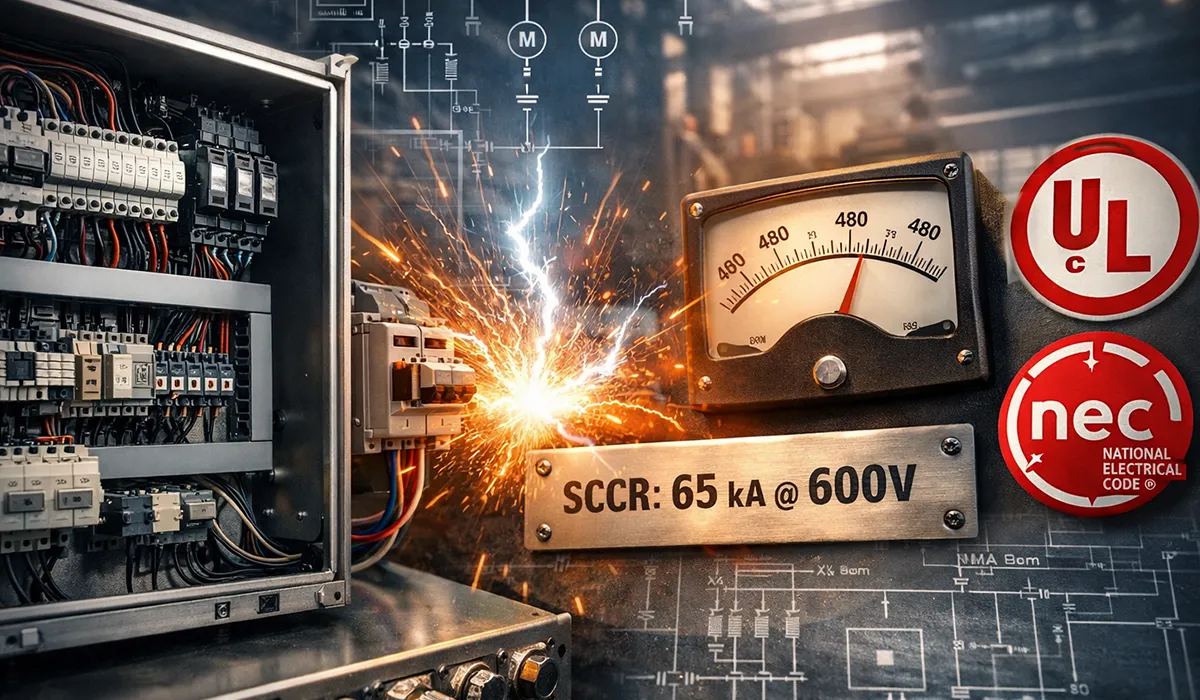
A compliant SCCR label must clearly display the panel’s voltage, horsepower, or amp ratings, and the calculated SCCR value — for example, “SCCR: 65 kA @ 600 V” — so that installers and inspectors can verify code compliance onsite. This article serves as a valuable resource for those seeking detailed information on SCCR labeling requirements: SCCR Label Guide.
Component Selection & Ratings
UL 508A compliance requires careful component selection. Only UL-listed or UL-recognized components with clear ratings must be used, and understanding which sub-standard governs each device is essential. If you are looking for more information about CE marking for industrial control panels — a parallel compliance concern for export markets — it is recommended not to miss reading this CE marking guide.
| Requirement | Item |
|---|---|
| Only UL‑listed or UL‑recognized components with clear ratings should be used | UL Listing |
| UL 489 (molded‑case circuit breakers), UL 1077 (supplementary protectors), and UL 98 (disconnect switches) must be applied correctly within the panel | Applicable Standards |
| Components not properly rated become the “weakest link” and lower the overall SCCR | SCCR Impact |
Motor Branch Protection Rules
Motor branch circuits often have specific overcurrent protective device requirements; selecting the right combination ensures both NEC and UL 508A compliance for those parts of the design.
Wiring, Spacings & Terminations
When discussing wiring, you must follow the National Electrical Code. Details that may appear minor can break compliance. UL 508A enforces wiring methods and spacings that help prevent electrical arcing, overheating, and failure. Panels must follow correct wire sizing, creepage/clearance requirements, and secure terminations with documented torque values.
Further exploration of UL 508A wiring standards can be found in the following recommended reading: UL 508A Wiring Standards.
Control Transformer Sizing
Sizing control transformers correctly is key to protecting control circuits without undermining SCCR or violating NEC 409 voltage criteria. Calculations should be documented in your panel’s drawing package.
Enclosures & Environmental Ratings
Panels under UL 508A must be housed in enclosures that meet the appropriate NEMA enclosure types (e.g., NEMA 1, 12, 4X) for the intended environment. Proper enclosure selection ensures dust, moisture, and corrosion protection consistent with NEC and UL 508A requirements. For a comprehensive understanding of IP vs NEMA ratings and how they relate to enclosure selection.
For a more focused comparison of two of the most common industrial ratings, further exploration of IP55 vs NEMA 12 differences can be found in the following recommended reading: IP55 vs NEMA 12 comparison.
Labeling & Documentation Package
A compliant panel must include more than an SCCR label. UL 508A expects a complete documentation package for every panel shipped.
| Details Required | Document / Item |
|---|---|
| Manufacturer data, voltage, horsepower/amps, and SCCR value | Nameplate |
| Conductor types and torque values clearly indicated | Wiring Diagrams |
| Full list of components with UL certification marks | Bill of Materials (BOM) |
| Clearances, spacings, and component placement clearly shown | Layout Drawings |
Torque & Conductor Tables
Including torque charts and conductor sizing tables in the documentation helps AHJs and installers verify that the panel was built and tested in accordance with related safety standards. This article serves as a valuable resource for those seeking detailed information on EMC requirements for industrial control panels, which must also be addressed within the documentation pack.
Listing vs Field Evaluation
There is a significant difference between having a UL 508A-listed panel and merely undergoing a field evaluation by an inspector. A listed panel carries a UL mark and is backed by ongoing inspections. In contrast, a field evaluation may accept an unlisted panel based on evidence of compliance at the time of installation. Understanding the implications of each is essential for project acceptance and liability management. If you are looking for more information about grounding and earthing systems that affect field inspection outcomes, it is recommended not to miss reading this grounding and earthing guide.
UL 891 vs UL 1558 vs UL 508A
Standards like UL 891 and UL 1558 address different parts of electrical distribution. Understanding these differences helps you specify the right equipment for power distribution as opposed to control, securing compliance and maintaining appropriate safety margins. For a comprehensive understanding of the UL 891 standard, we highly recommend reviewing this UL 891 switchboard guide.
| Description | Standard |
|---|---|
| Covers low‑voltage switchboards used mainly for power distribution in commercial and light industrial facilities | UL 891 |
| Covers metal-enclosed low-voltage switchgear with higher short-circuit withstand and more stringent compartmentalization — suitable for critical industrial power systems | UL 1558 |
| Focuses on industrial control panels — not main distribution assemblies | UL 508A |
How to Get UL 508A Listed
To obtain UL-certified panels, work with a UL‑certified panel shop or develop procedures that meet UL’s follow‑up services. This also includes formal documentation procedures, shop audits, and procedural consistency approved by UL. If you are looking for more information about compliance in busbar manufacturing a key part of the UL listing process.
Real‑World U.S. Use Cases
Industries from manufacturing to water treatment often specify UL 508A panels because they demonstrate compliance and reduce inspection delays. Knowing UL 508A inside out helps you avoid redesigns and costly onsite corrections. For a comprehensive understanding of real-world UL 508A applications, we highly recommend reviewing this UL 508A application guide.
Conclusion
UL 508A is vital for ensuring the safety and reliability of industrial control panels. From adhering to SCCR calculation methods to following strict component selection guidelines and documentation requirements, compliance with UL 508A helps minimize risks and ensures that control panels can handle electrical failures and meet installation standards. Whether you’re manufacturing in-house, collaborating with a UL panel shop, or working with Authorities Having Jurisdiction (AHJs), understanding and implementing UL 508A guidelines is critical for successful project execution. By focusing on safety, accuracy, and documentation, UL 508A minimizes costly mistakes and ensures a seamless path from design to installation. To stay ahead in the industry, continuous alignment with this standard is essential for quality assurance and long-term operational success.