


If you’d rather listen than read, feel free to play the audio file below for the rest of this article.
What Is a DIN Rail?
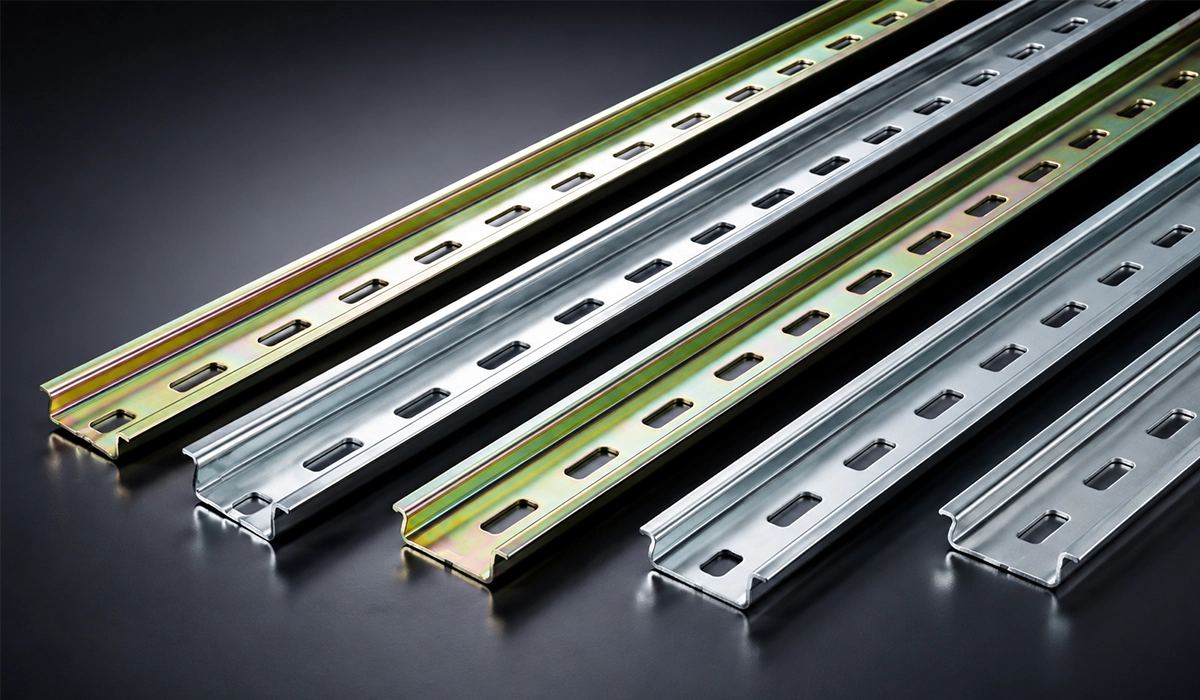
A DIN rail is a standardized metal strip that mounts electrical components inside a control panel or enclosure. It provides mechanical support, not electrical conduction. Most rails are formed from steel or aluminum, and components clip directly onto the profile.
The name comes from Deutsches Institut für Normung, the German standards body that originated the format. DIN rail mounting has since become the international default. The sections below cover the main types, materials, applications, and how rail differs from busbar.
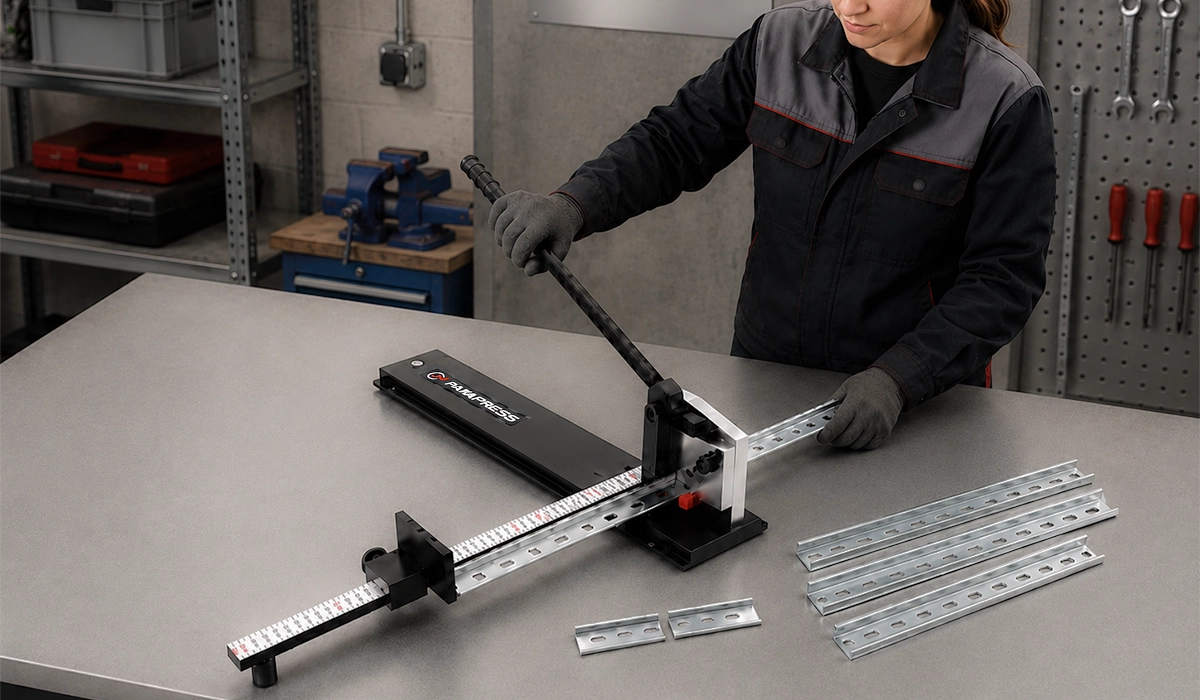
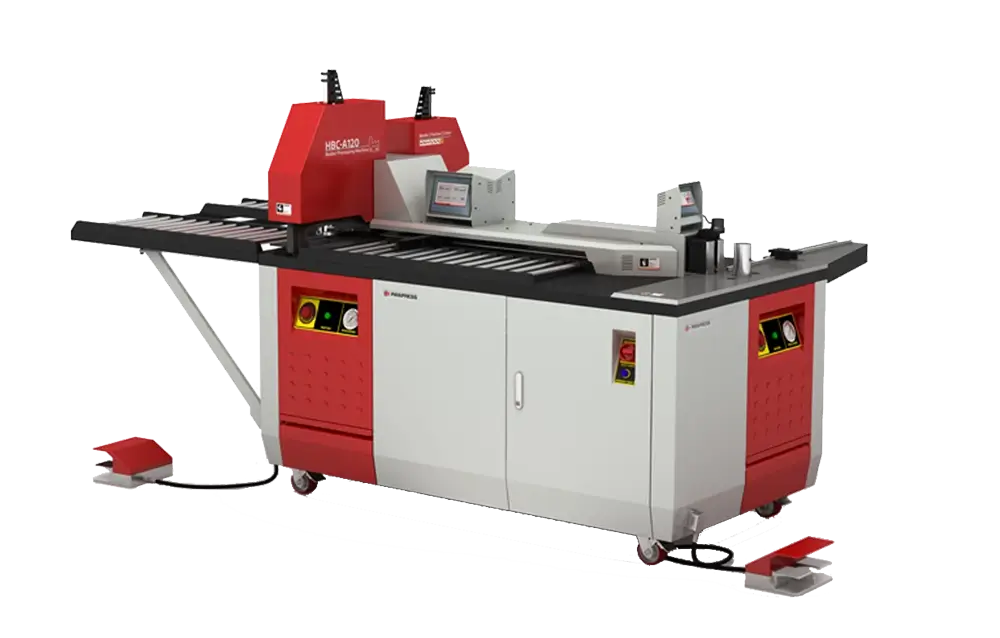
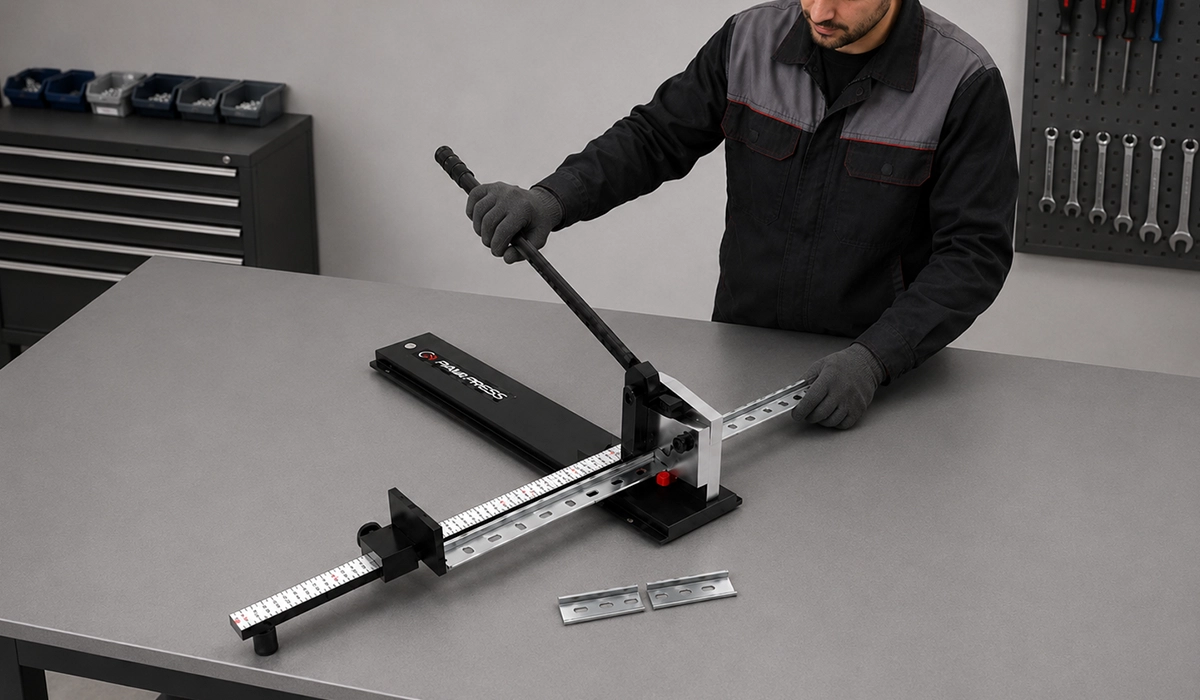
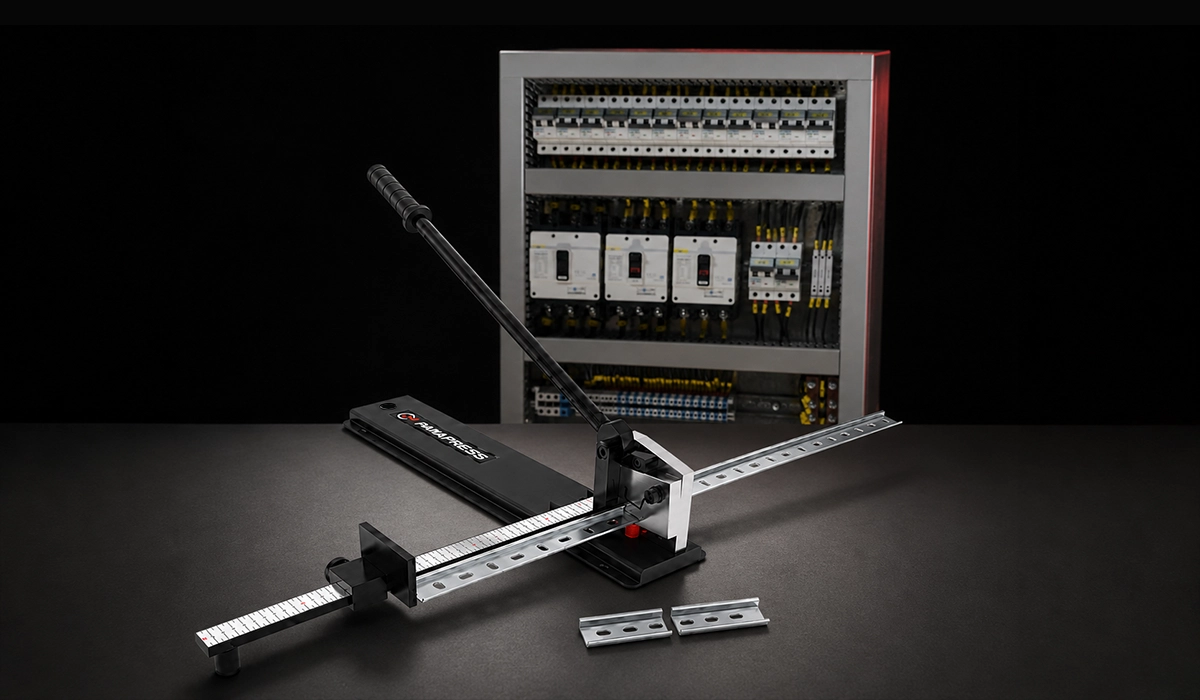
Before continuing, it is worth seeing the machine that does this job in one DIN rail cutter in action.
What Does a DIN Rail Do?
The rail solves an assembly problem. Without it, every component in a panel would need its own drilled and tapped mounting holes, positioned individually against a drawing. That is slow, hard to modify, and unforgiving of error.
A DIN rail replaces that with snap-on mounting. The rail is fixed to the backplate once, and components clip onto it in seconds. Repositioning a device means sliding it along the rail rather than drilling fresh holes, which matters when a panel is modified in the field.
Typical rail-mounted components include:
- Circuit breakers and RCDs
- Relays and contactors
- Terminal blocks
- PLCs and I/O modules
- Power supplies
The function is mechanical by default. Anyone asking what is a DIN rail doing in a panel has the answer here: it holds devices in position and maintains spacing, but it does not carry current between them.
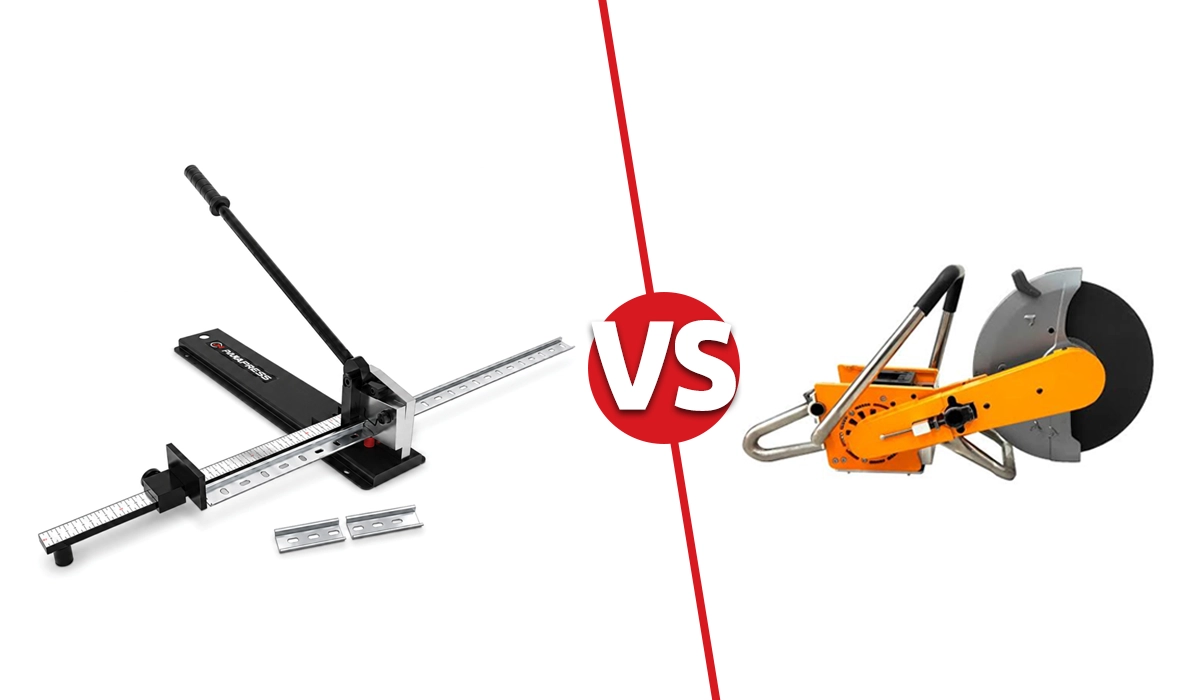
Rail also arrives in fixed lengths and has to be trimmed to fit the enclosure, so the tooling you use for that job matters as much as the profile you specify — the available shearing tool options are compared in a separate guide.
DIN Rail Types and Sizes at a Glance
Three profiles cover almost all installed rail: TS35 top hat, TS15 miniature, and TS32 G-section. DIN rail sizes are standardized across manufacturers, which is what makes components interchangeable. For full dimensions and guidance on choosing between them, see our DIN rail types and sizes guide.
TS35 (Top Hat) — The Default Choice
TS35 dominates because component compatibility is effectively universal: manufacturers design clips around this profile, so a breaker from one supplier fits rail from another. It handles the load of densely populated panels without deflection. Full measurements are covered in TS35 DIN rail dimensions, so they are not repeated here.
TS15 and TS32 — When They’re Used Instead
TS15 is the miniature profile, used where enclosure depth is tight and the mounted devices are small — compact instrumentation, sensor interfaces, and low-density terminal work. TS32 is the G-section rail, an asymmetrical profile found mainly in older installations. New designs rarely specify G-rail, but it still appears during retrofit work on legacy panels.
Since TS35 accounts for most installed rail, its dimensions and tolerances are worth reading in detail before you specify a panel — the profile is covered in TS35 rail explained.
What Are DIN Rails Made Of?
Steel is the usual DIN rail material, supplied as zinc-plated steel or galvanized steel. It carries load well, resists deflection under densely mounted components, and the plating provides corrosion protection in normal indoor enclosure conditions.
An aluminum DIN rail is lighter and naturally corrosion-resistant, which suits outdoor cabinets, marine environments, and washdown areas. The trade-off is lower load capacity, since aluminum is softer and flexes more readily under heavy device arrangements.
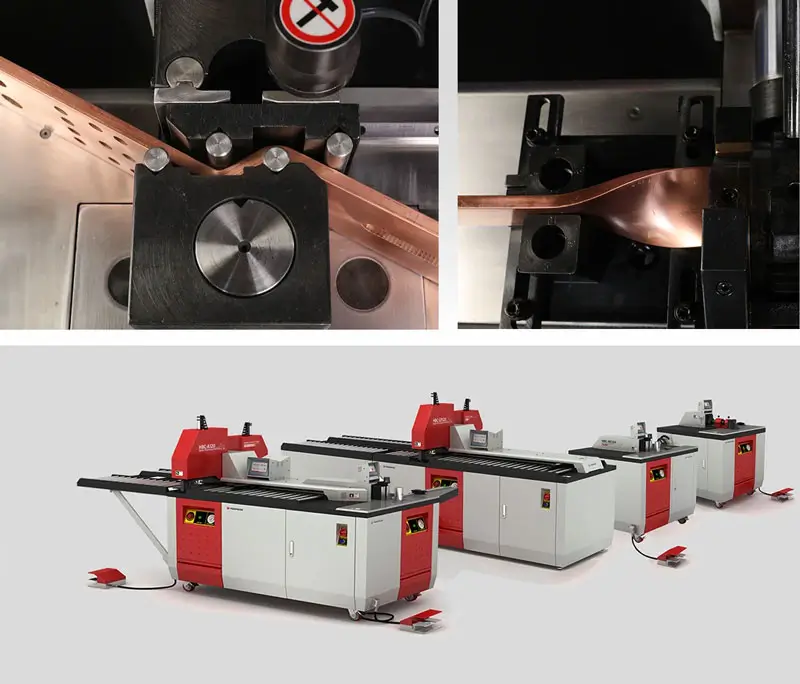
Copper rail also exists, and this is where confusion starts. A copper busbar rail is not a mounting rail — it functions as a grounding or distribution busbar. The profile may look similar; the purpose is entirely different.
Material also changes how the profile behaves under a blade, since plated steel and aluminum do not shear the same way, which is one of the points covered in what to check first.
DIN Rail vs. Busbar: Clearing Up the Confusion
The DIN rail vs busbar question is the most common point of confusion, and the answer is straightforward. A DIN rail is mechanical support. A busbar is a current-carrying conductor, engineered specifically to move power between points in an assembly. They are not variants of the same product. The distinction shows in how each is specified.
| Criterion | DIN Rail | Busbar |
|---|---|---|
| Primary Function | Mechanical Support | Current-Carrying Conductor |
| Specified By | Profile, Material, Mechanical Load | Current Rating, Cross-Section, Short-Circuit Withstand |
| Typical Material | Zinc-Plated or Galvanized Steel, Aluminum | Copper or Aluminum |
| Carries Operating Current | No | Yes, by Design |
| Governing Reference | IEC 60715 | IEC 61439 (Assembly Context) |
Busbar is sized by current rating, cross-section, and short-circuit withstand. Rail is selected by profile, material, and mechanical load. Nothing about a standard mounting rail is designed or rated to carry operating current.
One exception is worth knowing. A DIN rail fitted with grounding terminal blocks can serve a chassis-ground path, since the terminals bond devices to the rail and the rail to the enclosure earth. That is a protective function rather than a distribution one, and any specific rating claim should be verified against the applicable standard and the terminal manufacturer’s data before it is relied upon.
Where DIN Rails Are Used
DIN rail applications span most sectors that build electrical assemblies. Control panels and switchgear are the largest category, where rail organizes breakers, relays, and terminals inside the enclosure.
Industrial automation is the second, with PLCs, I/O modules, and sensor interfaces clipped to rail inside machine control cabinets. Power supply mounting is a third, since DIN-format supplies are designed specifically for rail installation.
In every one of these sectors the rail still has to be shortened to fit somewhere, and the choice between a powered shear and a hand saw affects both finish and cycle time — the two are compared in shearing versus sawing.
Renewable energy installations are a growing fourth: solar and wind inverter cabinets use rail to mount protection devices, monitoring equipment, and DC isolation components. The common factor is any enclosure where devices must be organized, accessible, and modifiable after commissioning.
Download the attached file to explore the complete data and supporting information.
Cutting DIN Rail to Length
Rail ships in standard 1-metre and 2-metre lengths and is cut to fit the enclosure on site or in the workshop. The cut must be clean and burr-free, because a burred end damages component clips as devices slide on and creates a sharp edge for the installer.
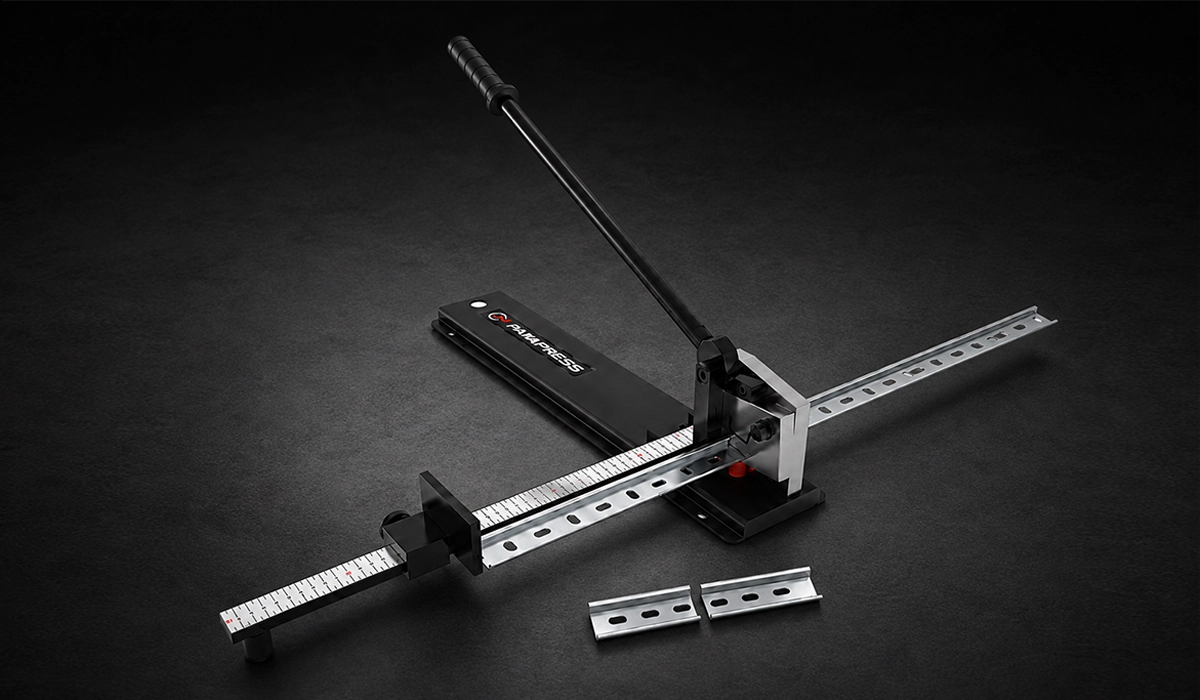
A hacksaw works but leaves burrs that need filing. A dedicated DIN rail cutter shears the profile cleanly in one action without secondary finishing.
The practical steps, the tools involved and the mistakes that leave a burred end are set out in our full guide to clean, burr-free cuts.
DIN Rail Standards in Brief
IEC 60715, published in Europe as EN 60715, is the current international DIN rail standard. It defines the profiles, dimensions, and tolerances that make components from different manufacturers interchangeable.
Anyone working to a drawing that still cites the superseded European numbers will find the clause-by-clause detail in our guide to the DIN rail standard.
Older references still appear on legacy drawings: EN 50022 covered top hat rail, EN 50035 the G-section, and EN 50045 the miniature profile. These have been superseded but remain in circulation on archived documentation. The full history is covered in our IEC 60715 standard in full guide.
Download this resource to compare the details more easily during your review process.
Conclusion about DIN Rail
Getting rail type, material, and standard right prevents two recurring problems: components that do not fit the profile specified, and rail that deflects or corrodes under conditions it was never rated for. Both are cheap to avoid at design stage and expensive to correct in a commissioned panel. The linked guides cover each topic in depth, and PAYAPRESS supplies rail and busbar tooling for shops fabricating their own.

Rate this article
Choose a rating from 1 to 5 stars.
No ratings yet
0 Comments
No comments yet. Be the first to comment.