Last updated: August 2025
By: Manufacturing Engineer — 10+ years in LV switchgear fabrication (IEC 61439 projects across EMEA)
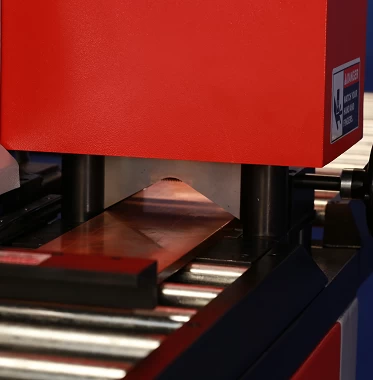
Short answer: because physics, fixturing, and quality. When you cut copper or aluminum busbars, you work against three realities: the hold-down clamps that secure the bar, the blade overlap or kerf that separates material, and the shear-affected zone that forms at the cut edge. Together, these mean you should plan for small lead/tail off-cuts— even on machines marketed as “burr-free.”
Why Busbar Cutting Creates Scrap
Hold-down clamps must press on the bar to prevent movement. That clamp land becomes off-cut once you separate the part. Then the blade needs overlap to complete the cut. In shearing, the metal passes through rollover → burnish → fracture → burr. A short crop at the start/end removes these deformed zones and helps you hit squareness and edge-finish specs.
Shearing vs. Sawing: What Changes in Edge Quality
Shearing is fast and has minimal kerf, but can leave rollover/burr if clearance is off or tooling is dull. It’s excellent for high-volume straight cuts and works best with a defined deburr step.
Sawing removes a blade-width kerf but typically yields a cleaner 90° face out of the machine. It’s slower and generates chips, yet may cut your rework on critical lap joints.
How to Minimize Off-Cut Waste on Busbar Cutting Machines
- Keep blade clearance right & edges sharp. Burr height rises with poor clearance and dull tools.
- Use accurate stops/CNC backgauges and plan cut sequences to minimize remnants. Simple nesting helps.
- Sequence for quality: crop a short “starter” piece to dial in squareness and burrs before the first customer part.
- Standardize deburring for consistent safety and contact area; use brushing or light face-milling as needed.
- QA the edge: define acceptable burr height and squareness; add simple go/no-go checks to your traveler.
Busbar Cutting Methods vs. Scrap Needs & Edge Quality
| Method | Why scrap is needed | Off-cut planning | Edge quality after cut | Typical finishing | Best use case |
|---|---|---|---|---|---|
| Shearing (guillotine) | Clamp land + blade overlap; shear zone forms | Yes (lead & tail trim) | High throughput; burr/rollover if clearance or edges are off | Deburr; occasional face clean | High-volume straight cuts |
| Sawing | Kerf removes material; fixturing still needs approach | Usually (process-dependent) | Cleaner 90° face; wider kerf; slower | Light deburr | Precision lengths and squared faces |
| Punch-cut on integrated lines | Die exit/entry + clamp requirements | Yes (case-by-case) | Controlled, still verify burrs | Deburr | Automated lines with nesting |
Notes: Qualitative guidance only—verify on your own thickness/grade and QA spec.
Standards and Good Practice for Busbar Edges and Joints
While standards don’t specify a scrap length, IEC 61439 frames the assembly performance (temperature rise, dielectric, short-circuit) you must meet. Pair this with the Copper Development Association’s “Copper for Busbars” design guide when defining joint geometry and spacing. Consistent, burr-free edges support reliable contact pressure and lower thermal risk.
Buying Checklist: “Burr-Free” Claims to Validate
- Cut your copper and share macro photos of the edges.
- State burr height target and squareness on a sample report.
- Show clamp design and the required lead/tail.
- Disclose blade steel and resharpening intervals.
- Demonstrate length repeatability on three consecutive pieces.
Price & TCO Factors That Affect Scrap and Rework
- Tooling lifecycle: blade wear, resharpening, spare sets.
- Setup waste & changeovers: how many trims per batch?
- Operator time: deburring, inspection, rework.
- Uptime: maintenance and calibration access.
- Material recycling: off-cut handling and reclaim value.
Need deeper budgeting context? See our busbar machine price guide.
RFQ Checklist for Busbar Cutting Quality
- Material grade (Cu/Al), thickness × width, plating/coating.
- Preferred method (shear/saw) and edge requirement (squareness, face finish).
- Burr height target and measurement method.
- Expected lead/tail off-cut and clamp land requirements.
- Sample cuts on our bar with photos + dimensional report.
- Maintenance plan (clearance checks, sharpening cadence).
- Throughput target (parts/hour), changeover time.
FAQs
Why is there scrap when cutting busbars?
Clamps need land and blades need overlap; trimming removes deformed zones to meet edge/squareness specs.
Can “burr-free” cutting eliminate off-cut entirely?
You can reduce scrap with optimized tooling and fixturing, but most setups still need small lead/tail trims—verify on your own bars.
Shearing vs sawing—what should I pick?
Shearing = speed and minimal kerf, typically needs deburr. Sawing = cleaner 90° face with kerf loss; slower. Choose by edge spec and takt time.
How do I minimize burr height?
Maintain clearance and sharp blades; standardize deburring and measure burr height in QA.