A double throw switch might sound like jargon reserved for electrical engineers, but it’s really a fundamental idea with real-world applications anyone specifying panels or backup power systems needs to understand. At its core, this type of switch lets you pick between two different circuits or sources with one actuator, which is why it’s indispensable in changeover jobs such as switching from utility power to generator power.
In simple everyday language, imagine a road with two possible directions — a double throw switch is the traffic light that lets the car go left or right (two possible outputs) instead of just stopping or going forward (one). The industrial nuance comes from how many circuits it controls and how robust the mechanism is, especially when handling high currents or safety-critical roles. For a comprehensive understanding of the electrical standards that govern these devices.
This guide walks you from basic definitions through wiring patterns and industrial use cases, explains how a DPDT switch works, shows where double throw safety switches fit, and highlights key standards like IEC 60947-3 you’ll see on many spec sheets.
If you are looking for more information about topic switchgear and busbar standards., it is recommended not to miss reading this article.
For your convenience, if you prefer listening, you can listen to the rest of this article via the audio file below.
What Is a Double Throw Switch?
A double throw switch is a type of electromechanical device where each pole can connect to one of two outputs. Instead of just connecting point A to nothing (off) or one output (single throw), a double throw switch lets you choose between two circuits or sources.
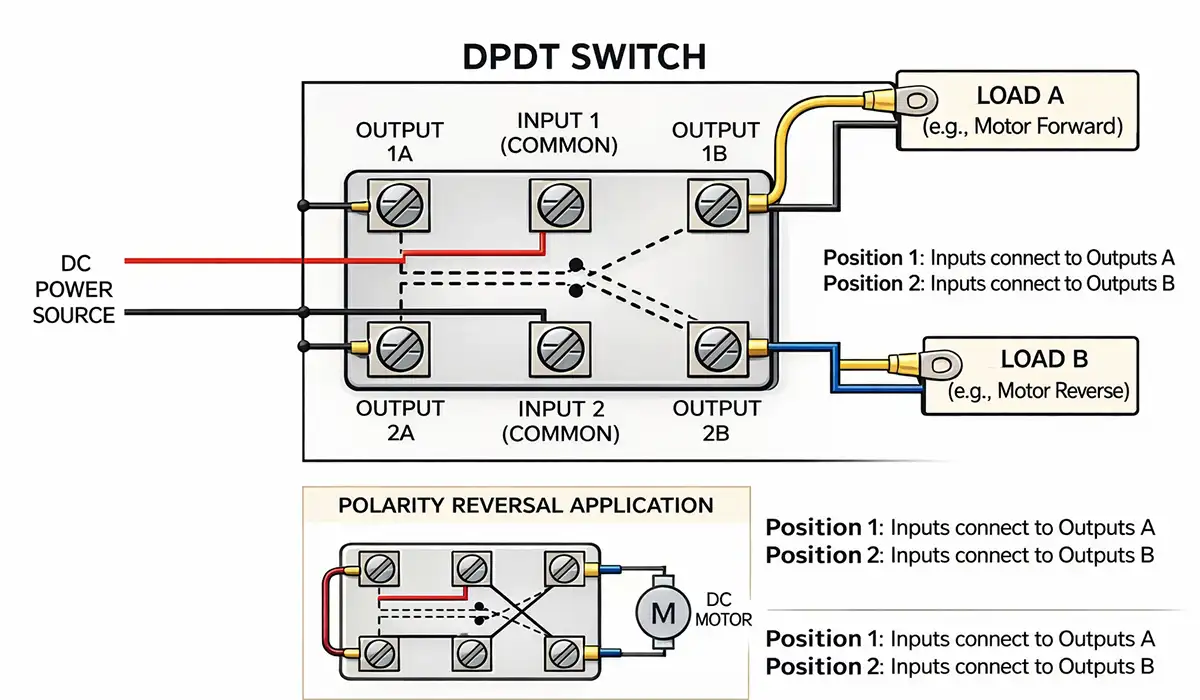
Take the DPDT switch (“Double Pole Double Throw”) — it essentially packs two independent SPDT sections into one body. You get six terminals: two inputs (one per pole) and four outputs (two throws per pole), so flipping the actuator changes both circuits at the same time. Further exploration of switch poles and throws fundamentals can be found in the following recommended reading: Arrow Electronics – Switch Fundamentals.
This structure is useful when you need to control two separate circuits at once (like line and neutral) or when you need multiple output choices from one actuation. The term “double pole double throw explained” basically boils down to “two circuits that can each go to two outputs.”
Poles vs Throws — Quick Primer
Every switch has poles and throws. Poles are how many independent circuits the device controls, and throws are how many outputs each pole can connect to. A single throw switch only has one output for each pole — essentially an ON/OFF job. In contrast, a double throw has two possible outputs, think of it as a choice between Source A and Source B with one handle.
Where Double Throw Switches Are Used
Double throw switches appear across electrical designs whenever there’s a need to choose between two circuits or power sources. One of the most common scenarios is switching between utility and backup generator power in industrial or commercial settings, where safe, manual changeover is critical.
In distribution panels and motor control centers, changeover switches help you isolate a load from one source and connect it to another without resorting to messy jumper wiring or unsafe workarounds. They’re also used in systems that must alternate between two loads from the same source or in control panels with complex logic paths.
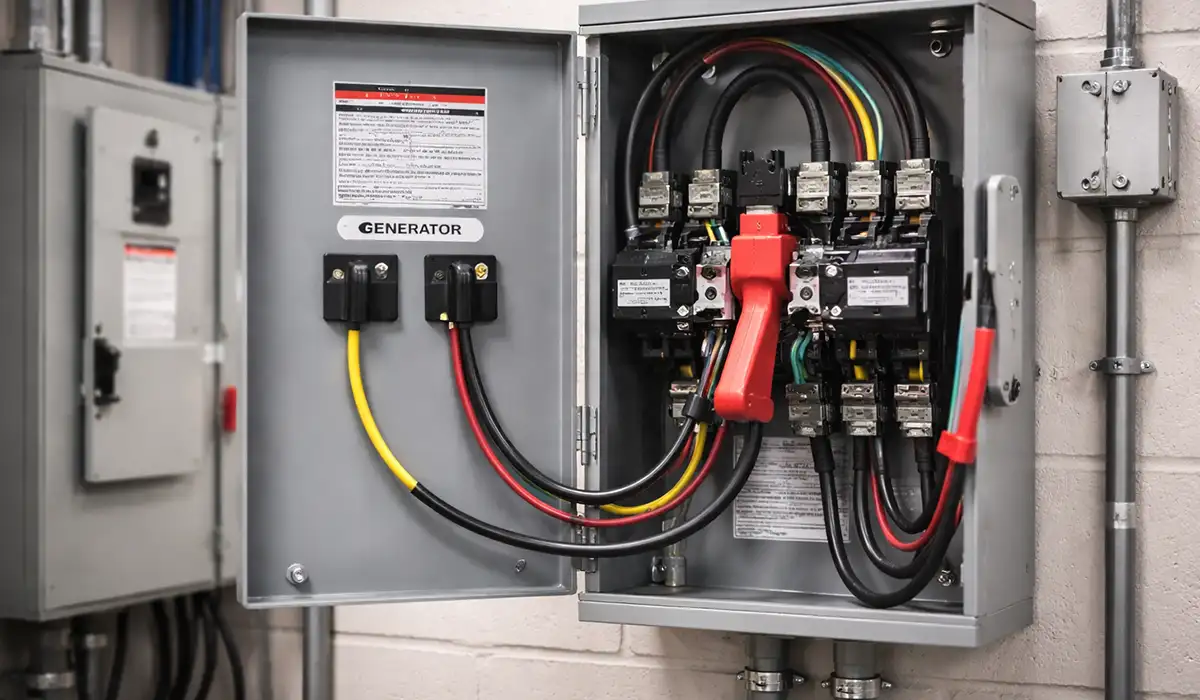
On generator projects, a double throw changeover device may stand in a panel to ensure that only one power source is connected at a time, eliminating backfeed into another source — a requirement in many electrical codes. For a comprehensive understanding of industrial switchboard assembly standards in this context, we highly recommend reviewing Industrial Switchboard UL 891 Guide.
Double Throw Safety Switches (Industrial)
In industrial distribution, a double throw safety switch (often a switch-disconnect switch) includes two interlocked switches designed so they cannot both be closed simultaneously. This prevents two sources from being tied together accidentally.
These safety switches are rugged, rated for significant current ranges (e.g., 30 A to over 1200 A), and often offered in fusible and non-fusible variants with features like visible blade mechanisms and padlockable OFF positions. They’re meant for environments where loading must be isolated quickly and distinctly, such as service entrance panels, generator changeover points, or industrial distribution racks.
| Switch Type Description | TYPE |
|---|---|
| Single circuit, one output — basic ON/OFF function; simplest form of switching | SPST |
| Single circuit, two outputs — selects between Source A and Source B with one actuator | SPDT |
| Two independent circuits, each with one output — simultaneous ON/OFF for two circuits | DPST |
| Two independent circuits, each with two outputs — full changeover for line and neutral simultaneously | DPDT |
| Interlocked dual switch-disconnector; prevents both sources connecting at once; rated 30 A–1200+ A | DT Safety Switch |
Manual Transfer Switches vs “Double Throw”
A manual transfer switch is a type of double throw function: it manually shifts your load between two power sources (like utility and generator) by flipping a handle or lever. This is essentially what many double throw safety switches do in a panelboard context.
The key difference between manual and automatic transfer switches (ATS) is that automatic versions detect power loss and switch without human intervention. Manual ones rely on a person to make the change when needed. For homes and small businesses, a manual approach might be cost-effective and straightforward; for facilities where uptime and quick response are critical, automatic switching is often required.
For more background on how transfer switches operate, this article serves as a valuable resource: Transfer Switch
Relevant Standards and Ratings
When you buy switches for industrial use, you’re not just picking amperage and housing style — you’re buying compliance with standards. IEC 60947-3 is the primary international standard for switches, disconnectors, switch-disconnectors, and fuse-combination units used in low-voltage distribution and motor circuits up to 1000 V AC or 1500 V DC. It defines how equipment must perform in normal and abnormal service, including tests, marking, and behavior expectations.
“Switch-disconnector” is a term you’ll encounter here. Essentially, it’s a device that combines switching capability with isolation — it can make and break current under operational conditions while also providing a clear open gap for safety and maintenance. Switches compliant with IEC 60947-3 and equivalent regional standards (such as UL 98 for the U.S.) are designed to be safe, predictable, and suitable for distribution panel roles.
For a comprehensive understanding of how IEC 61439 design verification intersects with switchgear compliance, we highly recommend reviewing IEC 61439 Design Verification & Compliance Guide.
Safety & Compliance Considerations
Industrial double throw switches often include features beyond basic switching. Visible break or visible blade contacts let you confirm the circuit is open before working on it. Padlock or lock-off provisions support maintenance lockout/tagout procedures, and enclosure ratings must match the installation environment — outdoor, indoor, washdown, and so on.
Choosing devices rated for proper utilization categories and enclosures is essential for safety and inspection compliance.
If you are looking for more information about IP and NEMA enclosure rating comparisons, it is recommended not to miss reading IP vs NEMA Ratings and IK.
How to Wire a DPDT Double Throw Switch
Wiring a DPDT switch is about understanding the common (COM) terminals and the two possible throws for each pole. Think of it as two SPDT switches sharing one actuator. This general pattern ensures that flipping the switch cleanly selects between two source paths or two load paths without partial connections or shorts.
- Identify the terminals: Most DPDT switches have six terminals — two common inputs and four outputs.
- Label your circuits: Mark the inputs and outputs you plan to connect (e.g., Source A/B or Load A/B).
- Connect sources and loads: Connect each common input to the respective source or load.
- Test in a de-energized state: Always verify continuity with a meter before applying power and check that connections match your desired behavior.
Correct conductor sizing for each terminal is equally important. For a comprehensive understanding of three-phase power cable selection in changeover circuits, we highly recommend reviewing Three-Phase Power Cable.
Common Wiring Patterns
Different wiring patterns you’ll see in practice include: one source feeding two loads (choose which load gets powered); two sources feeding one load (classic changeover); polarity reversal for motors and actuators in low-voltage DC circuits; and ON-ON-ON three-position configurations where some DPDT mechanisms allow three stable positions, useful for more complex routing.
Sizing & Selection Checklist
When selecting a double throw or DPDT device, start with voltage and current ratings that match your system load, then confirm the number of poles and throw function (ON-ON or ON-OFF-ON). Enclosure rating must match the environment, and mechanical life together with terminal type determines long-term installation quality. Standards compliance (IEC 60947-3 or equivalent) and correct interrupting capacity are non-negotiable.
Good practice is to oversize modestly and confirm the device’s interrupting capacity meets your application’s worst-case currents. This article serves as a valuable resource for those seeking detailed information on IP55 vs NEMA 12 enclosure ratings for panel environments.
Double Throw vs Single Throw (and Other Types)
A single throw switch simply connects or disconnects one circuit — it’s ON or OFF. A double throw switch offers two possible outputs for each pole, making it better for source selection, changeover functions, or systems requiring alternate paths. SPDT is the single-circuit version with two output choices, while DPDT adds a second circuit under the same actuator, which is handy in industrial panels where you want coordinated switching without separate switches.
If your job is simple ON/OFF, SPST or single throw may suffice. If you’re selecting between sources or need coordinated multi-circuit switching, a double throw variant is what you want. Further exploration of overcurrent protection coordination with these switches can be found in the following recommended reading: Methods of Protection Against Overcurrent.
Industrial Buying Guide: What to Look For
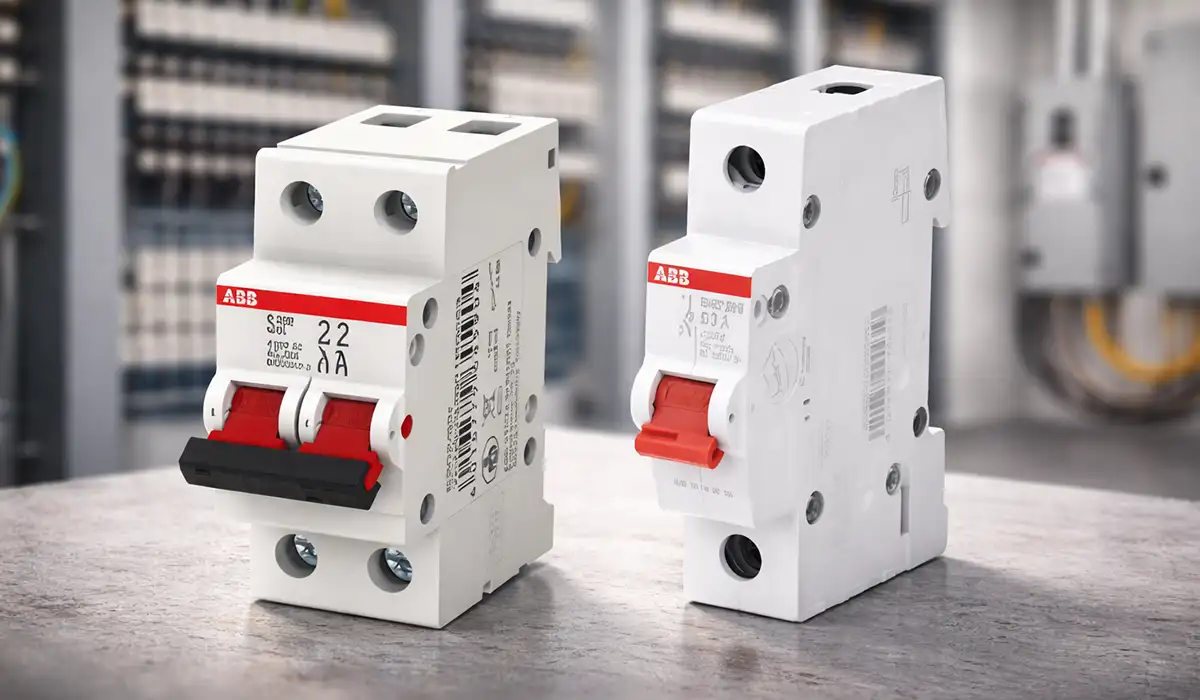
Specifiers scanning datasheets should focus on interlock mechanisms, visible isolation features, fusible vs non-fusible options, and short-circuit ratings appropriate to their panel. Devices with service entrance ratings or stacked switch options help save space while meeting code. Match your switch’s usage category (e.g., AC-21A/B for mixed loads, AC-23 for motor loads) and confirm the design life and mechanical durability match expected operations.
EMC requirements for the wider control panel also deserve attention during the selection phase. For a comprehensive understanding of industrial control panel EMC requirements, we highly recommend reviewing Industrial Control Panel EMC Requirements – IEC 61000.
Frequently Asked Questions (FAQs)
Is a Manual Transfer Switch the Same as a Double Throw Switch?
A manual transfer switch is often implemented as a double throw function, manually moving the load between two sources. It’s a subset of double throw switching used for generator changeover. The underlying mechanism — two interlocked positions — is the same in both cases.
Why Do Some Double Throw Safety Switches Have Interlocks?
Interlocks prevent both switches from closing at once, which would connect two sources in parallel — an unsafe condition that can damage equipment and create serious fault currents. This ensures only one path is energized at a time, which is a core safety requirement for any changeover application. Proper grounding of the installation is equally critical alongside interlock design.
What Standard Covers Switch-Disconnectors Used in Industry?
The IEC 60947-3 standard governs switches, disconnectors, and switch-disconnectors for low-voltage applications, specifying performance and testing requirements. For installations that also involve medium-voltage switchgear.
Can a DPDT Do ON-ON-ON (Three Positions)?
Yes, specific DPDT mechanisms and wiring patterns allow three stable positions for more complex routing or center-off logic. This is particularly useful in control panel applications where a neutral or bypass state is needed between the two active throw positions.
Do I Need a Transfer/DT Switch When Adding a Generator?
Yes — transfer switches isolate the generator from the utility and ensure safe load changeover, avoiding dangerous backfeeding. This is a code requirement in most jurisdictions.
Real-World Examples & Tips
In real panel shops, designers pick stacked double throw switches to save wall space without sacrificing rating, and installers use fine-stranded wire guidelines to avoid termination issues. Outdoor installations usually require NEMA 3R outdoor fusible DT switches to meet both safety and environmental demands. Safety compliance in busbar manufacturing that feeds these installations follows the same discipline of visible isolation and documented testing.