


Prefer listening? You can play the audio version of the rest of this article below.
What Is Single-Phase Power?
A single-phase supply delivers alternating current through one sinusoidal voltage waveform. The voltage rises, peaks, falls to zero, and reverses — repeating at the supply frequency. In Europe and Asia, that frequency is 50Hz; in North America, it runs at 60Hz.
The single-phase AC circuit uses two conductors: one live (phase) wire and one neutral. An earth conductor adds safety. Standard values are 230V at 50Hz across most of the world, and 120V at 60Hz across North America.
If you are looking for more information about Electrical Fundamentals, it is recommended not to miss reading this article.
Power delivery in a single-phase system pulsates rather than staying constant. Because the waveform crosses zero twice per cycle, instantaneous power dips to zero 100 or 120 times every second.
Consequently, this pulsation rarely affects lighting, heaters, or small electronics. However, it matters in motor design and any equipment that depends on smooth torque output.
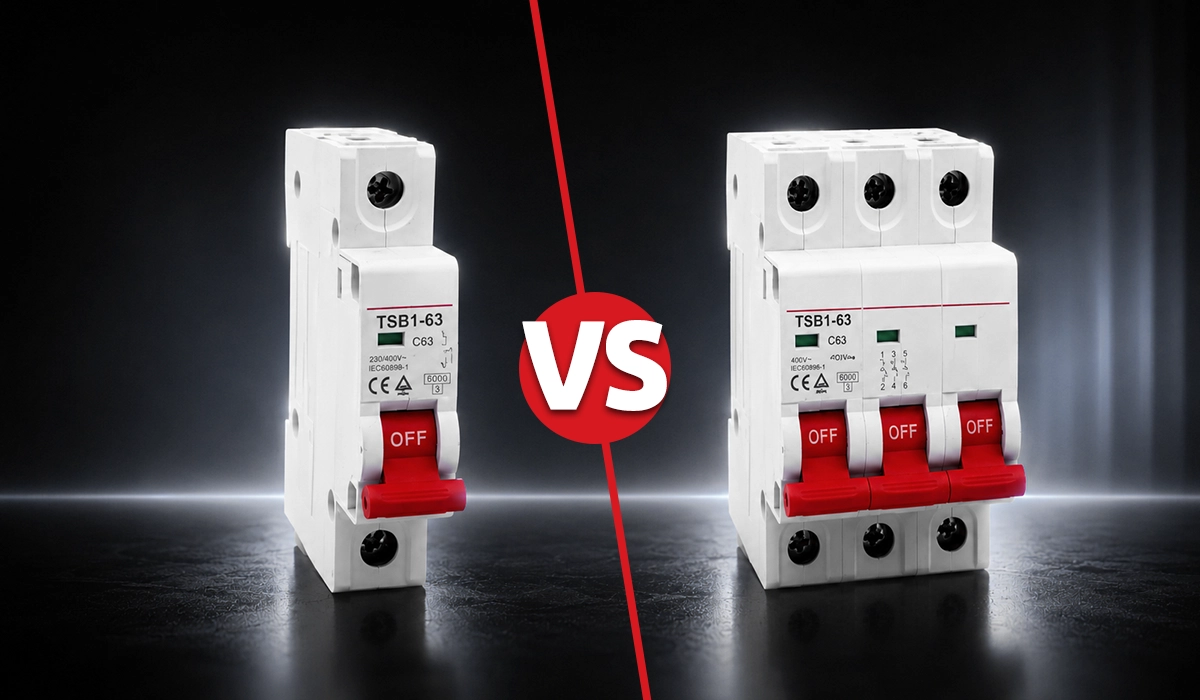
In the Single-Phase vs Three-Phase Power debate, single-phase remains the simpler foundation. It suits homes and light commercial loads but seldom exceeds a few kilowatts in practice.
Visit this page to learn more about the specifications, applications, and related details.
What Is Three-Phase Power?
Three-phase power consists of three sinusoidal voltage waveforms of equal amplitude and frequency. Each phase is displaced 120 degrees from the next. These waveforms — labeled L1, L2, and L3 (or A, B, C in North America) — flow through three live conductors, with or without a neutral.
Because the three phases are spaced 120 degrees apart, their instantaneous values sum to zero in a balanced three-phase load. As a result, the neutral conductor carries little or no current under balanced conditions.
Furthermore, the three pulsating waveforms complement each other so total delivered power stays smooth and steady. This constant delivery is why three-phase power is used in industry for motors, drives, and large continuous loads.
Standard three-phase line voltages are 400V at 50Hz in Europe and 480V at 60Hz in North America. Phase-to-neutral values of 230V and 120V come from the same systems.
Nikola Tesla and Mikhail Dolivo-Dobrovolsky pioneered the polyphase system in the late 1800s. Today it forms the backbone of global power transmission and industrial distribution.
For a comprehensive understanding of Voltage, Current, and Resistance, we highly recommend reviewing this article.
Key Technical Differences at a Glance
A direct comparison highlights how differently each system behaves. The table below summarizes the parameters that matter most when engineers specify equipment, size cables, or evaluate a phase upgrade.
| Parameter | Single-Phase | Three-Phase |
|---|---|---|
| Number of Live Conductors | 1 | 3 |
| Neutral Conductor | Required | Optional (Balanced Loads) |
| Voltage Waveforms | 1 Sinusoid | 3 Sinusoids, 120° Apart |
| Standard Voltage (Europe) | 230 V Phase-to-Neutral | 400 V Line / 230 V Phase |
| Standard Voltage (North America) | 120 V / 240 V | 208 V / 480 V Line-to-Line |
| Power Delivery | Pulsating | Constant (Smooth) |
| Power Formula | P = V × I × cos(φ) | P = √3 × VL × IL × cos(φ) |
| Typical Power Range | Up to ~10 kW | 10 kW to MW Range |
| Typical Applications | Residential, Light Commercial | Industrial, Commercial, Motors |
| Motor Starting Torque | Lower | Higher and Smoother |
| Conductor Efficiency | Lower | Higher (More Power per Conductor) |
| System Complexity | Simple | More Complex |
| Installation Cost | Lower | Higher |
Two rows in this Single-Phase vs Three-Phase Power comparison deserve special attention. The first is power delivery: single-phase pulsates, while three-phase stays smooth. That property drives motor torque quality, mechanical vibration, and process control performance.
The second is conductor efficiency. Three-phase carries roughly three times the power of single-phase using only one extra wire. Consequently, copper cost, cable losses, and switchgear sizing all improve in three-phase installations.
As load grows, the difference between single-phase and three-phase power widens. Below 10 kW, single-phase usually wins on simplicity. Above that threshold, three-phase wins on performance and lifetime cost.
Standards bodies such as the IEC and NEMA codify these parameters globally. Therefore, equipment nameplates carry consistent information for design teams worldwide.
Further exploration of Ohm’s Law Explained can be found in the following recommended reading.
Voltage Relationships in Three-Phase Systems
Engineers must distinguish phase voltage from line voltage before applying any three-phase formula. The geometry of three sinusoids spaced 120 degrees apart fixes this relationship for both star and delta connections.
In a star (wye) connection, phase voltage (V_Ph) sits between any live conductor and the neutral. Line voltage (V_L) sits between any two live conductors. The math is:
V_L = √3 × V_Ph ≈ 1.732 × V_Ph
For example, Europe’s 230V phase yields 400V line. In North America, a 120V phase yields 208V line, while a 277V phase yields 480V line. The 277V/480V configuration serves most commercial and industrial buildings.
In a delta connection, there is no neutral. Line voltage equals phase voltage instead, while currents differ: I_L = √3 × I_Ph
| Connection | Phase Voltage | Line Voltage | Neutral Available |
|---|---|---|---|
| Star (Wye) — Europe | 230 V | 400 V | Yes |
| Star (Wye) — North America LV | 120 V | 208 V | Yes |
| Star (Wye) — North America HV | 277 V | 480 V | Yes |
| Delta — Typical | Same as Line | 400 V / 480 V | No |
Understanding this relationship is essential. It governs the three-phase power formula, the correct tap on a three-phase transformer, and nameplate selection for industrial loads.
This downloadable guide gives you a more structured overview of the subject.
Where Each System Is Used—Applications in Practice
The choice between single-phase and three-phase service tracks two variables: total electrical demand and load type. Below roughly 10 kilowatts, single-phase remains efficient and economical. Above it, three-phase becomes the rational choice.
Geography also shapes the picture. Residential power distribution systems worldwide rely almost entirely on single-phase service. By contrast, factories, commercial parks, and data centers receive three-phase service for industrial-grade distribution.
Furthermore, the nature of the load matters as much as the total wattage. Resistive loads such as heating and lighting tolerate single-phase pulsation without issue. Rotating machinery — pumps, compressors, conveyors, machine tools — depends on the smooth torque that only three-phase delivers naturally.
The two subsections below walk through typical single-phase power applications and then the three-phase power advantages that made it the universal industrial standard.
If you are looking for more information about Electrical Power Formula, it is recommended not to miss reading this article.
Typical Applications of Single-Phase Power
Single-phase suits applications where demand stays modest and pulsating delivery has no operational impact. Residential single-phase power is the dominant case worldwide. Homes run lighting, heating, small appliances, consumer electronics, and motors up to a few kilowatts on a two-wire supply.
Why does residential power use single-phase? The answer is economics. Infrastructure is cheaper, loads stay small, and three-phase smoothness brings no benefit at 200–300 watts. Common single-phase power applications also include small retail spaces, light workshops, domestic HVAC units, and lighting circuits in small commercial buildings.
Typical Applications of Three-Phase Power
Three-phase power is the universal standard for industrial facilities, large commercial buildings, and any application driving big motors or continuous high-power demand. Constant, non-pulsating delivery is essential for smooth motor operation, precise process control, and efficient long-distance transmission.
Beyond motors, three-phase supply splits loads across three live conductors. This creates a balanced three-phase load that minimizes neutral current. Common applications include industrial motors and drives, CNC machinery, compressors, pumps, industrial HVAC and chillers, welders, data centers, commercial elevators, and high-bay lighting.
Single-Phase vs Three-Phase Motors: A Critical Industrial Comparison
Motors are where the choice between phase systems has the sharpest industrial impact. The Single-Phase vs Three-Phase Power decision shapes torque, efficiency, reliability, and the size of equipment that can be deployed economically.
A central question for plant engineers is: what is the difference between single-phase and three-phase motors? The short answer lies in how each system creates a rotating magnetic field. Three-phase supply produces this field naturally; single-phase requires auxiliary starting circuits.
Consequently, this difference cascades through every aspect of motor performance. It governs starting torque, vibration profile, efficiency band, and the practical ceiling on motor size. As a result, the same power rating costs more, weighs more, and runs less efficiently in single-phase form.
The two subsections below detail single-phase motor design and its limits, then explain why three-phase induction motors became the industrial workhorse. Three-phase vs single-phase motors is rarely a close call above 3–5 kW.
Moreover, modern variable frequency drives amplify these differences further by extracting extra efficiency from three-phase motors across a wider operating range.
How Single-Phase Motors Work and Their Limitations
A single-phase induction motor cannot self-start. The single sinusoidal supply alone does not produce a rotating magnetic field. Therefore, designers add capacitor-start, split-phase, or shaded-pole circuits to create the necessary phase shift.
Consequently, single-phase motors typically deliver lower starting torque, more mechanical vibration, and 3–5 efficiency points below an equivalent three-phase machine. The starting components also create extra failure points, and most designs are capped near 3–5 kW.
Why Three-Phase Motors Are the Industrial Standard
A three-phase induction motor is inherently self-starting. The three displaced waveforms generate a rotating magnetic field in the stator naturally. No capacitor banks or auxiliary windings are required.
This advantage cascades into smooth torque, higher power density, simpler construction, and 88–97% efficiency across a wide load range. Three-phase motors also scale cleanly from fractional kilowatts to multi-megawatt machines.
| Parameter | Single-Phase Motor | Three-Phase Motor |
|---|---|---|
| Self-Starting | No (Auxiliary Circuit Needed) | Yes |
| Starting Torque | Low to Moderate | High |
| Power Output Range | Up to ~5 kW Typical | Fractional kW to Multi-MW |
| Efficiency | 70–85% Typical | 88–97% Typical |
| Vibration | Moderate (Pulsating Power) | Low (Constant Power) |
| Construction Complexity | Higher (Starting Components) | Lower (Simpler Design) |
| Maintenance | More Frequent | Less Frequent |
| Cost per kW Output | Higher | Lower |
| Typical Applications | Domestic Appliances, Small Tools | All Industrial Applications |
Save this downloadable resource for quick access whenever you need it.
Efficiency and Energy Implications
How does three-phase power reduce energy losses? The answer begins with conductor efficiency. A three-phase system transmits three times the power of single-phase using only 1.5 times the conductor material. Therefore, copper cost per kilowatt drops by roughly 50%.
Transmission losses follow the same logic. For the same delivered power, three-phase operates at lower current per conductor, which directly reduces I²R losses in cables. Cooler cables also extend insulation life.
Motor efficiency reinforces these gains. Three-phase motors run 5–10 efficiency points ahead of single-phase equivalents. For a 10 kW motor operating 6,000 hours annually, a 7% improvement saves roughly 4,200 kWh per year.
Furthermore, balanced loading is the fourth lever. Three-phase systems split loads across three phases, minimizing neutral current and voltage imbalance. This protects sensitive equipment and helps maintain power factor close to unity.
In short, across the Single-Phase vs Three-Phase Power efficiency comparison, three-phase wins on every measurable parameter once load grows beyond light commercial scale.
This external page provides additional insights that may help with your evaluation.
Can Three-Phase Equipment Run on Single-Phase Power?
Can I run three-phase equipment on single-phase power? Not directly — and attempting it usually damages the motor. Three-phase machines need the rotating magnetic field that only a balanced three-phase supply produces naturally.
Without the missing third phase, the motor cannot generate starting torque, draws excessive single-phase current, and overheats within minutes.
However, four practical workarounds exist. Each fits a different scale and load type:
- Rotary phase converters generate the third phase mechanically using a motor-generator set, producing true three-phase output suitable for most motors.
- Static phase converters simulate a third phase with capacitors. They cost less but deliver imbalanced voltage, limiting use to non-critical loads.
- Variable frequency drives (VFDs) with single-phase input synthesize true three-phase output and add soft-start plus speed control.
- Utility upgrades convert incoming service to three-phase, often the most economical long-term path for multiple three-phase loads.
For most small manufacturers under 10 kW today, a VFD remains the fastest, cleanest solution and adds productivity benefits.
Visit the linked website to better understand the background, standards, and practical use cases.
Cost Considerations: Installation, Infrastructure, and Running Costs
The cost difference between single-phase and three-phase installation breaks into three categories: capital infrastructure, equipment, and lifetime running cost.
Installation cost favors single-phase. A two-wire service uses smaller cables, lighter transformers, and simpler switchgear. Therefore, for small facilities below 10 kW demand, the added cost of three-phase service rarely pays back.
Equipment cost flips above 3–5 kW. Three-phase motors and drives become cost-competitive per kilowatt because they need fewer components and pack more power per kilogram of frame.
Running cost is where three-phase pulls ahead decisively. Higher motor efficiency, lower transmission losses, and simpler maintenance compound year after year. For a plant running motors 6,000 hours annually, savings often offset the upgrade cost within two to four years.
Moreover, utility tariffs matter. Many regions charge lower per-kWh rates for three-phase industrial accounts than for single-phase commercial customers. In the Single-Phase vs Three-Phase Power cost analysis, short-term savings favor single-phase, while long-term savings favor three-phase at industrial scale.
Access the full file here to review all technical notes, examples, and recommendations.
How to Identify Whether a Supply Is Single-Phase or Three-Phase
How to identify single-phase vs three-phase supply is a question every technician faces on an unfamiliar site. Three methods give a reliable answer.
The first method is conductor counting. Open the main distribution board and count the live conductors. A single-phase supply shows one phase wire plus neutral. A three-phase supply shows three phase wires, with or without a neutral.
Next, color coding offers a quick visual check. Although conventions vary by region, three-phase boards consistently use three distinctly colored phase conductors. In Europe under IEC standards, brown, black, and grey identify L1, L2, and L3. In US installations under NEC, black, red, and blue commonly mark 208V systems.
Then comes direct voltage measurement, the most definitive method. Set a multimeter to AC volts. In a single-phase circuit, you read roughly 230V or 120V between live and neutral. In a three-phase star system, you read phase-to-neutral on each leg, and 400V, 208V, or 480V between any two phases.
Finally, equipment nameplates state the phase explicitly. Markings such as “1Ø” or “3Ø” appear alongside voltage and frequency information.
Conclusion about Single-Phase vs Three-Phase Power
The choice between single-phase and three-phase power is rarely close at industrial scale. Single-phase remains the right answer for homes, small commercial spaces, and standalone loads under 10 kW. Three-phase wins almost everywhere else.
The reasons are technical and economic. Constant power delivery enables smooth motor operation. Higher conductor efficiency reduces both copper cost and lifetime losses. Self-starting induction motors run cleaner, last longer, and scale up to multi-megawatt machines without auxiliary circuits. Balanced loading and lower neutral current also protect sensitive equipment downstream.
For facilities running on single-phase but planning expansion, the question is no longer “if” but “when.” Evaluate the upgrade against motor inventory, projected demand, and utility tariffs. In most industrial cases, payback justifies the move.
The phase decision is ultimately a design choice — and getting it right early avoids costly retrofits later. Engineers who weigh the question carefully at the planning stage typically deliver more efficient, lower-cost facilities than those who default to single-phase by habit.



Rate this article
Choose a rating from 1 to 5 stars.
No ratings yet