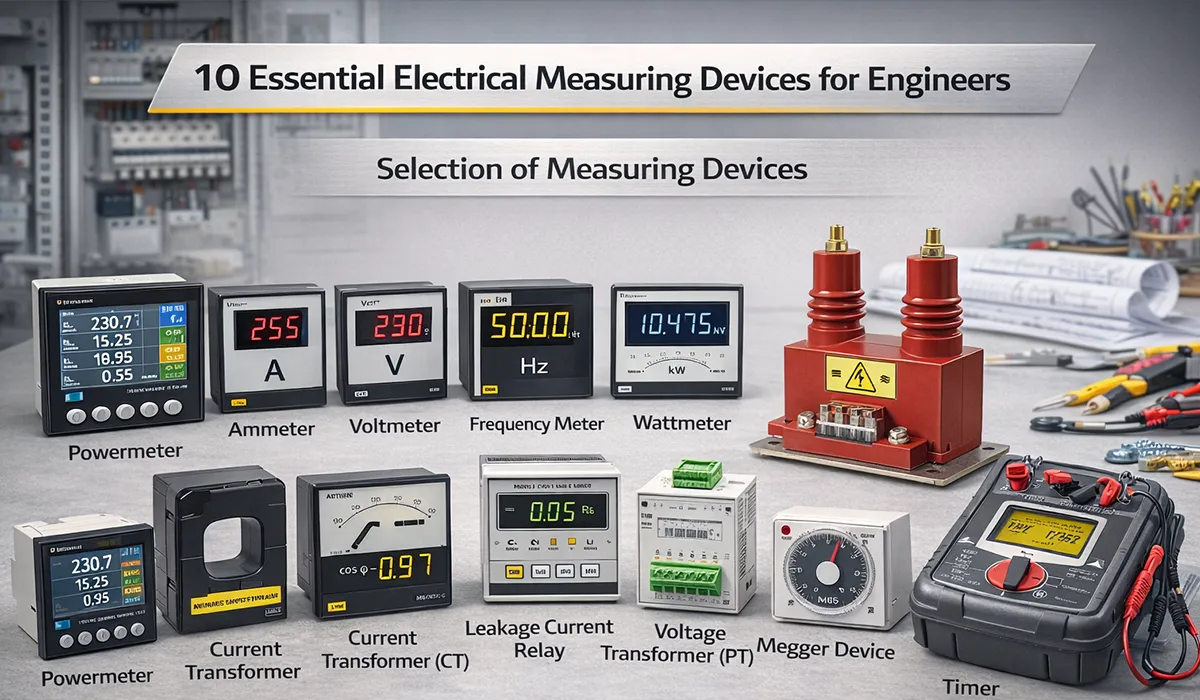
Powermeter, ammeter, frequency meter, current transformer, cosine phi meter, etc. In electrical systems and main electrical switchboards, and in most industrial environments, electrical measuring devices are needed to inspect and manage electrical equipment and to analyze parameters such as current, voltage, power, frequency, power factor, etc. For a comprehensive understanding of the standards governing these systems, we highly recommend reviewing this article on standards for switchgear and busbar systems. Further exploration of applicable electrical regulations can be found in the following recommended reading on the electrical standards guide.
Prefer listening? You can play the audio version of the rest of this article below.
Selection of Measuring Devices
Before selecting any measuring device for a switchboard, the following criteria must be carefully evaluated to ensure accurate measurement, safety, and compatibility with the installation environment. If the information related to switchboard design was interesting and informative to you, researching pollution degree and overvoltage category concepts can be very engaging.
| Detail | Selection Criterion |
|---|---|
| 1.5, and if necessary 1 | Accuracy Class |
| Example: 2000 V for 40–600 V operation | Test Voltage |
| Current, voltage, power, frequency, power factor, etc. | Quantity to Measure |
| Panel door, surface, flush, or internal mounting | Installation Condition |
| 72×72 / 96×96 / 144×144 mm | Device Dimensions |
| Direct connection or via CT / PT | Connection Method |
Powermeter
A powermeter is designed and manufactured to measure and calculate power, energy, active power, reactive power, power factor (Power Factor), current, and voltage. A panel powermeter or power analyzer is one of the electrical measuring devices used to measure and monitor multiple parameters related to power and energy in the electrical industry, large and small factories, industrial power operators, and testing single-phase and three-phase power transformers.
Further exploration of Powermeter can be found in the following recommended reading.
Ammeter
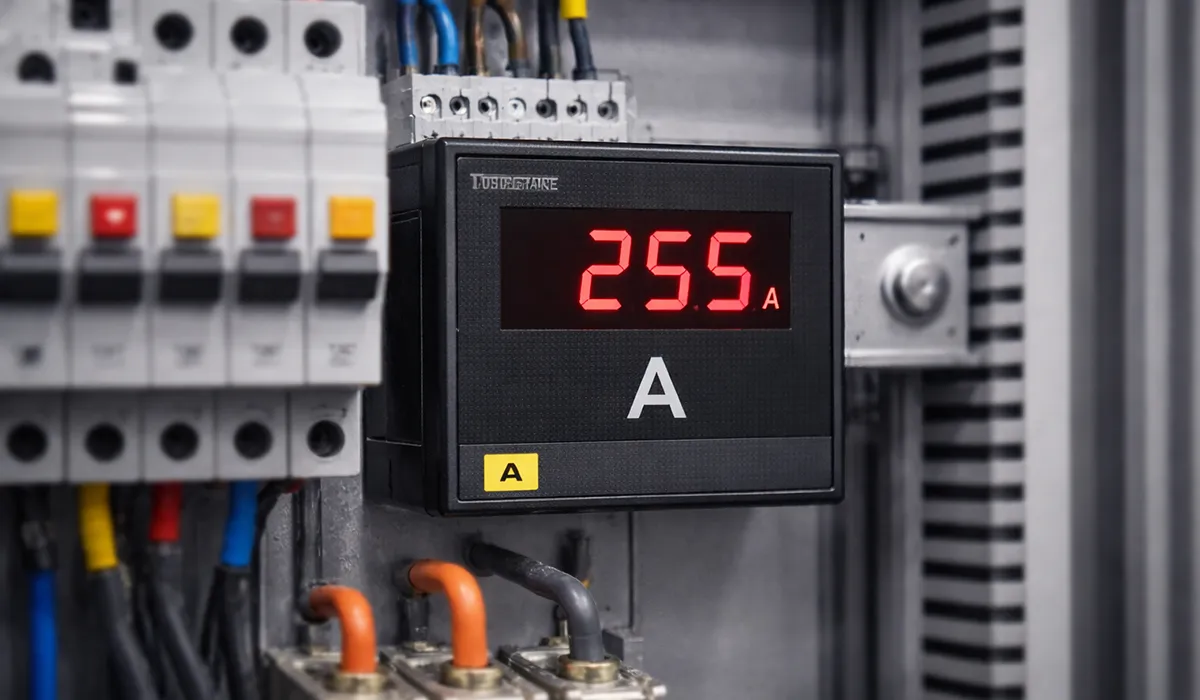
An ammeter is a device for measuring the effective current in a circuit and is connected in series with the load. To measure the current passing through the load, the ammeter must be placed in series with the load. To extend measurement in low-power DC and AC currents, parallel resistors (Rp), called an ammeter shunt, are used.
In switchboards, an ammeter can be installed to measure the current of each load, and a separate ammeter can be installed in the circuit to measure the total current. In three-phase current, if the load is balanced, the current of one phase can be measured with one ammeter and considered for the other two phases. However, since balanced loads are usually not placed on the main busbars of the board, one ammeter is used for each busbar, and in total three ammeters are used.
This article serves as a valuable resource for those seeking detailed information on Ammeter.
Ammeters are available in two types, AC and DC. When using an ammeter, the circuit current must not exceed its rated or maximum current. For example, an ammeter 0 to 10 A measures only currents within this range.
In cases where, due to high current or the impossibility of connecting the busbar to the ammeter, using the ammeter alone is not possible, a current transformer is used. Sometimes the load current is higher than this value, and in that case, the ammeter range can be extended using several methods, the most common being the use of a current transformer, or CT. In a CT, the primary of the transformer consists of a conductor or busbar, and the secondary consists of a coil.
Note that when using a current transformer, the transformation ratio must be applied to the numerical value read from the ammeter. It should be noted that in most ammeters, the CT ratio is defined for the measuring device, so the number shown by the ammeter is actually the real current value, and there is no need to apply the ratio separately.
For installation in three-phase low-current switchboards (less than 100 A), it is connected directly (straight-through, without a converter), and for higher amperages it is connected using a current transformer. The primary winding of the current transformer is only the current-carrying busbar (bar).
An ammeter is selected according to the current flowing through the circuit with approximately 20% extra current, so that for a current of 60 A in the low-voltage network, the ammeter is placed directly in the current path of the load, and current higher than this value is measured through the CT and provided to the ammeter.
The scaling of this type of ammeter must be based on the primary current of the circuit, and the current transformer ratio must be stated in the ammeter specifications. Panel measuring devices are usually manufactured with accuracy class 1.5.
To order an ammeter, the following points must be considered:
| Detail | Ordering Specification |
|---|---|
| 48×48, 72×72, 96×96, 144×144, 96×48 mm | Ammeter Size |
| Flush mounted (door) or Surface mounted | Installation Method |
| 0.5, 1, or 1.5 — lower number = higher accuracy | Accuracy Class |
| CT ratio supplying the ammeter | CT Ratio |
| 1, 1.2, 2, 5, or 6 (use 5–6 for motor applications) | Graduation |
| 90°, 180°, or 240° | Needle Travel Angle |
This characteristic is called Graduation in English, and the number indicating this quantity can be 1, 1.2, 2, 5, or 6. In motor applications, due to the starting current being 5 to 6 times the rated current, Graduation = (5 or 6) is required; therefore, in non-motor applications, this number can be 1.2 or 2.
Note: Some ammeters can be equipped with a needle that can only move from smaller numbers toward larger numbers. This type of ammeter, equipped with a secondary needle with this characteristic, is called an ammeter equipped with Max.Demand. Since busbars play a crucial role in the production of electrical panels, obtaining more information about three-phase power cables can be very important and essential.
Voltmeter
To measure circuit voltage, a voltmeter is used, which is connected in parallel with the circuit. Like an ammeter, a voltmeter is manufactured in two types, AC and DC. To extend measurement in low-voltage single-phase DC and AC, series resistors (Rs) are used to increase internal resistance. If we want to measure network voltage in the switchboard, we must connect the two terminals of the voltmeter directly to the desired busbars, for example phase R and wire MP, or two phases R and S.
When they want to measure the voltage of different phases relative to the neutral wire, or phase-to-phase voltages in pairs, a volt selector switch is used.
Since voltmeters used on normal switchboards are usually intended to measure a specific voltage and the variation range of this voltage is small (for example, the phase-to-phase voltage of the network is 400 volts), these voltmeters have a graduated scale in which the divisions are compressed at the beginning and, around the intended measurement range, have a wider graduation. Today, the use of digital voltmeters has become common, where the voltage value appears as a number on the display.
If you are looking for more information about Voltmeter, it is recommended not to miss reading this article.
To measure high voltages (medium and high voltage), a voltage transformer is used, which is usually designed and manufactured with a ratio of 20 kV to 200 V. In three-phase switchboards, using a special switch (voltmeter switch, line key), with only one voltmeter it is possible to easily measure the voltages of each phase T, N-S, N-R, N, as well as the line voltages T, R-S, T-R, S at any time.
Another difference between a voltmeter and an ammeter is that the needle Graduation can never be 5 or 6 times the rated voltage of the system, because network voltage does not become 5 or 6 times its rated voltage. Usually, Graduation = 1.2 is sufficient.
In the low-voltage network, the voltmeter installed on the switchboard has a scale from 0 to 500 volts. In control switchboards of high-voltage networks, the voltmeter scale is based on the network voltage. In this type of voltmeter, the P.T or C.T transformation ratio is applied, and the primary and secondary voltages are written on the voltmeter. For a comprehensive understanding of wiring practices used alongside these instruments, we highly recommend reviewing this article on types of electrical wires and cables.
Frequency Meter
One of the electrical measuring devices is the frequency meter. Electrodynamic, induction, and iron ratio meters, by adding some electrical components such as inductor, capacitor, and electrical resistance, can be used as a frequency meter. Frequency meters are generally analog (needle type) and can measure frequency over a wide range.
To measure frequency, three types of frequency meters are used: reed (vibrating), needle type, and digital. Due to the high accuracy and resistance of vibrating frequency meters to mechanical shocks, this type is used more in switchboards for measuring low and medium frequencies.
| Characteristics & Best Use | Frequency Meter Type |
|---|---|
| High shock resistance, simple construction, low price — ideal for industrial switchboards | Vibrating (Reed) |
| Wide measurement range — used in power plants and distribution substations | Needle Type |
| Highest accuracy, numerical display — widely used in modern installations | Digital |
| Includes two frequency meters — used for synchronizing generators with the network | Synchroscope |
Digital frequency meters are widely used due to high accuracy in frequency measurement. The frequency meter is connected in parallel to the network. The main application of a frequency meter is in switchboards for synchronizing (paralleling) two generators with the network.
A vibrating frequency meter consists of a series of metal blades placed next to each other inside a coil. Each blade has a specific vibration frequency. When the coil is connected to alternating current, an alternating magnetic field is created inside it. Under the effect of the magnetic field, the blade whose vibration frequency is twice the frequency of the alternating current resonates with the field changes and starts vibrating, thus indicating the frequency of the current passing through the coil.
A single-phase frequency meter operates with 230 volts, and a three-phase frequency meter operates with 400 volts. If the content related to frequency measurement in switchboards was both interesting and helpful, further study of industrial switchboard UL 891 standards could be just as fascinating.
Wattmeter
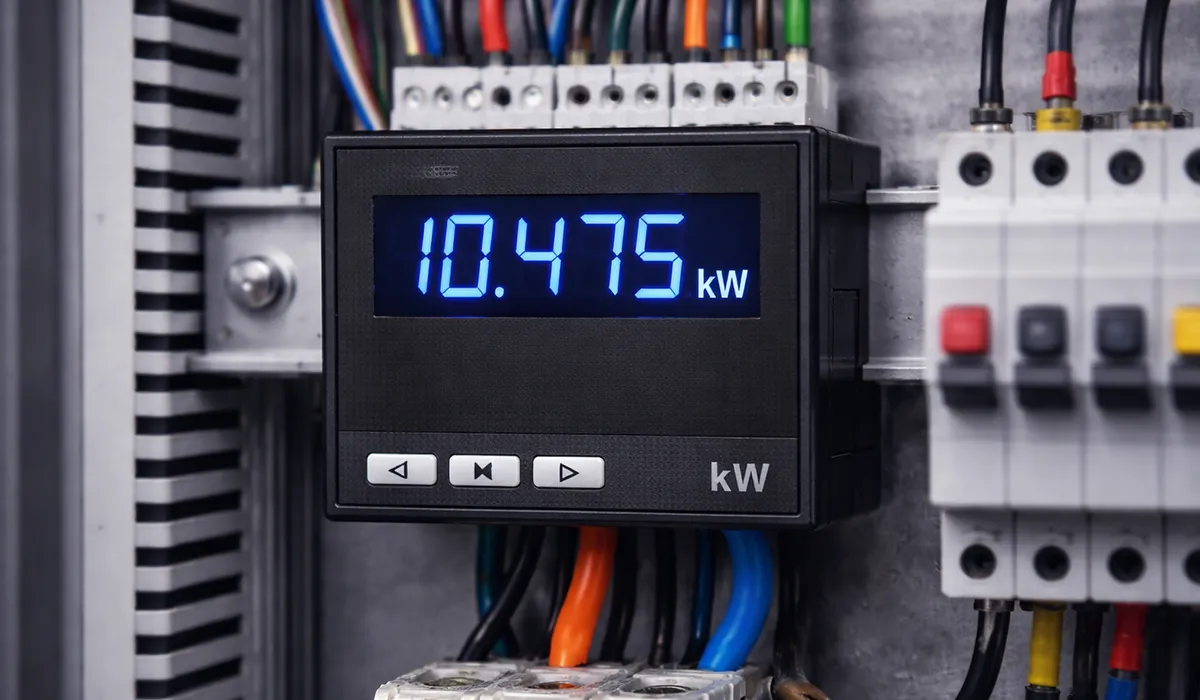
A wattmeter is another electrical measuring device used to measure the real power of loads. A wattmeter has a current coil and a voltage coil. The current coil is connected in series and the voltage coil is connected in parallel to the load; therefore, these two coils form two separate circuits. On the device body, the terminals of these two coils are marked with current and voltage symbols, and care must be taken during connection to avoid mistakes.
A wattmeter measures the active power, and a varmeter measures the reactive power of the circuit. These measuring devices have both current and voltage inputs, because to measure power, both voltage and current are required. The wattmeter assembly consists of two elements: a galvanometer and a transducer.
In a three-phase system with a balanced load, only one wattmeter is used, because by measuring the power of one phase and multiplying it by 3, three-phase power can be obtained. For voltages and currents higher than the stated values, in alternating current, a voltage converter and a current converter must be used.
To order a wattmeter or varmeter, pay attention to the following:
| Detail | Ordering Specification |
|---|---|
| CT ratio and PT ratio must both be stated | Transformation Ratios |
| Must be clearly specified by the user | Accuracy Class |
| 3-phase 3-wire balanced / 3-phase 3-wire unbalanced / 3-phase 4-wire unbalanced | Network Type |
| Size, installation method, full-scale deflection angle of needle | Galvanometer Specs |
| 4–20 mA output if signal transmission to control room is needed | Transducer Output |
Varmeter
Another electrical measuring device is the varmeter. A varmeter is a device that measures reactive (non-useful) power of the circuit. Varmeter connections are similar to wattmeter connections. If the insights you gained from wattmeter and varmeter specifications were intriguing and informative, exploring IEC 61439 design verification and compliance might be of great interest to you as well.
Cosine Phi Meter
In factories and power plants where the power factor of the circuit must be controlled, a cosine phi meter is used to measure it. The cosine phi meter is another electrical measuring device that has two moving coils and one fixed coil, and in total has four or five connection terminals, and is used in three-phase and single-phase circuits. It must be noted that a cosine phi meter, whether single-phase or three-phase, only shows the cosine phi of the phase on which its fixed coil is connected. If the power factor of the circuit is less than the allowable limit, a penalty is considered in electricity bills.
Cosine phi meters intended for switchboard installation are usually manufactured for voltages of 110, 220, 380, and 500 volts and currents of 5 A and 1 A. For voltages and currents higher than the stated rated values, a voltage converter and a current converter must be used.
In three-phase current, if the load is balanced, connecting one cosine phi meter is sufficient. But if the load is unbalanced, one separate cosine phi meter is used in each phase path.
| Application | Scale Type |
|---|---|
| Only inductive loads — value 1 (Cos ᴓ) shown at scale end | 90° One-Sided |
| Both inductive and capacitive loads — value 1 in the center, Ind and Cap on each side | 90° Two-Sided |
| Power plants and substations — Cos ᴓ = 1 written twice with 180° difference | 360° Rotating |
Each cosine phi meter, whether connected in a single-phase or three-phase circuit, only shows the power factor of the phase on which its current coil is installed. The voltage and current values in the coils are similar to a wattmeter; therefore, for installation on industrial switchboards, a current transformer is definitely needed.
Today, portable cosine phi meters are used that can easily determine the power factor of each phase separately. The display can also be seven-segment (digital). The application of this type of cosine phi meter is mostly for companies responsible for installing capacitor banks for power factor correction. If the information about power factor measurement was valuable and interesting to you, researching how to calculate capacitor bank capacity could be just as captivating. If the content on cosine phi meters was interesting and insightful to you.
Multimeter
A multimeter is a device that measures several electrical parameters including: current of each phase of the circuit, phase-to-phase voltages and voltages relative to neutral, and in some cases network frequency, or energy and power.
Measuring Transformers
Since line current and voltage are high and cannot be measured directly, these devices are used to sample the current. These devices are connected in series as CTs and in parallel as CVT, PTs in the circuit. Also, for isolating high-voltage networks, measuring and protection systems use this device.
Insulating equipment connected to the secondary of these transformers from the primary side of the network, and the possibility of standardizing measuring and protective equipment for specific current or voltage values, are other important features. In each voltage or current transformer, the measured quantity, voltage or current, must be reduced by a specific ratio, and the accuracy of the measured values on the secondary must not exceed the permissible limit.
If the information about Measuring Transformers was engaging and informative for you, gathering more knowledge about types of earthing systems could be very exciting.
Current Transformer (CT)
The primary winding of current transformers is connected in series with the power circuit, and their secondary winding is connected to suitable measuring equipment such as meters, protective equipment such as relays, etc. The impedance Zb connected to the CT secondary winding is very small compared to the primary impedance; in other words, the CT secondary is in a short-circuit condition. Proper insulation of measuring and protective circuits from the primary network voltage, and protecting devices against overload, are important features of these transformers.
The primary winding of a current transformer is shown with uppercase letters K and L, and its secondary winding with lowercase letters k and l, and the primary winding must be placed in the circuit so that its input is connected to K; in other words, the phase current must enter K.
When current passes through the conductor, a magnetic field (an induced voltage at the two ends of the wire) is created in the secondary winding. By connecting an ammeter to the CT secondary, the mentioned induced current, which is equal to or less than the rated current of the ammeter, passes through it. Therefore, current transformers are stated with a transformation ratio, such as a 100/5 current transformer.
| Detail | CT Specification |
|---|---|
| In series with the power circuit | Primary Connection |
| Connected to meters, relays, protection equipment | Secondary Connection |
| Often 5 A (e.g., 100 A / 5 A or 200 A / 5 A) | Secondary Rated Current |
| K (input) and L (output) — uppercase for primary | Terminal Markings |
| Never use a fuse in the CT secondary supply path | Safety Rule |
Leakage Current Relay
The Schneider Electric earth fault relay, or leakage current protective relay, using a transformer identifies leakage current to earth and issues a trip command, and protects against grounding of parts to prevent human casualties and fire. The leakage current relay transformer is used to sample the current passing through the main cables. For a comprehensive understanding of grounding practices, we highly recommend reviewing this article on grounding and earthing systems.
Voltage Transformer (PT)
To extend the measurement range of a voltmeter when the load voltage is not within the allowable range of the voltmeter, and when it is not possible to connect the voltmeter directly across the load, a step-down voltage transformer (PT) can be used alongside the voltmeter, in other words, voltage can be measured indirectly. In this case, the two ends of the primary winding of the voltage transformer are connected in parallel in the circuit, and the voltmeter is connected to the secondary wiring.
The secondary voltage of PTs or voltage transformers is often 100 volts, and like current transformers, their transformation ratio (Kv) for rated conditions is expressed as a fractional number (such as 20KV/100 V).
Voltage and Current Transducer
The task that transducers perform with an input, whether current or voltage, is that they are fed from the secondary of the voltage or current transformer and provide a DC value in the milliampere range at their output. The purpose of this output is to make the converted current or voltage transferable in the milliampere range to distant locations. Clearly, a 5 A secondary of a current transformer or a 100 V secondary of a voltage transformer cannot be transmitted to a control room located 500 meters away. This is where the transducer becomes meaningful.
Transducers often provide 20 mA at their output for their rated input. But if the secondary current of the current transformer becomes zero, we can expect the transducer to show 0 mA or 4 mA at its output. If we want the transducer to show 4 mA for zero input, the transducer must have a separate power supply.
| Detail | Transducer Parameter |
|---|---|
| Secondary of CT (5 A) or PT (100 V) | Input Source |
| 4–20 mA DC (standard) or 0–20 mA | Output Signal |
| 20 mA = rated input; 4 mA or 0 mA = zero input | Output at Rated Input |
| Required if output must show 4 mA at zero input | Separate Power Supply |
| Up to 500 meters for control room signal transmission | Transmission Distance |
Megger Device
A megger is one of the electrical measuring devices used to detect earth fault and short circuit, and also for cable troubleshooting. By measuring each cable separately, if an earth fault between the cable and ground has not occurred, the resistance shown by the megger will be infinite, and if an earth fault occurs, the megger shows a resistance.
When a transformer in distribution lines fails for some reason, it is transferred to the transformer repair workshop, and then tests are performed. The megger works such that by turning the drive handle (manual handle), the device begins producing DC voltage. The positive and negative wires of the megger are connected to the faulty winding, and by applying this voltage to them, the resistance is measured. Since buses play a crucial role in the production of electrical panels, obtaining more information about methods of measuring earth resistance can be very important and essential.
| Application | Megger Voltage Range |
|---|---|
| General cable insulation testing | 1250 V |
| Low-voltage winding to body insulation testing | 2500 V |
| High-voltage winding to body insulation testing | 5000 V |
Timer
A timer is one of the command devices in automatic control circuits that is responsible for controlling the circuit for a specified time. Sometimes it is expected that a circuit starts working sometime after receiving a command, or that after a certain period it stops working, and for this purpose, timers are used in industrial electrical circuits.
Types of Single-Phase and Three-Phase Meters
- Low-voltage and control wiring must be done at minimum with 2.5 mm² wire, capable of withstanding 1000 volts.
- If a signal lamp is used to indicate the presence of phase, these lamps must have low consumption and be suitable for panel installation.
- The colored cap on the lamp must not deform or change color due to lamp heat.
- Electrical connection of devices installed on the panel door and other moving parts of the panel, or inside the panel, must be made using flexible cable or wire and inside a metal corrugated conduit.
- The maximum volume occupied inside the conduit by conductors must not exceed 40% of the internal volume of the conduit.
Meter Specifications:
- Rated voltage, rated current, rated frequency, number of revolutions in kWh, type of power measured (active and reactive).
- If voltage or current transformers are used to supply measuring devices, ensure that the VA of the supplied devices does not exceed the VA of the intended transformer.
- In the CT supply path, never use a fuse.
- For calculating switchboard equipment, each of the feeder lines from the switchboard must be examined independently.
- Primary information needed for calculations includes: load power, nominal voltage, nominal current, nominal frequency, power factor, efficiency, type of connection to the network (single-phase, three-phase, delta, star, etc.), distance from the switchboard, ambient temperature (thermal factor), adjacency of conductors, simultaneity of loads.
- Sub-panels are considered as loads relative to the main panel, and for calculating the cross-sectional area of the main feeder cable supplying the sub-panel, the necessary calculations must be performed.
- Protective equipment of feeder lines and devices supplied from the panel, and also the method of operating devices, affect the selection of devices inside the panel and their number and type.
- The required power for equipment calculations is active power, and only in the calculation of the capacitor panel is reactive power considered.
- After obtaining the specifications of all outgoing lines from each cell, by drawing the single-line diagram, we determine the equipment required for each load, write the specifications of each on it, and finally obtain the total power drawn from the panel busbar and the main breaker.
If the information about meter specifications and panel wiring was valuable and interesting to you, researching industrial control panel EMC requirements per IEC 61000 could be just as captivating.
Conclusion
In conclusion, the selection and integration of electrical measuring devices—ranging from basic ammeters and voltmeters to advanced power analyzers and transducers—form the backbone of efficient industrial switchboard management. By meticulously evaluating criteria such as accuracy class, installation conditions, and the appropriate use of current or voltage transformers, engineers can ensure precise monitoring of critical parameters like power factor, frequency, and real power. Adhering to technical standards in wiring, utilizing specialized tools like meggers for insulation testing, and implementing protective components like leakage current relays not only optimizes energy consumption and prevents utility penalties but also guarantees the safety and longevity of the entire electrical infrastructure. Finally, if you are looking for more information on enclosure ratings, it is recommended not to miss reading this article on IP55 vs NEMA 12 ratings.