


Prefer listening? You can play the audio version of the rest of this article below.
AFCI Arc-Fault Protection: Definitions & Purpose (and why I cared)
When I say “AFCI,” I’m not talking about a nicer breaker brand or a fancy toggle. I’m talking about a device designed to detect dangerous arcing conditions that standard breakers often ignore until it’s too late. That difference matters.
Before I bought anything, I wrote two goals on a sticky note and stuck it to my tool bag:
- Reduce fire risk from arcing faults (especially in living spaces)
- Avoid nuisance trips by doing the install cleanly and troubleshooting like an adult
The complete resource file is available here for offline reading and comparison.
what is AFCI in electrical panels?
AFCI stands for Arc-Fault Circuit Interrupter. In plain terms: it’s a protective device that opens the circuit when it detects electrical arcing patterns that can start fires—the kind you can get from damaged cords, loose connections, or worn insulation.
In my head, I simplified it like this:
- Regular breaker: “Too much current? I trip.”
- AFCI breaker: “That current pattern looks like a dangerous arc? I trip.”
If you are looking for more information about electrical panels, it is recommended not to miss reading this article.
what is an arc fault circuit?
An arc fault is an unintended electrical arc—a tiny, high-energy “jump” of electricity through air or across a compromised connection. It can happen in two common ways:
- Series arcing: a loose connection in-line with the load (think: a terminal screw that’s barely holding on)
- Parallel arcing: hot-to-neutral or hot-to-ground arcing (think: damaged insulation letting conductors get too friendly)
This is exactly the kind of early-stage failure that can heat up materials without pulling enough current to trip a standard breaker quickly.
If the information related to switchgear basics was interesting and informative to you, researching arc fault protection can be very engaging.
What is an arc fault protection?
An arc-fault breaker is usually a breaker-type AFCI that installs in your panel (though AFCI receptacles exist for certain scenarios). Its job is arc-fault protection: detect dangerous arcs and shut off power before heat turns into ignition.
Here’s the mental model that helped me:
Overcurrent protection stops too much electricity.
Arc-fault protection stops bad electricity behavior.
What does “arc fault” mean on breaker?
The first time my new breaker tripped, I saw the indicator pattern and thought, “Great… now I have a haunted panel.”
On many AFCI breakers, “arc fault” (or an LED code) indicates the breaker believes it detected an arc-fault signature—not just a normal overload. It doesn’t automatically mean your house is on fire, but it does mean you should take the trip seriously and troubleshoot methodically.
How It Works (the part I had to read twice)
I’m not an “electrons are magic” person. I need the why. So before install day, I spent a night learning how AFCIs actually detect arcs.
My big “aha” was this: AFCIs look for patterns in the current waveform that match hazardous arcing behavior, then they de-energize the circuit.
For engineers and procurement teams, this downloadable file provides a useful reference for decision-making.
How does an AFCI breaker work?
At a high level, an AFCI breaker has electronics that monitor the circuit’s current “signature.” When it sees a signature consistent with dangerous arcing (and not the normal arcing you get from switching a light on), it trips.
A technical deep-dive I found helpful explained detection using amplitude + duration logic to decide when to open the breaker.
How do AFCI breakers work in the real world (not the brochure version)?
Real world: the breaker is trying to distinguish between:
- Normal arcs (switch contacts, brushed motors, plugging something in)
- Abnormal arcs (loose terminals, damaged cords, compromised insulation)
That’s why AFCI installs can feel “picky.” They’re supposed to be. But picky doesn’t mean random—most nuisance trips I’ve seen had a cause I could eventually explain.
For a comprehensive understanding of panel components, we highly recommend reviewing this article.
How does an arc fault breaker work?
Functionally, it’s a standard breaker plus a detection system. UL describes AFCIs as devices that de-energize the circuit when an arc fault is detected to reduce fire ignition risk.
And the CPSC has long framed AFCIs as protection against fires from unsafe wiring conditions where standard protection may not respond early enough.
AFCI Arc-Fault Breakers: Where Required (and when to use them)
This is where my “DIY remodel” turned into a “DIY paperwork and code edition” side quest.
In the U.S., AFCI requirements largely come from NEC 210.12, but your local authority decides which NEC edition is adopted (or amended). So, the rule isn’t “what I read online,” it’s “what my jurisdiction enforces.”
Still, the NEC trend is clear: AFCI coverage expanded over time.
- 1999 NEC introduced AFCI requirements with an effective date of Jan 1, 2002 (initially focused on bedrooms).
- 2008 NEC expanded AFCI coverage into many other living areas (family rooms, dining rooms, etc.).
- 2014 NEC added kitchens and laundry areas to the required list.
The complete resource file is available here for offline reading and comparison.
Since busbars play a crucial role in the production of electrical panels, obtaining more information about busbar systems can be very important and essential.
How to choose between AFCI Breaker & Fault Breakers
My personal rule became:
- If it’s a living space circuit I’m modifying, I treat AFCI as the default unless there’s a clear exception or local amendment.
Even if your code doesn’t demand it for every scenario, the safety upside is hard to ignore when you’ve seen cooked insulation up close. (NFPA also frames AFCIs as a major safety step born out of fire prevention goals.)
You can review the original source here to verify the technical details.
What circuits require arc fault breakers?
A common modern interpretation (again: check your adopted code edition) is that AFCI protection applies to many 120V, 15A and 20A branch circuits in dwelling unit living areas—kitchens, bedrooms, hallways, laundry, and similar spaces.
I printed a simple “circuit map” and marked what I was touching.
If the details you gathered about voltage differences were interesting and insightful, you may find diving deeper into circuit protection equally captivating.
My remodel circuit shortlist (example):
| Circuit | Area | What I changed | My safety upgrade decision |
|---|---|---|---|
| Bedroom outlets | Bedroom | Added receptacles | AFCI breaker |
| Living room outlets | Living room | Replaced old devices | AFCI breaker |
| Kitchen small appliance | Kitchen | New countertop receptacles | AFCI + GFCI needs |
| Laundry | Laundry area | Added receptacle | AFCI + GFCI needs (often) |
Where do I need arc fault breakers?
If you’re in the U.S., start with your local adopted NEC edition and look at dwelling unit locations and branch circuit ratings described under the relevant AFCI rules. A widely-circulated 2023 NEC summary lists the familiar “living areas” pattern (kitchens, bedrooms, closets, hallways, laundry, etc.).
Where are arc-fault GFCI breakers required?
This one confused me early: AFCI and GFCI protect against different hazards.
- AFCI: fire risk from arcing patterns
- GFCI: shock risk from ground-fault current imbalance (different detection method)
So, you’ll see locations where both are required by code in certain editions—kitchens and laundry areas are classic examples where AFCI requirements expanded while GFCI already existed for shock protection.
That’s why dual-function AFCI/GFCI breakers exist: one breaker to satisfy both protections when the circuit demands both.
Further exploration of circuit breaker finders can be found in the following recommended reading.
When were AFCI breakers required?
The timeline that mattered for my permit conversation:
- AFCIs entered the NEC in 1999 with an effective date of Jan 1, 2002 for the initial bedroom-focused requirement.
- Then, requirements expanded in later code cycles (notably 2008 and 2014).
This source provides further explanation and can help you compare the details more accurately.
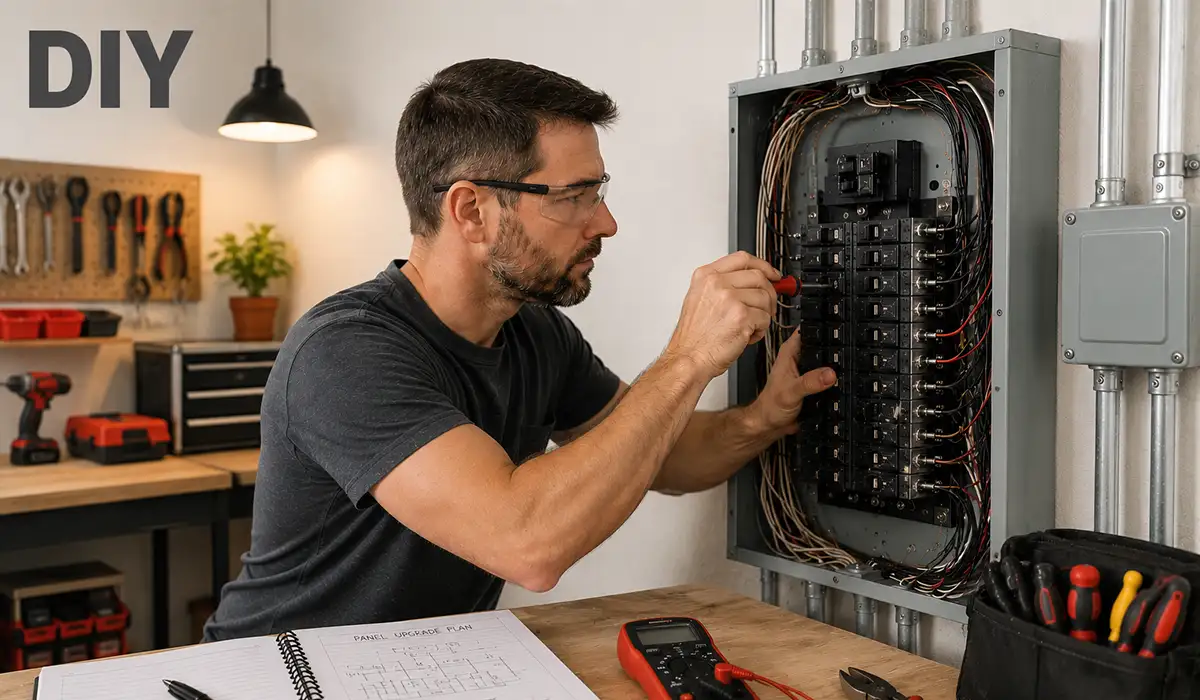
My Step-by-Step DIY Journey (and the parts that went sideways)
I did this in phases because I didn’t want to be the person eating dinner by flashlight for a week.
Here’s the order I followed:
- Plan and label
- Choose breaker types
- Install one circuit
- Test and live with it
- Scale up
My prep checklist (the boring stuff that saved me)
Before touching the panel:
- I labeled every circuit as accurately as possible (some were… optimistic guesses).
- I bought a torque screwdriver because “tight enough” is not a spec.
- I replaced a few sketchy backstabbed receptacles preemptively because AFCI + loose device = drama.
Choosing the breakers (and why brand matching matters)
This is where a lot of DIYers get burned: you generally can’t just buy “any AFCI breaker” and jam it into “any panel.”
I had a Square D panel, so I stayed in that ecosystem for listed compatibility. If you’ve got Siemens, Eaton, GE, etc., the right breaker line matters.
Not glamorous, but it’s the difference between “safe upgrade” and “mystery heat source.”
If the information on GE breakers was engaging and informative for you, gathering more knowledge about brand compatibility could be very exciting.
Install day: the first circuit took forever
The first AFCI breaker install took me an embarrassing amount of time because I was moving slowly and triple-checking everything:
- Main off (and verify!)
- Deadfront removed
- Neutral/ground routing confirmed
- Breaker seated cleanly
- Neutral landed where required for that breaker design
- Panel reassembled carefully
Then I flipped it on… and it held.
I celebrated with the most cautious victory coffee of my life.
If the content related to 200 amp panels was both interesting and helpful, further study of panel upgrade planning could be just as fascinating.
The Nuisance Trip Phase (aka my humility arc)
The first nuisance trip happened on day two.
I was vacuuming the living room and the breaker tripped with an “arc-fault” indication. My first thought was “my wiring is doomed.” My second thought was “okay, troubleshoot like a technician, not like a panicked raccoon.”
The troubleshooting flow that actually worked for me
I used this sequence:
- Unplug everything on that circuit
- Reset breaker
- Plug devices back one by one
- Note which device triggers it
- If it’s not a device, inspect the outlets/switches on that run for loose terminals or damaged conductors
About half the time, it was a device. The other half, it was a connection.
A simple “trip cause chart” from my first week
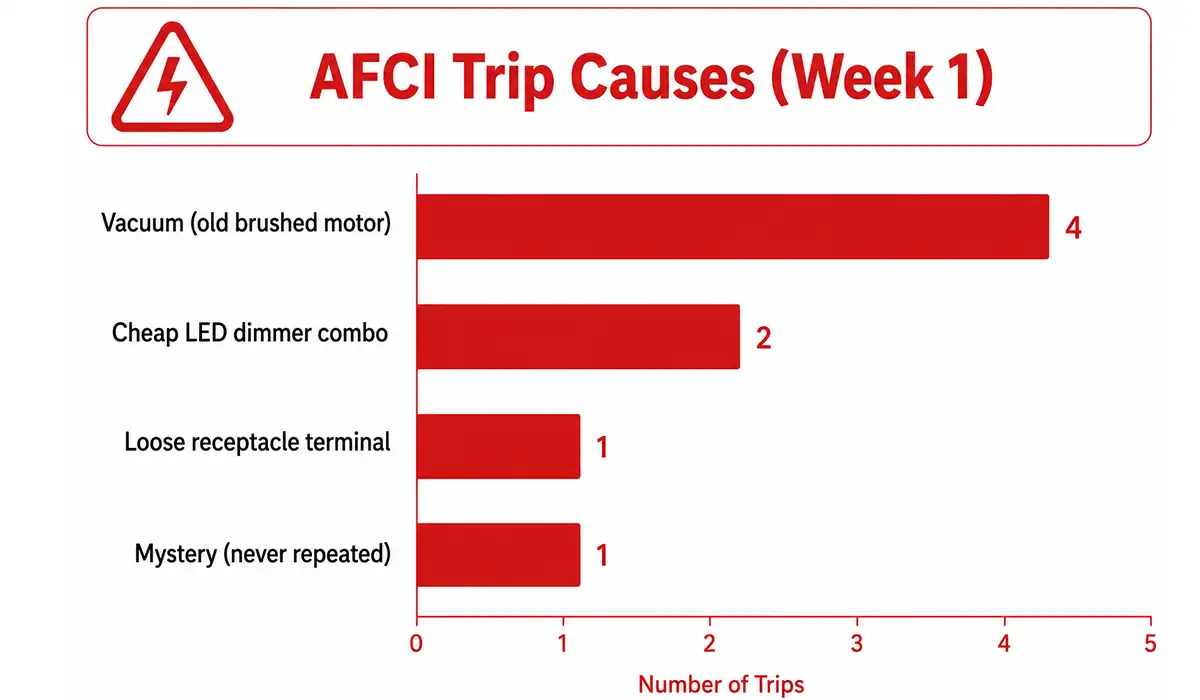
The “loose terminal” one was the scariest because it proved the AFCI wasn’t being annoying—it was being useful.
What fixed my worst nuisance trips
- Swapped a bargain dimmer for a higher-quality unit
- Moved one troublesome device to a different circuit
- Re-terminated two receptacles using proper screw terminals (no backstabs)
- Tightened neutrals carefully and ensured no shared-neutral weirdness on circuits that weren’t designed for it
And yes, once I cleaned up the weak points, the trips mostly stopped.
If the insights you gained from industrial wiring were intriguing and informative, exploring proper conductor termination might be of great interest to you as well.
The Table I Wish I Had at the Start
Here’s the “plain English” version I keep in my notes now:
| Protection Type | What it mainly prevents | What it detects | Common location examples |
|---|---|---|---|
| Standard breaker | Overload / short circuit | High current | Everywhere |
| AFCI (arc-fault) | Electrical fires from arcing | Arc-fault signatures | Many dwelling living areas |
| GFCI (ground-fault) | Shock hazards | Hot/neutral imbalance | Wet/damp areas (varies by code) |
| Dual-function | Both fire + shock hazards | Both systems | Places needing both protections |
If the information about switchgear secrets was valuable and interesting to you, researching modern protection systems could be just as captivating.
AFCI Arc-Fault Protection: What I’d Do Differently Next Time (Conclusion)
If I could redo this project, I’d do three things sooner:
- Replace weak devices first (loose outlets, sketchy dimmers, worn cords)
- Map circuits more carefully (shared neutrals and multi-wire circuits deserve respect)
- Upgrade in phases so troubleshooting stays simple
AFCI breakers aren’t magic, and they’re not perfect. But once I understood the “why” and cleaned up my workmanship, they felt less like finicky electronics and more like a genuinely smarter safety layer—especially for the kinds of hidden problems you don’t see until smoke shows up.
If the content on emergency panels was interesting and insightful to you, continuing to explore electrical safety upgrades could be both exciting and beneficial.
Faq about


Rate this article
Choose a rating from 1 to 5 stars.
No ratings yet