
Busbar Basics in My DIY Electrical Panel Project
When I first searched online, I found dozens of versions of the same question: what is a busbar, what is a bus bar, what is a busbar in an electrical panel, what is the function of a busbar, and even what is an electrical bus. I had all of those questions too.
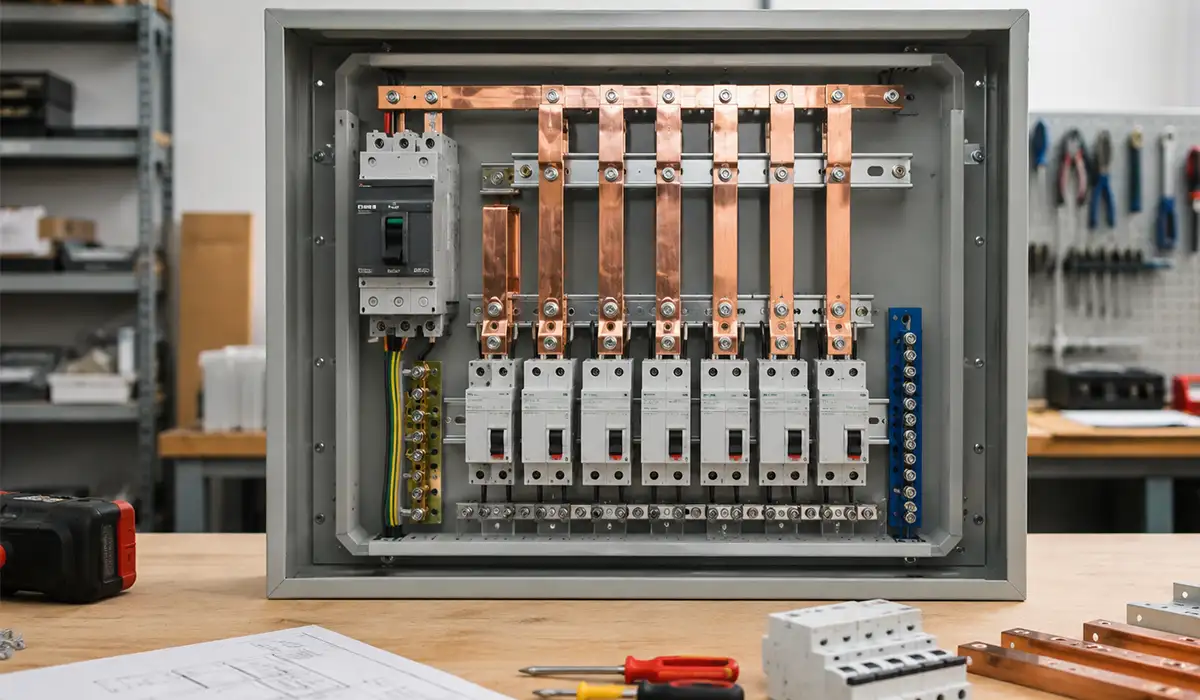
In simple terms, a busbar is a solid conductor, usually copper or aluminum, used to collect and distribute electrical power inside a panel or system.
Instead of running many separate cables from one source to many loads, a busbar gives you a common conductive path that is strong, compact, and easier to organize.
I am not going to re-explain the basics here, because we have a full guide on what a busbar is in an electrical panel covering function, types, materials and sizing rules. What I will say is what actually clicked for me: a busbar is not a cable substitute, it is a layout decision. The moment I stopped thinking “how do I carry 220 amps” and started thinking “how do I want this panel to look when I open it in three years,” everything else fell into place.
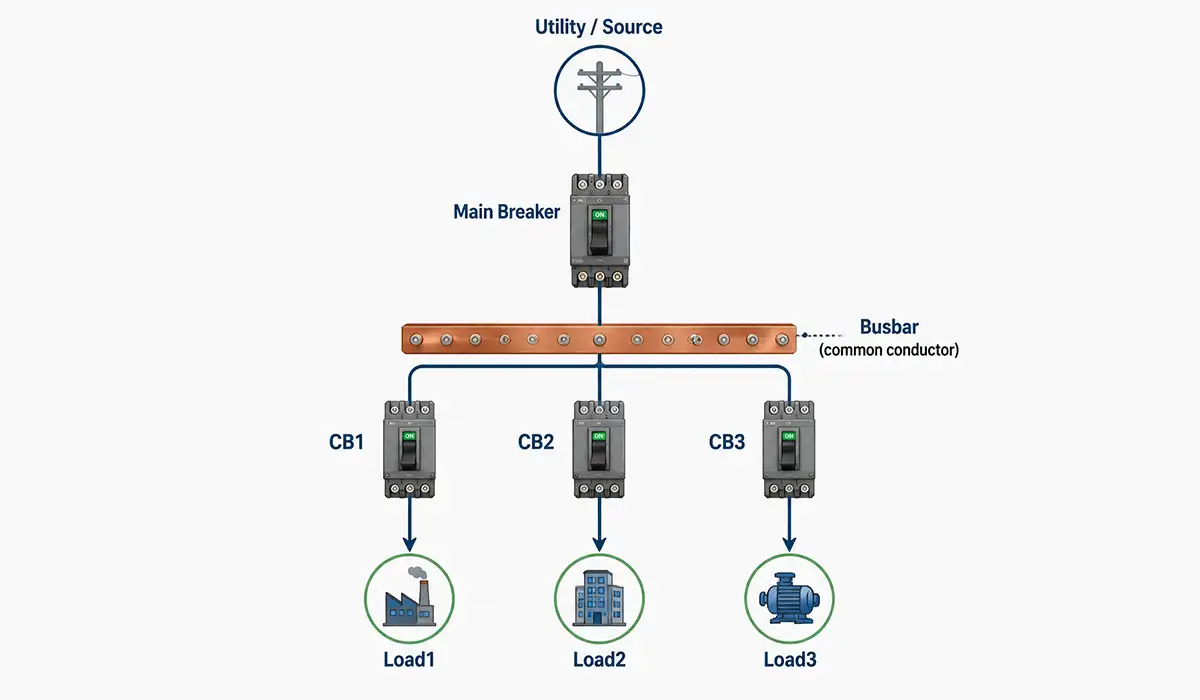
A busbar works because it has a low-resistance conductive cross-section, so it can carry current efficiently while keeping voltage drop and heat under control, if it is properly sized and installed.
Why is it called a busbar?
I was curious about this too.
The term bus in electricity refers to a common conductor that serves multiple circuits. The word is widely believed to come from the idea of an “omnibus” or common carrier, meaning it carries many connections together.
So, a busbar is basically a bar-shaped common conductor.
Busbar Types and Systems I Compared Before Building
When I started shopping and researching, I realized “busbar” can mean different things depending on context. I wasted time comparing products that were not even meant for the same application.
This section is exactly what I wish someone had explained to me on day one.
Busbar types by material and construction
For a DIY panel, the first decision was material.
I compared copper and aluminum, and also looked at rigid bars vs laminated flexible busbars.
For my workshop build, I chose a tinned copper flat bar because it was easier to size in a compact panel and I wanted cleaner long-term contact surfaces.
Copper or aluminium for a DIY panel busbar?
For a workshop panel, this decision took me about an evening, and it went to copper — but not for the reason I expected.
| Copper | Aluminium | |
|---|---|---|
| Section Needed for the Same Current | Baseline | About 1.6× larger |
| Weight for the Same Duty | Heavier per unit volume | Roughly half, for equal rating |
| Material Cost | Higher per kg | Considerably lower |
| Jointing | Standard hardware, straightforward | Needs bimetallic hardware and anti-oxidant compound |
| Oxide Layer | Conductive enough to work with | Forms an insulating oxide in seconds — must be cleaned right before assembly |
| Best For | Compact panels, DIY-scale work | Long runs where weight and cost dominate |
The row that decided it was jointing. Aluminium is genuinely cheaper, and if I were running thirty metres of bar it would probably win. But in a small enclosure, every centimeter of extra section costs me layout space, and aluminium’s oxide layer means every joint has to be cleaned and compounded within minutes of assembly. For someone working alone, at their own pace, that is a real risk.
I chose tinned copper flat bar. The tin plating was worth the small premium — it keeps the contact faces clean between the day I cut the bar and the day I finally bolt it up, which for a DIY project can be several weekends apart.
Rigid bar or flexible laminated busbar?
I looked at laminated flexible busbar for the two connections that had to reach around a support bracket. In the end I bent rigid bar instead, but flexible is worth knowing about: it absorbs misalignment and vibration, and it lets you make a connection that would otherwise need two bends and perfect tolerances. Our flexible busbar guide covers where it earns its cost. For a static panel with accessible terminals, rigid bar is cheaper and stiffer.
Busbar types in power systems and the single busbar system
Then I ran into another topic: busbars in power systems.
This is not only about the bar itself, but also about the arrangement of how power flows in substations and switchgear. I first saw this when reading about redundancy in industrial plants.
Common system arrangements include:
- Single busbar system (simple and economical)
- Sectionalized single busbar (a step up in reliability)
- Double busbar system (more flexibility/redundancy)
- Main and transfer bus (maintenance flexibility)
In a single busbar system, all feeders connect to one common bus. It is simple and cost-effective, but maintenance or faults can affect more circuits.
That concept helped me think better about my own panel layout. I did not build a “power system” style arrangement, but I did split critical and non-critical loads onto separate sections, which made troubleshooting easier.
What is a bus coupler in electrical systems?
This term confused me at first.
A bus coupler is a breaker or switching device used to connect two bus sections together. It can allow load transfer, redundancy, or maintenance isolation.
I saw a Schneider and Siemens switchgear example at a facility where one bus section fed production lines and another fed HVAC. The bus coupler allowed flexibility during maintenance.
In a small DIY panel, you usually do not have a formal bus coupler, but the concept is still useful. It teaches you to think in sections, not just in “one big power mess.”
What Is a Busbar Trunking System?
A busbar trunking system (also called busway in many regions) is a prefabricated power distribution system used to carry and distribute power across buildings or industrial spaces.
It is not the same thing as a small flat busbar inside a panel.
Busbar trunking usually comes as enclosed modular sections with tap-off points and insulation systems. I first encountered it in a commercial building retrofit where cable trays were crowded.
Use cases include:
- High-rise buildings
- Data centers
- Factories
- Commercial facilities with long distribution runs
What Is a Bus Duct?
I also searched “what is a bus duct” and assumed it was a different technology.
In many contexts, bus duct refers to enclosed busbar systems used for high-current power distribution, especially between major equipment like transformers and switchgear.
Depending on region and manufacturer terminology, bus duct and busbar trunking may overlap or be used differently.
My practical rule now is:
- Panel busbar = inside a panel/cabinet
- Busbar trunking / busway = modular building distribution
- Bus duct = enclosed high-current interconnection/distribution path
Busbar spelling mistakes I ran into
I am including this because it genuinely happened during my research.
I searched and saw terms like:
- boost bars
- buzz bars
- busser
- electrical buss
Most of these are spelling mistakes, auto-correct issues, or non-technical variations.
DIY Busbar Sizing: How I Picked My Bar
This is where my project stopped being “fun shopping” and became real engineering.
I made my first design mistake here by sizing only for current and ignoring heat, enclosure conditions, and future expansion. I had to redo the bar layout after a test run showed more heat than I liked.
My busbar sizing workflow
I now use this simple workflow before I cut anything.
| Step | What I Check | Why It Matters |
|---|---|---|
| 1 | Continuous current (A) | Base sizing target |
| 2 | Duty and load diversity | Real operating profile |
| 3 | Material (Cu or Al) | Conductivity and size impact |
| 4 | Temperature rise / enclosure ventilation | Heat management |
| 5 | Fault level / short-circuit withstand | Mechanical and thermal survival |
| 6 | Insulation clearances and creepage | Safety and compliance |
| 7 | Connection points and hole spacing | Real installability |
| 8 | Future expansion margin | Saves rework later |
How I Sized the Busbar for 220 A (Worked Example)
I will share the practical method I used, not a substitute for standards-based design.
I estimated my panel demand around 220 A continuous with some motor starting behavior and future headroom. I wanted a copper bar size that would run cooler and allow expansion.
I compared a few options:
| Copper Busbar Size | Cross-sectional Area | Rough Current Density Check (Example) | My Decision |
|---|---|---|---|
| 25 x 5 mm | 125 mm² | Thermally adequate for 220 A, but no room to grow | Rejected on expansion, not heat |
| 30 x 5 mm | 150 mm² | Comfortable now, tight if I add a second CNC | Backup option |
| 40 x 5 mm | 200 mm² | Runs cool and leaves real expansion headroom | Chosen |
| 50 x 5 mm | 250 mm² | Electrically excellent, but bend radius and support spacing became awkward | Rejected on layout |
To be clear about my own reasoning here: 25 × 5 mm would have carried 220 A perfectly well. Our copper busbar current rating table puts 25 × 5 mm at around 415 A in still air, and even with enclosure derating that is not marginal. I did not go to 40 × 5 mm because I was worried about heat. I went there because I had already rebuilt this panel once, and I did not want to do it a third time when the next machine arrives. If your load is genuinely fixed, size down and save the copper.
Busbar Design Is More Than Amps
My early mistake was treating busbar sizing like cable sizing only.
Busbar design also needs attention to:
- Short-circuit forces (electromagnetic force can be significant)
- Support spacing (long unsupported spans can vibrate or deform)
- Thermal expansion
- Joint quality and torque
- Insulation supports and barriers
- Clearance and creepage distances
- Ventilation inside the panel
When I moved one support bracket closer to a breaker connection point, vibration during switching reduced noticeably.
Clearance and creepage are the two dimensions you cannot eyeball; our busbar clearances guide works through how they are derived.
Busbar materials and UL surface tracking concerns for high-voltage busbars
There is one materials topic that goes well beyond DIY work but is worth understanding, because it explains why insulation choice is not a detail: UL surface tracking requirements for busbar support materials.
I ran into this while helping review insulation support materials for a project that was beyond basic DIY work.
Here is the practical takeaway I use:
- The busbar conductor may be copper/aluminum, but surface tracking risk is often about the insulation/support material around the energized parts.
- Material selection for high-voltage or high-pollution environments often considers properties like:
- Comparative Tracking Index (CTI)
- Dielectric strength
- Flame resistance
- Moisture resistance
- Creepage design performance
- Common materials used in busbar insulation/support systems can include:
- GPO-3 (glass polyester laminate)
- FR-4 / epoxy glass laminates (depending on application)
- SMC/DMC thermoset compounds
- Engineered thermoplastics with appropriate UL recognition
My most important lesson was this: Do not assume a generic sheet material is compliant just because the base polymer sounds familiar. You need the exact grade, datasheet, UL recognition details, and the actual product/system design review.
For high-voltage busbars, I would always coordinate with the manufacturer, UL file documentation, and the relevant standards team.
UL Certification Process (PDF)
Cutting and Bending Busbar as a DIY Job
This part was the most satisfying and the most humbling.
I thought cutting and bending the copper bar would be easy. It was not.
Copper is forgiving in some ways, but it will expose sloppy measurement and poor tooling immediately.
How I Cut the Copper Bar—and What I Got Wrong First
My first attempt was with a basic saw setup and rushed clamping.
The cut wandered slightly, and the burrs were worse than I expected. That one mistake created extra work at the connection surfaces.
After trial and error, my process improved a lot:
- Mark clearly with a scriber and square
- Clamp firmly on both sides if possible
- Use a suitable cutting method (shear, band saw, or proper cutting tool)
- Deburr both faces and edges
- Check width and squareness before drilling
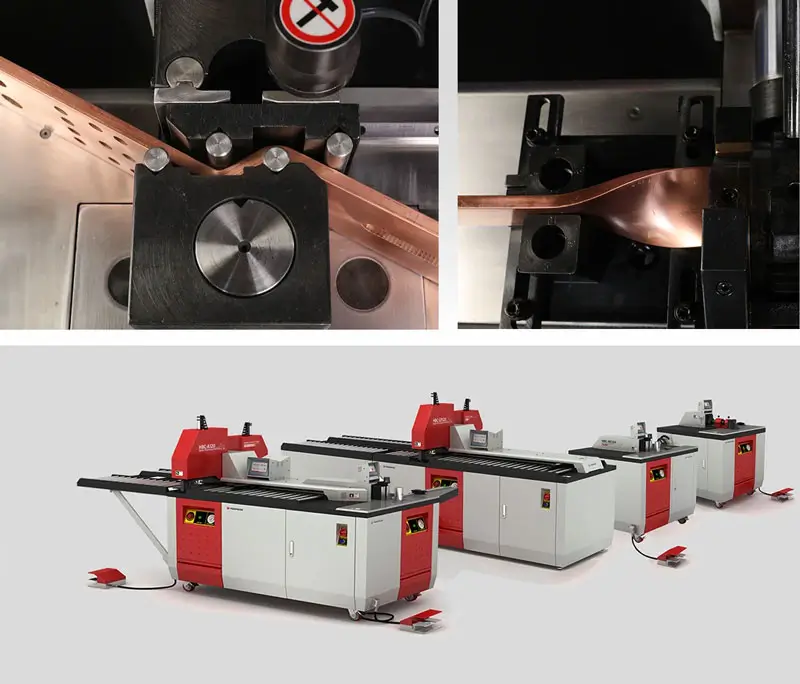
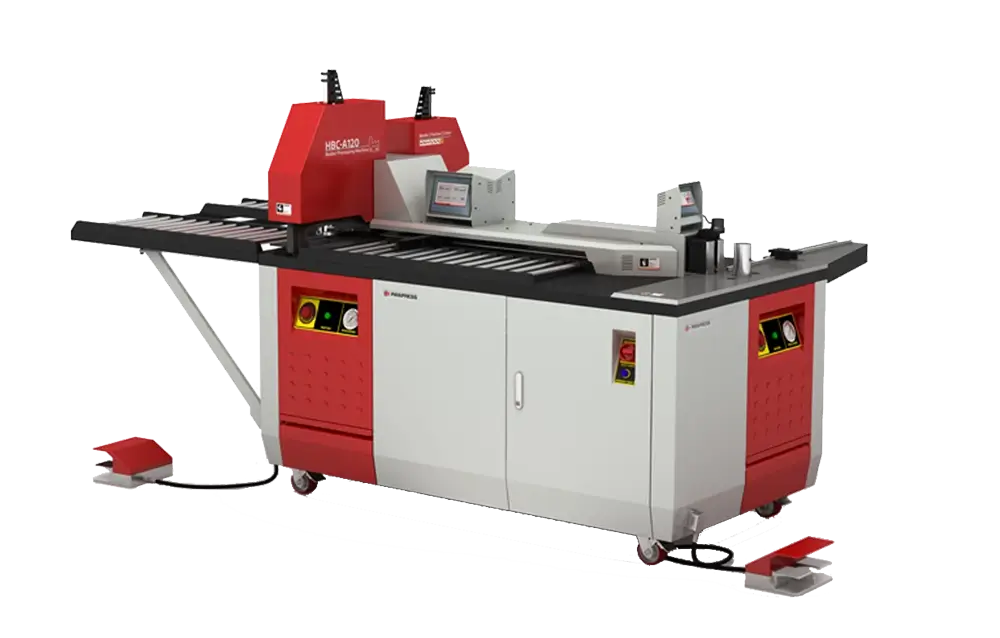
For cleaner results, I later used a shop busbar cutting tool at a local fabricator, and the difference was obvious. The cut quality saved time downstream.
How did I shape copper for panel routing?
Shaping copper is where layout planning matters.
I had one section that needed to pass around a support and line up with a molded-case breaker terminal. My first shape looked okay on the bench but misaligned by a few millimeters inside the panel.
That was enough to create stress at the joint, which I did not want.
Therefore, I changed my routine:
- I made a cardboard template first
- I marked reference centerlines, not only outer edges
- I checked terminal hole centers before bending
- I dry-fitted supports before final shaping
That simple template step probably saved me three reworks.
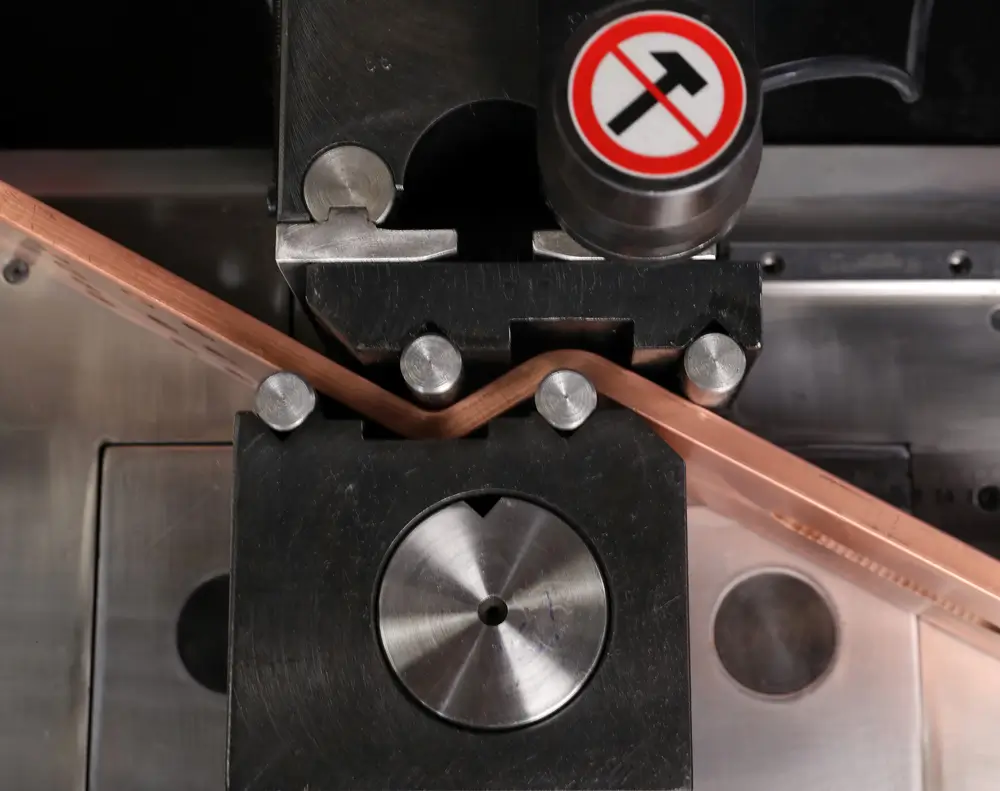
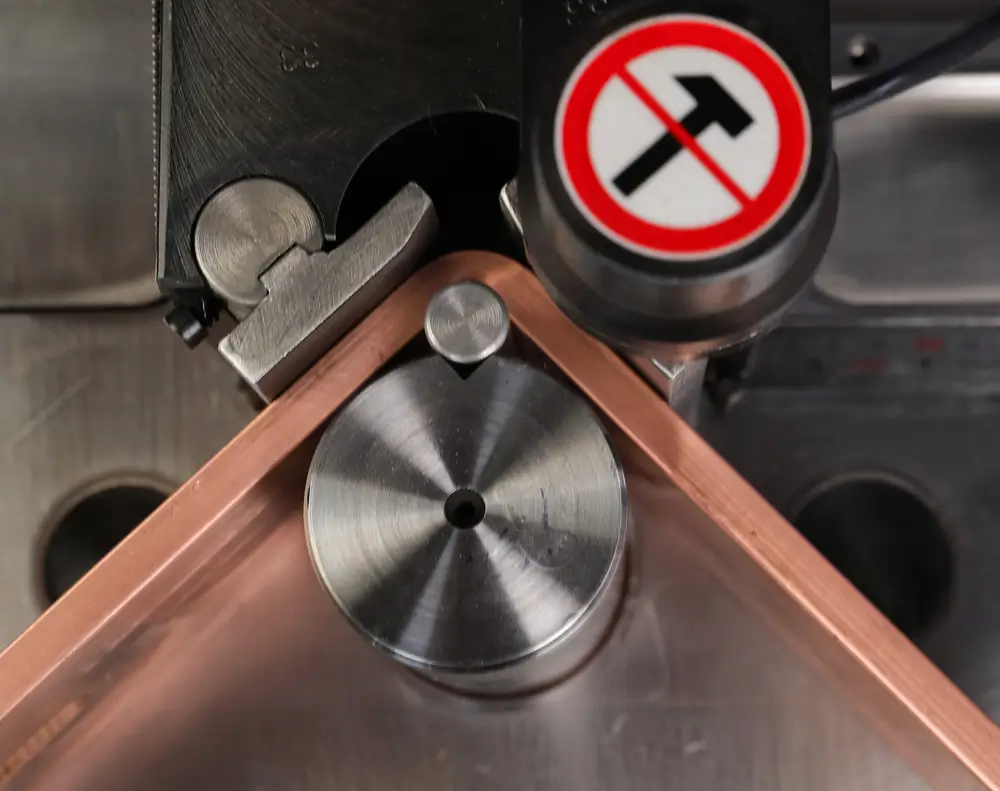
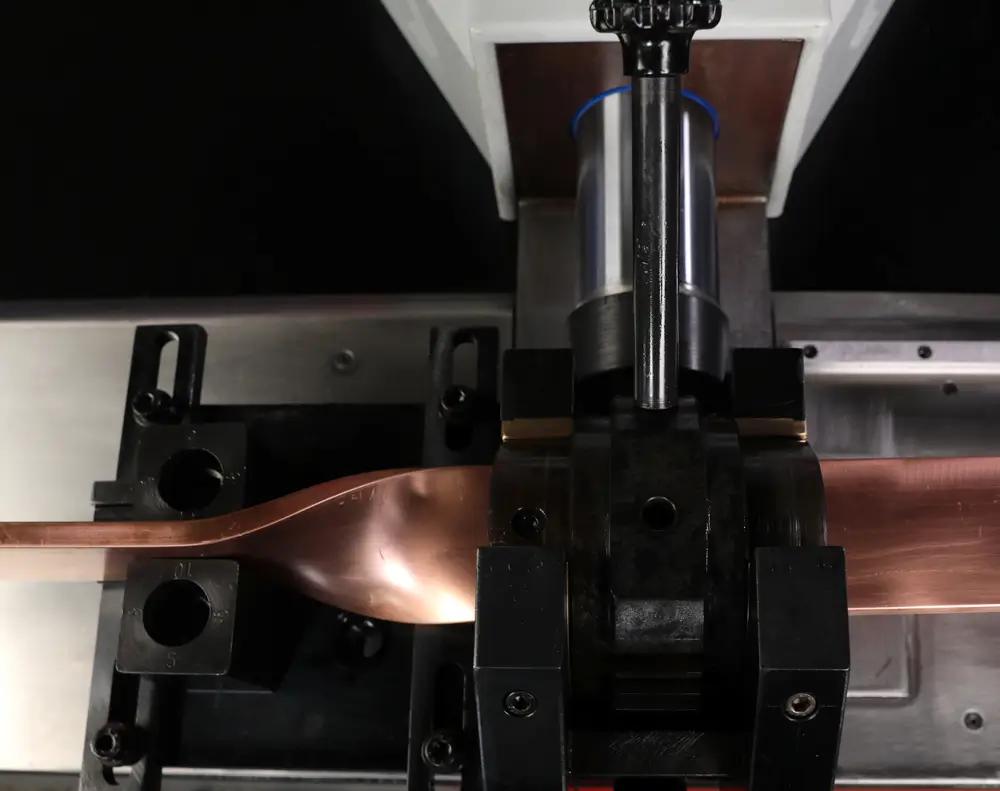
How to Make a Clean Single Bend in Busbar
This was one of the biggest learning moments.
A clean single bend is not just “push until the angle looks right.”
What matters is:
- Correct die/radius selection
- Consistent bend line marking
- Material thickness
- Springback compensation
- Orientation (keeping twist out)
- Keeping the bend in the same plane
I used a hydraulic busbar bender on a borrowed setup once, and later I tested a smaller manual/hydraulic arrangement. In both cases, I got better results when I:
- Marked the bend centerline carefully
- Aligned the bar against a repeatable stop
- Bent in stages, checking angle incrementally
- Accounted for springback (especially when I wanted precise angles)
- Checked flatness after bending
My first bend overshot the target angle, and trying to “fix” it made the finish worse. Since then, I always approach the final angle gradually.
Springback is the part that catches everyone out — the bending calculation guide explains how to allow for it.
Manufacturing mistakes that improved my final result
These are the mistakes I personally made and now watch for every time:
| Mistake | What Happened | What I Changed |
|---|---|---|
| Measured from outer edge only | Hole and terminal alignment drifted | Switched to centerline references |
| Ignored burrs after cutting | Poorer contact surface and fit | Deburred immediately after every cut |
| Bent before dry fit | Rework and wasted material | Mock-up fit before final bend |
| Used inconsistent bend reference | Angles varied part to part | Added physical stop and angle checks |
| Rushed drilling sequence | Hole spacing mismatch | Pilot mark, clamp, verify, then drill/punch |
Busbar Installation in an Electrical Panel: My Step-by-Step Sequence
By the time I reached installation, I had already learned that most electrical problems start before power is ever turned on.
A neat busbar install is not only about appearance. It directly affects temperature rise, reliability, and maintenance safety.
The Install Order That Stopped Me Forcing Bars Into Place
I started with the supports and insulation barriers before tightening any final connections.
That helped me avoid forcing the bar into place.
My install sequence looked like this:
- Mount insulators/supports
- Place busbar sections loosely
- Check clearances, alignment, and access to terminals
- Install connection hardware finger-tight
- Verify branch component alignment
- Apply correct torque sequence
- Recheck clearances after torque
- Label sections and phases
- Perform continuity and insulation checks (as applicable)
One practical lesson: if a busbar needs to be “pulled” into position with bolts, something is wrong. Mechanical stress at joints comes back later as heat and looseness.
Busbar Inspection Checklist: What I Check and With What Tool
I now treat busbar inspection as a separate task, not an afterthought.
For dimensional checks, I used a caliper, square, angle gauge, and a simple checklist.
| Inspection Item | What I Checked | Tool I Used | Why It Matters |
|---|---|---|---|
| Width and thickness | Matches design | Caliper / micrometer | Current capacity and fit |
| Length | End-to-end accuracy | Steel rule / caliper | Terminal alignment |
| Hole diameter and position | Center spacing and edge distance | Caliper, template | Connection integrity |
| Bend angle | Target angle and consistency | Angle gauge | Fit and stress control |
| Flatness / twist | Bar stays in intended plane | Straight edge / visual check | Joint surface contact |
| Edge finish | Burrs, sharp edges | Visual / glove check | Safety and contact quality |
| Surface condition | Oxidation, scratches, plating damage | Visual | Connection reliability |
After energizing and loading the panel, I also did a temperature check with an IR thermometer and later borrowed a thermal camera. That was one of the best decisions I made.
A connection that looks fine can still run hot.
Load Testing and Thermal Checks After Energising
This was my favorite part of the project because it turned theory into proof.
I ran my workshop loads in stages and monitored:
- Voltage stability
- Connection temperature
- Noise/vibration
- Breaker terminal heating
- Overall panel heat buildup
The busbar itself stayed stable, but one branch connection warmed more than expected. The issue was not busbar size. It was joint preparation and tightening consistency.
That lesson alone justified the whole project.
Fault current puts real mechanical force on the bar — see short-circuit withstand and mechanical strength.
Busbar Applications and Busbar Material Choices Beyond My DIY Panel
Once I finished my panel, I started noticing busbars everywhere.
Not literally on the street, of course, but in electrical rooms, UPS cabinets, inverters, and factory equipment. Understanding busbars changed how I read electrical systems.
Where are busbars commonly used?
Here are the places I now expect to find them:
- Main low-voltage switchboards
- Distribution boards and panelboards
- Motor control centers
- Generator synchronization panels
- UPS and battery energy storage systems
- Solar inverter combiner/distribution equipment
- EV charging infrastructure
- Transformer to switchgear connections (often via bus duct/busway)
- High-current machine distribution sections
Even when cables are still used, busbars often appear at the high-current distribution points.
Sustainable Busbar Sourcing
I also became more interested in sustainability after seeing how much scrap copper can accumulate during fabrication.
For smaller eco-conscious projects, I now look for suppliers/fabricators that can offer:
- Recycled-content copper or aluminum information
- RoHS / REACH compliance documentation (when relevant) Documentation (PDF)
- Responsible plating and finishing processes
- Scrap return/recycling programs
- ISO 14001-aligned manufacturing practices (if available) Documentation (PDF)
- Local sourcing to reduce transport impact
In one project, a local fabricator agreed to keep and recycle all offcuts and share the weight records. It was a small step, but it made the project cleaner and more intentional.
My quick busbar decision chart for future projects
I keep this simple decision chart in my notebook.
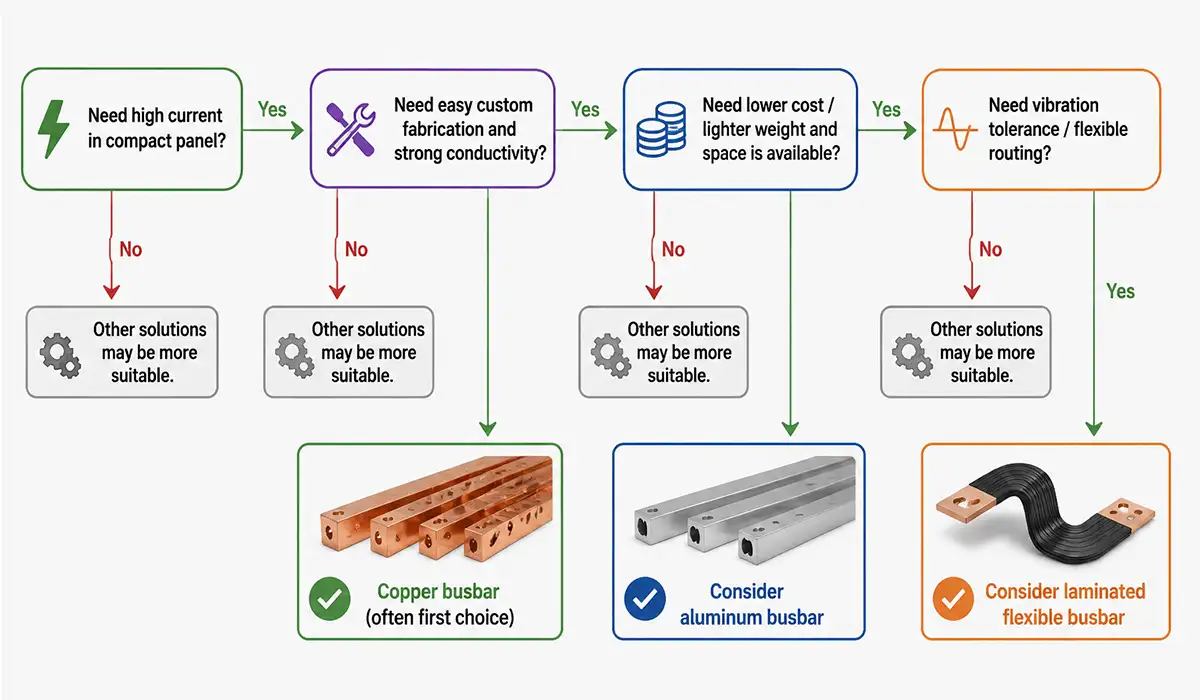
It is not a full engineering method, but it helps me start the right conversation.
Busbar Conclusion From My DIY Journey
If I had to summarize my busbar journey in one sentence, it would be this: busbars look simple, but good busbar work is a mix of electrical design, mechanical accuracy, and patient execution.
I started with basic questions like “what is a busbar?” and “why not just use cables?” and ended up learning about sizing, heat, short-circuit forces, insulation materials, bend quality, inspection methods, and even system-level concepts like bus couplers and bus duct.
My biggest improvements came from slowing down:
- I stopped rushing measurements.
- I started using templates.
- I treated inspection as part of the build.
- I checked performance under real load.
If you are planning a DIY panel project, busbars can make your design cleaner and more reliable, but only if you respect the details. Start small, stay safe, and verify everything twice.