Electric Generator Basics to Advanced: Types, Standards, and Sizing
Power outages, remote job sites, critical facilities, and even grid-scale plants all lean on the same idea: turn motion into electricity, reliably, safely, and within the rules. An electric generator is simple in principle, but the moment you add motors, electronics, transfer switches, and compliance requirements, “simple” becomes “please don’t guess.”
This guide walks from fundamentals (Faraday’s law) to real-world selection (prime vs standby ratings, fuel trade-offs, motor starting, power quality/THD), and finishes with the standards specifiers actually get judged on: NEC Article 445, NFPA 110, UL 2200, and IEC 60034.
This article serves as a valuable resource for those seeking detailed information on switchgear coordination with alternators: Standards for Switchgear and Busbar Systems.
What Is an Electric Generator? (Definition & Core Principle)
An electric generator converts mechanical energy into electrical energy using electromagnetic induction. A prime mover (engine, turbine, wind rotor, water turbine) spins a rotating magnetic field or conductor so voltage is induced in windings.
In power plants, generators are usually turbine-driven; in facilities and job sites, they’re commonly packaged as engine-generator sets. Regardless of size, the physics is the same: changing magnetic flux produces an EMF.
How Does an Electric Generator Work?
Faraday’s law links induced EMF to the rate of change of magnetic flux, which is why motion and magnetism are the heart of generation. It helps to think in two flavors: “transformer EMF” from a changing field and “motional EMF” from conductors moving through a field.
Inside the machine, the rotor and stator do the rotating/stationary work, while the excitation system and automatic voltage regulator (AVR) manage the field so voltage stays usable as load changes.
Generator Types and Where Each Fits
When people say “types of electric generators,” they usually mean output form (AC vs DC), portability (inverter portable vs conventional), or application class (standby vs prime vs continuous). Those choices affect power quality, fuel consumption, maintenance, and what standards apply.
A quick reality check: most modern electric infrastructure runs on AC, so AC generators dominate bulk power. DC generators still exist, but mostly in niche roles or as part of systems that immediately convert output using power electronics.
| Generator Type | TYPE |
|---|---|
| Produces AC via synchronous rotor/stator; frequency tied to speed & pole count; dominant in grid & facility power | AC Alternator |
| Produces DC using a commutator; niche/legacy applications; modern systems use alternator + rectifier instead | DC Dynamo |
| AC → DC → controlled AC via inverter; low THD, variable engine speed, quieter, suitable for sensitive electronics | Inverter Generator |
| Conventional portable; fixed engine speed; suitable for resistive loads; lower cost but higher THD | Conventional Portable |
| Permanently installed; paired with ATS; standby, prime, or continuous ratings; code-listed installation required | Standby (Fixed) |
AC Generators (Alternators)
An alternator is essentially a synchronous generator: frequency is tied to rotor speed and pole count, and large-scale systems generally operate on a three-phase configuration. For big units, synchronization to the grid matters — voltage, frequency, and phase must all align before paralleling.
Excitation can be brushless, field-wound, or permanent magnet based, and the AVR adjusts field current to hold voltage as loads swing. That’s why “excitation system” is not trivia — it’s operational stability.
DC Generators (Dynamos)
A dynamo produces DC using a commutator, mechanically rectifying the generated AC inside the machine. Historically important, but less common today because solid-state rectification and DC buses are usually cheaper and more controllable.
You’ll still see DC generator concepts in education, legacy systems, and certain specialized applications, but most modern “DC power” is produced by alternators plus rectifiers.
Inverter Generators vs Conventional Portables
An inverter generator typically makes AC, rectifies to DC, then inverts back to controlled AC. The practical benefits are better power quality (lower THD), quieter operation via variable engine speed, and easier paralleling on many models.
Conventional portables can be perfectly fine for resistive loads, but inverter units are often preferred for sensitive electronics because waveform quality and frequency regulation are typically tighter. If you are looking for more information about EMC and power quality requirements for control environments, it is recommended not to miss reading Industrial Control Panel EMC Requirements – IEC 61000.
Standby Generators (Fixed Installations)
A standby generator is permanently installed and commonly paired with an automatic transfer switch (ATS) so loads switch to generator power during an outage without manual intervention. This is where fuel supply planning and maintenance discipline stop being optional.
For stationary sets, UL 2200 is a key safety standard, and building/code frameworks often require listing for certain applications. Further exploration of UL compliance for industrial switchboard assemblies can be found in the following recommended reading: Industrial Switchboard UL 891 Guide.
Key Components Inside an Electric Generator
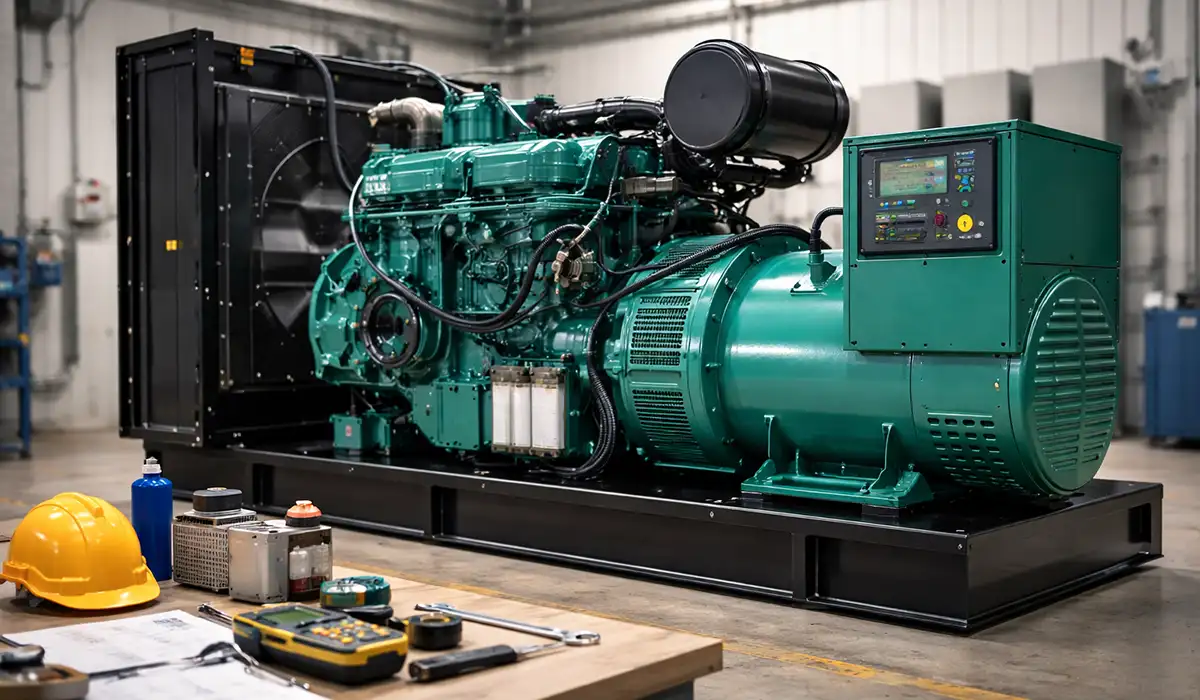
At a high level: stator/rotor, bearings, cooling, and an enclosure form the physical machine; controls and protection make it survivable in the real world. Most engine-generator packages also include a governor (speed control), sensors, and a control panel for status and shutdown logic.
On the electrical side, the field winding (or permanent magnets) provides the magnetic field, while the AVR adjusts excitation to regulate terminal voltage as loads change. Good regulation reduces nuisance trips and stress on connected equipment.
Enclosure selection for the operating environment is equally critical. For a comprehensive understanding of IP and NEMA enclosure ratings as they apply to generator housings, we highly recommend reviewing IP vs NEMA Ratings and IK.
Power Quality & THD Considerations
THD (total harmonic distortion) measures how much a waveform deviates from a clean fundamental. Higher THD can create extra heating and misbehavior in certain electronics, drives, and UPS systems, especially when combined with poor voltage regulation.If you have sensitive loads, an inverter generator or a higher-performance alternator/AVR system is worth considering. Consumer guidance and technical references consistently tie inverter designs to cleaner output for electronics.
Pollution degree and overvoltage categories also interact with waveform quality in panel design — further exploration of these concepts can be found in the following recommended reading: Pollution Degree and Overvoltage Category Concepts.
Selecting the Right Generator (Industrial & Commercial Focus)
Start with a load audit: running kW, starting kVA (motors), and whether loads are step-applied (e.g., large HVAC) or sequenced. Oversimplified “add everything up” sizing is how you buy a generator that looks great on paper and collapses on motor starts.
Next, pick the duty rating: standby vs prime vs continuous affects allowable loading and maintenance expectations. Then lock in voltage/frequency, environment (temperature, altitude, enclosure), and compliance needs (NEC/NFPA/UL/IEC).
Fuel Choices: Diesel vs Natural Gas vs Propane
Diesel often shines for high load acceptance and on-site energy density, but it also brings fuel storage management and emissions considerations. Natural gas can simplify long outages if the gas utility is reliable, while propane stores well and avoids stale gasoline problems in smaller and medium systems.
The “best fuel” is usually the one you can actually supply during the scenario you’re planning for. For critical facilities, that means thinking about utility dependencies and refill logistics, not just brochure efficiency.
Sizing for Motor Starts and Non-Linear Loads
Motor starting is the sizing trap: locked-rotor kVA creates voltage dip, and too much dip means contactors drop out, drives fault, and suddenly your day is ruined. Practical motor-start sizing guides show how alternator reactance and starting methods influence voltage dip.Non-linear loads such as VFDs, UPS, and switch-mode power supplies can also stress regulation and waveform quality.
Enclosure ratings for generator sets operating outdoors or in harsh conditions also deserve attention. For a comprehensive understanding of IP55 vs NEMA 12 for generator installations, we highly recommend reviewing IP55 vs NEMA 12 Comparison.
Installation, Codes & Standards (What Specifiers Must Know)
For U.S. installations, NEC Article 445 is the generator-specific anchor, and it interacts with other articles depending on whether the system is emergency, legally required standby, or optional standby. Even high-level summaries highlight recurring themes: markings/nameplate data, overcurrent protection, conductor sizing, and disconnecting means.
For emergency and standby system performance, NFPA 110 is widely referenced for requirements around EPSS classification, testing, and reliability expectations, especially in life safety or critical operations contexts.
NEC Article 445 (Generators)
Article 445 addresses generator installation requirements such as nameplate/marking, overcurrent protection, and disconnecting means, with conductor and protection coordination considerations depending on the system design.
The key specifier move: coordinate the generator, ATS, and downstream protective devices so the installation meets both safety intent and operational behavior — no nuisance trips, no undersized conductors, clear disconnecting means. Three-phase cable selection is central to this coordination.
Overcurrent protection coordination is equally important at the system level. Further exploration of protection methods can be found in the following recommended reading: Methods of Protection Against Overcurrent.
NFPA 110 (Emergency & Standby Power Systems)
NFPA 110 covers performance requirements for Emergency Power Supply Systems (EPSS), including classification concepts like Level 1 vs Level 2 and operational/testing expectations. Industry guidance documents commonly discuss “Type” concepts (like response time expectations) and maintenance/testing routines for compliance-driven facilities, which is why commissioning and recordkeeping are part of the spec, not an afterthought. Grounding requirements are a non-negotiable layer of NFPA 110 compliance.
This article serves as a valuable resource for those seeking detailed information on earthing system design for emergency power installations: Types of Earthing Systems.
UL 2200 & IEC 60034 Compliance
UL 2200 focuses on stationary engine-generator assemblies as complete systems, not just a pile of “recognized” components. UL Solutions provides summaries of edition changes and effective dates, and UL’s standards catalog outlines scope.IEC 60034 is the core IEC series for rotating electrical machines, with IEC 60034-1 addressing rating and performance across rotating machines. CE marking requirements for control panels frequently intersect with IEC compliance.
For installations in hazardous locations, zone classification adds another compliance layer. Further exploration of ATEX and IECEx zone marking can be found in the following recommended reading: ATEX vs IECEx: Differences, Zones, and Marking.
Operation, Maintenance & Reliability
Reliability is built on predictable routines: oil and filters, cooling system checks, battery and charger health, fuel system condition, and periodic exercise under meaningful load. For critical systems, load bank testing and documented maintenance are common expectations.
Common failure modes are rarely mysterious: dead batteries, neglected fuel, coolant issues, and controls that never get exercised until the worst possible moment. Treat maintenance like an operational requirement, not a “nice to have.”
Earth resistance verification is a key recurring maintenance task for generator installations. For a comprehensive understanding of measurement techniques, we highly recommend reviewing Methods of Measuring Earth Resistance.
Safety Essentials (CO, Shock, Fire)
Carbon monoxide is a serious portable-generator hazard. CPSC guidance is clear: use generators outside only, at least 20 feet from the home, and never in garages, carports, or near openings where exhaust can drift indoors.
Also: avoid backfeeding, use proper transfer equipment, let units cool before refueling, and use CO alarms. Many newer portables advertise CO shutoff features, but that’s a safety layer, not permission to ignore placement rules.
Correct grounding is equally non-negotiable for shock protection. Further exploration of grounding system design can be found in the following recommended reading: Grounding and Earthing Systems.
Arc flash hazards are present during generator commissioning and switchgear maintenance. This article serves as a valuable resource for those seeking detailed information on arc flash labeling requirements: Arc Flash Label Requirements – NFPA 70E & IEEE 1584 Quick Reference.
For busbar systems and manufacturing environments that feed generator installations, safety compliance is equally critical. If you are looking for more information about safety-first practices in busbar manufacturing, it is recommended not to miss reading Safety First: Ensuring Compliance in Busbar Manufacturing.
Frequently Asked Questions (FAQs)
How Does an Electric Generator Produce Electricity?
By electromagnetic induction: a changing magnetic field relative to a conductor induces voltage, typically via a rotor/stator arrangement in practical machines. This principle applies uniformly from small portable units to gigawatt power plant turbines.
What’s the Difference Between a Generator and an Alternator?
An alternator is an AC generator (often synchronous) producing alternating current, while “generator” can refer broadly to AC or DC machines. Historically, DC generators used commutators; modern systems mostly use alternators.IEC 61439 design verification principles apply to the assemblies that house and protect these machines.
Is an Inverter Generator Better for Electronics?
Often yes: inverter designs typically deliver cleaner, more stable output (lower THD) and quieter operation, though they can cost more and may offer less peak power per dollar compared to conventional portables of the same rating.
Which Fuel Is Best for Standby Generators?
It depends on runtime and supply: diesel offers strong on-site energy density, natural gas can support long outages if the utility is reliable, and propane stores well and avoids stale fuel issues in many standby setups. The right answer is always tied to your specific logistics and risk scenario.
What Standards Apply to Emergency Standby Systems?
Common touchpoints include NEC Article 445 for generator installation rules, NFPA 110 for EPSS performance and maintenance expectations, UL 2200 for stationary engine-generator assemblies, and IEC 60034 for rotating machine rating and performance scope.