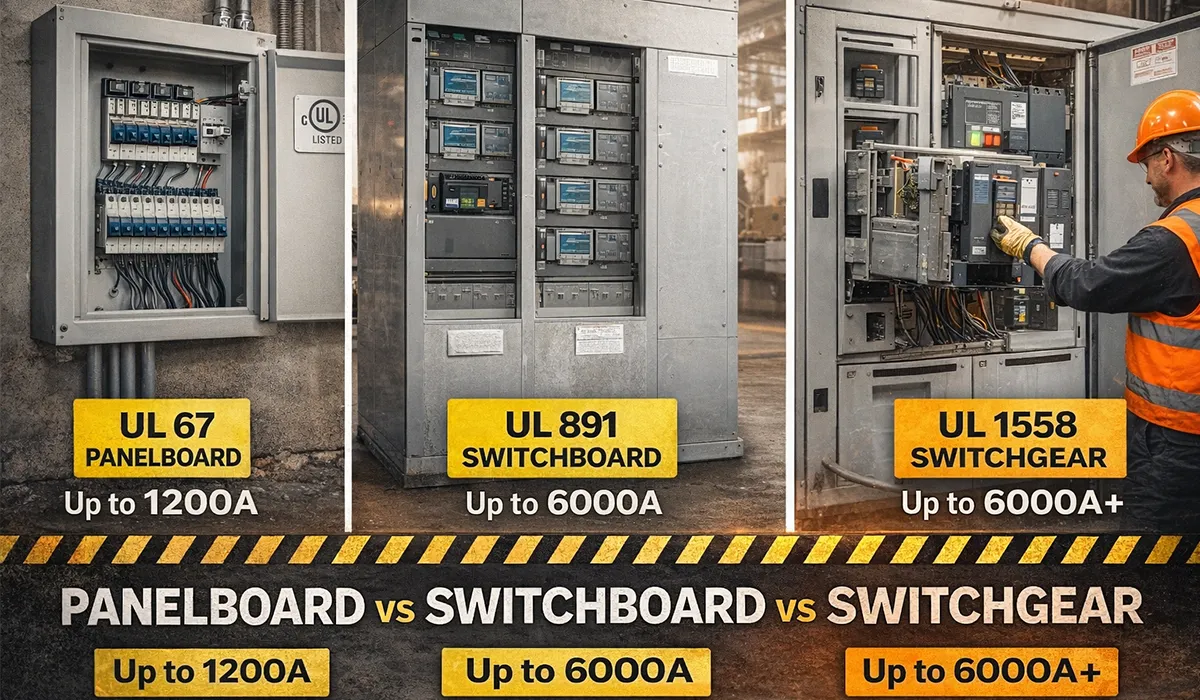
Choosing the right equipment for electrical distribution in an industrial or commercial setting is crucial. Panelboards (UL 67) provide compact, cost-effective protection for branch circuits with a capacity of up to 1200A, ideal for non-residential buildings. For higher capacity needs, switchboards (UL 891) are the preferred choice, capable of handling up to 6000A in commercial and light industrial applications. However, in mission-critical environments like data centers, switchgear (UL 1558) takes precedence. Designed with features like draw-out circuit breakers and compartmentalization, switchgear ensures reliability and maintenance flexibility in demanding settings. This article will explore the key differences between these three systems, helping you choose the right one for your specific needs.
How to Choose: Panelboard vs Switchboard vs Switchgear
Powering your industrial facility requires the right distribution equipment. Panelboards (UL 67) offer compact, wall-mounted protection for branch circuits up to 1200A. For higher capacity, freestanding switchboards (UL 891) manage loads up to 6000A in standard industrial settings. However, mission-critical sites like data centers prioritize switchgear (UL 1558). With draw-out breakers and compartmentalization, switchgear ensures maximum reliability and maintenance flexibility for demanding environments.
For a comprehensive understanding of switchgear and busbar systems, we highly recommend reviewing this switchgear standards guide.
UL 891 vs UL 1558 vs UL 67: Key Differences
UL 891 switchboards are the most commonly used low-voltage distribution equipment in commercial and light industrial buildings across the United States. UL 1558 low-voltage switchgear is developed for mission-critical power distribution, where reliability, ease of maintenance, and operational consistency are paramount. UL 67 is a safety standard for electrical panelboards used in non-residential buildings, ensuring safe design, construction, and components including circuit breakers and busbars.
| Key Characteristics | Standard |
|---|---|
| Compact, wall-mounted protection for branch circuits up to 1200A — suited for non-residential buildings | UL 67 (Panelboard) |
| Freestanding distribution up to 6000A with MCCBs — cost-effective for commercial and light industrial use | UL 891 (Switchboard) |
| Metal-enclosed drawout breakers with high short-time withstand ratings — designed for mission-critical environments | UL 1558 (Switchgear) |
If you are looking for more information about the UL 891 standard in detail, it is recommended not to miss reading this UL 891 switchboard guide.
Core Functional Differences
UL 891 switchboards are designed for cost efficiency and compact distribution, typically featuring group-mounted molded case circuit breakers (MCCBs) or fixed-frame breakers. Commonly used in commercial and standard industrial buildings, UL 891 systems offer flexibility, supporting both bolted and plug-in breaker configurations for easy maintenance and reduced downtime.
In contrast, UL 1558 switchgear engages metal-enclosed drawout circuit breakers, fixed individually, and is developed for high short-time withstand ratings. This design allows for maintenance or breaker replacement without needing to shut down the full busbar, making it ideal for mission-critical environments like industrial plants, data centers, and infrastructure projects. While UL 891 focuses on cost efficiency and flexibility, UL 1558 prioritizes reliability and service consistency under severe fault conditions, making it the preferred choice for applications where power interruptions could result in significant financial or safety risks.
Further exploration of internal arc testing and type tests for switchgear can be found in the following recommended reading: IEC 62271-200 internal arc guide.
Breaker Types and Standards
Circuit breakers come in various types, each suitable for different use cases. For general protection in residential settings, molded-case circuit breakers (MCCBs) as outlined by UL 489 offer reliable overload and short-circuit protection. In more demanding industrial environments, drawout breakers such as those in UL 1066 allow easier maintenance without affecting the whole system. Meanwhile, metal-enclosed systems provide high withstand ratings for mission-critical installations following standards like ANSI C37.13 for equipment that requires continuous uptime.
In choosing a circuit breaker, understanding standards such as ANSI C37.16 for fixed-mounted breakers helps identify the right fit. UL 489 focuses on safety for general applications, while UL 1066 and ANSI C37 standards are designed for higher reliability and advanced performance. Always consider your specific needs — system voltage and fault interruption capacity — and consult a professional to ensure compliance and safety.
This article serves as a valuable resource for those seeking detailed information on overcurrent protection methods for these circuit types.
Construction and Accessibility
When selecting switchboards, accessibility is a key factor, especially when comparing front-access vs. rear-access designs. Front-access switchboards allow operators to interact with all components from the front, reducing maintenance and space requirements behind the equipment — particularly important in environments with limited space.
Rear-access switchboards are usually preferred in more exclusive setups, offering easier access to back components and allowing more flexible wiring options. However, they require more space and careful consideration of clearance and equipment footprint. Dead-front switchboards, as defined in UL 891 and NEMA PB-2, enhance safety by preventing live components from being exposed. If you are looking for more information about dead-front switchboard design, it is recommended not to miss reading UL’s dead-front replacement guide.
Bus Bracing and Ampacity
UL 891 switchboards typically manage up to 6000A with 3-cycle withstand ratings and non-insulated busbars. UL 1558 switchgear provides insulated busbars and higher short-time ratings for mission-critical reliability. Structural limits affect short-circuit performance and system growth — switchgear’s compartmentalized design offers superior protection against severe fault conditions and downtime. For a comprehensive understanding of busbar compliance and safety requirements. Think of a switchboard as a standard power strip for an office, while switchgear is a high-security vault designed to keep a massive factory running even during a surge.
Ratings: AIC and SCCR
The interrupting rating AIC applies specifically to protective devices such as circuit breakers or fuses. It defines the maximum fault current a device can safely clear without welding closed or causing equipment damage. Conversely, the short-circuit current rating SCCR applies to the entire assembly, describing the maximum fault current the equipment can safely withstand without breaking down.
For low-voltage assemblies including those governed by NEC Article 408, the SCCR is a measure of the product as a whole. While a UL 489 molded-case breaker or UL 1066 power circuit breaker has an individual AIC, the assembly’s overall SCCR cannot exceed the AIC rating of its protective device. In service entrance equipment, these ratings are vital for maintaining system integrity — UL 1558 switchgear generally provides higher short-time withstand ratings than UL 891 switchboards, essential for achieving selective coordination.
Further exploration of AIC vs SCCR ratings can be found in the following recommended reading: Eaton AIC vs SCCR guide.
Coordination and Protection Strategy
UL 1558 switchgear enhances selective coordination through high short-time ratings and UL 1066 breakers, whereas UL 891 and UL 67 typically use standard UL 489 breakers. Proper NEC labeling and nameplates ensure compliance during commissioning and testing. This article serves as a valuable resource for those seeking detailed information on arc flash label requirements, which directly tie into the arc-flash mitigation strategy for all three equipment types.
For arc-flash mitigation, switchgear offers superior compartmentalization over switchboards. In UL 67 panelboards, choosing a main breaker provides local fault protection, while main lugs lack internal disconnects, impacting maintenance and safety.
Coordination with Upstream Device
Low-voltage distribution relies on UL 67 panelboards, UL 891 switchboards for standard loads, and UL 1558 switchgear for mission-critical reliability. Unlike switchboards with fixed breakers, switchgear uses drawout UL 1066 breakers and compartmentalization for maintenance continuity. AIC measures a breaker’s break capacity, while SCCR defines the assembly’s withstand limit — switchgear offers superior safety with higher short-time ratings and insulated busbars.
Transfer Switching Integration
UL 1008 transfer switches are integral to ensuring reliable power transfer between utility and backup sources. When integrated with switchboards — particularly service entrance rated systems — they provide seamless transitions during power interruptions. These switches are designed to meet safety standards, ensuring proper coordination and compliance for critical applications.
Service Entrance and ATS
Service entrance rated switchboards, as per UL 891, are designed to manage the initial connection of power into a building. They must meet specific NEC labeling and nameplate essentials, ensuring proper identification of circuit ratings, fault currents, and operational limits for safety and compliance.
ATS (Automatic Transfer Switches) in switchgear provide seamless power transfer, while in switchboards, they are integrated with protection features. Both setups ensure reliable power delivery in critical systems.
Main Device Selection
When selecting the main device, consider the differences between UL 1066 and UL 489 breakers. UL 1066 offers higher reliability for industrial applications with metal-enclosed breakers, while UL 489 is more cost-effective for general use. UL 98 breakers serve as disconnects, offering another layer of safety in electrical systems.
Installation Under NEC Article 408
When installing electrical equipment per NEC Article 408, it is essential to comply with installation requirements for switchboards and panelboards to ensure safety and efficiency. The article outlines proper placement, access, and clearance zones around electrical systems to minimize risks during maintenance and operation. Nameplate and working clearances are crucial under NEC Article 408 and NEC 110 — nameplates should clearly display ratings, operating conditions, and safety warnings.
For a comprehensive understanding of NEC Article 408 installation requirements, we highly recommend reviewing this NEC Article 408 guide.
Labeling and Nameplates
NEC labeling and nameplate requirements for LV assemblies ensure proper identification of equipment ratings and operational limits. These labels must include details such as voltage, current, fault protection, and the manufacturer’s information.
Commissioning and Testing
Commissioning and testing are essential steps in ensuring the proper functionality and safety of electrical systems. During commissioning, an acceptance test checklist is typically used to verify equipment performance, functionality, and safety before full operation — confirming compliance with design specifications.
Incorporating maintenance and arc-flash mitigation strategies during commissioning ensures that potential hazards are addressed early. Selective coordination is another key aspect, ensuring that protective devices operate in the correct sequence to isolate faults without disrupting the entire system. Standards like ANSI C37.13 and ANSI C37.16 provide guidance for testing and commissioning procedures, while NETA ATS outlines industry best practices for acceptance testing.
Further exploration of grounding and earthing checks during commissioning can be found in the following recommended reading: grounding and earthing system guide.
Arc-Flash Study Tie-In
UL 1558 switchgear incorporates arc-flash mitigation features like trip settings and fault isolation to minimize hazards. After conducting a coordination study, it’s essential to update labels with accurate arc flash boundaries, incident energy levels, and protective settings to ensure safety and compliance with updated NEC and industry standards.
Cost and Value Comparison
Comparing switchboard, switchgear, and panelboard costs: switchboards generally offer a more cost-effective solution for medium-power distribution, while switchgear is typically more expensive due to its higher performance and additional safety features like arc flash mitigation. Panelboards, typically the least expensive option, are suited for lower-power applications.
| Key Characteristics | Equipment Type |
|---|---|
| Lowest cost, compact design, limited capacity — suited for low-power branch circuit protection | Panelboard (UL 67) |
| Mid-range cost, higher capacity up to 6000A, good flexibility — ideal for commercial and standard industrial | Switchboard (UL 891) |
| Highest cost, maximum reliability, drawout breakers and arc-flash mitigation — required for mission-critical environments | Switchgear (UL 1558) |
Footprint comparison is also an important factor. Switchboards and switchgear tend to have larger equipment footprints and require more clearance for proper ventilation and maintenance. Panelboards have a compact design but are limited in capacity.
If you are looking for more information about IP and NEMA enclosure ratings that govern environmental protection for all three types, it is recommended not to miss reading this IP vs NEMA ratings guide.
Upgrade and Migration Paths
Upgrading from a panelboard to a switchboard is often necessary when power demands increase. Switchboards offer greater capacity and flexibility, making them ideal for future-proofing electrical systems. When deciding between a switchboard and switchgear, consider future growth and the need for higher performance, fault protection, and arc-flash mitigation. Switchgear is suitable for environments requiring robust, high-performance protection.
Standards and Safety (U.S.)
Understanding the differences in construction and testing between UL 891 and UL 1558 is key for selecting the right equipment. UL 891 covers switchboards, typically designed for lower power applications focused on cost-efficiency. UL 1558 is used for low-voltage switchgear and is built for higher performance, providing additional features like enhanced fault protection and arc-flash mitigation. Testing under UL 1558 tends to be more rigorous to meet the higher reliability standards needed for industrial and mission-critical applications.
NEC Article 408 outlines safety and construction guidelines for switchboards and panelboards, emphasizing proper labeling, clearances, and coordination. For switchgear, ANSI C37.13 and C37.16 provide further performance standards, especially when considering UL 489 and UL 1066 for circuit breakers and their respective roles in fault protection. This article serves as a valuable resource for those seeking detailed information on electrical standards and their hierarchy.
Documentation Essentials
Documentation essentials for NEC labeling and nameplate requirements include clear identification of voltage, current, fault protection, and manufacturer details for LV assemblies. Commissioning and testing records must also be maintained to verify proper installation, performance, and safety compliance for future reference and inspections.
Maintenance and Arc-Flash Mitigation
Maintenance considerations for drawout LVPCB focus on ease of replacement and minimal system disruption. Regular inspections and testing of the drawout units ensure that components are functioning optimally and are safe to operate.
Further exploration of EMC and interference requirements relevant to panel maintenance can be found in the following recommended reading: EMC requirements for industrial control panels.
Arc-flash mitigation features in UL 1558 switchgear include zone-selective interlocking, which minimizes the impact of faults by isolating only the affected zone, reducing overall system downtime. Selective coordination requirements for switchboards and panelboards are essential to ensure protective devices operate in the correct sequence, preventing unnecessary outages and improving safety under fault conditions.
Spare Parts and Uptime
Spare parts and uptime are critical for maintaining system reliability. For drawout LVPCB, regular maintenance ensures easy replacement, while UL 1066 breakers require readily available parts to minimize downtime and ensure quick repairs. If you are looking for more information about three-phase power cables used in these systems, it is recommended not to miss reading this three-phase power cable guide.
Real-World Use Cases (U.S.)
To select between switchboard and switchgear, consider the facility’s needs. For vital facilities like healthcare and data centers, UL 1558 switchgear offers superior fault protection and reliability, essential for minimizing downtime. In contrast, UL 891 switchboards are ideal for less demanding applications such as industrial plants, where selective coordination and efficient power distribution are still important.
For service entrance applications, UL 67 panelboards are widely used in residential or commercial settings, providing reliable power distribution with less complexity and making them suitable for smaller loads compared to more robust switchgear solutions.
Footprint-Driven Decisions
Footprint-driven decisions are crucial for space optimization. Front-access switchboards like UL 891 have compact designs, requiring less clearance for maintenance compared to UL 1558 switchgear, which typically needs more space due to its enhanced features and fault protection. For a comprehensive understanding of the comparison between UL 891 and UL 1558 for reliability-critical projects.
Conclusion
In conclusion, the choice between panelboards, switchboards, and switchgear depends on your specific power distribution requirements. If you need a cost-effective solution for protecting branch circuits, panelboards (UL 67) are suitable. For higher power loads in commercial or industrial environments, switchboards (UL 891) provide the necessary flexibility and capacity. Switchgear (UL 1558), on the other hand, is ideal for mission-critical environments where reliability and advanced fault protection are paramount. Understanding your facility’s needs will help you make the best choice to ensure safe, efficient, and reliable electrical distribution.
What’s the difference between UL 891 and UL 1558?
UL 891 is for switchboards, offering cost-effective distribution for commercial and light industrial use. UL 1558 is switchgear, designed for mission-critical environments, providing high reliability and advanced fault protection. Further exploration of pollution degree and overvoltage categories that affect both standards can be found.
When should I use a UL 891 switchboard instead of a UL 67 panelboard?
Use UL 891 switchboards for higher power needs, supporting up to 6000A. UL 67 panelboards are ideal for smaller, residential, or light commercial applications.
What are AIC and SCCR ratings?
AIC (Ampere Interrupting Capacity) is the maximum fault current a device can safely interrupt. SCCR (Short-Circuit Current Rating) is the maximum fault current the entire assembly can withstand without damage.
What is selective coordination, and why is it important?
Selective coordination ensures only the protective device closest to a fault operates, preventing unnecessary outages and minimizing downtime in critical facilities.
Why is UL 1558 preferred for data centers and healthcare facilities?
UL 1558 switchgear provides superior reliability, ease of maintenance, and fault protection, making it ideal for mission-critical facilities where downtime can have serious consequences. If you are looking for more information about earth resistance measurement methods used during commissioning of these facilities.